SNOW, MOON AND FLOWERS OF THE ÔGIYA TEA HOUSE
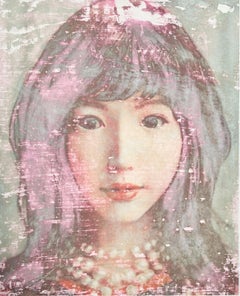
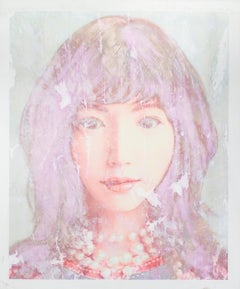
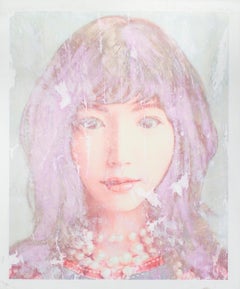
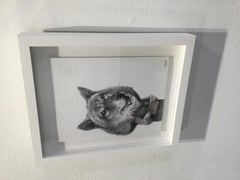
Head and shoulders portrait of a beautiful courtesan of the Ôgiya Tea House. With an attentive gesture, she brings her left hand behind her ear with delicate wrist and finger motion.
This image is part of the bijin-ga series, “Pretty women”, drawn by Mario BGil, based in the Kitigawa Utamaro woodblock print “Snow, moon and flowers from the Ôgiya Tea House” (1793-1795). The tittle is a Japanese topic in art and design originating from a poem by Tang dynasty poet Bai Juyi. It became popular in the late Edo used to describe serene beauty.
The artist reproduces the seal of the censor (Kiwame) and from the original publisher (Tsutaya, climbing leaf)), as it appears in the woodblock print used as a model; between the two, the signature of Mario BGil written in Japanese, with the date 14 (2014).
The mesaurements of the drawing are 76 x 56 cm., with a painted surface of 67 x 49,5 cm. (the woodblock print is 36,2 x 25,9 cm.).
With his work on the bijing-ga series, Mario BGil wanted to embellish, give brilliance and volume to the images presented by japanese artist Kitigawa Utamaro in those beautiful engravings, ennobled with the patina of time, which have served as inspiration. The result obtained is almost life-size portraits, endowed with strong chromaticism and valuable contrasts, all enhanced, in turn, with the volume provided by the weight and rigidity of the paper, and its thick texture (Fabriano Artistico “grana grosso”, 640g/m2; the thickness and hardness of the paper makes it necessary to transport it without rolling).
In this way, Mario BGil pays tribute to his admired artist and offers us a new and enriched vision of this popular facet of oriental art from the 18th and 19th centuries.
ABOUT THE ARTIST
Mario BGil is a self-taught artist who for years has combined his creative activity with his work in the family business, away from commercial art galleries. In 2012, a deep interest in oriental art was awakened in him and he began to study the great masters of Japanese Ukiyo-e prints, who had such an influence on the European avant-garde of the late XIX century.
The discovery of Kitagawa Utamaro (1753-1806), a key figure in the metropolitan culture of Edo (now Tokyo), and a point of reference in the history of Japanese engraving...
Category
2010s Edo Art by Medium: Carbon Pencil
MaterialsPaper, Carbon Pencil, Color Pencil