By Pierre Georges Jeanniot
Located in Paris, FR
Pierre-Georges Jeanniot (1848–1934)
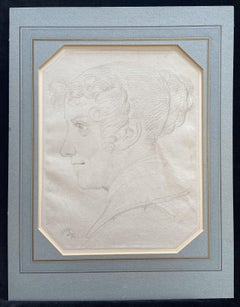
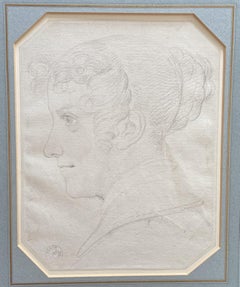
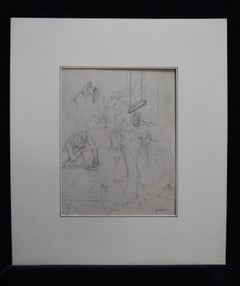
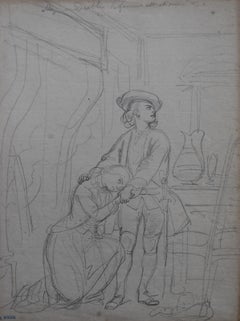
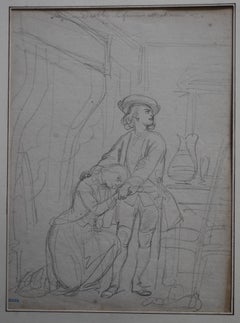
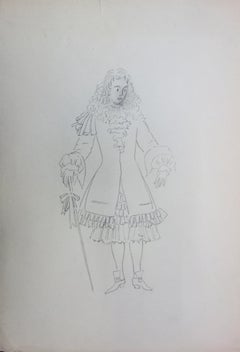
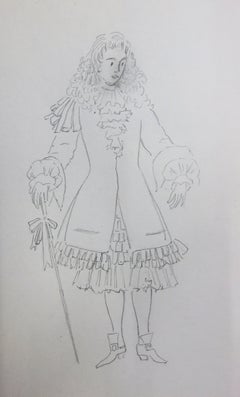
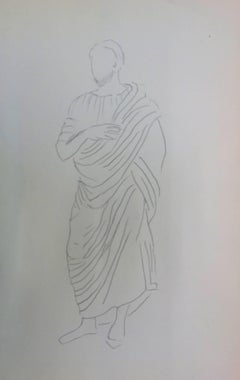
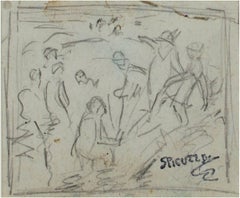
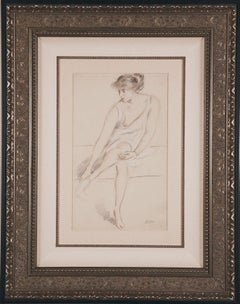
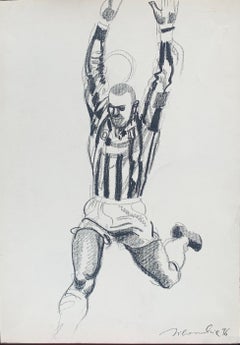
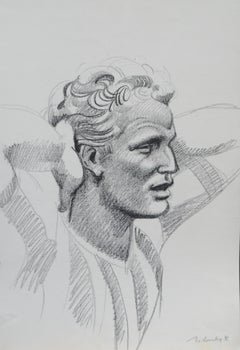
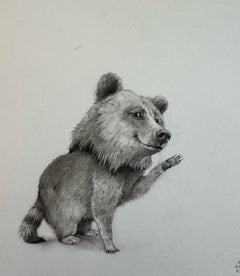
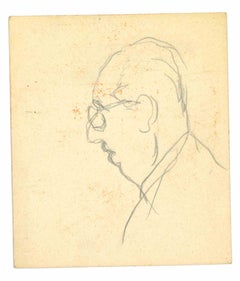
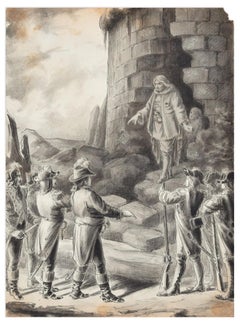
Portrait of Henri Rochefort ready for a duel,
Pencil on paper

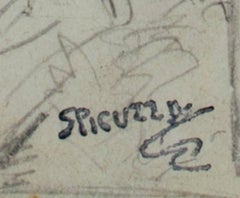
Signed and titled lower left
28 x 21 cm
In good condition : the left and right borders irregularly cut
In a modern cardboard mount : 45.5 x 35 cm
The subject of this drawing is, in a way, almost as interesting as the artist who portrayed him in this duel pose. As a reminder, Henri Rochefort, whose full name was Victor Henri de Rochefort-Luçay, was born in Paris on January 31, 1831, and died in Aix-les-Bains on July 1, 1913. He was a French journalist, playwright, and politician. A great polemicist in the pages of his newspapers (La Lanterne, La Marseillaise, L'Intransigeant), he defended radical, even extremist political views (anticlerical, nationalist, pro-Commune, Boulangist, socialist, and anti-Dreyfusard), which earned him the nickname “the man of twenty duels and thirty trials” and convictions, notably to the prison in Nouméa, from which he managed to escape in 1874, a unique feat..
Pierre-Georges Jeanniot (1848–1934) was a Swiss-French Impressionist painter, designer, watercolorist, and engraver who was born in Geneva, Switzerland, and died in France. His work often depicts the modern life in Paris.
He started out pursuing a military career, as an infantry officer (1866–1881). He was a lieutenant with the Twenty-third Infantry from 1868 to 1870. He fought in the Franco-Prussian War, was wounded at Rezonville, and was awarded the Légion d'Honneur. He subsequently served with the Ninety-fourth Infantry and the Seventy-third Infantry. At the time he left the army he held the rank of major, with the Chasseurs à Pieds.
He never ceased drawing. He was known for the first time in 1872 at the art exhibition Salon de Paris, where he presented a watercolor painting called Intérieur de forêt. The next year he presented the painting Le Vernan à Nass-sous-Sainte-Anne. From then on he was a regular contributor to the Salon de Paris, where he presented new works with views of Toulouse, Paris, Troyes, the edges of the Seine, and some portraits.
In 1881, after the army offered him the rank of commandant, he resigned to devote himself exclusively to painting. He took up residence in Paris. His works from this period represent mainly scenes of military life that allowed him to forge a reputation. Jeanniot established himself permanently in 1882 and obtained his first award the following year (medal third class of the Salon de Paris) with his les Flanqueurs (1883, Musée du Luxembourg). In 1886, La ligne de feu, souvenirs de la bataille de Rezonville, remembering the Battle of Mars-La-Tour (Museum of Pau), assured his notoriety.
From then on, he started to show a certain artistic independence. He then mostly portrayed Parisian women during the "Belle Epoque", women in bathing suits...
Category
1870s Romantic Art by Medium: Carbon Pencil