Provenance:
S. Spinelli Collection, Florence; their sale, Galleria Pesaro, Milan, July 11-14, 1928, lot 112 (unsold); reoffered Galleria Luigi Bellini, Florence, April 23-26, 1934, lot 132, as manner of Baldassare Peruzzi
Dr. Giacomo Ancona, Florence, 1930s, and after 1939, San Francisco; thence by descent to his son:
Mario Ancona, San Francisco; thence by descent to his children:
Mario Ancona III and Victoria Ancona, San Francisco, until 1995; thence to:
Phyllis Ancona Green, widow of Mario Ancona, Los Angeles (1995-2012)
Literature:
Donato Sanminiatelli, Domenico Beccafumi. Milan 1967, p. 170 (under paintings attributed to Beccafumi)
Among the precious survivors of Renaissance secular paintings for domestic interiors are several unusual and particularly attractive panels painted in Siena at the end of the fifteenth and beginning of the sixteenth centuries. These paintings depict exemplary figures from antiquity—heroes or heroines, as well as allegorical, literary, and mythological figures. For the most part, these panels have survived in groups of three, although it is possible that some of these works were painted either as part of larger series or as individual projects. One such trio by Beccafumi consists of two paintings now at the National Gallery, London (Marcia and Tanaquil) and a third in the Galleria Doria-Pamphilj, Rome (Cornelia). These were commissioned around 1517–1519 for the bedroom of Francesco di Camillo Petrucci in Siena and were most likely placed together as elements in the wall decoration (spalliere) or installed above the back of a bench or cassapanca. Another, earlier (ca. 1495–1500), set of three—Guidoccio Cozzarelli’s Hippo, Camilla, and Lucretia (Private Collection, Siena) survives with its original wooden framework—a kind of secular triptych. Judith, Sophonisba, and Cleopatra in the collection of the Monte dei Paschi, Siena, are by an anonymous artist close to Beccafumi called the “Master of the Chigi-Saracini Heroines.” Girolamo di Benvenuto’s Cleopatra, Tuccia, and Portia are dispersed (homeless, Prague, Chambery), and Brescianino’s Faith, Hope, and Charity are in the Pinacoteca Nazionale in Siena.
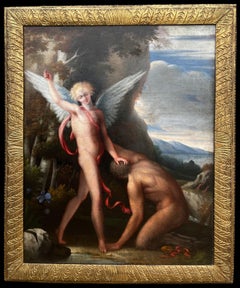
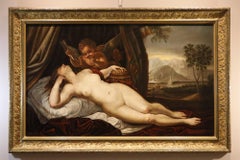
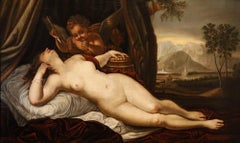
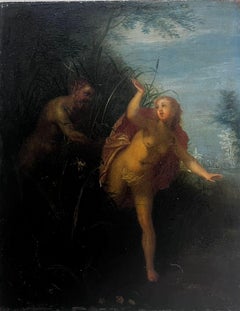
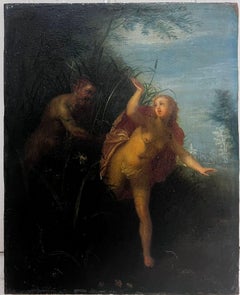
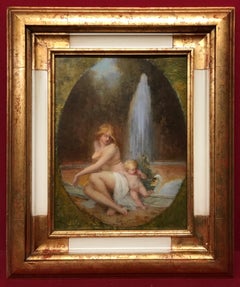
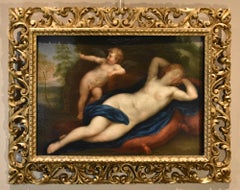
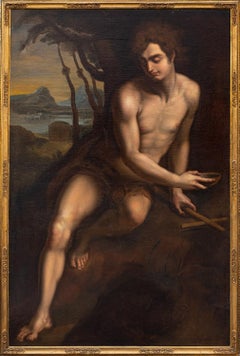
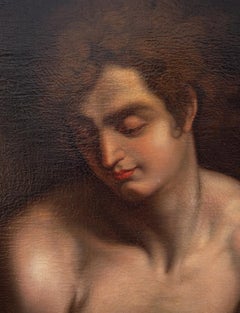
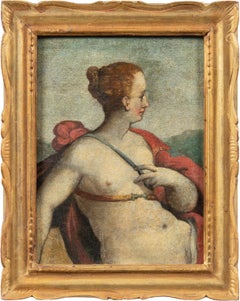
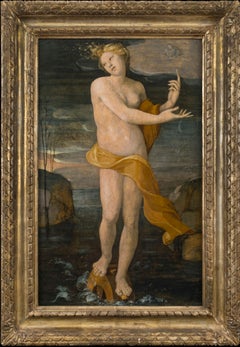
The present painting first appeared in the Spinelli sale in Florence in 1934, at which time it was sold with two panels of identical size and format. Each was catalogued as being by the “manner of Baldassare Peruzzi” and of unidentified subject. Of these, the painting depicting a male figure turned to the right has recently reappeared in a private Italian collection, while the location of the third work, portraying a cloaked figure turned three-quarters left, remains unknown. Our panel depicts the allegorical figure of Fortune. Here she is represented in typical fashion as a nude female figure balanced on a wheel (sometimes called the Rota Fortunae), her billowing drapery indicating that she is as changeable as the wind. The appearance of the Virgin and Child in the cloud at the upper right is an unusual addition to the iconography. The subjects of the two pendant male...
Category
16th Century Old Masters Nude Paintings