1820s Art

to
21
246
68
38
10
7
Overall Width
to
Overall Height
to
7,509
21,466
165,705
237,547
2,114
2,316
4,705
6,555
5,961
15,553
21,080
26,418
19,231
14,228
5,344
120
56
3
1
190
172
2
250
149
78
72
62
49
41
40
24
18
18
15
12
10
10
10
10
9
9
8
194
117
81
35
34
45
22
12
8
6
67
153
234
129
Period: 1820s
Gran Cratere marmoreo, con baccanale - Etching by Agostino Tofanelli - 1821

Gran Cratere marmoreo, con baccanale - Etching by Agostino Tofanelli - 1821

By Agostino Tofanelli

Located in Roma, IT

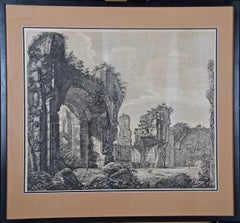
A. Tofanelli, P. Fontana, “Gran Cratere marmoreo, con baccanale” (Big marble Crater, with Bacchanal). Image Dim: cm 48x33, Dim: cm 59x44; Passepartout Dim: cm 69 x 49. Precious Etching on copper: Hand-Watercolored subject on black ink bottom. Designed by Agostino Tofanelli...

Category

1820s Art

Materials

Etching

"Various Himochi" Wagashi Festival Japanese Woodblock Print by Utagawa Toyokuni

"Various Himochi" Wagashi Festival Japanese Woodblock Print by Utagawa Toyokuni

By Utagawa Toyokuni

Located in Soquel, CA

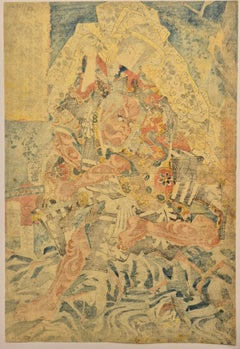
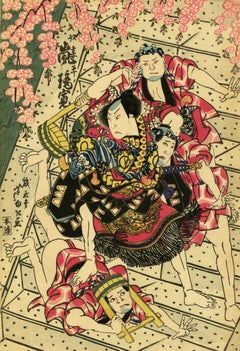
"Various Himochi" Wagashi Festival Japanese Woodblock Print by Utagawa Toyokuni Rare oversized early 19th century 5-tiered woodblock by Utagawa Ichiyosai Toyokuni, (Japan, 1769-1825), a Japanese lord and wife oversee a sekku festival of food, music, and dolls or toys. '"oshi" is the first day of “Mi (Snake)” in the third month of the lunar calendar. This day, known in modern Japan as the Girls' Festival, originated in China as a form of purification ceremony in which water and drinking peach blossom wine were used to drive away evil. Many kinds of hishi-mochi appear in this picture of hina ningyo (dolls associated with Hinamatsuri, or the Girl’s Day) from Omochae. The custom of eating special dishes at events throughout the year and at milestones in people's lives has existed since ancient times. This paragraph specifically focuses on the annual event called sekku, and life events that involve eating sweets. Joshi is the first day of “Mi (Snake)” in the third month of the lunar calendar. This day, known in modern Japan as the Girls' Festival, originated in China as a form of purification ceremony in which water and drinking peach blossom wine were used to drive away evil. According to the Keiso saijiki, in ancient China, on the third day of the third lunar month, people ate “ryuzetsuhan,” which is the juice of gogyo (Jersey cudweed) mixed with rice flour and nectar. In Japan, there is a record in the Heian period history book Nihon Montoku tenno jitsuroku [839-5] that it was an annual event to make kusamochi using gogyo on the third day of the third month of the lunar calendar, which may have been influenced by Chinese customs. The tradition of eating kusamochi on the third day of the third month of the lunar calendar continued after that. By the Edo period, however, hishimochi had come to be used as a sweet to serve on the third day of the third month. A picture of a hishimochi is included in the Morisada manko , which we mentioned in Part 1. According to it, hishimochi in the Edo period were often three layers of green-white-green instead of the now common red-white-green. However, it is possible to see from our collection that not all hishimochi were made in this way. Omochae published in 1857, is a good example. Omochae is a type of ukiyoe print...

Category

Edo 1820s Art

Materials

Ink, Rice Paper, Woodcut

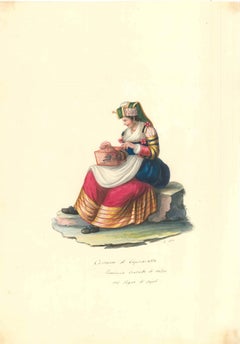
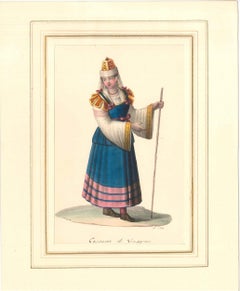
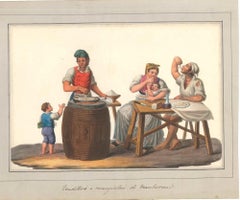
Costume di Sinagreci - Watercolor by M. De Vito - 1820 ca.

Costume di Sinagreci - Watercolor by M. De Vito - 1820 ca.

By Michela De Vito

Located in Roma, IT

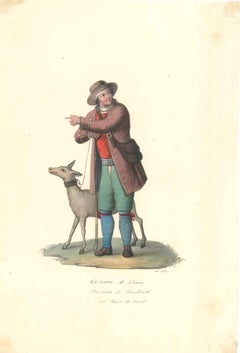
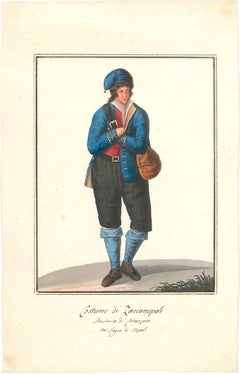
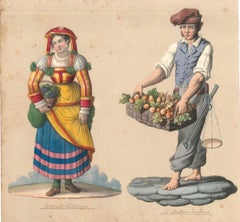
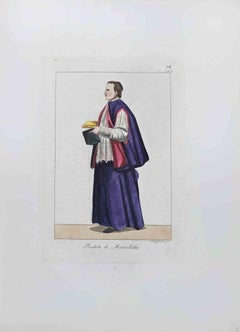
Costume di Sinagreci is a lovely watercolour on ivory-colored paper stuck on cardboard, created by the artist Michela De Vito in 1820 ca. Hand-titled "Costume di Sinagreci", in black ink on the lower margin at the center. Hand-signed in black ink on the lower right. Very good conditions, including a passepartout. This original old master watercolor represents a standing woman wearing a typical costume of Sinagreci: a beautiful and lavish blue long dress...

Category

Modern 1820s Art

Materials

Watercolor

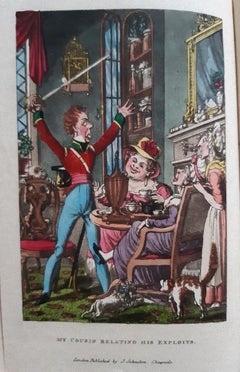
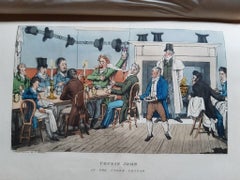
Twelve Copper Engravings, Hand Coloured, Gilt Frames, England, 1900s

Twelve Copper Engravings, Hand Coloured, Gilt Frames, England, 1900s

Located in Stamford, CT

English Traditional, Twelve Copper Engravings, Hand Coloured, Gilt Frames, England, 1821 Set of 12 engravings from the "Marmaduke Multiply Merry Method of Making Minor Mathematician...

Category

1820s Art

Materials

Engraving

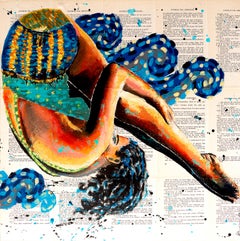
Portrait Starry Night Van Gogh French School 247 Chut Les Barbizons!

Portrait Starry Night Van Gogh French School 247 Chut Les Barbizons!

By Bazevian DelaCapuciniere

Located in Zofingen, AG

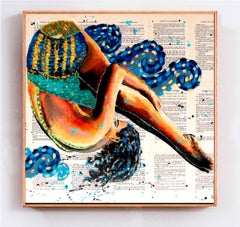
Portrait French PS 247 Starry Night Diving Portrait of a diving woman dress with a Vincent Van Gogh swimsuit A daring dive in the unknown! This is one of the famous artwork from V...

Category

Tonalist 1820s Art

Materials

Mixed Media, Oil, Acrylic, Gesso, Stretcher Bars

Bust of Nero - Original Etching by P. Fontana After B. Nocchi - 1821

Bust of Nero - Original Etching by P. Fontana After B. Nocchi - 1821

By Pietro Fontana

Located in Roma, IT

“Busto di Nerone” (Bust of Nerone) is a beautiful black and white burin and etching on paper, realized by the Italian artist Pietro Fontana, after Bernardino Nocchi as the inscriptions on plates on lower margins report “Bernardino Nocchi delineò./ Pietro Fontana incise Roma”. This original print is numbered on plate in Roman numerals on higher margin: “Tom II. /Tav. XVII" and is a plate from the series "Illustrazioni de'Monumenti scelti Borghesiani già esistenti nella Villa sul Pincio (..)date ora per la prima volta in luce dal cav. Gio. Gherardo De Rossi e da Stefano Piale sotto la guida di Vincenzo Feoli", by Ennio Quirino Visconti, published by Stamperia de Romanis in Rome, 1821. This old master’s original prints shows a precious piece of the Borghese's collection, the marble bust of the Roma Emperor, Nerone, realized with neoclassical style and a wise touch In excellent conditions with some light signs of the time, with some sporadic minor stains along the margins above all on the lower, and a usual yellowing of the paper on the lower margin, this wonderful burin has preserved still today his fresh impression. Illustrazioni de' Monumenti scelti Borghesiani This collection in two volumes is a beautifully detailed catalog of classical sculptures collected by Prince Borghese (1730-1800) in his Villa on the Pincio. Ennio Quirino Visconti (1751 - 1818) wrote the texts that accompany the large branches depicting. To these writings, which were available by the son of the illustrious archaeologist, the publishers added only a few illustrations relating to some minor monument of which copper had already been engraved. The engraved title-plate are signed by draughtsmen like Agostino Tofanelli, Stefano Tofanelli, Bernardino Nocchi, Domenico de Angelis or Teodoro Matteini, and by engravers Pietro Fontana Veneto, P. Vitali, Pietro Bettelini, Giovanni Folo Veneto, Giovanni Brunetti da Ravenna, Giovanni Ottaviani, Francesco Cecchini, Gio. Batta. Leonetti, Girolamo Carattoni, Domenico Cunego, Luigi Cunego, Alessandro Mochetti, Luigi Pizzi, Angelo Campanella or Giacomo Bossi. The Volume I shows ancient full-length statues, of the Borghese warrior by Agasias (two plates), Greek gods and heroes and Roman famous historical figures; the last two plates represents antique Egyptian deities. There are plates representing ancient bas-reliefs, sarcophagi, of mythological subjects, the Borghese Vase, portrait busts, a vase on an altar, two statues of Amor; and two modern statues, by Bernini (the Apollo and Daphne, and the David). «Très bel ouvrage» writes Brunet, «Grand ouvrage, le seul qui mérite, parmi ceux sur la villa Borgese, de figurer dans le chapitre aux Galeries et Collections» Vinet said, looking at this plate. Pietro Fontana (Bassano Romano,1762 – Rome, 1837) The Italian artist and engraver, Pietro Fontana was active in Rome and specialized in subjects dealing with the Vatican and the Papacy. He started his career as a student of Raffaello...
Category

Modern 1820s Art

Materials

Etching

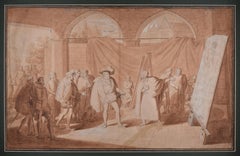
Palace with Vignettes of Scenes of Royal Court Life

Palace with Vignettes of Scenes of Royal Court Life

Located in Fairlawn, OH

Palace with Vignettes of Scenes of Royal Court Life Early 19th century Rajput School Gouache on heavy paper, mounted to gold flecked support board c. 1820 Unsigned as usual Inscribed...

Category

Rajput 1820s Art

Materials

Gouache

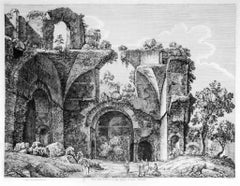
Ristauro del Tempio della Fortuna Prenestina - Etching by L. Rossini - 1826

Ristauro del Tempio della Fortuna Prenestina - Etching by L. Rossini - 1826

By Luigi Rossini

Located in Roma, IT

Ristauro del Tempio della Fortuna Prenestina. From the collection “Le antichità de’ contorni di Roma (...)” a Virtuous proof concerning the restoration of the Fortuna Prenestina Temple, with artchitectural plan, sections and some notes. Signed on plate “Rossini dis. e inc.” lower-left corner, with date and place “Roma, 1826”. In Excellent condition with some light stains. Image Dim: cm 67.5 x 51 , Dim: cm 70 x 53 Luigi Rossini (1790 – 1857) Like Giovanni Battista Piranesi, Luigi Rossini was an architect and his etchings have the same tendency to emphasize the massive constructions of the Ancient Rome. He became famous thanks to his etchings representing Roman landscapes and antique monuments...

Category

Modern 1820s Art

Materials

Etching

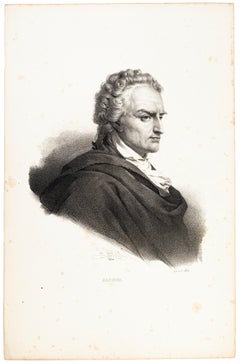
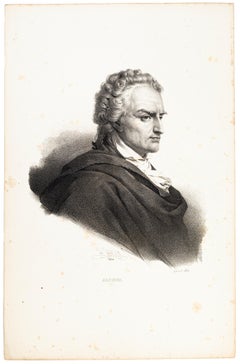
Alfieri - Original Lithograph by H. Grevedon - 1826

Alfieri - Original Lithograph by H. Grevedon - 1826

By Henri Grevedon

Located in Roma, IT

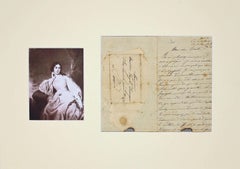
Alfieri is an original modern artwork realized by Henri Grevedon in 1826. Original Black and White Lithograph on paper. Signed and dated on the lower margin: C. Motte 1826. Titled on the central margin in capital letters: Alfieri. Fair conditions: some foxings on the surface. Alfieri is an original modern artwork realized by Henri Grevedon in 1826. Original Black and White Lithograph on paper. Signed and dated on the lower margin: C. Motte 1826. Titled on the central margin in capital letters: Alfieri. Quite good conditions: some foxings on the surface. Magnificent lithograph depicting the portrait of the great Italian author and playwright Vittorio Alfieri. The figure is in pose and express a great magniloquence and monumentality. This work has been realized by the French artist and engraver Henri Grévedon (Paris, 1776 - Paris, 1860). Grévedon studied painting in the Parisian workshop of Jean-Baptiste Regnault, professor of painting at the École des Beaux-Arts in Paris. Henri Grévedon exhibited from 1798 to 1806 and received a second medal in 1790. He was a first class gold medal in 1805 and won the first prize of the torso in 1806. He competed without success for the Prix de Rome in 1805 and 1806. According to Henri Beraldi, he "traveled the world, going to seek success in Russia in 1806 where he became an associate of the Academy of Saint Petersburg. He stayed in Stockholm in 1812, then in London, finally retured to Paris in 1816. Soon he devoted himself completely to lithography, and found there a reputation which would not have come to him with painting". He executed many painted portraits, paintings and miniatures, then he drew directly on the lithographic stone, working in particular for the workshop of Charles Motte during the 1820s. At the Salon of 1824, he won for the second time a gold medal for first class. Among the personalities he represented between 1825 and 1845, there were many actresses and dancers of his time such as the Taglioni, Fanny Elssler...

Category

1820s Art

Materials

Lithograph

41: Rope houses on the beach at Brighton

41: Rope houses on the beach at Brighton

Located in Columbia, MO

Edward William Cooke was born in Pentonville. His father, George Cooke, and uncle William Bernard Cooke were also well-known line engravers. Growing up in an environment of artists,...

Category

Naturalistic 1820s Art

Materials

Etching

Peter Schlemihl’s Wundersame G - Rare Book Illustrated by G. Cruikshank - 1827

Peter Schlemihl’s Wundersame G - Rare Book Illustrated by G. Cruikshank - 1827

By George Cruikshank

Located in Roma, IT

Peter Schlemihl’s Wundersame Geschichte is an original modern rare book written by Adelbert von Chamisso (Châlons-en-Champagne,1781 – Berlin, 1838) and illustrated by George Cruikshank (London, 1792 - London, 1878) in 1827. Published by Leonhard Schrag, Nürnberg. Original First Edition. Format: in 12°. The book includes 213 pages with Six full page Etchings and one Frontispiece. Mint conditions. George Cruikshank (London, 1792 - London, 1878) was a British caricaturist and book illustrator, praised as the "modern Hogarth" during his life. His book illustrations for his friend di lui Charles Dickens, and many other authors, reached an international audience. For Charles Dickens, Cruikshank illustrated Sketches by Boz...

Category

Romantic 1820s Art

Materials

Paper, Etching

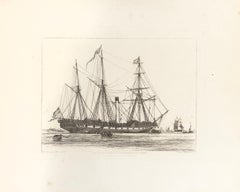
48: Gravesend Steam Packet

48: Gravesend Steam Packet

Located in Columbia, MO

Edward William Cooke was born in Pentonville. His father, George Cooke, and uncle William Bernard Cooke were also well-known line engravers. Growing up in an environment of artists,...

Category

Naturalistic 1820s Art

Materials

Etching