1820s Art

367 Results
to
25
242
71
40
10
5
Overall Width
to
Overall Height
to
7,703
21,650
167,278
236,822
2,167
2,374
4,758
6,540
6,037
15,990
21,409
26,841
19,435
14,214
5,501
124
56
1
1
191
171
2
249
147
75
72
61
50
42
40
26
18
17
15
12
11
10
10
9
8
8
8
199
113
78
35
33
45
23
12
8
6
61
158
235
127
Period: 1820s
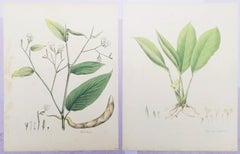
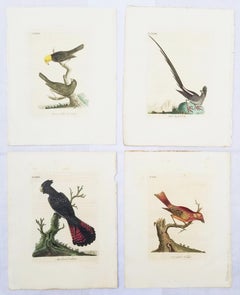
Set of Four Hand-Colored Ornithological Engravings by John Latham /// Bird UK

Set of Four Hand-Colored Ornithological Engravings by John Latham /// Bird UK

By John Latham

Located in Saint Augustine, FL

Artist: John Latham (English, 1740-1837) Titles: "Parrot-billed Grosbeaks" (Plate LXXXVII - 87), "White backed Coly" (Plate LXXXVI - 86), "Banksian Cockatoo" (Plate XXVII - 27), and "Variegated Tanager" (Plate XCIII - 93) Portfolio: A General History of Birds Year: 1821-1828 (second edition) Medium: Set of Four Original Hand-Colored Engravings on watermarked wove paper Limited edition: Unknown Printer: Jacob & Johnson, Winchester, UK Publisher: John Latham, Winchester, UK Sheet size (each): approx. 11.25" x 8.88" Image size (each): approx. 5.75" x 4.75" Reference: Brunet III, 872; Lowndes II, page 1314; Fine Bird Books page 87; Nissen IVB 532; Zimmer page 376 Condition: "Parrot-billed Grosbeaks" and "White backed Coly" have light offsetting to their sheets. "Banksian Cockatoo" and "Variegated Tanager" have moderate offsetting to their sheets. The "Variegated Tanager" also has a few light spots of discoloration at top in margins. They are all otherwise in good condition with strong colors Rare Notes: Provenance: acquired from Christie's, New York, NY, December 19, 1990. Comes from Latham's famous eleven volume portfolio "A General History of Birds" (1821-1828) (second edition), which consists of 193 hand-colored prints, made from engraved plates. "Parrot-billed Grosbeaks" and "Variegated Tanager" have an unidentified "1821" watermark lower right and upper right respectively. "Banksian Cockatoo" as a partially visible "1820?" watermark lower right. Biography: John Latham (27 June 1740 – 4 February 1837) was an English physician, naturalist and author. His main works were A General Synopsis of Birds (1781–1801) and General History of Birds (1821–1828). He was able to examine specimens of Australian birds...

Category

Victorian 1820s Art

Materials

Watercolor, Engraving, Intaglio
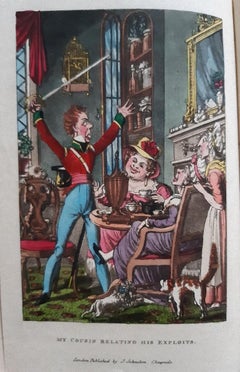
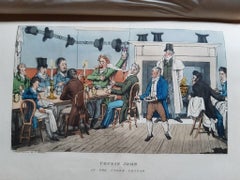
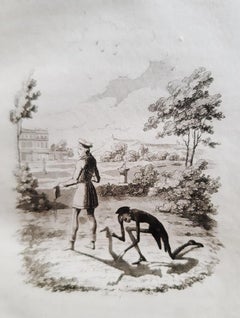
My Cousin in the Army - Rare Book Engraved by G. Cruikshank - 1822

My Cousin in the Army - Rare Book Engraved by G. Cruikshank - 1822

By George Cruikshank

Located in Roma, IT

My Cousin in the Army (original title "My cousin in the Army, or Johnny Newcome on the Peace Establishment") is an original modern rare book illustrated by George Cruikshank (London, 1792 - London, 1878) in 1822. Published by Johnston, London. Original First Edition. Format: in 8°. The book includes 316 pages with 16 full page hand colored aquatints. Mint conditions. George Cruikshank (London, 1792 - London, 1878) was a British caricaturist and book illustrator, praised as the "modern Hogarth" during his life. His book illustrations for his friend di lui Charles Dickens, and many other authors, reached an international audience. For Charles Dickens, Cruikshank illustrated Sketches by Boz...

Category

Modern 1820s Art

Materials

Paper, Etching

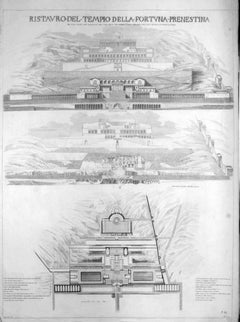
Ristauro del Tempio della Fortuna Prenestina - Etching by L. Rossini - 1826

Ristauro del Tempio della Fortuna Prenestina - Etching by L. Rossini - 1826

By Luigi Rossini

Located in Roma, IT

Ristauro del Tempio della Fortuna Prenestina. From the collection “Le antichità de’ contorni di Roma (...)” a Virtuous proof concerning the restoration of the Fortuna Prenestina Temple, with artchitectural plan, sections and some notes. Signed on plate “Rossini dis. e inc.” lower-left corner, with date and place “Roma, 1826”. In Excellent condition with some light stains. Image Dim: cm 67.5 x 51 , Dim: cm 70 x 53 Luigi Rossini (1790 – 1857) Like Giovanni Battista Piranesi, Luigi Rossini was an architect and his etchings have the same tendency to emphasize the massive constructions of the Ancient Rome. He became famous thanks to his etchings representing Roman landscapes and antique monuments...

Category

Modern 1820s Art

Materials

Etching

“Home Life”
“Home Life”

“Home Life”

Located in Southampton, NY

Watercolor on paper by the Swiss artist, Simon Daniel Lafond. Signed and dated lower right, 1820. In very good condition, wth minor toning. Colors are strong with incredible detail ...

Category

Academic 1820s Art

Materials

Paper, Watercolor

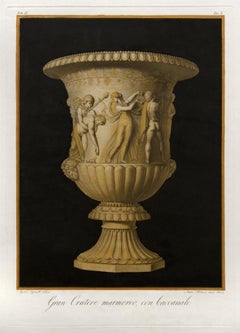
Gran Cratere marmoreo, con baccanale - Etching by Agostino Tofanelli - 1821

Gran Cratere marmoreo, con baccanale - Etching by Agostino Tofanelli - 1821

By Agostino Tofanelli

Located in Roma, IT

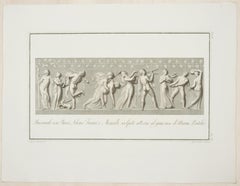
A. Tofanelli, P. Fontana, “Gran Cratere marmoreo, con baccanale” (Big marble Crater, with Bacchanal). Image Dim: cm 48x33, Dim: cm 59x44; Passepartout Dim: cm 69 x 49. Precious Etching on copper: Hand-Watercolored subject on black ink bottom. Designed by Agostino Tofanelli...

Category

1820s Art

Materials

Etching

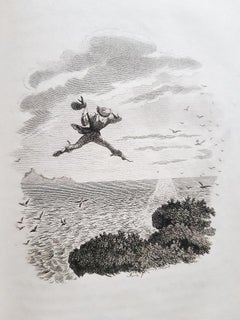
Peter Schlemihl’s Wundersame G - Rare Book Illustrated by G. Cruikshank - 1827

Peter Schlemihl’s Wundersame G - Rare Book Illustrated by G. Cruikshank - 1827

By George Cruikshank

Located in Roma, IT

Peter Schlemihl’s Wundersame Geschichte is an original modern rare book written by Adelbert von Chamisso (Châlons-en-Champagne,1781 – Berlin, 1838) and illustrated by George Cruikshank (London, 1792 - London, 1878) in 1827. Published by Leonhard Schrag, Nürnberg. Original First Edition. Format: in 12°. The book includes 213 pages with Six full page Etchings and one Frontispiece. Mint conditions. George Cruikshank (London, 1792 - London, 1878) was a British caricaturist and book illustrator, praised as the "modern Hogarth" during his life. His book illustrations for his friend di lui Charles Dickens, and many other authors, reached an international audience. For Charles Dickens, Cruikshank illustrated Sketches by Boz...

Category

Romantic 1820s Art

Materials

Paper, Etching

Bust of Nero - Original Etching by P. Fontana After B. Nocchi - 1821

Bust of Nero - Original Etching by P. Fontana After B. Nocchi - 1821

By Pietro Fontana

Located in Roma, IT

“Busto di Nerone” (Bust of Nerone) is a beautiful black and white burin and etching on paper, realized by the Italian artist Pietro Fontana, after Bernardino Nocchi as the inscriptions on plates on lower margins report “Bernardino Nocchi delineò./ Pietro Fontana incise Roma”. This original print is numbered on plate in Roman numerals on higher margin: “Tom II. /Tav. XVII" and is a plate from the series "Illustrazioni de'Monumenti scelti Borghesiani già esistenti nella Villa sul Pincio (..)date ora per la prima volta in luce dal cav. Gio. Gherardo De Rossi e da Stefano Piale sotto la guida di Vincenzo Feoli", by Ennio Quirino Visconti, published by Stamperia de Romanis in Rome, 1821. This old master’s original prints shows a precious piece of the Borghese's collection, the marble bust of the Roma Emperor, Nerone, realized with neoclassical style and a wise touch In excellent conditions with some light signs of the time, with some sporadic minor stains along the margins above all on the lower, and a usual yellowing of the paper on the lower margin, this wonderful burin has preserved still today his fresh impression. Illustrazioni de' Monumenti scelti Borghesiani This collection in two volumes is a beautifully detailed catalog of classical sculptures collected by Prince Borghese (1730-1800) in his Villa on the Pincio. Ennio Quirino Visconti (1751 - 1818) wrote the texts that accompany the large branches depicting. To these writings, which were available by the son of the illustrious archaeologist, the publishers added only a few illustrations relating to some minor monument of which copper had already been engraved. The engraved title-plate are signed by draughtsmen like Agostino Tofanelli, Stefano Tofanelli, Bernardino Nocchi, Domenico de Angelis or Teodoro Matteini, and by engravers Pietro Fontana Veneto, P. Vitali, Pietro Bettelini, Giovanni Folo Veneto, Giovanni Brunetti da Ravenna, Giovanni Ottaviani, Francesco Cecchini, Gio. Batta. Leonetti, Girolamo Carattoni, Domenico Cunego, Luigi Cunego, Alessandro Mochetti, Luigi Pizzi, Angelo Campanella or Giacomo Bossi. The Volume I shows ancient full-length statues, of the Borghese warrior by Agasias (two plates), Greek gods and heroes and Roman famous historical figures; the last two plates represents antique Egyptian deities. There are plates representing ancient bas-reliefs, sarcophagi, of mythological subjects, the Borghese Vase, portrait busts, a vase on an altar, two statues of Amor; and two modern statues, by Bernini (the Apollo and Daphne, and the David). «Très bel ouvrage» writes Brunet, «Grand ouvrage, le seul qui mérite, parmi ceux sur la villa Borgese, de figurer dans le chapitre aux Galeries et Collections» Vinet said, looking at this plate. Pietro Fontana (Bassano Romano,1762 – Rome, 1837) The Italian artist and engraver, Pietro Fontana was active in Rome and specialized in subjects dealing with the Vatican and the Papacy. He started his career as a student of Raffaello...

Category

Modern 1820s Art

Materials

Etching

Fishermen - Lithograph - 1824

Fishermen - Lithograph - 1824

Located in Roma, IT

Fishermen is a lithograph on paper realized by an Anonymous artist in 1824. Good conditions with slight foxing, The artwork is realized through perfect hatching and deft strokes, c...

Category

Modern 1820s Art

Materials

Lithograph

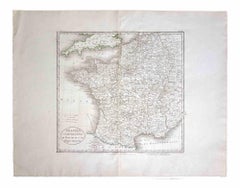
Map of France - Etching - 1820

Map of France - Etching - 1820

Located in Roma, IT

Map of France is an Original Etching realized by an unknown artist of 19th century in 1820. Very good condition on two sheets of white paper joined at t...

Category

Modern 1820s Art

Materials

Etching

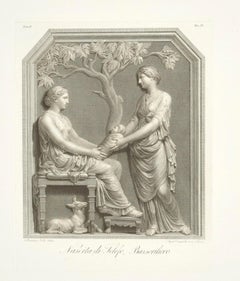
Birth of Telefon, on a Bas-Relief - Original Etching by A. Campanella

Birth of Telefon, on a Bas-Relief - Original Etching by A. Campanella

By Angelo Campanella

Located in Roma, IT

“Nascita di Telefo, Bassorilievo” (Birth of Telefo, Bas-relief) is a beautiful black and white burin and etching on paper, realized by the artist Angelo Campanella, after Bernardino Nocchi, as the inscriptions on plates on lower margins report “Bernardino Nocchi delineò/ Angelo Campanella incise Roma”. This original print is numbered on plate in Roman numerals on higher margin: “Tom II. /Tav. IX" and is a plate from the series "Illustrazioni de'Monumenti scelti Borghesiani già esistenti nella Villa sul Pincio (..)date ora per la prima volta in luce dal cav. Gio. Gherardo De Rossi e da Stefano Piale sotto la guida di Vincenzo Feoli", by Ennio Quirino Visconti, published by Stamperia de Romanis in Rome, 1821. This old master’s original prints shows a beautiful piece of the Borghese's collection, a classical bas-rilief representing the birth of Telefo, a Greek hero and myth. In excellent conditions with some light signs of the time with some sporadic minor stains along the higher margins,this wonderful etching has preserved still today his beauty and his fresh impression. Illustrazioni de' Monumenti scelti Borghesiani This collection in two volumes is a beautifully detailed catalog of classical sculptures collected by Prince Borghese (1730-1800) in his Villa on the Pincio. Ennio Quirino Visconti (1751 - 1818) wrote the texts that accompany the large branches depicting. To these writings, which were available by the son of the illustrious archaeologist, the publishers added only a few illustrations relating to some minor monument of which copper had already been engraved. The engraved title-plate are signed by draughtsmen like Agostino Tofanelli, Stefano Tofanelli, Bernardino Nocchi, Domenico de Angelis or Teodoro Matteini, and by engravers Pietro Fontana Veneto, P. Vitali, Pietro Bettelini, Giovanni Folo Veneto, Giovanni Brunetti da Ravenna, Giovanni Ottaviani, Francesco Cecchini, Gio. Batta. Leonetti, Girolamo Carattoni, Domenico Cunego, Luigi Cunego, Alessandro Mochetti, Luigi Pizzi, Angelo Campanella or Giacomo Bossi. The Volume I shows ancient full-length statues, of the Borghese warrior by Agasias (two plates), Greek gods and heroes and Roman famous historical figures; the last two plates represents antique Egyptian deities. There are plates representing ancient bas-reliefs, sarcophagi, of mythological subjects, the Borghese Vase, portrait busts, a vase on an altar, two statues of Amor; and two modern statues, by Bernini (the Apollo and Daphne, and the David). «Très bel ouvrage» writes Brunet, «Grand ouvrage, le seul qui mérite, parmi ceux sur la villa Borgese, de figurer dans le chapitre aux Galeries et Collections» Vinet said, looking at this plate. Angelo Campanella (Rome, 1748 – 1815) Angelo Campanella was an Italian painter and engraver, learned his art under Giovanni Volpato. He engraved the statues of twelve apostles found in the church of St. John Lateran in Rome, and some of the plates for Gavin Hamilton's Schola Itálica including The Presentation in the Temple after Fra Bartolommeo...

Category

Modern 1820s Art

Materials

Etching

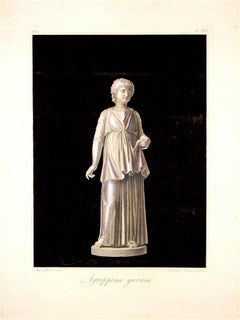
Young Agrippina - Original Etching by Agostino Tofanelli - 1821

Young Agrippina - Original Etching by Agostino Tofanelli - 1821

By Agostino Tofanelli

Located in Roma, IT

“Agrippina Giovane” (The young Agrippina) is an original etching realized by A. Tofanelli and A. Mochetti. Image Dim: cm 48x33, Dim: cm 59x44; Passepartout Dim: cm 69 x 49. Precious Etching on copper: Hand-colored subject on black ink bottom. Designed by Agostino Tofanelli and engraved by Alessandro...

Category

1820s Art

Materials

Etching

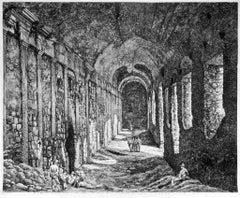
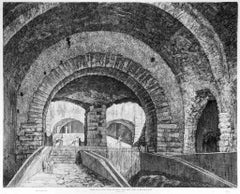
Veduta interna delle Sostruzioni ... - Etching by Luigi Rossini - 1824

Veduta interna delle Sostruzioni ... - Etching by Luigi Rossini - 1824

By Luigi Rossini

Located in Roma, IT

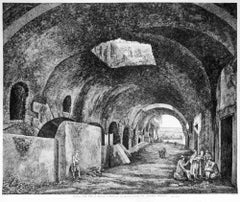
Veduta interna delle Sostruzioni dei Portici del tempio d'Ercole in Tivoli (...) is an original etching realized by Luigi Rossini. From the series “Le antichità de’ contorni di Roma (...)” it is an artist's proof with real technical virtuosity, with sharp details, representing the walkways under the portici of Hercules Temple in Tivoli. Signed on plate “Rossini dis. e inc.” lower-left corner, with indication of date and place “Roma, 1824”. In very good conditions. Luigi Rossini (1790 – 1857) Like Giovanni Battista Piranesi, Luigi Rossini was an architect and his etchings have the same tendency to emphasize the massive constructions of the Ancient Rome. He became famous thanks to his etchings representing Roman landscapes and antique monuments...

Category

Modern 1820s Art

Materials

Etching

Iris /// Antique Natural History Botany Botanical Flower Art Science Garden

Iris /// Antique Natural History Botany Botanical Flower Art Science Garden

By Pierre Corneille Van Geel

Located in Saint Augustine, FL

Artist: Pierre Corneille Van Geel (Flemish, 1796-1838) Title: "Iris" Portfolio: Sertum Botanicum Year: 1828 (First edition) Medium: Original Hand-Colored Lithograph on wove paper Lim...

Category

Victorian 1820s Art

Materials

Watercolor, Lithograph

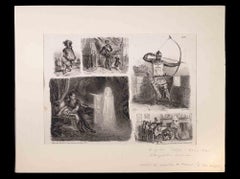
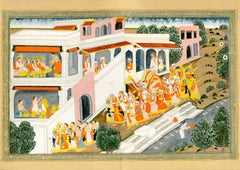
Palace with Vignettes of Scenes of Royal Court Life

Palace with Vignettes of Scenes of Royal Court Life

Located in Fairlawn, OH

Palace with Vignettes of Scenes of Royal Court Life Early 19th century Rajput School Gouache on heavy paper, mounted to gold flecked support board c. 1820 Unsigned as usual Inscribed...

Category

Rajput 1820s Art

Materials

Gouache

Ara con Tripode - Etching by V. Feoli After B. Nocchi - 1821

Ara con Tripode - Etching by V. Feoli After B. Nocchi - 1821

By Pietro Fontana

Located in Roma, IT

Image dimensions: 33.7 x 48.6 cm. “Ara con tripode” (Ara with tripod) is a beautiful black and white burin and etching on paper, realized by the artist Vincenzo Feoli, after Bernardino Nocchi as the inscriptions on plates on lower margins report “Bernardino Nocchi delineò/ Vincenzo Feoli incise in Roma”. This original print is numbered on plate in Roman numerals on higher margin: “Tom II. /Tav. XXVIII" and is a plate from the series "Illustrazioni de'Monumenti scelti Borghesiani già esistenti nella Villa sul Pincio (..)date ora per la prima volta in luce dal cav. Gio. Gherardo De Rossi e da Stefano Piale sotto la guida di Vincenzo Feoli", by Ennio Quirino Visconti, published by Stamperia de Romanis in Rome, 1821. Original Title: Ara con Tripode di quindecemviri, e la corona...

Category

Old Masters 1820s Art

Materials

Etching

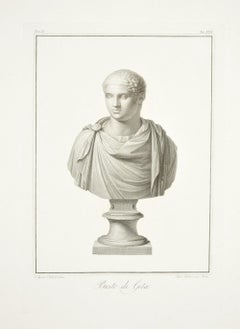
Bust of Geta Etching by Pietro Fontana, Old Masters, 1821, Unframed

Bust of Geta Etching by Pietro Fontana, Old Masters, 1821, Unframed

By Pietro Fontana

Located in Roma, IT

Image dimensions: 48.4 x 33.2 cm Busto di Geta (Bust of Geta) is a superb black and white burin and etching on paper, realized by the artist Pietro Fontana, after Agostino Tofanelli, as the inscriptions on plate on the lower margin report “Agostino Tofanelli delineò / Pietro Fontana incise Roma”. This original print is numbered on plate in Roman numerals on the higher margin: “Tom II. / Tav. XXII" and is a plate from the series "Illustrazioni de' Monumenti scelti Borghesiani già esistenti nella Villa sul Pincio (..) date ora per la prima volta in luce dal cav. Gio. Gherardo De Rossi e da Stefano Piale sotto la guida di Vincenzo Feoli", by Ennio Quirino Visconti, published by Stamperia de Romanis in Rome in 1821. This old master’s original print shows a beautiful piece of the Borghese's collection: a marble bust of Geta in a neoclassical style. Geta (full name Publius Septimius Geta) was the son of Septimius Severus and Julia Domna, and the brother of Caracalla. He was a Roman co-emperor from 209 to 212 AD, first with his father and then with his brother. His biography is very interesting: he was the younger son of Septimius Severus and his second wife; his face was obliterated because of the damnatio memoriae ordered by his brother Caracalla, who had him assassinated. In excellent conditions, with some light signs of time, some sporadic minor stains along the lower margin, and a usual and imperceptible yellowing of the paper on the margins. This wonderful etching has preserved its charming and fresh impression. Pietro Fontana (Bassano Romano, 1762 – Rome, 1837) The Italian artist and engraver Pietro Fontana was active in Rome and specialized in subjects dealing with the Vatican and the Papacy. He started his career as student of Raffaello Morghen...

Category

Old Masters 1820s Art

Materials

Etching

Acquaiolo in Strada - Original Ink and Watercolor - 1828

Acquaiolo in Strada - Original Ink and Watercolor - 1828

Located in Roma, IT

Acquaiolo In Strada is an original watercolor on paper, realized in 1828, by an anonymous artist whose signature seems to be G.M. (hand-written in pencil on lower left corner) Good ...

Category

1820s Art

Materials

Ink, Watercolor

Sculpture of Cupid Chained - Original Etching by F. Cecchini - 1821

Sculpture of Cupid Chained - Original Etching by F. Cecchini - 1821

By Francesco Cecchini

Located in Roma, IT

"Amore incatenato Statua” (Unchained Eros, Statue) is a wonderful black and white burin and etching on paper, realized by the Italian artist Francesco Cecchini (1790-1820), after Bernardino Nocchi (Lucca, 1741 - Rome, 1812) as the inscriptions on plates on lower margins report “Bernardino Nocchi delineò/ Francesco Cecchini incise Roma”. This original print is numbered on plate in Roman numerals on higher right corner “Tom. II.Tav. XXX” and is a plate from the series "Illustrazioni de'Monumenti scelti Borghesiani già esistenti nella Villa sul Pincio (..)date ora per la prima volta in luce dal cav. Gio. Gherardo De Rossi e da Stefano Piale sotto la guida di Vincenzo Feoli", by Ennio Quirino Visconti, published by Stamperia de Romanis in Rome, 1821. The Borghese Collection is known to be the most important antique statue one, after the Torlonia Collection in Rome. This old master’s original prints representing a precious piece of the Borghese collection, an Eros statue unchained, is in excellent conditions with some minor stains on the margins, some signs of the time and a usual yellowing of the paper along the external margins, do not affect the image. Illustrazioni de'Monumenti scelti Borghesiani This collection in two volumes is a beautifully detailed catalog of classical sculptures collected by Prince Borghese (1730-1800) in his Villa on the Pincio. Ennio Quirino Visconti (1751 - 1818) wrote the texts that accompany the large branches depicting. To these writings, which were found and made available by the son of the illustrious archaeologist, the publishers added only a few illustrations relating to some minor monument of which copper had already been engraved. The engraved title-plate are signed by draughtsmen like Agostino Tofanelli, Stefano Tofanelli, Bernardino Nocchi, Domenico de Angelis or Teodoro Matteini, and by engravers Pietro Fontana Veneto, P. Vitali, Pietro Bettelini, Giovanni Folo Veneto, Giovanni Brunetti da Ravenna, Giovanni Ottaviani, Francesco Cecchini, Gio. Batta. Leonetti, Girolamo Carattoni, Domenico Cunego, Luigi Cunego, Alessandro Mochetti, Luigi Pizzi, Angelo Campanella or Giacomo Bossi. The Volume I shows ancient full-length statues, of the Borghese warrior...

Category

Modern 1820s Art

Materials

Etching

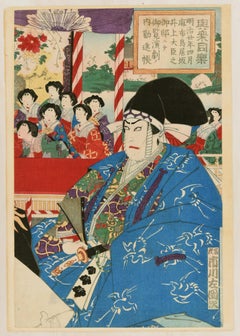
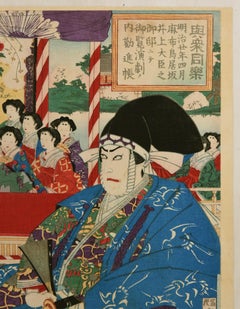
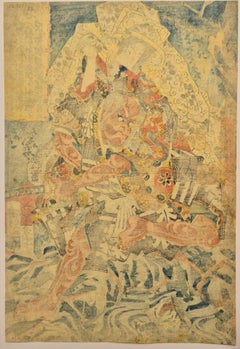
Kabuki Scene from "Kanjincho" -  Woodcut by 1887 ca.

Kabuki Scene from "Kanjincho" - Woodcut by 1887 ca.

By Kunichika Toyohara

Located in Roma, IT

A scene from the important representation of Tenno Kabuki's Play "Kanjincho", held during the Meiji Era in the House of Minister Kaoru Inoue at the presence of the Emperor Akinori Aki and of the Princess Akira Terada. Attributed to the Ukiyo-e Master Kinichika Toyohara (Oshima Yasohachi), specialised in the representations of Kabuki Scenes on Woodcut blocks...

Category

1820s Art

Materials

Woodcut

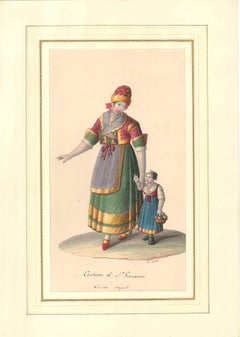
Monaco Rochettino - Watercolor by M. De Vito - 1820 ca.

Monaco Rochettino - Watercolor by M. De Vito - 1820 ca.

By Michela De Vito

Located in Roma, IT

Watercolour on ivory colored paper, 1820 c.a. Beautiful watercolour representing a monk. Hand-titled black ink on lower margin. Excellent conditions. Michela De Vito In the XIX century, Michela De Vito native of Abruzzi, worked in Naples and became a famous artist. She was maybe the daughter or sister of Camillo de Vito...

Category

Modern 1820s Art

Materials

Watercolor

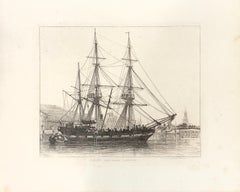
04: A Frigate
04: A Frigate

04: A Frigate

Located in Columbia, MO

Edward William Cooke was born in Pentonville. His father, George Cooke, and uncle William Bernard Cooke were also well-known line engravers. Growing up in an environment of artists,...

Category

1820s Art

Materials

Etching

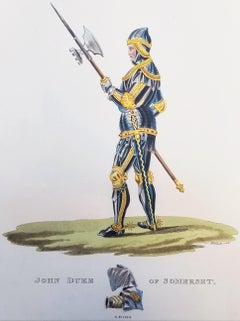
John Duke of Somerset /// Medieval Knight Soldier Warrior Sword Spear Pike Art

John Duke of Somerset /// Medieval Knight Soldier Warrior Sword Spear Pike Art

Located in Saint Augustine, FL

Artist: Samuel Rush Meyrick (English, 1783-1848) Title: "John Duke of Somerset" (Vol. 2, Plate XLIX - 49) Portfolio: A Critical Inquiry into Antient Armour Year: 1824 (First edition)...

Category

Old Masters 1820s Art

Materials

Watercolor, Engraving, Aquatint, Intaglio, Etching

48: Gravesend Steam Packet

48: Gravesend Steam Packet

Located in Columbia, MO

Edward William Cooke was born in Pentonville. His father, George Cooke, and uncle William Bernard Cooke were also well-known line engravers. Growing up in an environment of artists,...

Category

Naturalistic 1820s Art

Materials

Etching

53: Fishing Smack, Schooner, Sloop-rigged Barge

53: Fishing Smack, Schooner, Sloop-rigged Barge

Located in Columbia, MO

Edward William Cooke was born in Pentonville. His father, George Cooke, and uncle William Bernard Cooke were also well-known line engravers. Growing up in an environment of artists,...

Category

Naturalistic 1820s Art

Materials

Etching

06: Baroque
06: Baroque

06: Baroque

Located in Columbia, MO

Edward William Cooke was born in Pentonville. His father, George Cooke, and uncle William Bernard Cooke were also well-known line engravers. Growing up in an environment of artists,...

Category

1820s Art

Materials

Etching