1820s Art

to
25
246
72
37
8
7
Overall Width
to
Overall Height
to
7,593
21,417
163,200
229,757
1,998
2,263
4,983
6,528
5,750
14,976
20,635
25,731
18,663
13,962
5,390
127
54
3
1
190
172
2
249
145
79
69
60
49
45
40
26
19
17
14
12
11
11
10
10
8
8
8
203
114
85
36
28
46
24
14
8
6
56
162
181
127
Period: 1820s
Testa Quasi Colossale di Lucio Vero - Etching by P. Fontana

Testa Quasi Colossale di Lucio Vero - Etching by P. Fontana

By Francesco Cecchini

Located in Roma, IT

“Testa quasi colossale di Lucio Vero” (Almost colossal head of Lucio Vero) is a wonderful black and white etching on paper, realized by the Italian artist Pietro Fontana (Bassano Romano,1762 – Rome, 1837), after Teodoro Matteini (Pistoia, 1754 - Venice, 1831), as the inscriptions on plates on lower margins report “Teodoro Matteini del./ Pietro Fontana inc. Roma”. This original print is numbered on plate in Roman numerals on higher margin: “Tom II. /Tav. XXVI" and is a plate from the series "Illustrazioni de'Monumenti scelti Borghesiani già esistenti nella Villa sul Pincio (..)date ora per la prima volta in luce dal cav. Gio. Gherardo De Rossi e da Stefano Piale sotto la guida di Vincenzo Feoli", by Ennio Quirino Visconti, published by Stamperia de Romanis in Rome, 1821. This old master’s original prints representing a precious piece of the Borghese's collection, the marble bust of the Roman Empero Lucio Vero, is in excellent conditions with a usual yellowing of the paper at the edges, some light signs of the time( some light thinning of paper along the margin do not affect the image) but with fresh impression. Illustrazioni de' Monumenti scelti Borghesiani This collection in two volumes is a beautifully detailed catalog of classical sculptures collected by Prince Borghese (1730-1800) in his Villa on the Pincio. Ennio Quirino Visconti (1751 - 1818) wrote the texts that accompany the large branches depicting. To these writings, which were available by the son of the illustrious archaeologist, the publishers added only a few illustrations relating to some minor monument of which copper had already been engraved. The engraved title-plate are signed by draughtsmen like Agostino Tofanelli, Stefano Tofanelli, Bernardino Nocchi, Domenico de Angelis or Teodoro Matteini, and by engravers Pietro Fontana Veneto, P. Vitali, Pietro Bettelini, Giovanni Folo Veneto, Giovanni Brunetti da Ravenna, Giovanni Ottaviani, Francesco Cecchini, Gio. Batta. Leonetti, Girolamo Carattoni, Domenico Cunego, Luigi Cunego, Alessandro Mochetti, Luigi Pizzi, Angelo Campanella or Giacomo Bossi. The Volume I shows ancient full-length statues, of the Borghese warrior by Agasias (two plates), Greek gods and heroes and Roman famous historical figures; the last two plates represents antique Egyptian deities. There are plates representing ancient bas-reliefs, sarcophagi, of mythological subjects, the Borghese Vase, portrait busts, a vase on an altar, two statues of Amor; and two modern statues, by Bernini (the Apollo and Daphne, and the David). «Très bel ouvrage» writes Brunet, «Grand ouvrage, le seul qui mérite, parmi ceux sur la villa Borgese, de figurer dans le chapitre aux Galeries et Collections» Vinet said, looking at this plate. Pietro Fontana (Bassano Romano,1762 – Rome, 1837) The Italian artist and engraver, Pietro Fontana was active in Rome and specialized in subjects dealing with the Vatican and the Papacy. He started his career as a student of Raffaello Morghen...

Category

Modern 1820s Art

Materials

Etching

The King's Camelopard

The King's Camelopard

Located in Amsterdam, NL

Charles Frederick de Brocktorff (1775–1850) ‘Camelopard – a present from the Pacha of Egypt to the King – at Malta on its way to England’ Signed and dated C.F. de Brocktorff. / 1827. lower right, inscribed as titled in the painted margins lower centre. Pencil and watercolour heightened with gold paint and gum arabic on paper, 36.8 x 27.9 cm A gift so majestic, it made kings blush, and a gift so grand, it would startle Europe into a craze. Pasha Muhammad Ali of Egypt (1805-1848) did it in 1827: he sent to Europe three magical spotted, horned creatures, each with a neck reaching the skies and legs as long as a house is high. One giraffe to King Charles X of France, one to Francis I of Austria and the most fabled one to King George IV of England. A curious sight for Europeans, who had not seen such a beast since the Medici giraffe in 1487. Few animals created more of a stir in Europe than these royal...

Category

Naturalistic 1820s Art

Materials

Gold

Double-sided Horse Studies by Théodore Géricault

Double-sided Horse Studies by Théodore Géricault

Recto: two horses, preparatory study for the lithograph "Les Boueux" ("The Muddy Ones") Verso: four studies of horse heads (including two preparatory studies for the watercolor "Plowing in England"), a study of a life guard with the rump of his horse (preparatory to the lithograph "A Party of Life...

Category

Old Masters 1820s Art

Materials

Carbon Pencil

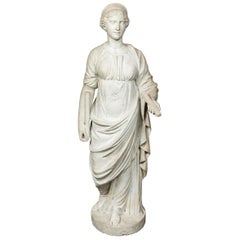
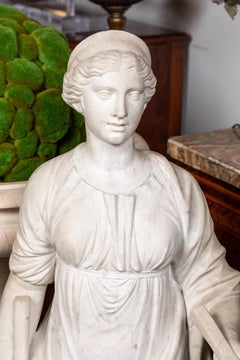
Antique, Marble Sculpture of Juno

Antique, Marble Sculpture of Juno

Located in Los Angeles, CA

Stunningly hand carved, large, circa 1825, solid Carrara marble statue of the crowned, Roman goddess, Juno- known in ancient times as the ruler of marriage, home, and family, a champ...

Category

1820s Art

Materials

Marble

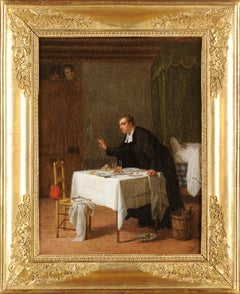
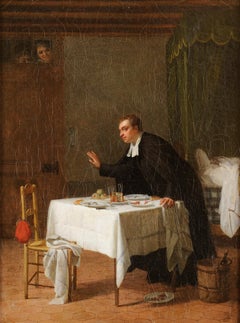
A priest dinning in good company

A priest dinning in good company

Located in BELEYMAS, FR

Pierre DUVAL LECAMUS (Lisieux 1790 - Saint-Cloud 1854) Dinner in good company Oil on canvas H. 32.5 cm; W. 24.5 cm Around 1820 Related works : - Painting from the 1822 Salon and kep...

Category

French School 1820s Art

Materials

Canvas, Oil

Bennett: Bowling Green, New York, 1826

Bennett: Bowling Green, New York, 1826

Located in Chesterfield, MI

Historical Print entitled "Bennett: Bowling Green, New York" 1826 as noted in bottom Left Corner It was published by Rudolf Leach Fine Arts, Inc., 225 Fifth Avenue, New York City ...

Category

Realist 1820s Art

Materials

Lithograph

Set of Four Hand-Colored Ornithological Engravings by John Latham /// Bird UK

Set of Four Hand-Colored Ornithological Engravings by John Latham /// Bird UK

By John Latham

Located in Saint Augustine, FL

Artist: John Latham (English, 1740-1837) Title: "New-Zealand Plover", "Nilid Grosbeak", "Black-throated Bunting", and "Variegated Chatterer" Portfolio: A General History of Birds Year: 1821-1828 (second edition) Medium: Set of Four Original Hand-Colored Engravings on wove paper Limited edition: Unknown Printer: Jacob & Johnson, Winchester, UK Publisher: John Latham, Winchester, UK Reference: Brunet III, 872; Lowndes II, page 1314; Fine Bird Books page 87; Nissen IVB 532; Zimmer page 376 Sheet size (each): approx. 11.13" x 8.75" Image size (each): approx. 4.75" x 4.5" Condition: "New-Zealand Plover" has some light offsetting and a few faint areas of discoloration at top in margin. "Nilid Grosbeak" has some faint areas of discoloration. They are all otherwise in excellent condition with strong colors Rare Notes: Provenance: acquired from Christie's, New York, NY, December 19, 1990. Comes from Latham's famous eleven volume portfolio "A General History of Birds" (1821-1828) (second edition), which consists of 193 hand-colored prints, made from engraved plates. "New-Zealand Plover" has an unidentified "1823" watermark lower right. Biography: John Latham (27 June 1740 – 4 February 1837) was an English physician, naturalist and author. His main works were A General Synopsis of Birds (1781–1801) and General History of Birds (1821–1828). He was able to examine specimens of Australian birds...

Category

Victorian 1820s Art

Materials

Watercolor, Engraving, Intaglio
Map of Africa - Original Etching by C. Brue - 1820

Map of Africa - Original Etching by C. Brue - 1820

Located in Roma, IT

Map of Africa is an original etching realized by C.Brue in 1820. The print comes from the Series "Atlas Universal" PL. 31. The state of preservation of the artwork is good except f...

Category

Modern 1820s Art

Materials

Etching

Young Agrippina - Original Etching by Agostino Tofanelli - 1821
Young Agrippina - Original Etching by Agostino Tofanelli - 1821

Located in Roma, IT

“Agrippina Giovane” (The young Agrippina) is an original etching realized by A. Tofanelli and A. Mochetti. Image Dim: cm 48x33, Dim: cm 59x44; Passepartout Dim: cm 69 x 49. Precious Etching on copper: Hand-colored subject on black ink bottom. Designed by Agostino Tofanelli and engraved by Alessandro...

Category

1820s Art

Materials

Etching

Unloading on the beach

Unloading on the beach

By Jean Antoine Théodore Gudin

Located in PARIS, FR

Théodore GUDIN Paris 1802 - Boulogne Billancourt 1880 Unloading on the beach Watercolor on paper Signed and dated "T Gudin 1827" bottom left 15 x 23 cm sheet 31.5 x 38 cm framed Bea...

Category

French School 1820s Art

Materials

Watercolor

"Various Himochi" Wagashi Festival Japanese Woodblock Print by Utagawa Toyokuni

"Various Himochi" Wagashi Festival Japanese Woodblock Print by Utagawa Toyokuni

By Utagawa Toyokuni

Located in Soquel, CA

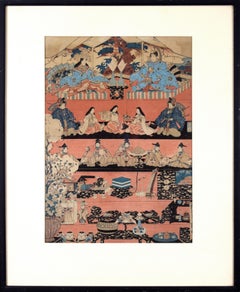
"Various Himochi" Wagashi Festival Japanese Woodblock Print by Utagawa Toyokuni Rare oversized early 19th century 5-tiered woodblock by Utagawa Ichiyosai Toyokuni, (Japan, 1769-1825), a Japanese lord and wife oversee a sekku festival of food, music, and dolls or toys. '"oshi" is the first day of “Mi (Snake)” in the third month of the lunar calendar. This day, known in modern Japan as the Girls' Festival, originated in China as a form of purification ceremony in which water and drinking peach blossom wine were used to drive away evil. Many kinds of hishi-mochi appear in this picture of hina ningyo (dolls associated with Hinamatsuri, or the Girl’s Day) from Omochae. The custom of eating special dishes at events throughout the year and at milestones in people's lives has existed since ancient times. This paragraph specifically focuses on the annual event called sekku, and life events that involve eating sweets. Joshi is the first day of “Mi (Snake)” in the third month of the lunar calendar. This day, known in modern Japan as the Girls' Festival, originated in China as a form of purification ceremony in which water and drinking peach blossom wine were used to drive away evil. According to the Keiso saijiki, in ancient China, on the third day of the third lunar month, people ate “ryuzetsuhan,” which is the juice of gogyo (Jersey cudweed) mixed with rice flour and nectar. In Japan, there is a record in the Heian period history book Nihon Montoku tenno jitsuroku [839-5] that it was an annual event to make kusamochi using gogyo on the third day of the third month of the lunar calendar, which may have been influenced by Chinese customs. The tradition of eating kusamochi on the third day of the third month of the lunar calendar continued after that. By the Edo period, however, hishimochi had come to be used as a sweet to serve on the third day of the third month. A picture of a hishimochi is included in the Morisada manko , which we mentioned in Part 1. According to it, hishimochi in the Edo period were often three layers of green-white-green instead of the now common red-white-green. However, it is possible to see from our collection that not all hishimochi were made in this way. Omochae published in 1857, is a good example. Omochae is a type of ukiyoe print...

Category

Edo 1820s Art

Materials

Ink, Rice Paper, Woodcut

Still-life of various art objects

Still-life of various art objects

Located in BELEYMAS, FR

François CARLIER-RUBRECQ (active around 1820-1830) Study of various works of art Oil on canvas H. 50 cm; L. 58.5 cm Signed and dated upper left, countersigned on the stretcher 1825 ...

Category

French School 1820s Art

Materials

Oil, Canvas

Charte von Sud-America (Map of South America) - Etching with Hand-Drawn Outlines

Charte von Sud-America (Map of South America) - Etching with Hand-Drawn Outlines

Located in Soquel, CA

Map of south America, engraved by Franz Pluth (Czech, 1800-1871), from the book "Neueste Länder - und Völkerkunde, ein geographisches Lesebuch für alle Stände" by Linder, F. L. (Prag...

Category

Other Art Style 1820s Art

Materials

Paper, Printer's Ink, Etching

The Morning vVsit - Original Lithograph by Charles Haslewood Shannon - 1906

The Morning vVsit - Original Lithograph by Charles Haslewood Shannon - 1906

By Charles Haslewood Shannon

Located in Roma, IT

The morning visit is an original artwork realized by English artist Charles Haslewood Shannon (1863-1937) Lithograph print for the Burlington magazine. Monogrammed on plate on the lower right. Proof n. 45. Passepartout cm 42x27 Good conditions except for a sign of humidity that doesn't affect the image. Charles Haslewood Shannon (1863-1937) was an English artist best known for his portraits. Painter and lithographer, born near Sleaford, Lincolnshire. Shannon studied at Lincoln School of Art and at Lambeth School of Art. During the early 20th century, his work was also featured in 'The Venture', an obscure short-lived art...

Category

Modern 1820s Art

Materials

Lithograph

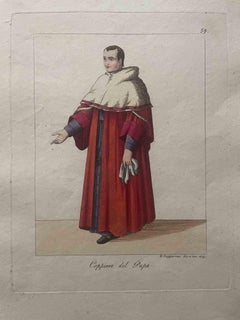
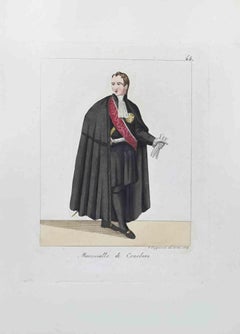
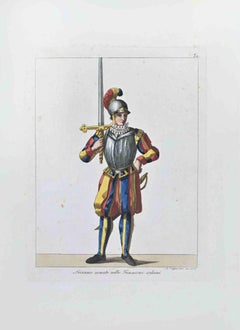
The  Swiss Guard - Etching by Giuseppe Capparoni - 1828

The Swiss Guard - Etching by Giuseppe Capparoni - 1828

Located in Roma, IT

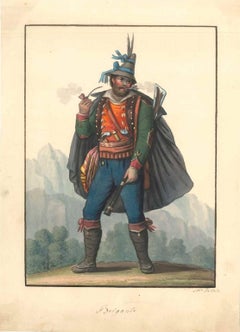
The  Swiss Guard is an Artwork realized in 1828 by the Engraver, Giuseppe Capparoni (Rome 1800- 1879). Etching hand colored on ivory paper. Signed on plate and dated on the right ma...

Category

Modern 1820s Art

Materials

Etching

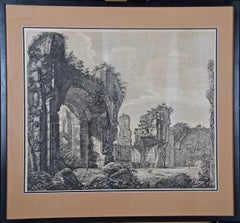
The Basilica of St. Paul in Rome, Early 19th Century Etching by Luigi Rossini

The Basilica of St. Paul in Rome, Early 19th Century Etching by Luigi Rossini

By Luigi Rossini

Located in Alamo, CA

"Rovina della gran Basilica di S. Paolo fueri le mura accaduta" (View of the Ruins of the Great Triumphal Arch of S. Paolo Fuori le Mura) from "Le Antichita Romane" (Ancient Rome), published in Rome in 1823. It depicts the destruction of the Basilica of St. Paul after the fire of 1823. People stand in the road and on the right observing the damage amid debris, which includes many fragments of columns. The etching is presented in a silver-color wood frame with an off-white double mat with a black inner mat. There are a few small spots, but it is otherwise in very good condition. See item # LU117324669722 for another Rossini etching...

Category

Old Masters 1820s Art

Materials

Etching

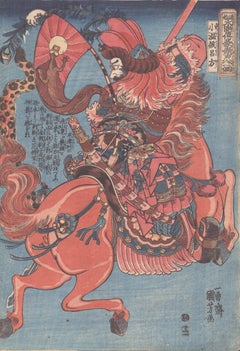
Kabuki Scene from "Kanjincho" -  Woodcut by 1887 ca.

Kabuki Scene from "Kanjincho" - Woodcut by 1887 ca.

By Kunichika Toyohara

Located in Roma, IT

A scene from the important representation of Tenno Kabuki's Play "Kanjincho", held during the Meiji Era in the House of Minister Kaoru Inoue at the presence of the Emperor Akinori Aki and of the Princess Akira Terada. Attributed to the Ukiyo-e Master Kinichika Toyohara (Oshima Yasohachi), specialised in the representations of Kabuki Scenes on Woodcut blocks...

Category

1820s Art

Materials

Woodcut

Drawing of Putti with Anchor by Jean-Jacques le Barbier l'Ainé (1738-1826)

Drawing of Putti with Anchor by Jean-Jacques le Barbier l'Ainé (1738-1826)

By Jean Jacques Francois Le Barbier

Located in SANTA FE, NM

Drawing of Putti with Anchor Jean-Jacques le Barbier l'Ainé (1738-1826) Black pencil on paper Signed and dated lower left "...1822. 12 years l waiting" Considering that the anchor ...

Category

Academic 1820s Art

Materials

Paper, Pencil

Palace with Vignettes of Scenes of Royal Court Life

Palace with Vignettes of Scenes of Royal Court Life

Located in Fairlawn, OH

Palace with Vignettes of Scenes of Royal Court Life Early 19th century Rajput School Gouache on heavy paper, mounted to gold flecked support board c. 1820 Unsigned as usual Inscribed...

Category

Rajput 1820s Art

Materials

Gouache

“The Race”
“The Race”

“The Race”

By Henry Alken

Located in Southampton, NY

Graphite and watercolor attributed to the well known British artist, Henry Thomas Alken. Circa 1825. Unsigned. Condition: Good. Provenance: Christie’s London, 1993. Matted but presently unframed. Alken was born on 12 October 1785 in Soho, Westminster, and baptised on 6 November at St James's Church, Piccadilly. He was the third son of Samuel Alken, a sporting artist. Two of his brothers were George and Samuel Alken the Younger, also an artist. In 1789, the Alken family moved from Soho to 2, Francis Street East, Bedford Square. Young Henry first studied under his father and then with the miniature painter John Thomas Barber...

Category

Academic 1820s Art

Materials

Paper, Watercolor, Graphite