1880s Art

to
152
700
221
167
82
93
Overall Width
to
Overall Height
to
7,585
21,487
164,451
234,613
2,045
2,295
4,978
6,552
5,796
15,202
20,899
26,050
18,762
14,179
5,388
291
130
18
14
11
5
3
1
1
618
602
10
814
399
296
234
176
115
100
98
81
78
62
62
57
52
49
49
47
38
36
34
436
352
319
243
220
61
51
34
33
14
439
401
577
542
Period: 1880s
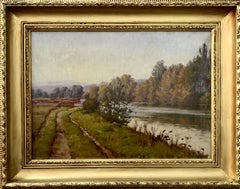
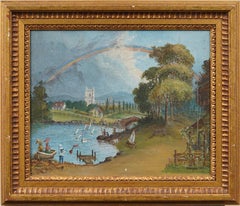
Late 19th Century Swiss Farm Scene Landscape

Late 19th Century Swiss Farm Scene Landscape

Located in Soquel, CA

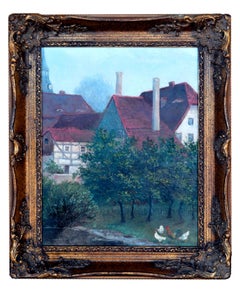
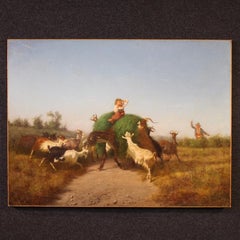
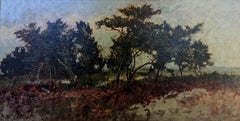
Stunning late 19th century landscape watercolor painting of a farm scene by an unknown artist. Presented in a giltwood frame. Image size, 16"H x 20"L.

Category

Impressionist 1880s Art

Materials

Paper, Watercolor

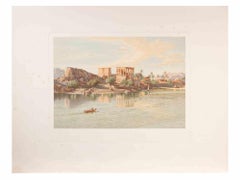
Egyptian Ruins - Lithograph after Karl Werner - 1881

Egyptian Ruins - Lithograph after Karl Werner - 1881

By Karl Werner

Located in Roma, IT

Egyptian Ruins is a modern artwork realized d'apres Karl Werner. Mixed colored cromolithograph.  The artwork is after the watercolor realized by the artist during a trip to Egypt b...

Category

Modern 1880s Art

Materials

Lithograph

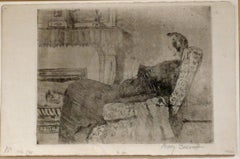
BEFORE THE FIREPLACE. NO. 1.

BEFORE THE FIREPLACE. NO. 1.

By Mary Cassatt

Located in Portland, ME

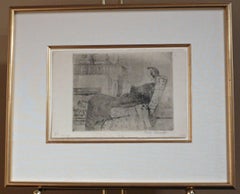
Cassatt, Mary. BEFORE THE FIREPLACE. NO. 1. Breeskin 64. Soft-grpund etching and aquatint, c. 1882. State 2 (of 3) with the light tone added, and the profile still indistinct. Si...

Category

1880s Art

Materials

Etching

Ancient Views of Panama and the District of Colon - Original Vintage Photo

Ancient Views of Panama and the District of Colon - Original Vintage Photo

Located in Roma, IT

Ancient Views of Panama and the District of Colon is a set of two different prints made in 1880s Prints in very good condition, applied on a single cardboard. Caption in Italian in...

Category

1880s Art

Materials

Paper, Photographic Paper

Three 19th C. Engravings of Classical Italian Bronze Architectural Elements

Three 19th C. Engravings of Classical Italian Bronze Architectural Elements

Located in Alamo, CA

A grouping of three engravings depicting classical Italian architectural features held in the National Museum of Naples, entitled "Bronze Hydria", "Marbre Naissance de Bacchus" and "...

Category

Other Art Style 1880s Art

Materials

Engraving

Portrait of Madame M.L. - Original Lithograph by Charles Joshua Chapli - 1884

Portrait of Madame M.L. - Original Lithograph by Charles Joshua Chapli - 1884

By Charles Joshua Chaplin

Located in Roma, IT

Portrait of Madame M.L. is a beautiful lithograph on brown paper realized by Charles Joshua Chaplin in 1884 as cover of the Catalogue off the "Salon" in Paris in 1884. A woman, sitting on clouds and reading a book with angels in celebration, is the personification of the poetry. This modern artwork, signed and titled on plate on lower corner "Portrait de M.L., d'apres Ch.Chaplin" , is realized with a very fresh impression and a rapid linein good conditions, except for a diffused foxing. Inscription in the top of the plate, 15 Cent. le Numero - Administration_ 15, rue Daunou, Paris - Le Matin - Supplement Illustre Tableaux du Salon de 1884. Charles Joshua Chaplin ( Les Andelys, 1825 –Paris 1891) Charles Joshua Chaplin was a French painter and printmaker who painted both landscapes and portraits. He was an accomplished artist mastering different techniques and was best known for his elegant portraits of young women. He studied at the Academy of Fine Art in Paris from 1840, he was a private pupil of Michel Martin Drolling whose apprentices included Paul Baudry...

Category

Modern 1880s Art

Materials

Lithograph

Rough Weather at Blatchington Pulling in the Fishing Nets on the English Coast

Rough Weather at Blatchington Pulling in the Fishing Nets on the English Coast

By Sir Frank Short

Located in Soquel, CA

Drypoint etching rawing of a coastal scene with figures drawing a net or boat form the sea by Sir Francis (Frank) Job Short (British, 1857 - 1945) Sir Frank Short, Royal Academy*, was a printmaker and teacher of printmaking. He revived the practices of mezzotint* and aquatint* engraving, and also wrote about printmaking to educate a wider public. Signed "Frank Short" lower right with monogram in the print "S within a shield" Titled lower left "Rough Weather at Blatchington" Lower left "Trial Proof" Image, 8.5"H x 10.88"W Mat, 16"H x 20"W x 0.13 Professionally cleaned and ph nuetral washed by our paper conservator. (new images posting) Francis Job Short was born on 19 June 1857 in Britain, at Stourbridge, Worcestershire. He was educated to be a civil engineer. He was engaged on various works in the Midlands until 1881, when he came to London as assistant to Mr Baldwin Latham in connection with the Parliamentary Inquiry into the pollution of the river Thames. In 1883 he was elected an associate member of the Institution of Civil Engineers. Having worked at the Stourbridge School of Art in his early years he joined the South Kensington School of Art*, in 1883. He also worked at the life class under Professor Fred...

Category

Impressionist 1880s Art

Materials

Rag Paper, Drypoint, Etching, Gouache

“Figures on Camelback along the Nile”

“Figures on Camelback along the Nile”

By Paul B. Pascal

Located in Southampton, NY

Wonderful original orientalist gouache by the well known French artist, Paul B. Pascal. Signed lower right. Circa 1885. Condition is excellent. The scene depicts figures on camelback along the Nile with pyramids in the background. Newly professionally matted and framed in antique style frame. Under glass. Overall framed measurements are 11 by 13 inches. Provenance: A Sarasota, Florida estate. Paul B. Pascal (1839–1905) was a French landscape painter. He did landscape paintings of the Middle East and the Mediterranean coast with gouache. After he emigrated to the United States in 1893, he did paintings of the American wilderness...

Category

Academic 1880s Art

Materials

Gouache, Archival Paper

1884 Original poster Esposizione Generale Italiana in Torino

1884 Original poster Esposizione Generale Italiana in Torino

Located in PARIS, FR

Crafted in 1884 by the skilled artist Francesco Gamba, the original poster for the Esposizione Generale Italiana (General Italian Exhibition) in Turin is a remarkable piece of art th...

Category

1880s Art

Materials

Linen, Paper, Lithograph

"Spring Calf, " Frederic Ede, watercolor, impressionist, pastoral landscape, 1889

"Spring Calf, " Frederic Ede, watercolor, impressionist, pastoral landscape, 1889

By Frederic Charles Vipond Ede

Located in Wiscasset, ME

Frederic Charles Vipond Ede was born in 1865 in Nottawa in Ontario, Canada. He began his studies in America before traveling to Paris, where he studied at the Académie Julian under T...

Category

Impressionist 1880s Art

Materials

Watercolor

“Tending the Sheep”
“Tending the Sheep”

“Tending the Sheep”

By Myles Birket Foster

Located in Southampton, NY

Beautifully executed original hand colored lithograph using gouache and watercolor. Scene in Surrey, England. Signedxwith monogram in plate lower left, Myles Birket Foster. Published by M. H. Long. Condition is very good. In original 2 inch wide birdseye maple antique frame with thick museum mat with gold innner edge. Overall 22 by 26 inches. Biography Myles Birket Foster (4 February 1825 – 27 March 1899) was a popular English illustrator, watercolour artist and engraver in the Victorian period. His name is also to be found as Myles Birkett Foster. Life and work Foster was born in North Shields, England of a primarily Quaker family, but his family moved south to London in 1830, where his father founded M. B. Foster & sons — a successful beer-bottling company. He was schooled at Hitchin, Hertfordshire and on leaving initially went into his father's business. However, noticing his talent for art, his father secured an apprenticeship with the notable wood engraver, Ebenezer Landells, where he worked on illustrations for Punch magazine and the Illustrated London News. On leaving Landells' employ, he continued to produce work for the Illustrated London News and the Illustrated London Almanack. He also found work as a book illustrator and, during the 1850s, trained himself to paint in watercolours. His illustrations of Longfellow’s Evangeline and books of poetry by other contemporaries were a great success, and he quickly became a successful artist in watercolours. Birket Foster became an Associate of the "Old" Watercolour Society (Later the Royal Watercolour Society) in 1860 and exhibited some 400 of his paintings at the Royal Academy over more than 2 decades. Birket Foster travelled widely, painting the countryside around Scotland, the Rhine Valley, the Swiss lakes and in Italy, especially Venice. In 1863 he moved to Witley, near Godalming in Surrey where he had a house ("The Hill") built. Being friendly with Edward Burne-Jones and William Morris, he had the house decorated and furnished in contemporary style, with tiles and paintings by Burne-Jones and Morris' firm, Morris and Company. The same year he published a volume of "English Landscapes," with text by Tom Taylor...

Category

Impressionist 1880s Art

Materials

Lithograph, Watercolor, Gouache

Tempera on cardboard of Pre-Raphaelite scope, c. 1880.

Tempera on cardboard of Pre-Raphaelite scope, c. 1880.

Located in Vicenza, VI

Pre-Raphaelite author's painting, probably English, dated 1880 and unsigned. The work depicts a gender scene set in a wooded landscape, with three female figures and two children ar...

Category

Pre-Raphaelite 1880s Art

Materials

Tempera, Cardboard

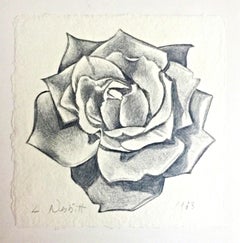
Exquisite  Rose Drawing (unique) done in graphite, hand signed with provenance

Exquisite Rose Drawing (unique) done in graphite, hand signed with provenance

By Lowell Nesbitt

Located in New York, NY

Lowell Nesbitt Untitled Rose, 1983 Graphite on Lanaquarelle Watercolor Paper Signed and dated on the front Framed Unique, poignant, exquisitely rendered graphite drawing on watercolor paper with deckled edges. This work is framed and ready to hang; frame bears Alan Brown Gallery (Hartsdale) label verso. It was acquired from the Estate of Noel Frackman, renowned art historian, scholar, writer, and professor with a lifelong passion for 20th Century Art - and a close personal friend of Lowell Nesbitt. She earned a M.A. from Sarah Lawrence College in English Literature and a M.A. and Ph.D. in Art History from the Institute of Fine Arts of New York University. She was an art critic for the Patent Trader Newspaper and the Scarsdale Inquirer, contributing editor for Arts Magazine, author of numerous catalogs including ''John Storrs'', for the Whitney Museum of American Art. For 19 years she was a faculty member at Purchase College, State University of New York. Measurements: Framed: 13 inches by 13 inches x .5 Artwork: approx. 10.5 inches by 10.5 inches Lowell Nesbitt Biography: Lowell Blair Nesbitt, painter, printmaker, draughtsman, and sculptor, was born in Baltimore, Maryland on 4 October 1933. He studied at Tyler School of Art at Temple University in Philadelphia and at the Royal Academy of Arts in London. Nesbitt worked in abstraction until Robert Indiana suggested in the early 1960s that he explore realism in his paintings. As subjects for his work he favored studio interiors, articles of clothing, piles of shoes, his Rottweiler, the Neo-Classical facades of 19th century cast iron buildings, and Manhattan's bridges. He was also famous for his enormous paintings and prints of roses, lilies, irises, and other flowers. In 1980, the United States Post Office issued...

Category

Realist 1880s Art

Materials

Graphite, Mixed Media
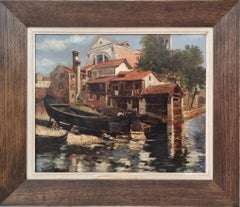
"Arquebusiers En Manoeuvre", After Marchetti

"Arquebusiers En Manoeuvre", After Marchetti

Located in Soquel, CA

Figurative landscape of four infantrymen in formation with their long arquebus guns by Adolphe Ancker (Dutch, 19th Century), after Marchetti. Signed and dated "Adolph Ancker 1888" lo...

Category

American Impressionist 1880s Art

Materials

Paper, Watercolor, Pencil

19th century etching black and white seascape print boats water buildings signed

19th century etching black and white seascape print boats water buildings signed

By Thomas Moran

Located in Milwaukee, WI

This black and white etching by American painter and print maker of the Hudson River School in New York: Thomas Moran, is a rare Klackner #53 of the catalogue raisonné, depicting "The Harbor of Vera...

Category

Hudson River School 1880s Art

Materials

Parchment Paper, Etching

La sieste a la ferme des Greves - Barbizon Landscape Pastel by Leon Lhermitte

La sieste a la ferme des Greves - Barbizon Landscape Pastel by Leon Lhermitte

By Léon Augustin Lhermitte

Located in Marlow, Buckinghamshire

Signed figure in landscape pastel on canvas by French Barbizon painter Leon Augustin Lhermitte. The piece depicts a farmyard scene on a bright summer's day. A young woman is taking a...

Category

Barbizon School 1880s Art

Materials

Canvas, Pastel

Le Matin - Etching by James Tissot - 1886

Le Matin - Etching by James Tissot - 1886

By James Tissot

Located in Roma, IT

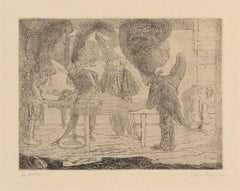
Wonderful mezzotint and etching on China paper applied. The inscription reads: "Le matin/ J. J. Tissot Sc. et ex. 1886". Titled, signed and dated on plate on the lower margin, below ...

Category

Modern 1880s Art

Materials

Etching, Aquatint

Porcelain Lamp - Original Watercolor and Ink drawing - 1880s

Porcelain Lamp - Original Watercolor and Ink drawing - 1880s

Located in Roma, IT

"Porcelain Lamp" is an original watercolor and ink drawing on ivory-colored paper realized in 1880ca. by Anonymous french Artist of 19th Century. In very good conditions. The artw...

Category

Modern 1880s Art

Materials

Ink, Watercolor

Impressionist Painting of Cows and Trees by C.H. Miller, Long Island

Impressionist Painting of Cows and Trees by C.H. Miller, Long Island

By Charles Henry Miller

Located in New York, NY

Charles Henry Miller (American, 1842-1922) Untitled (Cows and Trees), c, 1885 Oil on canvas 18 x 24 in. Signed lower left: Chas. H. Miller, N.A. Charles Henry Miller was a noted artist and painter of landscapes from Long Island, New York. The American poet Bayard Taylor called him, "The artistic discoverer of the little continent of Long Island." Miller was educated at Mount Washington Collegiate Institute, and graduated in medicine at the New York Homeopathic Institute in 1864. Before his graduation, he had occasionally painted pictures, and in 1860 he exhibited The Challenge Accepted at the National Academy of Design, in New York City. He lived in Queens at the summer estate, Queenslawn, originally purchased by his parents. He went abroad in 1864 and again in 1867, and was a pupil in the Bavarian Royal Academy at Munich under the instruction of Adolf Lier...

Category

American Impressionist 1880s Art

Materials

Canvas, Oil

Der Philosoph - Etching by Max Klinger - 1885

Der Philosoph - Etching by Max Klinger - 1885

By Max Klinger

Located in Roma, IT

Image dimension cm 29.7x19.9. Printed in the lower margin, center: «Max Klinger / Der Philisoph / (Aus «Vom Tode, II») / Pan I 2». Engraving from the art periodical Pan, vol. I, no...

Category

Symbolist 1880s Art

Materials

Etching

On the Moors - England Original Watercolor 19th Century

On the Moors - England Original Watercolor 19th Century

By David Cox the Younger

Located in Soquel, CA

On the Moors - England Original Watercolor 19th Century Mid 19th century watercolor of the North York Moors in Spring by David Cox (English, 9 July 1809 – 6 December 1885), known as...

Category

Contemporary 1880s Art

Materials

Watercolor, Laid Paper

"Residence At Terrell" Date 1881 TEXAS CATTLE SCENE GRANDFATHER TEXAS ART

"Residence At Terrell" Date 1881 TEXAS CATTLE SCENE GRANDFATHER TEXAS ART

By Frank Reaugh

Located in San Antonio, TX

Frank Reaugh (1860-1945) Dallas Artist Image Size: 3 3/4 x 5 1/2 Frame Size: 15 x 18 Medium: Pastel on paperboard Circa 1881 "Residence At Terrell" From the collection of Lucretia Coke. Signed F.R. Lower Left & S7 On Verso 1881 or 2, 2 or 3 miles from next house. Frank Reaugh (1860-1945) Charles Franklin Reaugh. THE FRANK REAUGH GALLERY AT THE PANHANDLE-PLAINS HISTORICAL MUSEUM by Michael R. Grauer, Curator of Art, Panhandle-Plains Historical Museum Called the pejorative "Rembrandt of the Longhorn" and "Longhorn Leonardo," and the gentler "Painter to the Longhorns," Charles Franklin "Frank" Reaugh was a master pastellist unparalleled in Texas and the greater Southwest. While he advertised himself as a "landscape and cattle painter" and insisted he was the historian of the Texas longhorn, he has effectively, and unfortunately, pigeonholed his art. More appropriately, Frank Reaugh is often called the "Dean of Texas Painters." His name is synonymous with the "old guard" of Texas art history, along with Robert Onderdonk, Hermann Lungkwitz, William Henry Huddle, Henry McArdle, and others. Reaugh's paintings focused on the landscape of the American West generally, and the American Southwest, specifically. He captured subtleties in a land of high contrast where others only saw the rawness. He painted the overwhelmingly blue sky, the illimitable plains, and the great gashes in the land that are called canyons, arroyos, or breaks in the West. And he painted the Texas longhorn, or Texas cattle, as he referred to them. Usually no more important than the mesquite, yucca, sagebrush, and cholla that also populate his compositions of the Western landscape, the Texas longhorn became his recognized symbol. Today, some commercial galleries even insist that one of his works is more valuable if it has a cow in it! These commercial zealots in their search for a longhorn often overlook the beauty of his landscapes; they cannot see the landscape for the longhorns. Born near Jacksonville, Illinois in 1860, Reaugh first came to Texas in a wagon in 1876 at the age of fifteen. He moved with his parents to a farm near Terrell, Texas, until 1890 when they moved to Dallas and settled in what is now the Oak Cliff area. Reaugh had no formal education but fared well without it for his mother, Clarinda Reaugh, was his teacher in all things. The daughter of a Presbyterian minister, his mother instilled in her only child an appreciation of nature, grounded in her own readings in zoology, botany, and natural history. Her teachings were infused with the philosophies of the famed Swiss zoologist Louis Agassiz and John Burroughs, supporter and contemporary of Walt Whitman, who wrote extensively on his symbiotic relationship with nature. Clarinda Reaugh also encouraged her son's interest in drawing through her own interest in the fine arts. Reaugh's father, George Washington Reaugh, was a mechanic, carpenter, cabinetmaker, and farmer, who had participated in the Gold Rush of 1849. It was from his father that Reaugh learned to be extremely adept with his hands, and later made his own picture frames and patented several inventions. George Reaugh's sense of adventure may have spurred his son's annual trips to West Texas and beyond, which began in the early 1880s. Reaugh's first exposure to art came through reproductions in popular magazines such as Harper's, Scribner's, and Century Illustrated. Rosa Bonheur's Horsefair, the Dutch painter Paulus Potter's Young Bull, and the landscapes of Frederic Edwin Church and J. M. W. Turner were favorites of his. (In fact, his late works are often especially reminiscent of Church and Turner.) From these early reproductions in black and white, Reaugh learned well the lessons of value and composition. While he studied and copied magazine reproductions, Reaugh also became interested in bovine anatomy. Using a "two-bit" book on cattle and sheep anatomy as his text, the young artist collected bones near the Reaugh farm and made measurements from family livestock. He supplemented his scientific studies with sketches made from longhorn cattle brought up from South Texas to fatten on grass nearby. In the early 1880s, Reaugh met two cattlemen, Frank and Romeo Houston, who had interests throughout North Texas, and accompanied them on cattle drives and roundups near present-day Wichita Falls and in Indian Territory (now Oklahoma). His first documented trip to Western Texas came in 1883; probably near present day Wichita Falls and Henrietta, Texas. Reaugh made numerous sketches during these trips, often from the saddle, and later enlarged and composed them in the studio. His field sketches resulted in his first two pastel masterpieces, Watering the Herd (1889) and The One-O Roundup (1894). and his oil The Approaching Herd (1902). These trips with the Houstons, begun as early as 1883, spurred a wanderlust for West Texas that lured Reaugh until he was nearly eighty. Reaugh took his first formal art training at the Saint Louis Museum and School of Fine Arts during the winter of 1884-85. He spent most of his time there drawing from plaster casts of Greek, Roman, and Italian sculpture and possibly live models. Reaugh also met Halsey C. Ives, director of the school, who lectured on avant-garde art trends in Europe, particularly French Impressionism. Later, Ives was instrumental in the acceptance of Reaugh's work for display at the Louisiana Purchase Exposition, held in Saint Louis in 1904. Following his studies at Saint Louis, Reaugh returned to Terrell and began teaching art to young ladies in the area. He supplemented his art classes with a stint at teaching public school, and by November 1888 had saved enough money for a trip to Europe. Upon arriving at Paris, Reaugh enrolled at the Academie Julian, a school very popular with international students, especially Americans. He drew and painted from the figure while at the Academie under Jules Lefebvre, John-Joseph Benjamin Constant, and Henri-Lucien Douciet, all members of the "juste milieu" in France. Reaugh studied at the Academie for half of each day then supplemented his formal instruction by making copies of or studying paintings in the Louvre and the Luxembourg Palace. Logically he was especially drawn to the pastels in what he later called the 'pastel room' in the Louvre. In his 1927 pamphlet, Pastel, Reaugh wrote of the pastel painters he saw in the gallery: "[John] Russell, of England, and [Maurice-Quentin de] La Tour, [Jean Etienne] Liotard, [Jean Simeon] Chardin, and [Madame Vigee] Le [sic] Brun. These were great painters. . .the work of all of them may be seen in the pastel room of the Louvre, as fresh and bright, apparently, as on the day it was done." In addition to the pastellists he mentioned, Reaugh also saw pastels in the Louvre by Rosalba Carriera, Francois Boucher, and Pierre Paul Prudhon. At the end of March 1889, Reaugh traveled through Belgium and Holland, studying paintings of the Flemish and Dutch schools, and particularly those of The Hague School, of which Anton Mauve was a part. He returned to Paris in time to see the Exposition Universelle, at which paintings by French Impressionists Cezanne, Manet, Monet, and Pissarro were exhibited. This may have been Reaugh's initial exposure to Impressionism. Reaugh returned to Texas at the end of May 1889. Between 1890 and 1915, Frank Reaugh enjoyed his greatest success as an artist. He exhibited works at two world's fairs: the World's Columbian Exposition at Chicago in 1893 and the Louisiana Purchase Exposition in 1904. He also exhibited at the prestigious National Academy of Design at New York, the Pennsylvania Academy of the Fine Arts at Philadelphia, and the Art Institute of Chicago. Moreover, Reaugh became a member of the Society of Western Artists and exhibited with that group all over the United States. Finally, Reaugh toured his pastels with much success, especially in the upper Midwest. Simultaneously, Reaugh continued his trips to the West and, beginning in the 1890s, he started using a camera as a sketching tool. He photographed the landscape as well as cattle, and in 1893 photographed in Palo Duro Canyon; perhaps his first trip to the 'Grand Canyon of Texas'. After 1900, Reaugh turned his genius to inventing and patented several devices including a folding lap easel, a water pump, and a cooling mechanism for internal combustion engines, among other things. He also patented Reaugh Pastels, using a formula he developed and shaped into an octagonal-shape stick for easier gripping. Allegedly, either John Singer Sargent or William Merritt Chase used Reaugh Pastels. Reaugh also became more active in Dallas art and civic circles. After first offering private art lessons, he organized the Dallas School of Fine Arts in 1899. He urged Dallas to build the city's first art gallery in 1900, to which he donated a painting, and helped found the Dallas Art Association in 1903. Furthermore, Reaugh arranged the loan of paintings from then-contemporary American artists in the East and Midwest for the State Fair of Texas. An vocational naturalist, Reaugh also organized a popular nature study club in Dallas, members of which were young ladies who grew to be influential Dallas civic leaders. Nevertheless, despite his ground-level work to bring art to Dallas, as the Dallas Art Association grew Reaugh was pushed aside by socialites and his contributions forgotten. Around 1910 and possibly earlier, he began taking students with him on his trips West. Among them were Texas artists Edward G. Eisenlohr, Florence McClung, Lloyd Goff...
Category

Impressionist 1880s Art

Materials

Pastel

La Rue du Canal - View of New Orleans - Woodcut Print After Hubert Clerge - 1880

La Rue du Canal - View of New Orleans - Woodcut Print After Hubert Clerge - 1880

By Charles Laplante

Located in Roma, IT

Image dimensions: 11.8 x 15.4 cm. La rue du Canal is a beautiful black and white xilograph on paper, realized in 1880 by the French wooden engraver Charles Laplante (Sèvres, 1837 - Paris, 1903), after Hubert Clerget (1818-1899). Original title: La rue du Canal, à la Nouvelle-Orléans Signed on plate on sides. With an incredible freshness of line and a full mastery of the artistic technique, this original print portrays a wonderful glimpse of a street in New Orleans. Title on plate, on lower margin at the center. The original print is mounted in a white cardboard passepartout, cm 30 x 40. In excellent conditions, this beautiful modern artwork is an illustration of the French newspaper " Le Tour du Monde", and on the back has another illustration representing the general Sherman...

Category

Modern 1880s Art

Materials

Woodcut