1880s Art

to
172
738
218
167
78
85
Overall Width
to
Overall Height
to
7,702
21,708
163,761
226,669
2,003
2,280
4,944
6,495
5,861
15,033
20,544
25,710
18,610
14,068
5,502
319
119
18
15
7
5
4
1
1
624
618
12
839
414
303
249
186
129
103
95
82
81
62
61
61
53
51
50
46
41
38
34
423
333
321
265
238
66
52
36
33
14
416
443
565
461
Period: 1880s
Walking Stag
Walking Stag

Walking Stag

By Antoine-Louis Barye

Located in PARIS, FR

Walking Stag No.2 by Antoine-Louis BARYE (1796-1875) A bronze sculpture with a nuanced brown patina Signed on the base " Barye " Probably cast by " Brame " France circa 1880 heig...

Category

French School 1880s Art

Materials

Bronze

La Passagère du 54 - Promenade en Yacht (The Passenger of 54 – Yacht Ride)

La Passagère du 54 - Promenade en Yacht (The Passenger of 54 – Yacht Ride)

By Henri de Toulouse-Lautrec

Located in Palo Alto, CA

Henri de Toulouse-Lautrec La Passagère du 54 - Promenade en Yacht (The Passenger of 54 – Yacht Ride), 1896 is captivating work featuring a woman lounging unaffectedly in a striped ch...

Category

Post-Impressionist 1880s Art

Materials

Lithograph

HERMMANN LEON - Painting 19th Century - Portrait of a Dog in Interior

HERMMANN LEON - Painting 19th Century - Portrait of a Dog in Interior

By Charles Herrmann-Léon 1

Located in Saint-Ouen, FR

HERRMANN LEON Charles (1838-1908) Portrait of a Dog in interior Oil on canvas signed low left Old frame re-gilded with gold leaves Dim canvas : 56 X 46 cm Dim frame : 69 X 59 cm HERRMANN LEON Charles (1838-1908) French painter 19th century Born 22 july 1838 in Le Havre. Died 1...

Category

Academic 1880s Art

Materials

Oil

Turkish Horse
Turkish Horse

Turkish Horse

By Antoine-Louis Barye

Located in PARIS, FR

"Turkish Horse" by Antoine-Louis Barye (1796-1875) Bronze with nuanced dark brown patina cast by BARBEDIENNE France circa 1880 height 28 cm length 31,5 cm This is the biggest size...

Category

French School 1880s Art

Materials

Bronze

Peony, c. 1880's

Peony, c. 1880's

Located in Santa Monica, CA

Peony, c. 1880's Vintage Hand Colored Albumen Print Paper is 11 5/8 x 9 1/2 inches, Matted to 20 x 16 inches

Category

1880s Art

Materials

Photographic Paper

Oil on canvas English Romanticism Landscape with Tiger

Oil on canvas English Romanticism Landscape with Tiger

Located in Valladolid, ES

One of a kind large-format English Romantic landscape. This is a very powerful work, with a melancholic and contemplative character, in which nature takes center stage, characterist...

Category

Pre-Raphaelite 1880s Art

Materials

Canvas

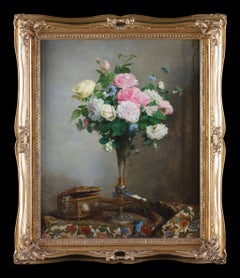
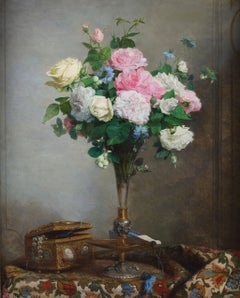
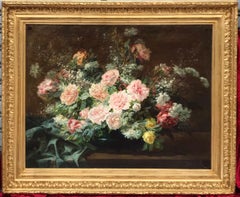
“Still Life with Roses”

“Still Life with Roses”

Located in Southampton, NY

Original oil on canvas laid down on board by the well known American artist, Jean Paul Selinger. Signed top right by the artist along with “Florence” where the artist visited in the...

Category

Impressionist 1880s Art
Materials

Canvas, Oil

French School circa 1880, Portrait of a boy holding a book, drawing

French School circa 1880, Portrait of a boy holding a book, drawing

Located in Paris, FR

French school circa 1880 Portrait of a boy holding a book graphite and white gouache on paper 39.5 x 32 cm oval view in good condition, slightly yellowed with age In its original ova...

Category

Academic 1880s Art

Materials

Gouache, Pencil

LE PETIT ENTERREMENT (The Small Funeral)

LE PETIT ENTERREMENT (The Small Funeral)

By Félix Hilaire Buhot

Located in Portland, ME

Buhot, Felix. LE PETIT ENTERREMENT (The Small Funeral). B/G 154. Second state of two. Etching, roulette, aquatint and drypoint printed in blue on tan wove paper, 1880. 3 3/8 x 4 1/2 inches; 86 x 115 mm., (sheet 8 3/8 x 10 3/8 inches; 215 x 264 mm.). Signed with the red owl...

Category

1880s Art

Materials

Drypoint, Etching

View of the Venetian Lagoon style of Pietro Galter (1840/1901)

View of the Venetian Lagoon style of Pietro Galter (1840/1901)

Located in GOUVIEUX, FR

View of the Venetian Lagoon Oil on panel Venetian School, 19th century, without signature dated 1889 In the style of Pietro Galter Dimensions: 39 × 21 cm This composition depicts a t...

Category

Italian School 1880s Art

Materials

Oil

Horse Carriage in the Bourgeoise Yard

Horse Carriage in the Bourgeoise Yard

Located in Saint-Ouen, FR

James Thomas Wheeler (1849 - 1888) Horse Carriage in the Yard Oil on canvas signed low right Old original frame gilded with leaves Canvas size : 55 X 65 cm Frame size : 85 X 95 cm

Category

Academic 1880s Art

Materials

Oil

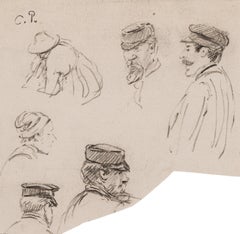
Edouard Detaille (1848 1912), A Carnival character, original signed Drawing

Edouard Detaille (1848 1912), A Carnival character, original signed Drawing

By Jean Baptiste Édouard Detaille

Located in Paris, FR

Edouard Detaille (1848-1912) A Carnival character and a Zouave 19.5 x 12.5 cm Pen and ink on paper Signed lower left with the initials (faded) In a modern framing : 35 x 28 cm T...

Category

Academic 1880s Art

Materials

Ink

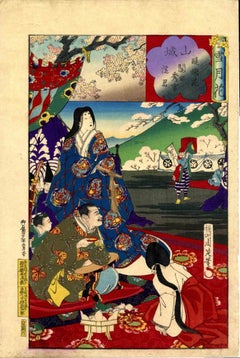
Pair Japanese Woodblock, Matted, Custom Ebony Frames

Pair Japanese Woodblock, Matted, Custom Ebony Frames

Located in Stamford, CT

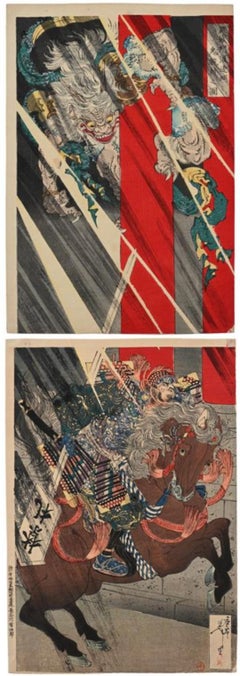
A pair of Japanese Woodblocks each in a fine custom matted frame with fine ebony and gilt decorations. Each signed and dated on the reverse. Listed below. -A courtyard lady in a comm...

Category

1880s Art

Materials

Wood

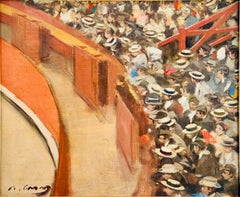
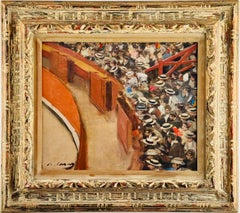
Ramón Casas, Corrida

Ramón Casas, Corrida

Located in Madrid, ES

RAMÓN CASAS Spanish, 1866 - 1932 CORRIDA signed "R. Casas" (lower left) oil on canvas 15 x 18-1/8 inches (38 x 46 cm.) framed: 23-1/4 x 26 inches (59 x 66 cm.) PROVENANCE The artist...

Category

Post-Impressionist 1880s Art

Materials

Canvas, Oil

Ship LUCY G. DOW
Ship LUCY G. DOW

Ship LUCY G. DOW

Located in Costa Mesa, CA

The strength of a great ship portrait lies with its overall striking composition blended with an attention to detail. Charles Sidney Raleigh was extremely skilled with both elements, and this is one of his finest works. An American full-rigged ship of large proportions, LUCY G. DOW is one of many ships owned by Maine interests, where the ship would be locally built and consortium owned. More Maine captains owned part of their ships than any other East Coast region, it appears through an informal survey of lists. Note the fine details of the captain and crew hard at work onboard off the coast. The numerous buildings are clustered on the peninsular stretch with a pier coming out near the lighthouse’s walkway. At the distance, ship masts...

Category

Other Art Style 1880s Art

Materials

Canvas, Oil

Paysage de Montigny-sur-Loing par Camille Dufour (1841-1933)

Paysage de Montigny-sur-Loing par Camille Dufour (1841-1933)

Located in GOUVIEUX, FR

"Paysage de Montigny-sur-Loing" par Camille Dufour (27x18 cm, sur panneau) Découvrez cette magnifique peinture de Camille Dufour (né le 8 février 1841 et décédé le 3 janvier 1933), c...

Category

French School 1880s Art

Materials

Oil

"Residence At Terrell" Date 1881 TEXAS CATTLE SCENE GRANDFATHER TEXAS ART

"Residence At Terrell" Date 1881 TEXAS CATTLE SCENE GRANDFATHER TEXAS ART

By Frank Reaugh

Located in San Antonio, TX

Frank Reaugh (1860-1945) Dallas Artist Image Size: 3 3/4 x 5 1/2 Frame Size: 15 x 18 Medium: Pastel on paperboard Circa 1881 "Residence At Terrell" From the collection of Lucretia Coke. Signed F.R. Lower Left & S7 On Verso 1881 or 2, 2 or 3 miles from next house. Frank Reaugh (1860-1945) Charles Franklin Reaugh. THE FRANK REAUGH GALLERY AT THE PANHANDLE-PLAINS HISTORICAL MUSEUM by Michael R. Grauer, Curator of Art, Panhandle-Plains Historical Museum Called the pejorative "Rembrandt of the Longhorn" and "Longhorn Leonardo," and the gentler "Painter to the Longhorns," Charles Franklin "Frank" Reaugh was a master pastellist unparalleled in Texas and the greater Southwest. While he advertised himself as a "landscape and cattle painter" and insisted he was the historian of the Texas longhorn, he has effectively, and unfortunately, pigeonholed his art. More appropriately, Frank Reaugh is often called the "Dean of Texas Painters." His name is synonymous with the "old guard" of Texas art history, along with Robert Onderdonk, Hermann Lungkwitz, William Henry Huddle, Henry McArdle, and others. Reaugh's paintings focused on the landscape of the American West generally, and the American Southwest, specifically. He captured subtleties in a land of high contrast where others only saw the rawness. He painted the overwhelmingly blue sky, the illimitable plains, and the great gashes in the land that are called canyons, arroyos, or breaks in the West. And he painted the Texas longhorn, or Texas cattle, as he referred to them. Usually no more important than the mesquite, yucca, sagebrush, and cholla that also populate his compositions of the Western landscape, the Texas longhorn became his recognized symbol. Today, some commercial galleries even insist that one of his works is more valuable if it has a cow in it! These commercial zealots in their search for a longhorn often overlook the beauty of his landscapes; they cannot see the landscape for the longhorns. Born near Jacksonville, Illinois in 1860, Reaugh first came to Texas in a wagon in 1876 at the age of fifteen. He moved with his parents to a farm near Terrell, Texas, until 1890 when they moved to Dallas and settled in what is now the Oak Cliff area. Reaugh had no formal education but fared well without it for his mother, Clarinda Reaugh, was his teacher in all things. The daughter of a Presbyterian minister, his mother instilled in her only child an appreciation of nature, grounded in her own readings in zoology, botany, and natural history. Her teachings were infused with the philosophies of the famed Swiss zoologist Louis Agassiz and John Burroughs, supporter and contemporary of Walt Whitman, who wrote extensively on his symbiotic relationship with nature. Clarinda Reaugh also encouraged her son's interest in drawing through her own interest in the fine arts. Reaugh's father, George Washington Reaugh, was a mechanic, carpenter, cabinetmaker, and farmer, who had participated in the Gold Rush of 1849. It was from his father that Reaugh learned to be extremely adept with his hands, and later made his own picture frames and patented several inventions. George Reaugh's sense of adventure may have spurred his son's annual trips to West Texas and beyond, which began in the early 1880s. Reaugh's first exposure to art came through reproductions in popular magazines such as Harper's, Scribner's, and Century Illustrated. Rosa Bonheur's Horsefair, the Dutch painter Paulus Potter's Young Bull, and the landscapes of Frederic Edwin Church and J. M. W. Turner were favorites of his. (In fact, his late works are often especially reminiscent of Church and Turner.) From these early reproductions in black and white, Reaugh learned well the lessons of value and composition. While he studied and copied magazine reproductions, Reaugh also became interested in bovine anatomy. Using a "two-bit" book on cattle and sheep anatomy as his text, the young artist collected bones near the Reaugh farm and made measurements from family livestock. He supplemented his scientific studies with sketches made from longhorn cattle brought up from South Texas to fatten on grass nearby. In the early 1880s, Reaugh met two cattlemen, Frank and Romeo Houston, who had interests throughout North Texas, and accompanied them on cattle drives and roundups near present-day Wichita Falls and in Indian Territory (now Oklahoma). His first documented trip to Western Texas came in 1883; probably near present day Wichita Falls and Henrietta, Texas. Reaugh made numerous sketches during these trips, often from the saddle, and later enlarged and composed them in the studio. His field sketches resulted in his first two pastel masterpieces, Watering the Herd (1889) and The One-O Roundup (1894). and his oil The Approaching Herd (1902). These trips with the Houstons, begun as early as 1883, spurred a wanderlust for West Texas that lured Reaugh until he was nearly eighty. Reaugh took his first formal art training at the Saint Louis Museum and School of Fine Arts during the winter of 1884-85. He spent most of his time there drawing from plaster casts of Greek, Roman, and Italian sculpture and possibly live models. Reaugh also met Halsey C. Ives, director of the school, who lectured on avant-garde art trends in Europe, particularly French Impressionism. Later, Ives was instrumental in the acceptance of Reaugh's work for display at the Louisiana Purchase Exposition, held in Saint Louis in 1904. Following his studies at Saint Louis, Reaugh returned to Terrell and began teaching art to young ladies in the area. He supplemented his art classes with a stint at teaching public school, and by November 1888 had saved enough money for a trip to Europe. Upon arriving at Paris, Reaugh enrolled at the Academie Julian, a school very popular with international students, especially Americans. He drew and painted from the figure while at the Academie under Jules Lefebvre, John-Joseph Benjamin Constant, and Henri-Lucien Douciet, all members of the "juste milieu" in France. Reaugh studied at the Academie for half of each day then supplemented his formal instruction by making copies of or studying paintings in the Louvre and the Luxembourg Palace. Logically he was especially drawn to the pastels in what he later called the 'pastel room' in the Louvre. In his 1927 pamphlet, Pastel, Reaugh wrote of the pastel painters he saw in the gallery: "[John] Russell, of England, and [Maurice-Quentin de] La Tour, [Jean Etienne] Liotard, [Jean Simeon] Chardin, and [Madame Vigee] Le [sic] Brun. These were great painters. . .the work of all of them may be seen in the pastel room of the Louvre, as fresh and bright, apparently, as on the day it was done." In addition to the pastellists he mentioned, Reaugh also saw pastels in the Louvre by Rosalba Carriera, Francois Boucher, and Pierre Paul Prudhon. At the end of March 1889, Reaugh traveled through Belgium and Holland, studying paintings of the Flemish and Dutch schools, and particularly those of The Hague School, of which Anton Mauve was a part. He returned to Paris in time to see the Exposition Universelle, at which paintings by French Impressionists Cezanne, Manet, Monet, and Pissarro were exhibited. This may have been Reaugh's initial exposure to Impressionism. Reaugh returned to Texas at the end of May 1889. Between 1890 and 1915, Frank Reaugh enjoyed his greatest success as an artist. He exhibited works at two world's fairs: the World's Columbian Exposition at Chicago in 1893 and the Louisiana Purchase Exposition in 1904. He also exhibited at the prestigious National Academy of Design at New York, the Pennsylvania Academy of the Fine Arts at Philadelphia, and the Art Institute of Chicago. Moreover, Reaugh became a member of the Society of Western Artists and exhibited with that group all over the United States. Finally, Reaugh toured his pastels with much success, especially in the upper Midwest. Simultaneously, Reaugh continued his trips to the West and, beginning in the 1890s, he started using a camera as a sketching tool. He photographed the landscape as well as cattle, and in 1893 photographed in Palo Duro Canyon; perhaps his first trip to the 'Grand Canyon of Texas'. After 1900, Reaugh turned his genius to inventing and patented several devices including a folding lap easel, a water pump, and a cooling mechanism for internal combustion engines, among other things. He also patented Reaugh Pastels, using a formula he developed and shaped into an octagonal-shape stick for easier gripping. Allegedly, either John Singer Sargent or William Merritt Chase used Reaugh Pastels. Reaugh also became more active in Dallas art and civic circles. After first offering private art lessons, he organized the Dallas School of Fine Arts in 1899. He urged Dallas to build the city's first art gallery in 1900, to which he donated a painting, and helped found the Dallas Art Association in 1903. Furthermore, Reaugh arranged the loan of paintings from then-contemporary American artists in the East and Midwest for the State Fair of Texas. An vocational naturalist, Reaugh also organized a popular nature study club in Dallas, members of which were young ladies who grew to be influential Dallas civic leaders. Nevertheless, despite his ground-level work to bring art to Dallas, as the Dallas Art Association grew Reaugh was pushed aside by socialites and his contributions forgotten. Around 1910 and possibly earlier, he began taking students with him on his trips West. Among them were Texas artists Edward G. Eisenlohr, Florence McClung, Lloyd Goff...

Category

Impressionist 1880s Art
Materials

Pastel

French Countryside
French Countryside

French Countryside

Located in Sheffield, MA

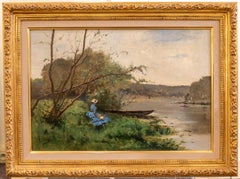
Charles Charlay-Pompon French, 1854-1914 French Countryside Oil on canvas Signed lower right 11 by 21 in. w/frame 16 ½ by 26 ½ in. Charles Charl...

Category

Impressionist 1880s Art
Materials

Oil

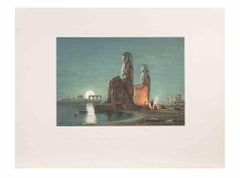
Egyptian Ruins - Lithograph after Karl Werner - 1881

Egyptian Ruins - Lithograph after Karl Werner - 1881

Located in Roma, IT

Egyptian Ruins is a modern artwork realized d'apres Karl Werner. Mixed colored cromolithograph.  The artwork is after the watercolor realized by the artist during a trip to Egypt b...

Category

Modern 1880s Art

Materials

Lithograph

Labrador - Seascape - oil on canvas circa 1885 Canada - FRANCIS DRAPER JR

Labrador - Seascape - oil on canvas circa 1885 Canada - FRANCIS DRAPER JR

By Francis Draper Jr.

Located in Rancho Santa Fe, CA

This evocative seascape by Francis Draper Jr. depicts the austere and rugged coastline of Labrador. A rocky formation dominates the horizon, rendered in earthy browns and deep shadow...

Category

American Impressionist 1880s Art
Materials

Oil, Canvas

"Similitudes" original etching

"Similitudes" original etching

By Jean-Louis Forain

Located in Henderson, NV

Medium: original etching. Executed by Forain for J. K. Huysmans "Croquis Parisiens" and published in Paris in 1880 by Henri Vaton in a total edition of 545. Printed on laid paper. Pl...

Category

1880s Art
Materials

Etching

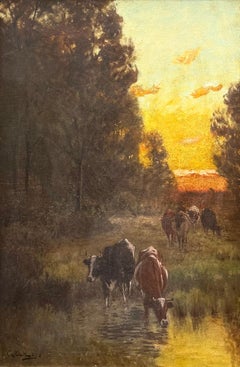
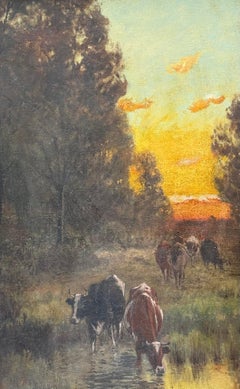
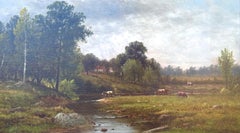
"Flushing Landscape with Cows, " Charles Henry Miller, Barbizon, Rural Farm

"Flushing Landscape with Cows, " Charles Henry Miller, Barbizon, Rural Farm

By Charles Henry Miller

Located in New York, NY

Charles Henry Miller Flushing Landscape with Cows, circa 1880 Signed lower left Oil on canvas 13 x 19 inches Charles Henry Miller was a noted artist and painter of landscapes from Long Island, New York. The American poet Bayard Taylor called him, "The artistic discoverer of the little continent of Long Island." Miller was educated at Mount Washington Collegiate Institute, and graduated in medicine at the New York Homeopathic Institute in 1864. Before his graduation, he had occasionally painted pictures, and in 1860 he exhibited The Challenge Accepted at the National Academy of Design, in New York City. He lived in Queens at the summer estate, Queenslawn, originally purchased by his parents. He went abroad in 1864 and again in 1867, and was a pupil in the Bavarian Royal Academy at Munich under the instruction of Adolf Lier...

Category

Barbizon School 1880s Art
Materials

Canvas, Oil

Victorian Oil Painting, Portrait Of A Girl With Wildflowers, Flora

Victorian Oil Painting, Portrait Of A Girl With Wildflowers, Flora

Located in Cheltenham, GB

This charming late 19th-century oil painting by British artist Rowland Holyoake (1861-1928) depicts a girl carrying wildflowers while wearing a straw hat decorated with the same. It ...

Category

Pre-Raphaelite 1880s Art
Materials

Canvas, Oil