1880s Art

to
173
738
219
167
80
86
Overall Width
to
Overall Height
to
7,701
21,705
163,708
226,565
2,002
2,279
4,942
6,496
5,851
15,024
20,548
25,707
18,594
14,060
5,501
319
119
18
15
7
5
4
1
1
623
622
12
842
415
304
249
187
129
103
95
82
82
63
61
61
53
51
49
47
41
38
34
426
335
321
265
238
66
52
36
33
14
419
443
564
466
Period: 1880s
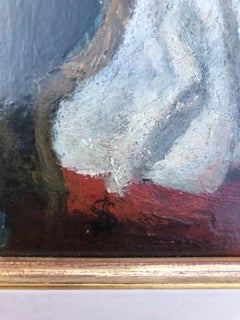
Victorian Oil Painting, Portrait Of A Girl With Wildflowers, Flora

Victorian Oil Painting, Portrait Of A Girl With Wildflowers, Flora

Located in Cheltenham, GB

This charming late 19th-century oil painting by British artist Rowland Holyoake (1861-1928) depicts a girl carrying wildflowers while wearing a straw hat decorated with the same. It ...

Category

Pre-Raphaelite 1880s Art

Materials

Canvas, Oil

19th century color lithograph beetles nature forest tree leaves animal signed

19th century color lithograph beetles nature forest tree leaves animal signed

By Louis Prang

Located in Milwaukee, WI

"Stag Beetle & Longicorn Beetle" is an original color lithograph by Louis Prang. It depicts two forest-dwelling beetles. The artist signed the piece in the stone lower left. It was published by Selmar Hess in New York. 8" x 5" art 19 3/8" x 16" framed Louis Prang (March 12, 1824 – September 14, 1909) was an American printer, lithographer, publisher, and Georgist. He is sometimes known as the "father of the American Christmas card". Prang's early activities in the US publishing architectural books and making leather goods were not very successful, and he began to make wood engravings for illustrations in books. In 1851 he worked for Frank Leslie, art director for Gleason's Pictorial Drawing-Room Companion, and later with John Andrew. In 1851, he married Rosa Gerber, a Swiss woman he had met in Paris in 1846. In 1856, Prang and a partner created a firm, Prang and Mayer, to produce lithographs. The company specialized in prints of buildings...

Category

Academic 1880s Art
Materials

Lithograph

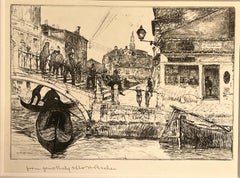
THE LITTLE COURT - CLOTH FAIR

THE LITTLE COURT - CLOTH FAIR

By James Abbott McNeill Whistler

Located in Portland, ME

Whistler, James A. M. THE LITTLE COURT CLOTH FAIR. Spink 22. Lithograph, 1887. A lifetime impression, one of 12 printed by Way and signed in pencil with the Butterfly. Printed on Ivory colored wove paper without watermark. The sheet 11 9/16 x 6 inches. In very good condition with slight discoloration from the mat in the areas outside the mat window. Provenance: Collection of Otto Gerstenberg (see below) with his collectors stamp, Lugt 2785, the Secretary Montag's "M" and the inventory numbers 61248 KO5182 all on the verso; Horizon Gallery, Rockport, MA, with its label and annotations on the frame backing. Framed. Very rare. The following are translations from the entry on Gerstenberg in Lugt: Lugt 1921: O. GERSTENBERG (born 1848), director of the Insurance Company "Victoria", lives in Berlin. Old and modern prints. Otto Gerstenberg, born in Pyritz, studied mathematics and philosophy at the University of Berlin. After having been employed at the Prussian Statistical Office, in 1873 he entered the insurance company "Victoria" in Berlin as a mathematician-calculator, and became its director in 1888. He developed it in the following years and brought it up. to its present importance. Around 1900 he began to collect prints of which he now has a very large cabinet; as elders especially Schongauer, Dürer and Rembrandt, then Lucas de Leyde, Hirschvogel, van Dijck, Ostade and the French portrait painters. As modern it is necessary to point out, among the Germans »Greiner, Klinger, Leibl, Liebermann, Menzel, Stauffer-Bern; among the French, Corot, Daumier, Degas, Forain, Lepère, Manet, Meryon, Toulouse-Lautrec; among the English, Bone, Dodd, Goff, Haden, Strang; then an important work by Whistler and Goya and leaves by Rops and Zorn. Also has beautiful paintings. Lugt 1956: During the 1914-1918 war, the collectort had his collection transported to Switzerland and, when the war was over, he decided, quite reluctantly, to sell it. In the spring of 1922 the sale was concluded in Zurich with the merchants Gust. Mayer, of Colnaghi & C ° of London, and Mr. A. MacDonald, then a partner of Harlow & C ° of New York, who bought the set at a price corresponding roughly to the total prices paid by Gerstenberg. This was a large sum, because he had acquired several of his finest pieces in the big sales between 1900 and 1914 against the big enthusiasts of the time such as Morgan, Gutmann, Rothschild etc. It was Gaiser, of the firm H. G. Gutekunst in Stuttgart, who had generally carried out his orders in the sales. MacDonald believed he had a buyer for the set in America, but when the collection arrived there those hopes were dashed by a change in economic conditions. He then sold the parts separately. We will get an idea of ​​the importance of this collection by the following enumeration of the most beautiful pieces: among the Dürer, the Adam and Eve (from the Buccleuch and Hubert collections), the Saint-Eustache, the Mélancolie (from the collection Behaim, Dumesnil and Scholtz), the Knight of Death (from the Barnard and Hubert collections) and the Life of the Virgin series (from the St. Aubin collection); Dürer's work was almost complete. Quite remarkable was the Rembrandts' series, in which we note the Piece aux cent florins, sur Japon (collection Weber and Hubert), the Three Crosses, 1st state and 2nd state (collection Artaria and Hubert), the Little Tomb ( coll. John Wilson) and another proof on Japan, Death of the Virgin in Irstate (Josi coll.), St. Jerome, B. 103, unstead (Josi, Aylesford, Buccleuch and Hawkins coll.), the St. François (coll. Theobald); the series of portraits by Rembrandt was superb: Rembrandt himself drawing, B. 22, Ir état (from the Worlidge, Brit. Mus., Dighton and Theobald collections) and the same in the second state on Japan (Morrison collection), all the states of Clement de Jonghe, Jan Asselijn, Irtat (Josi, Aylesford, Buccleuch and Hubert coll.), old Haaring, 2nd state (same sources) and the young, 2nd state in Japan (Brodhurst and Lanna collection) , the Lutma in 1st state on japan (Josi, Aylesford, Baccleuch and Hubert collection) and a superb 2nd state (from the Firmin-Didot and Hubert collections), the Six in 3rd state (Ploos van Amstel collection); in landscapes: the three Trees (coll. Theobald), the three Chaumières (coll. Morgan and Lesecq des Tournelles), the Landscape with the tower, Ir état (coll. Aylesford, Holford and Hubert), the Campagne du peseur d ' gold, on Japan (Barnard, Holford and Theobald collection) and a State of Landscape with the drinking cow, on Japan (Theobald collection). Then a series of 51 Schongauer, including several of the first order, 8 of Hirschvogel, the portraits by van Dijck himself in first states (except D. 10 and 15, the most beautiful of the collection Theobald), beautiful series by Claude and van Ostade. The purchase included neither the important modern prints that Gerstenberg owned, nor his beautiful prints by Goya, nor a few drawings by the latter and Rembrandt. Gerstenberg was an enthusiastic collector who passionately loved his collection. When in 1922 the buyers announced their decision to acquire his old prints at the agreed price, he could not contain his tears. He later consoled himself by developing his series of watercolors and drawings of the French school of the nineteenth century, and he managed to own a magnificent set of Delacroix, Daumier, Degas, Monet and, in general, the Impressionists. . We do not know, at the present time, what happened to this part of his collection, but it is feared that part of it was lost or destroyed in the offices of the insurance company "Victoria" in Berlin or in its property in Silesia during the Russian invasion in 1945. The Toulouse-Lautrec which had been evacuated to Denmark were sold out of court after the war from 1939 to 1945. Gertstenberg died ,very old in 1935. The mark reproduced by us in L.2785 has rarely been used, but the origin of the prints is more easily recognized by the initial M, followed by a number (see L.1840c...

Category

1880s Art

Materials

Lithograph

"Rue du Mont Cenis, Montmartre" original etching

"Rue du Mont Cenis, Montmartre" original etching

By Charles Adams Platt

Located in Henderson, NV

Medium: original etching. This impression on wove paper was printed in 1885 for the Sylvester R. Koehler portfolio of etchings and published by Cassell & Company. Plate size: 5 1...

Category

1880s Art

Materials

Etching

Enrique Valls Peñarroya (XIX-XX) - El escribano

Enrique Valls Peñarroya (XIX-XX) - El escribano

Located in Sant Celoni, ES

Firmado por el artista en la parte inferior y fechado del año 1889 El estado de conservación es bueno, con una limpieza ganaria mucho mas.... Se presenta enmarcada la obra con un m...

Category

1880s Art

Materials

Oil

Orientalist Scenes in Pair - Dutch Painting 19th Century

Orientalist Scenes in Pair - Dutch Painting 19th Century

Located in Saint-Ouen, FR

VAN WYK Henri (1833-NC) signed HENRI Orientalist scenes in pair Oil on wood panel signed low left Old frame re-gilded with gold leaves Dim wood : 22 X 41 cm Dim frame : 33 X 55 cm V...

Category

Academic 1880s Art
Materials

Oil

"A Fallow Field" original etching

"A Fallow Field" original etching

By James Smillie

Located in Henderson, NV

Medium: original etching. This is a rich, dark impression on wove paper, printed in 1885 for the Sylvester R. Koehler portfolio of etchings and published by Cassell & Company. Plate ...

Category

1880s Art

Materials

Etching

Late 19th century color cityscape Milwaukee trees figures lake churches

Late 19th century color cityscape Milwaukee trees figures lake churches

By Theodore R. Davis

Located in Milwaukee, WI

"View of the City of Milwaukee" from "Harper's Weekly" is an original hand-colored wood engraving by Theodore R. Davis. It depicts an aerial view of the Wisconsin lakeside city in 1882. 9" x 13 3/8" art 17 5/8" x 21 3/4" frame Theodore R. Davis (1840–1894) was a 19th-century American artist, who made numerous drawings of significant military and political events during the American Civil War and its aftermath. As a child, Theodore R. Davis was taken to Washington D.C. where he graduated from Rittenhouse Academy. When he was fifteen, he moved to New York where studied art under Henry W. Herrick and James Walker. The Training Theodore Davis received under James Walker was informal. Davis typified certain artists as "special artists" was hired by popular magazines and newspapers. He was hired by them to illustrate the Civil War. He was hired by Harpers Weekly in 1861.[ During the Civil War, he served as a captain in the 15th Connecticut Volunteer Infantry. After the war, he became a companion of the New York Commandery of the Military Order of the Loyal Legion of the United States. Some of these drawings include the Battle of Champion Hill, and the most significant sketch of General Joseph E. Johnston and General William T. Sherman meeting at the Bennett Farm near Durham Station to discuss the surrender terms of the remaining Confederate armies in the Southeast. After the war when the Cyclorama in Atlanta was being painted, Davis was asked for his ideas having traveled with Sherman's army. He was later added to the painting. Theodore Davis was a staff artist at Harper's Weekly. Many of his drawings were published as wood engravings in Harper's Weekly. Theodore R. Davis was chosen to create the Haye's China with a chance meeting. Mr. Davis suggested using flora and fauna of the American decor...

Category

Other Art Style 1880s Art

Materials

Engraving

"Les Laveuses" original etching

"Les Laveuses" original etching

Located in Henderson, NV

Medium: original etching. This impression on laid paper was printed in 1880 for Philip Gilbert Hamerton's very scarce "Etching and Etchers". Plate size: 6 1/4 x 4 3/4 inches (157 x 1...

Category

1880s Art

Materials

Etching

Sketch of a head - Carved in stone -

Sketch of a head - Carved in stone -

Located in Berlin, DE

Emil Faesch (1865 Basel - 1915 Basel). Sketch of a head. Charcoal on painting cardboard, 60 x 47.5 cm (folio size), signed and dated at lower right "E. Faesch. 1888.". Minor browning. - Carved in stone - About the artwork The life-size head has an immensely present presence. This effect is due to the fact that Faesch took his cue from academic classical...

Category

Realist 1880s Art

Materials

Chalk

The Little Ballerina

The Little Ballerina

Located in Saint-Ouen, FR

Alphonse PELLET (1853-1926) The Little Ballerina Oil on wood panel signed low right Old frame regilded with leaves Size panel : 30 X 43 cm - Size frame : 40 X 55 cm Alphonse PELLET...

Category

Academic 1880s Art
Materials

Oil

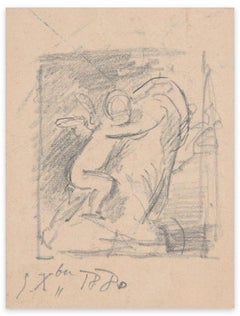
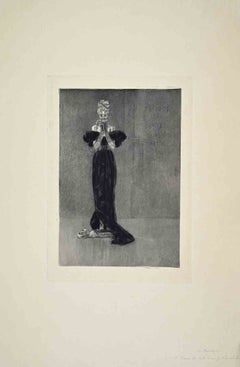
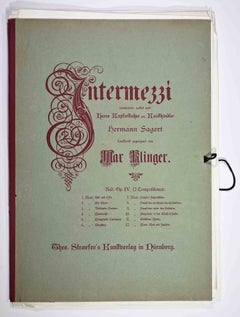
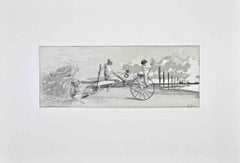
Amor, Tod und Jenseits - Etching by M. Klinger - 1881

Amor, Tod und Jenseits - Etching by M. Klinger - 1881

By Max Klinger

Located in Roma, IT

Amor, Tod und Jenseits, (Cupid, death and afterlife) is an original etching and aquatint on paper Chine collé, realized by Max Klinger in 1881, plate XII from “Intermezzi” Opus IV,...

Category

Symbolist 1880s Art

Materials

Etching, Aquatint

"Residence At Terrell" Date 1881 TEXAS CATTLE SCENE GRANDFATHER TEXAS ART

"Residence At Terrell" Date 1881 TEXAS CATTLE SCENE GRANDFATHER TEXAS ART

By Frank Reaugh

Located in San Antonio, TX

Frank Reaugh (1860-1945) Dallas Artist Image Size: 3 3/4 x 5 1/2 Frame Size: 15 x 18 Medium: Pastel on paperboard Circa 1881 "Residence At Terrell" From the collection of Lucretia Coke. Signed F.R. Lower Left & S7 On Verso 1881 or 2, 2 or 3 miles from next house. Frank Reaugh (1860-1945) Charles Franklin Reaugh. THE FRANK REAUGH GALLERY AT THE PANHANDLE-PLAINS HISTORICAL MUSEUM by Michael R. Grauer, Curator of Art, Panhandle-Plains Historical Museum Called the pejorative "Rembrandt of the Longhorn" and "Longhorn Leonardo," and the gentler "Painter to the Longhorns," Charles Franklin "Frank" Reaugh was a master pastellist unparalleled in Texas and the greater Southwest. While he advertised himself as a "landscape and cattle painter" and insisted he was the historian of the Texas longhorn, he has effectively, and unfortunately, pigeonholed his art. More appropriately, Frank Reaugh is often called the "Dean of Texas Painters." His name is synonymous with the "old guard" of Texas art history, along with Robert Onderdonk, Hermann Lungkwitz, William Henry Huddle, Henry McArdle, and others. Reaugh's paintings focused on the landscape of the American West generally, and the American Southwest, specifically. He captured subtleties in a land of high contrast where others only saw the rawness. He painted the overwhelmingly blue sky, the illimitable plains, and the great gashes in the land that are called canyons, arroyos, or breaks in the West. And he painted the Texas longhorn, or Texas cattle, as he referred to them. Usually no more important than the mesquite, yucca, sagebrush, and cholla that also populate his compositions of the Western landscape, the Texas longhorn became his recognized symbol. Today, some commercial galleries even insist that one of his works is more valuable if it has a cow in it! These commercial zealots in their search for a longhorn often overlook the beauty of his landscapes; they cannot see the landscape for the longhorns. Born near Jacksonville, Illinois in 1860, Reaugh first came to Texas in a wagon in 1876 at the age of fifteen. He moved with his parents to a farm near Terrell, Texas, until 1890 when they moved to Dallas and settled in what is now the Oak Cliff area. Reaugh had no formal education but fared well without it for his mother, Clarinda Reaugh, was his teacher in all things. The daughter of a Presbyterian minister, his mother instilled in her only child an appreciation of nature, grounded in her own readings in zoology, botany, and natural history. Her teachings were infused with the philosophies of the famed Swiss zoologist Louis Agassiz and John Burroughs, supporter and contemporary of Walt Whitman, who wrote extensively on his symbiotic relationship with nature. Clarinda Reaugh also encouraged her son's interest in drawing through her own interest in the fine arts. Reaugh's father, George Washington Reaugh, was a mechanic, carpenter, cabinetmaker, and farmer, who had participated in the Gold Rush of 1849. It was from his father that Reaugh learned to be extremely adept with his hands, and later made his own picture frames and patented several inventions. George Reaugh's sense of adventure may have spurred his son's annual trips to West Texas and beyond, which began in the early 1880s. Reaugh's first exposure to art came through reproductions in popular magazines such as Harper's, Scribner's, and Century Illustrated. Rosa Bonheur's Horsefair, the Dutch painter Paulus Potter's Young Bull, and the landscapes of Frederic Edwin Church and J. M. W. Turner were favorites of his. (In fact, his late works are often especially reminiscent of Church and Turner.) From these early reproductions in black and white, Reaugh learned well the lessons of value and composition. While he studied and copied magazine reproductions, Reaugh also became interested in bovine anatomy. Using a "two-bit" book on cattle and sheep anatomy as his text, the young artist collected bones near the Reaugh farm and made measurements from family livestock. He supplemented his scientific studies with sketches made from longhorn cattle brought up from South Texas to fatten on grass nearby. In the early 1880s, Reaugh met two cattlemen, Frank and Romeo Houston, who had interests throughout North Texas, and accompanied them on cattle drives and roundups near present-day Wichita Falls and in Indian Territory (now Oklahoma). His first documented trip to Western Texas came in 1883; probably near present day Wichita Falls and Henrietta, Texas. Reaugh made numerous sketches during these trips, often from the saddle, and later enlarged and composed them in the studio. His field sketches resulted in his first two pastel masterpieces, Watering the Herd (1889) and The One-O Roundup (1894). and his oil The Approaching Herd (1902). These trips with the Houstons, begun as early as 1883, spurred a wanderlust for West Texas that lured Reaugh until he was nearly eighty. Reaugh took his first formal art training at the Saint Louis Museum and School of Fine Arts during the winter of 1884-85. He spent most of his time there drawing from plaster casts of Greek, Roman, and Italian sculpture and possibly live models. Reaugh also met Halsey C. Ives, director of the school, who lectured on avant-garde art trends in Europe, particularly French Impressionism. Later, Ives was instrumental in the acceptance of Reaugh's work for display at the Louisiana Purchase Exposition, held in Saint Louis in 1904. Following his studies at Saint Louis, Reaugh returned to Terrell and began teaching art to young ladies in the area. He supplemented his art classes with a stint at teaching public school, and by November 1888 had saved enough money for a trip to Europe. Upon arriving at Paris, Reaugh enrolled at the Academie Julian, a school very popular with international students, especially Americans. He drew and painted from the figure while at the Academie under Jules Lefebvre, John-Joseph Benjamin Constant, and Henri-Lucien Douciet, all members of the "juste milieu" in France. Reaugh studied at the Academie for half of each day then supplemented his formal instruction by making copies of or studying paintings in the Louvre and the Luxembourg Palace. Logically he was especially drawn to the pastels in what he later called the 'pastel room' in the Louvre. In his 1927 pamphlet, Pastel, Reaugh wrote of the pastel painters he saw in the gallery: "[John] Russell, of England, and [Maurice-Quentin de] La Tour, [Jean Etienne] Liotard, [Jean Simeon] Chardin, and [Madame Vigee] Le [sic] Brun. These were great painters. . .the work of all of them may be seen in the pastel room of the Louvre, as fresh and bright, apparently, as on the day it was done." In addition to the pastellists he mentioned, Reaugh also saw pastels in the Louvre by Rosalba Carriera, Francois Boucher, and Pierre Paul Prudhon. At the end of March 1889, Reaugh traveled through Belgium and Holland, studying paintings of the Flemish and Dutch schools, and particularly those of The Hague School, of which Anton Mauve was a part. He returned to Paris in time to see the Exposition Universelle, at which paintings by French Impressionists Cezanne, Manet, Monet, and Pissarro were exhibited. This may have been Reaugh's initial exposure to Impressionism. Reaugh returned to Texas at the end of May 1889. Between 1890 and 1915, Frank Reaugh enjoyed his greatest success as an artist. He exhibited works at two world's fairs: the World's Columbian Exposition at Chicago in 1893 and the Louisiana Purchase Exposition in 1904. He also exhibited at the prestigious National Academy of Design at New York, the Pennsylvania Academy of the Fine Arts at Philadelphia, and the Art Institute of Chicago. Moreover, Reaugh became a member of the Society of Western Artists and exhibited with that group all over the United States. Finally, Reaugh toured his pastels with much success, especially in the upper Midwest. Simultaneously, Reaugh continued his trips to the West and, beginning in the 1890s, he started using a camera as a sketching tool. He photographed the landscape as well as cattle, and in 1893 photographed in Palo Duro Canyon; perhaps his first trip to the 'Grand Canyon of Texas'. After 1900, Reaugh turned his genius to inventing and patented several devices including a folding lap easel, a water pump, and a cooling mechanism for internal combustion engines, among other things. He also patented Reaugh Pastels, using a formula he developed and shaped into an octagonal-shape stick for easier gripping. Allegedly, either John Singer Sargent or William Merritt Chase used Reaugh Pastels. Reaugh also became more active in Dallas art and civic circles. After first offering private art lessons, he organized the Dallas School of Fine Arts in 1899. He urged Dallas to build the city's first art gallery in 1900, to which he donated a painting, and helped found the Dallas Art Association in 1903. Furthermore, Reaugh arranged the loan of paintings from then-contemporary American artists in the East and Midwest for the State Fair of Texas. An vocational naturalist, Reaugh also organized a popular nature study club in Dallas, members of which were young ladies who grew to be influential Dallas civic leaders. Nevertheless, despite his ground-level work to bring art to Dallas, as the Dallas Art Association grew Reaugh was pushed aside by socialites and his contributions forgotten. Around 1910 and possibly earlier, he began taking students with him on his trips West. Among them were Texas artists Edward G. Eisenlohr, Florence McClung, Lloyd Goff...

Category

Impressionist 1880s Art

Materials

Pastel

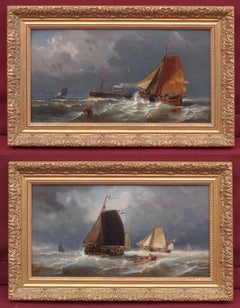
Marines in Pair - Dutch Painting 19th Century

Marines in Pair - Dutch Painting 19th Century

Located in Saint-Ouen, FR

VAN WYK Henri (1833-NC) Marines in pair Oil on wood panel signed low left Old frame re-gilded with gold leaves Dim wood : 23 X 41 cm Dim frame : 40 X 58 cm Certificate of authenticit...

Category

Academic 1880s Art
Materials

Oil

"Les Trembles" original etching

"Les Trembles" original etching

By Félix Bracquemond

Located in Henderson, NV

Medium: original etching. Catalogue reference Beraldi 218. Published in Paris in 1884 by Gazette des Beaux-Arts. A lovely impression in brown ink on laid paper. Plate size: 4 x 5 7/8...

Category

1880s Art

Materials

Etching

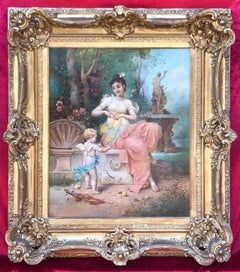
Young Lady and Cupid in The Park

Young Lady and Cupid in The Park

By Hans Zatzka

Located in Saint-Ouen, FR

Hans Zatzka (8 March 1859 – 17 December 1945 Young Lady With Cupid in The Park Oil on canvas circa 1880 signed low with pseudonym C.BRIAND Old Frame gilded with leaves Size canvas : ...

Category

Academic 1880s Art
Materials

Oil

“Flower Picking”
“Flower Picking”

“Flower Picking”

By Myles Birket Foster

Located in Southampton, NY

Beautifully executed original hand colored lithograph using gouache and watercolor. Scene in Surrey, England. Signedxwith monogram in plate lower left, Myles Birket Foster. Published by M. H. Long. Condition is very good. In original 2 inch wide birdseye maple antique frame with thick museum mat with gold innner edge. Overall 22 by 26 inches. Biography Myles Birket Foster (4 February 1825 – 27 March 1899) was a popular English illustrator, watercolour artist and engraver in the Victorian period. His name is also to be found as Myles Birkett Foster. Life and work Foster was born in North Shields, England of a primarily Quaker family, but his family moved south to London in 1830, where his father founded M. B. Foster & sons — a successful beer-bottling company. He was schooled at Hitchin, Hertfordshire and on leaving initially went into his father's business. However, noticing his talent for art, his father secured an apprenticeship with the notable wood engraver, Ebenezer Landells, where he worked on illustrations for Punch magazine and the Illustrated London News. On leaving Landells' employ, he continued to produce work for the Illustrated London News and the Illustrated London Almanack. He also found work as a book illustrator and, during the 1850s, trained himself to paint in watercolours. His illustrations of Longfellow’s Evangeline and books of poetry by other contemporaries were a great success, and he quickly became a successful artist in watercolours. Birket Foster became an Associate of the "Old" Watercolour Society (Later the Royal Watercolour Society) in 1860 and exhibited some 400 of his paintings at the Royal Academy over more than 2 decades. Birket Foster travelled widely, painting the countryside around Scotland, the Rhine Valley, the Swiss lakes and in Italy, especially Venice. In 1863 he moved to Witley, near Godalming in Surrey where he had a house ("The Hill") built. Being friendly with Edward Burne-Jones and William Morris, he had the house decorated and furnished in contemporary style, with tiles and paintings by Burne-Jones and Morris' firm, Morris and Company. The same year he published a volume of "English Landscapes," with text by Tom Taylor...

Category

Impressionist 1880s Art

Materials

Lithograph, Watercolor, Gouache

1880's, Italian Oil Paintings

1880's, Italian Oil Paintings

By Franz Auguste Rezia

Located in Los Angeles, CA

A beautifully painted, mated pair of signed 19th century, oil-on-board, Italian, atmospheric, Capriccio seascapes by listed artist, Franz Auguste Rezia  (1857-1906). Each held in per...

Category

1880s Art

Materials

Oil, Board

Tomb effigy in the ruin

Tomb effigy in the ruin

Located in PARIS, FR

Oil on canvas 130.5 x 97 cm Signed and dated lower right: A Marinier 1889 Alfred Hippolyte Marinier was born in Orsay in 1833. A student of Jules Noël and Henri Marie Beyle, he ex...

Category

1880s Art

Materials

Canvas, Oil

The bohemians
The bohemians

The bohemians

Located in BELEYMAS, FR

Paul-Louis MARTIN des AMOIGNES (Saint Benin d’Azy 1850 – Nevers 1925) The Bohemians Oil on panel H. 37 cm; W. 23 cm Monogrammed lower left "PLM" Circa 1886 Provenance: Private colle...

Category

French School 1880s Art

Materials

Oil, Wood Panel

Kämpfende Kentauren - Etching by Max Klinger - 1881

Kämpfende Kentauren - Etching by Max Klinger - 1881

By Max Klinger

Located in Roma, IT

Kämpfende Kentauren (Fighting Centaurs), is an etching and aquatint realized by  Max Klinger in 1881. Plate V from “Intermezzi” Opus IV, 2nd state on 2,  first edition. Here the art...

Category

Symbolist 1880s Art

Materials

Etching

Very important enamel plaque

Very important enamel plaque

Located in PARIS, FR

Allegories of Carnal Love and Chaste Love by Paul GRANDHOMME (1851-1944) and Alfred GARNIER (1848-1908) Very important plaque in translucent and opaque polychrome enamel on copper, with gold spangles and gold highlights. Set in its original silver setting. Presented in its original morocco leather box...

Category

Renaissance 1880s Art

Materials

Enamel

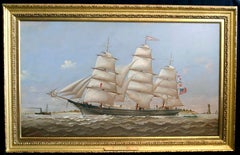
The Winning Yacht
The Winning Yacht

The Winning Yacht

By Edward Moran

Located in Jacksonville, FL

"The Winning Yacht," painted by Edward Moran in 1883, stands as a striking example of maritime art, capturing the exhilaration and beauty of yacht racing in the late 19th century. Mo...

Category

American Realist 1880s Art

Materials

Oil, Canvas

Venice with characters

Venice with characters

By Charles Cousin

Located in Saint-Ouen, FR

COUSIN Charles (1807-1887) Venice With Characters Oil on canvas signed low right Old frame gilded with leaves Dim canvas : 65 X 54 cm Dim frame : 91 X 80 cm COUSIN Charles (1807-1887) French painter 19th century Portraits, Landscapes, Waterscapes He was a frequent of the Leon Bonnat...

Category

Academic 1880s Art
Materials

Oil

"The Fisherman's Home" original etching

"The Fisherman's Home" original etching

Located in Henderson, NV

Medium: original etching and drypoint. This rich, dark impression on heavy cream wove paper is from the Sylvester R. Koehler portfolio of etchings, published in 1885 by Cassell & Com...

Category

1880s Art

Materials

Etching

The Defense, Romantic Engraving after Laslett John Pott

The Defense, Romantic Engraving after Laslett John Pott

By Laslett John Pott

Located in Long Island City, NY

Laslett John Pott, After by William Greatbach, English (1837 - 1898) - The Defense, Portfolio: New Gallery of British Art, Year: 1882, Medium: Engraving, Image Size: 6.75 x 9.75 ...

Category

Romantic 1880s Art

Materials

Engraving

"University of California Berkeley" original etching

"University of California Berkeley" original etching

By George Spiel

Located in Henderson, NV

Medium: original etching. Printed in 1888 on cream wove paper and published for the portfolio entitled "Picturesque California: The Rocky Mountains and the Pacific Slope". Image size...

Category

1880s Art

Materials

Etching

Portrait of A Man Wearing A Top Hat , attributed to Tom Roberts 1888

Portrait of A Man Wearing A Top Hat , attributed to Tom Roberts 1888

By Tom Roberts

Located in Gavere, BE

Portrait of A Man Wearing A Top Hat , attributed to Tom Roberts 1888 Thomas William Roberts ( 1856 – 1931) was an English-born Australian artist and a key member of the Heidelberg S...

Category

Realist 1880s Art

Materials

Gold Leaf

Petite Marchande de Banane - Orientalist, North African Girl Selling Bananas

Petite Marchande de Banane - Orientalist, North African Girl Selling Bananas

By Charles Zacharie Landelle

Located in Miami, FL

Beautiful Orientalist painting - The Framed size: 47 inches x 34.5 inches. Magnificent ornate Frame The paint surface looks like the style of William-Adolphe Bouguereau Signed lower right. Provenance: Gallery Label with inventory number: Size on label is in centimeters, which indicates the painting came from a United Kingdom art gallery. Subsequently, Robert Funk Fine Art...

Category

Romantic 1880s Art

Materials

Oil

"Tripod by Gouthiere" original etching

"Tripod by Gouthiere" original etching

Located in Henderson, NV

Medium: original etching. This impression on heavy cream wove paper is from the Sylvester R. Koehler portfolio of etchings, published in 1885 by Cassell & Company. Plate size: 11 1/4...

Category

1880s Art

Materials

Etching

"Pallas, Juno and Venus" etching

"Pallas, Juno and Venus" etching

Located in Henderson, NV

Medium: etching. Etched by Joseph Benwell Clark after the George Frederick Watts painting. This impression on cream laid paper was printed in sepia ink in 1880 by Francois Lienard an...

Category

1880s Art

Materials

Etching

The Flower Girl - Genre Scene 18th Century

The Flower Girl - Genre Scene 18th Century

By Theodore Levigne

Located in Saint-Ouen, FR

LEVIGNE Théodore (1848-1912) The Flower Girl and The Puppy Oil on canvas signed and dated 1883 low left Old Frame regilded with leaves Dimensions canvas : 120 X 70 cm Dimensions frame : 137 X 88 cm LEVIGNE Théodore (1848-1912) French Painter 19th-20th century Lyon School Born 1848 in Noirétable (Loire) - Died 11...

Category

Academic 1880s Art
Materials

Oil

Landscape from Barbizon With Characters

Landscape from Barbizon With Characters

Located in Saint-Ouen, FR

Paul Désiré Trouillebert (1829-1900) Landscape from Barbizon with characters Oil on canvas signed low right Old original sculpted wood frame gilded with leaves Size canvas : 33 X 41 cm Size frame : 43 X 51 cm Paul Désiré Trouillebert (1829-1900) Paul Désiré Trouillebert (1829 in Paris, France – 28 June 1900 in Paris, France) was a famous French Barbizon School painter in the mid-nineteenth and the early twentieth centuries. Trouillebert is considered a portraitist, a genre and landscape painter from the French Barbizon School. He was a student of Ernest Hébert...

Category

Barbizon School 1880s Art
Materials

Oil

Vue De Venise
Vue De Venise

Vue De Venise

By Henri Duvieux

Located in Sheffield, MA

Henri Duvieux French, 1855 – 1920 Vue De Venise Oil on canvas 15 ¾ in. by 25 ½ in. W/frame 25 ¾ by 35 ½ in. Signed lower right Henri Duvieux was an ar...

Category

Post-Impressionist 1880s Art
Materials

Oil