1880s Art

to
141
701
227
169
78
90
Overall Width
to
Overall Height
to
7,475
21,297
163,833
233,314
2,025
2,268
4,938
6,520
5,795
15,018
20,763
25,781
18,705
14,196
5,308
293
132
17
14
11
5
3
1
1
616
606
10
817
400
297
235
179
116
103
96
80
79
64
59
58
53
51
47
46
39
35
34
435
348
319
241
223
61
52
34
33
14
437
405
576
448
Period: 1880s
Maximilien Luce La Cueilleuse de Fruits

Maximilien Luce La Cueilleuse de Fruits

By Maximilien Luce

Located in Dallas, TX

Maximilien Luce (French, 1858-1941) La Cueilleuse de Fruits oil on newsprint laid down to board signed Luce (lower right) Sight: 13 1/2 x 6 1/2 in. (34.3 x 16.5cm) Frame: 17.5 x 10 I...

Category

Expressionist 1880s Art

Materials

Oil, Newsprint

"Arran" original etching

"Arran" original etching

By David Young Cameron

Located in Henderson, NV

Medium: original etching and drypoint. This impression on on cream wove paper was printed in 1889. Plate size: 5 x 9 3/4 inches (125 x 250 mm). Signed and titled in the plate (not ha...

Category

1880s Art

Materials

Etching
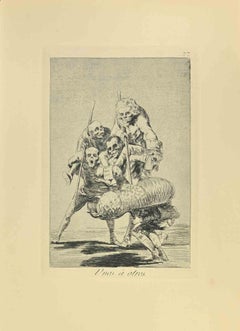
"Residence At Terrell" Date 1881 TEXAS CATTLE SCENE GRANDFATHER TEXAS ART

"Residence At Terrell" Date 1881 TEXAS CATTLE SCENE GRANDFATHER TEXAS ART

By Frank Reaugh

Located in San Antonio, TX

Frank Reaugh (1860-1945) Dallas Artist Image Size: 3 3/4 x 5 1/2 Frame Size: 15 x 18 Medium: Pastel on paperboard Circa 1881 "Residence At Terrell" From the collection of Lucretia Coke. Signed F.R. Lower Left & S7 On Verso 1881 or 2, 2 or 3 miles from next house. Frank Reaugh (1860-1945) Charles Franklin Reaugh. THE FRANK REAUGH GALLERY AT THE PANHANDLE-PLAINS HISTORICAL MUSEUM by Michael R. Grauer, Curator of Art, Panhandle-Plains Historical Museum Called the pejorative "Rembrandt of the Longhorn" and "Longhorn Leonardo," and the gentler "Painter to the Longhorns," Charles Franklin "Frank" Reaugh was a master pastellist unparalleled in Texas and the greater Southwest. While he advertised himself as a "landscape and cattle painter" and insisted he was the historian of the Texas longhorn, he has effectively, and unfortunately, pigeonholed his art. More appropriately, Frank Reaugh is often called the "Dean of Texas Painters." His name is synonymous with the "old guard" of Texas art history, along with Robert Onderdonk, Hermann Lungkwitz, William Henry Huddle, Henry McArdle, and others. Reaugh's paintings focused on the landscape of the American West generally, and the American Southwest, specifically. He captured subtleties in a land of high contrast where others only saw the rawness. He painted the overwhelmingly blue sky, the illimitable plains, and the great gashes in the land that are called canyons, arroyos, or breaks in the West. And he painted the Texas longhorn, or Texas cattle, as he referred to them. Usually no more important than the mesquite, yucca, sagebrush, and cholla that also populate his compositions of the Western landscape, the Texas longhorn became his recognized symbol. Today, some commercial galleries even insist that one of his works is more valuable if it has a cow in it! These commercial zealots in their search for a longhorn often overlook the beauty of his landscapes; they cannot see the landscape for the longhorns. Born near Jacksonville, Illinois in 1860, Reaugh first came to Texas in a wagon in 1876 at the age of fifteen. He moved with his parents to a farm near Terrell, Texas, until 1890 when they moved to Dallas and settled in what is now the Oak Cliff area. Reaugh had no formal education but fared well without it for his mother, Clarinda Reaugh, was his teacher in all things. The daughter of a Presbyterian minister, his mother instilled in her only child an appreciation of nature, grounded in her own readings in zoology, botany, and natural history. Her teachings were infused with the philosophies of the famed Swiss zoologist Louis Agassiz and John Burroughs, supporter and contemporary of Walt Whitman, who wrote extensively on his symbiotic relationship with nature. Clarinda Reaugh also encouraged her son's interest in drawing through her own interest in the fine arts. Reaugh's father, George Washington Reaugh, was a mechanic, carpenter, cabinetmaker, and farmer, who had participated in the Gold Rush of 1849. It was from his father that Reaugh learned to be extremely adept with his hands, and later made his own picture frames and patented several inventions. George Reaugh's sense of adventure may have spurred his son's annual trips to West Texas and beyond, which began in the early 1880s. Reaugh's first exposure to art came through reproductions in popular magazines such as Harper's, Scribner's, and Century Illustrated. Rosa Bonheur's Horsefair, the Dutch painter Paulus Potter's Young Bull, and the landscapes of Frederic Edwin Church and J. M. W. Turner were favorites of his. (In fact, his late works are often especially reminiscent of Church and Turner.) From these early reproductions in black and white, Reaugh learned well the lessons of value and composition. While he studied and copied magazine reproductions, Reaugh also became interested in bovine anatomy. Using a "two-bit" book on cattle and sheep anatomy as his text, the young artist collected bones near the Reaugh farm and made measurements from family livestock. He supplemented his scientific studies with sketches made from longhorn cattle brought up from South Texas to fatten on grass nearby. In the early 1880s, Reaugh met two cattlemen, Frank and Romeo Houston, who had interests throughout North Texas, and accompanied them on cattle drives and roundups near present-day Wichita Falls and in Indian Territory (now Oklahoma). His first documented trip to Western Texas came in 1883; probably near present day Wichita Falls and Henrietta, Texas. Reaugh made numerous sketches during these trips, often from the saddle, and later enlarged and composed them in the studio. His field sketches resulted in his first two pastel masterpieces, Watering the Herd (1889) and The One-O Roundup (1894). and his oil The Approaching Herd (1902). These trips with the Houstons, begun as early as 1883, spurred a wanderlust for West Texas that lured Reaugh until he was nearly eighty. Reaugh took his first formal art training at the Saint Louis Museum and School of Fine Arts during the winter of 1884-85. He spent most of his time there drawing from plaster casts of Greek, Roman, and Italian sculpture and possibly live models. Reaugh also met Halsey C. Ives, director of the school, who lectured on avant-garde art trends in Europe, particularly French Impressionism. Later, Ives was instrumental in the acceptance of Reaugh's work for display at the Louisiana Purchase Exposition, held in Saint Louis in 1904. Following his studies at Saint Louis, Reaugh returned to Terrell and began teaching art to young ladies in the area. He supplemented his art classes with a stint at teaching public school, and by November 1888 had saved enough money for a trip to Europe. Upon arriving at Paris, Reaugh enrolled at the Academie Julian, a school very popular with international students, especially Americans. He drew and painted from the figure while at the Academie under Jules Lefebvre, John-Joseph Benjamin Constant, and Henri-Lucien Douciet, all members of the "juste milieu" in France. Reaugh studied at the Academie for half of each day then supplemented his formal instruction by making copies of or studying paintings in the Louvre and the Luxembourg Palace. Logically he was especially drawn to the pastels in what he later called the 'pastel room' in the Louvre. In his 1927 pamphlet, Pastel, Reaugh wrote of the pastel painters he saw in the gallery: "[John] Russell, of England, and [Maurice-Quentin de] La Tour, [Jean Etienne] Liotard, [Jean Simeon] Chardin, and [Madame Vigee] Le [sic] Brun. These were great painters. . .the work of all of them may be seen in the pastel room of the Louvre, as fresh and bright, apparently, as on the day it was done." In addition to the pastellists he mentioned, Reaugh also saw pastels in the Louvre by Rosalba Carriera, Francois Boucher, and Pierre Paul Prudhon. At the end of March 1889, Reaugh traveled through Belgium and Holland, studying paintings of the Flemish and Dutch schools, and particularly those of The Hague School, of which Anton Mauve was a part. He returned to Paris in time to see the Exposition Universelle, at which paintings by French Impressionists Cezanne, Manet, Monet, and Pissarro were exhibited. This may have been Reaugh's initial exposure to Impressionism. Reaugh returned to Texas at the end of May 1889. Between 1890 and 1915, Frank Reaugh enjoyed his greatest success as an artist. He exhibited works at two world's fairs: the World's Columbian Exposition at Chicago in 1893 and the Louisiana Purchase Exposition in 1904. He also exhibited at the prestigious National Academy of Design at New York, the Pennsylvania Academy of the Fine Arts at Philadelphia, and the Art Institute of Chicago. Moreover, Reaugh became a member of the Society of Western Artists and exhibited with that group all over the United States. Finally, Reaugh toured his pastels with much success, especially in the upper Midwest. Simultaneously, Reaugh continued his trips to the West and, beginning in the 1890s, he started using a camera as a sketching tool. He photographed the landscape as well as cattle, and in 1893 photographed in Palo Duro Canyon; perhaps his first trip to the 'Grand Canyon of Texas'. After 1900, Reaugh turned his genius to inventing and patented several devices including a folding lap easel, a water pump, and a cooling mechanism for internal combustion engines, among other things. He also patented Reaugh Pastels, using a formula he developed and shaped into an octagonal-shape stick for easier gripping. Allegedly, either John Singer Sargent or William Merritt Chase used Reaugh Pastels. Reaugh also became more active in Dallas art and civic circles. After first offering private art lessons, he organized the Dallas School of Fine Arts in 1899. He urged Dallas to build the city's first art gallery in 1900, to which he donated a painting, and helped found the Dallas Art Association in 1903. Furthermore, Reaugh arranged the loan of paintings from then-contemporary American artists in the East and Midwest for the State Fair of Texas. An vocational naturalist, Reaugh also organized a popular nature study club in Dallas, members of which were young ladies who grew to be influential Dallas civic leaders. Nevertheless, despite his ground-level work to bring art to Dallas, as the Dallas Art Association grew Reaugh was pushed aside by socialites and his contributions forgotten. Around 1910 and possibly earlier, he began taking students with him on his trips West. Among them were Texas artists Edward G. Eisenlohr, Florence McClung, Lloyd Goff...

Category

Impressionist 1880s Art

Materials

Pastel

"The Soldier and the Laughing Girl" etching

"The Soldier and the Laughing Girl" etching

Located in Henderson, NV

Medium: etching (etched by Jules Jacquemart after Vermeer). This impression on wove paper was printed in 1885 for the Sylvester R. Koehler portfolio of etchings and published by Cass...

Category

1880s Art

Materials

Etching
"Hastings" original etching

"Hastings" original etching

By Stephen Parrish

Located in Henderson, NV

Medium: original etching. Catalogue reference: Schneider 113. Executed in 1885; this is a fine, dark impression with full original margins on watermarked laid paper from "The Portfol...

Category

1880s Art

Materials

Etching
Theodore Blake Wirgman (1848-1925)  Portrait of Ernest Albert Waterlow, drawing

Theodore Blake Wirgman (1848-1925) Portrait of Ernest Albert Waterlow, drawing

By Theodore Blake Wirgman

Located in Paris, FR

Theodore Blake Wirgman (1848-1925) Portrait of Sir Ernest Albert Waterlow RA, (1850-1919) pen and black ink on paper, inscribed with the name of the sitter on the verso of the sheet, now not visible under the framing 15 x 12 cm In a modern frame 34.5 x 30 cm Theodore Blake Wirgman (29 April 1848 – 16 January 1925) was an English painter and etcher who moved to London, studied at the Royal Academy schools, became a painter of history and genre subjects, and worked as a portrait artist for The Graphic. A number of these portraits are held at the National Portrait Gallery. Theodore Blake Wirgman was born in Belgium and died in London. He worked from a studio at 24 Dawson Place, Notting Hill, London, and joined The Arts Club in 1892. Wirgman was part of a group of avant-garde young artists who emulated Edward Burne-Jones and Simeon Solomon...

Category

Academic 1880s Art

Materials

Ink

"The Token" original etching

"The Token" original etching

Located in Henderson, NV

Medium: original etching. This impression was printed on laid paper and published in 1887 by the New York Etching Club. Plate size: 6 x 4 inches. Not signed.

Category

1880s Art

Materials

Etching
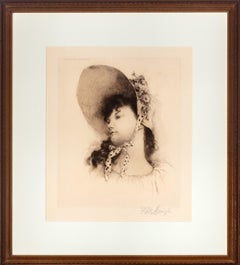
Jules TOULOT (1863-nc) Painting 19th century soldier uniform interior

Jules TOULOT (1863-nc) Painting 19th century soldier uniform interior

By Toulot Jules

Located in Saint-Ouen, FR

Toulot Jules (1863-nc) Pianist officer in the Second Empire period Oil on canvas signed low right Old frame regilded with gold leaves Dim canvas : 65 X 43 cm Dim frame : 90 X 67 cm TOULOT Jules (1863-nc) French painter 19th century Born 11th November 1863 in Champeinx (Puy de Dôme...

Category

Academic 1880s Art

Materials

Oil

Tempera on cardboard of Pre-Raphaelite scope, c. 1880.

Tempera on cardboard of Pre-Raphaelite scope, c. 1880.

Located in Vicenza, VI

Pre-Raphaelite author's painting, probably English, dated 1880 and unsigned. The work depicts a gender scene set in a wooded landscape, with three female figures and two children ar...

Category

Pre-Raphaelite 1880s Art

Materials

Tempera, Cardboard

"The College from the River" original etching

"The College from the River" original etching

Located in Henderson, NV

Medium: original etching. This impression on laid paper was printed in 1880 for Philip Gilbert Hamerton's very scarce "Etching and Etchers". Plate size: 4 x 5 3/4 inches. Signed in t...

Category

1880s Art

Materials

Etching
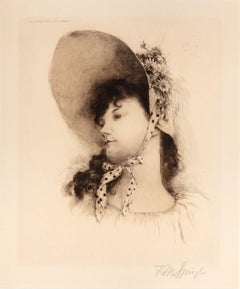
"The Drawing Lesson" original etching

"The Drawing Lesson" original etching

By Adolphe Lalauze

Located in Henderson, NV

Medium: original etching. This impression on laid paper was printed in 1880 for Philip Gilbert Hamerton's very scarce "Etching and Etchers". Plate size: 7 3/4 x 5 1/2 inches (197 x 1...

Category

1880s Art

Materials

Etching
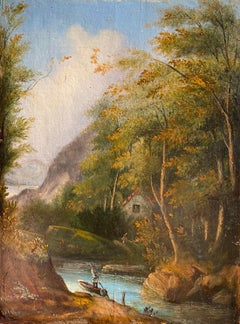
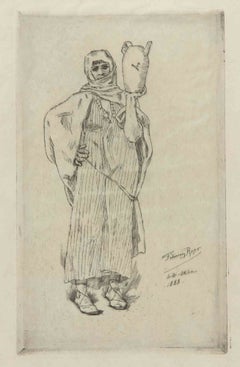
"Paysan Breton" original etching

"Paysan Breton" original etching

By Alphonse Legros

Located in Henderson, NV

Medium: original etching. Executed ca. 1880; this is a good impression with full original margins on laid paper from "The Portfolio" edition, published in London by Seeley, Jackson &...

Category

1880s Art

Materials

Etching
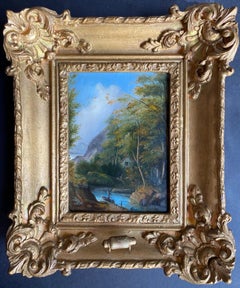
Temple Official
Temple Official

Temple Official

Located in London, GB

'Temple Official', pencil and watercolour on paper by Robert Taylor Pritchett (1882). This is the artist's portrait of a financial official in a Cantonese temple in Guangzhou, China in the latter half of the 19th century. His garment is typical of that of a senior civil servant of the Chinese government. Clothes were designed to indicate rank and status, becoming so distinct that the wearer’s position could be ascertained at a glance. During his second career as an artist, Pritchett traveled widely in the Pacific region in the 1880s. This artwork has been professionally restored and cleaned to preserve it for decades to come and therefore in good overall condition. It has also been newly framed and glazed. The artist has written 'The Treasurer & Temple' and '5 Geni Temple, Canton Jan. 22 1882' on the lower left and right hands of the artwork. Upon request a video of the work may be provided. About the Artist: Robert Taylor Pritchett (1823 - 1907), a gun maker and artist, was the son of Richard Ellis...

Category

1880s Art

Materials

Paper, Watercolor, Pencil

"Landscape with Sheep" etching

"Landscape with Sheep" etching

By James Smillie

Located in Henderson, NV

Medium: etching. Etched by James D. Smillie after this charming pastoral composition by Barbizon artist Charles Emile Jacque. This is a rich, dark impression on wove paper, printed i...

Category

1880s Art

Materials

Etching
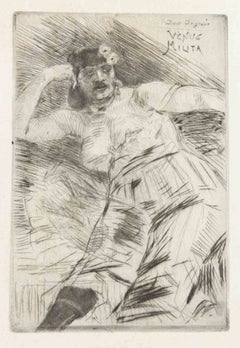
Antique English 19thC Victorian, Night time marine battle scene with sloop

Antique English 19thC Victorian, Night time marine battle scene with sloop

Located in Woodbury, CT

Well painted English Victorian scene of two boats in a battle at night time, off the coast of England. Though signed little is known about the painter. The piece is typically English in its style and the scene looks like the coast of the South of England. The painting has a sort of folk art quality, which maybe why the artist is not a listed painter...

Category

Victorian 1880s Art

Materials

Canvas, Oil

“Worcester, Massachusetts”

“Worcester, Massachusetts”

Located in Southampton, NY

Oil on wood panel painting of a Worcester, Massachusetts view by local resident artist Mabel Blake. Signed M. Blake lower left. Circa 1880. Condition is good. The bucolic scene depicts a man in a boat...

Category

Hudson River School 1880s Art

Materials

Oil, Board

Les Vieux (The Elders)

Les Vieux (The Elders)

By Félix Hilaire Buhot

Located in Middletown, NY

A lovely, dark impression with excellent provenance. Paris: Lemerre, 1880. Etching, drypoint, aquatint (dust ground and spirit ground), spit bite, and roulette in black on cream laid paper with a deckle edge, 6 3/4 x 4 1/2 inches (170 x 112 mm), full margins. Fourth state (of 5). An illustration from Alphonse Daudet's, Lettres de mon moulin, Paris, 1880. In very good condition with some light uniform toning and two areas of paper tape at the top right and left corners on the verso (from a former mount). With the 1921 J.H. de Bois circular ink stamp in green ink in the lower right margin on the recto (Lugt L.733). [Bourcard 113]. A note regarding the provenance: J. H. de Bois was a well known late-19th century modern art...

Category

French School 1880s Art

Materials

Etching, Drypoint, Aquatint

Miss Tic, Black-and-White Portrait Photograph, Archival Silver Print, 1986 by RF

Miss Tic, Black-and-White Portrait Photograph, Archival Silver Print, 1986 by RF

By Roberta Fineberg

Located in New york, NY

French Poet, visual artist, and female figure of street art, graffiti artist Miss Tic (1956 - 2022) is a contemporary French woman artist who printed her 'poc...

Category

Contemporary 1880s Art

Materials

Rag Paper, Digital, Archival Pigment, Digital Pigment

"Pan" lithograph

"Pan" lithograph

By (after) Jules Cheret

Located in Henderson, NV

Medium: lithograph (after the poster). This lithograph (in reduced size) was published in Paris in 1884 by Gazette des Beaux Arts. Size: 10 5/8 x 7 inches (265 x 180 mm). Signed in t...

Category

1880s Art

Materials

Lithograph

"Miriam and Donatello" original etching

"Miriam and Donatello" original etching

By Walter Shirlaw

Located in Henderson, NV

Medium: original etching. This etching from "The Hawthorne Portfolio" was printed in 1884 and illustrates a scene from Nathaniel Hawthorne's novel "The Marble Fawn. Plate size: 5 1/2...

Category

1880s Art

Materials

Etching
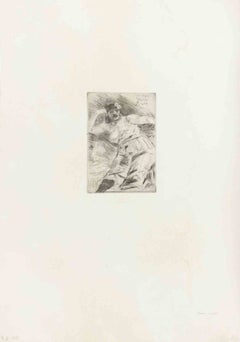
"Leisure Moments" original etching

"Leisure Moments" original etching

By James King

Located in Henderson, NV

Medium: original etching. Printed in 1888 and published by The New York Etching Club. Plate size: 8 1/2 x 5 5/8 inches (215 x 140 mm). Signed in the plate, not by hand. Condition: t...

Category

1880s Art

Materials

Etching
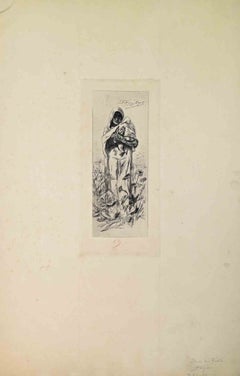
The Defense, Romantic Engraving after Laslett John Pott
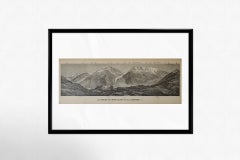
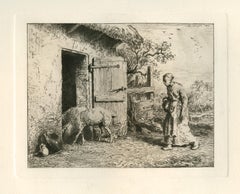
The Defense, Romantic Engraving after Laslett John Pott
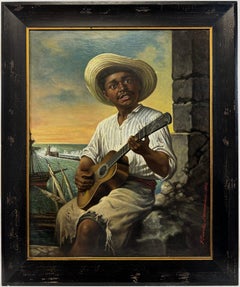
By Laslett John Pott

Located in Long Island City, NY

Laslett John Pott, After by William Greatbach, English (1837 - 1898) - The Defense, Portfolio: New Gallery of British Art, Year: 1882, Medium: Engraving, Image Size: 6.75 x 9.75 ...

Category

Romantic 1880s Art

Materials

Engraving
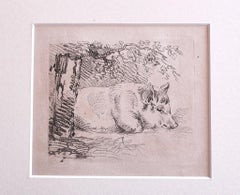
19th Century Oil on Board Signed C. Huber Austrian Painting Genre Scene, 1880

19th Century Oil on Board Signed C. Huber Austrian Painting Genre Scene, 1880

Located in Vicoforte, IT

A splendid painting from the second half of the 19th century. Oil on board artwork, signed C. Huber on the lower left, attributed to the Austrian painter and graphic artist Carl Rudo...

Category

1880s Art

Materials

Wood, Oil

Venetian Scene
Venetian Scene

Venetian Scene

By Henry Pember Smith

Located in New York, NY

In the 1880’s Smith made a trip to Italy, which added a whole new dimension to his work. His tight style was highly suited to the depiction of the majestic architecture and complex c...

Category

American Realist 1880s Art

Materials

Oil, Canvas