1890s Art

to
206
1,020
363
241
107
148
Overall Width
to
Overall Height
to
7,590
21,495
164,933
235,793
2,059
2,307
4,968
6,479
5,859
15,287
20,995
26,162
18,891
14,081
5,386
224
187
76
30
8
8
5
5
3
2
1,089
706
12
1,223
662
408
361
325
193
191
180
174
146
126
119
104
92
91
79
63
62
61
56
717
654
509
412
337
59
36
26
24
16
718
213
1,034
845
Period: 1890s
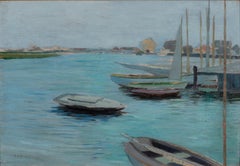
"A Man in His Garden, " Emil Carlsen, Backyard and Barn Impressionist Landscape

"A Man in His Garden, " Emil Carlsen, Backyard and Barn Impressionist Landscape

By Emil Carlsen

Located in New York, NY

Soren Emil Carlsen (1848 - 1932) A Man in His Garden, 1893 Oil on canvas 28 3/4 x 35 1/2 inches Signed and dated lower right Provenance: The artist [1848-1932] Macbeth Gallery, New York Grand Central Art Galleries, New York Luella May (Ruby) Carlsen (the artist's wife), New York Dines Carlsen (the artist's son), Falls Village, Connecticut Private Collection, Miami, Florida Exhibited: New York, Macbeth Gallery, Summer Exhibition: Painting by American Artists, July - August, 1926, no. 31 (as The Man in the Garden). Houston, Texas, Museum of Fine Arts, Exhibition of Contemporary American Art by Members of the Grand Central Art Galleries, January 13 - 27, 1929 (as The Man in the Garden). Miami Antique...

Category

American Impressionist 1890s Art

Materials

Canvas, Oil

La Naissance d’Annette (Birth of Annette)

La Naissance d’Annette (Birth of Annette)

By Edouard Vuillard

Located in Fairlawn, OH

La Naissance d’Annette (Birth of Annette) Color llithograph, 1899 Unsigned (as usual) Edition: 100 Publisher: Ambrose Vollard Printer: Auguste Clot, Paris Condition: Excellent with f...

Category

French School 1890s Art

Materials

Lithograph

Manchester
Manchester

Manchester

By Francis Dodd

Located in Douglas, Isle of Man

Francis Dodd R.A. 1874-1949, was an English landscape and portrait painter, draughtsman and etcher. He attended the Glasgow School of Art and travelled throughout Europe, France, Ita...

Category

1890s Art

Materials

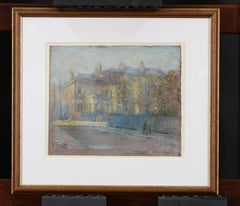
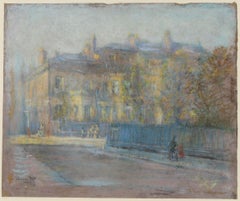
Paper, Pastel

Portrait of a Man Facing Left, Impressionist Monoprint, Circa 1890

Portrait of a Man Facing Left, Impressionist Monoprint, Circa 1890

By William Merritt Chase

Located in Fairlawn, OH

Portrait of a Man Facing Left Monotype printed in brown ink, c. 1880-1914 Signed in ink lower left: Chase (see photo) Provenance: Helen Chase Storm (the artist's daughter) Jackson Chase Storm (her son) Chapellier Galleries (as agent) James Bergquist, Boston References And Exhibitions: Exhibited at the Museum of Fine Arts, Boston and the Clark Art Institute, Williamstown, MA. (See MFA paperwork in photos) Reference: Ronald G. Pisano, Completed by D. Frederick Baker and Carolyn K. Lane, William Merritt Chase: Still Lifes, Interiors, Figures, Copies of Old Masters, and Drawings, Catalogue Raisonne, Vol. IV (New Haven and London: Yale University Press, 2010), Vol. 1, M. 8. (See photos of entry) William Merritt Chase (1840-2016) Born in Nineveh, Indiana Died New York, New York In 1883 Chase was involved in the organization of an exhibition to help raise funds for a pedestal for the Statute of Liberty. The exhibition featured loans of three works by Manet and urban scenes by the Italian Impressionist Giuseppe de Nittis. Both artists influenced Chase's Impressionistic style that gave rise to a series of New York park scenes. It is also thought that he was influenced by John Singer Sargent's In the Luxembourg Gardens (1879) which was exhibited in New York at this time. Indeed, Chase had met Sargent in Europe in 1881, the two men becoming lifelong friends with Sargent painting Chase's portrait in 1902. On another European trip in 1885, Chase met James McNeill Whistler in London. While Whistler had a reputation for being difficult, the two artists got along famously and agreed to paint one another's portrait. Eventually, however, Whistler's moods began to grate with Chase who wrote home stating "I really begin to feel that I never will get away from here". For his part, Whistler criticized Chase's finished portrait and, according to Hirshler, "complained about Chase for the rest of his life". While no record exists of Whistler's portrait of Chase; Chase's portrait of Whistler remains a well-known piece in his oeuvre. In 1887 Chase married Alice Gerson, the daughter of the manager of a lithography company. Though some fifteen years his junior (Chase was 37), he had known Alice for some time through her family's devotion to the arts. The pair, who would enjoy a happy marriage with Alice in full support of her husband's career, settled initially in Brooklyn...

Category

Impressionist 1890s Art

Materials

Monoprint

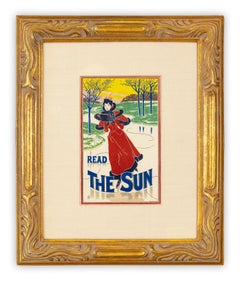
Read the Sun by Louis Rhead, Art Nouveau Japon lithograph, 1897

Read the Sun by Louis Rhead, Art Nouveau Japon lithograph, 1897

By Louis Rhead

Located in Chicago, IL

“America was quick to reveal strong Art Nouveau voices; it was Louis Comfort Tiffany who encouraged Bing to open his salon, and artists Will Bradley and Ethel Reed exhibited a Japonist simplicity that presented a strong, refined take on the Art Nouveau ideal. Louis Rhead was born in England but emigrated to the United States in 1883 at the age of 24, and quickly found himself celebrated both in the United States and in France, exhibiting his designs in the prestigious Salon des Cent in Paris in 1897.” -Quoted from Flowering Lines: Rare Art Nouveau Graphics 1883-1911 by Thomas Negovan (2017) Lithograph of Louis Rhead’s Read The Sun, published in 1897 by Imprimerie Chaix, the printing house known for publishing the works of Belle Epoque master Jules Chéret. While this poster was printed in multiple sizes and formats, this 1897 edition of 25 strikes on Japon paper is the most desirable and extremely scarce edition. Japon paper allows inks to rest upon its surface rather than being absorbed by a more permeable paper stock. The rare, small format poster lithographs created at this time were printed using rich, dense, lead inks. This world-class example of lithography captures superior resolution and color-richness to that of its large-format counterpart. This piece is presented professionally framed using all archival materials, including a hand-wrapped silk mat. This work arrives accompanied by a certificate of authenticity. Notable museum collections featuring works by John Louis...

Category

Art Nouveau 1890s Art

Materials

Lithograph

"The Artist's Palette" John Haberle, Pyrography, Trompe L'oeil 19th Century

"The Artist's Palette" John Haberle, Pyrography, Trompe L'oeil 19th Century

By John Haberle

Located in New York, NY

John Haberle The Artist's Palette, circa 1890 Oil on panel with brushes & palette knife 18 x 27 inches Provenance: The artist Mrs. Vera Demmer (artist's daughter), by descent Kennedy Galleries, New York Berry-Hill Galleries, New York Private Collection, New York Keno Auctions, New York, Americana: Paintings, Furniture and Decorative Arts, January 17, 2012, Lot 27 Arader Galleries, New York Exhibited: New York, Kennedy Galleries, John Haberle: An Exhibition of Paintings, Drawings and Watercolors, June 8, July 15, 1970, no. 17, p. 11, illustrated. Fort Worth, Texas, Amon Carter Museum, John Haberle Master of Illusion, November 29, 1985- January 19, 1986, p. 28. New Britain Museum of American Art, John Haberle American Master of Illusion, December 11, 2009 - March 11, 2010, p. 72; this exhibition later traveled to Chadds Ford, Pennsylvania, Brandywine River Museum, April 17 - July 11, 2010; Portland Museum of Art, Maine September 18 - December 12, 2010. Literature: Kennedy Galleries, Inc., Exhibition catalogue, American Still Lifes 19th & 20th Century, Kennedy Quarterly, Vol. XI, No. 2, November 1971, p. 109, (84). William Gerdts, Exhibition Catalogue, Joseph Decker...

Category

1890s Art

Materials

Mixed Media, Oil, Board

Schuylkill River

Schuylkill River

By John Sloan

Located in New York, NY

John Sloan etching Schuylkill River, 1894, signed, titled, annotated “100 proofs” [only 25 were printed], also signed by the printer “Peter Platt im...

Category

American Realist 1890s Art

Materials

Etching

"La Danse à la Campagne", 2nd plate by Pierre-Auguste Renoir

"La Danse à la Campagne", 2nd plate by Pierre-Auguste Renoir

By Pierre-Auguste Renoir

Located in Hinsdale, IL

RENOIR, PIERRE AUGUSTE (1841 -1919) "La Danse à la Campagne", 2nd plate (The Country Dance (second plate)) Delteil 2, Stella 2 Soft-ground Etching in black ink, c. 1890 Only State on smooth wove paper With the stamped signature, as issued Image Size: 8 5/8” x 5 1/3” Fine strong and tonal impression with full margins The most famous etching...

Category

Art Nouveau 1890s Art

Materials

Etching

"Femme au Tub" from "Elles" by Toulouse-Lautrec

"Femme au Tub" from "Elles" by Toulouse-Lautrec

By Henri de Toulouse-Lautrec

Located in Hinsdale, IL

TOULOUSE-LAUTREC, HENRI DE (1864-1901) "FEMME AU TUB" (Woman with Tub) From the series, “Elles”, c. 1896 Wittrock 159, Adhemar 204 From the edition of 100; per Wittrock Original color crayon brush and splatter lithograph, five colors, printed on wove paper Printed without margins to deckled edge of paper Bearing Artist’s Monogram Stamp...

Category

Art Nouveau 1890s Art

Materials

Crayon, Lithograph

Corinne
Corinne

Corinne

By Maurice Réalier-Dumas

Located in Fairlawn, OH

Corinne Color lithograph, 1898 Signed in the stone lower left (see photo) Published in L’Estampe Moderne with their blindstamp lower right corner, Lugt 2790 (see photo) Edition 2000 ...

Category

1890s Art

Materials

Lithograph

Storm Sky Over the Farm

Storm Sky Over the Farm

By Amos Sangster

Located in Buffalo, NY

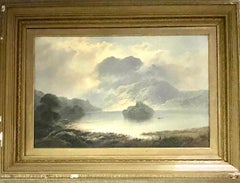
An original antique watercolor by American artist Amos Sangster featuring a dramatic allegorical composition and spectacular hand carved frame.

Category

American Realist 1890s Art

Materials

Paper, Watercolor

Going to the Park - Original lithograph, 1897

Going to the Park - Original lithograph, 1897

By Henri Evenepoel

Located in Paris, IDF

Henri EVENEPOEL (1862 - 899) Going to the Park, 1897 Original lithograph (Champenois workshop) Printed signature in the plate On vellum, 40 x 31 cm (c. 16 x 12 in) INFORMATION: Lit...

Category

Art Nouveau 1890s Art

Materials

Lithograph

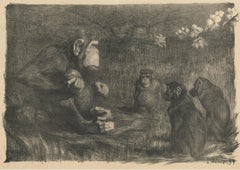
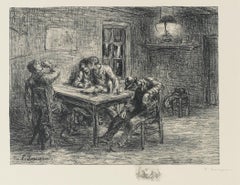
Le Judgement de Paris ouf famille singe

Le Judgement de Paris ouf famille singe

By Paul Jouve

Located in Fairlawn, OH

Le Judgement de Paris ouf famille singe Lithograph, 1897 Signed and dated in the stone lower right (see photo) Published in L’Estampe Moderne with their blindstamp lower right corner, Lugt 2790 (see photo) Edition 2000 Printed by Chapenois, Paris Condition: Excellent Image size: 9 5/8 x 13 5/8 inches Sheet size: 12 x 15 3/4 inches Paul Jouve (1878-1973) Paul Jouve was two years old when his father set up his ceramist workshop on Boulevard Saint Jacques in Paris. It is in this artistic universe that he grew up playing with colors, modeling the earth, pampered by his young mother, who dreamed of making a teacher of her. Very early on, his father, seeing his passion for drawing, encouraged him, introduced him to the Jardin des Plantes, where he developed a passion for the big cats that he practiced drawing. For the Universal Exhibition of 1900, the architect Binet, commissioned a frieze of wild animals of more than 100m representing tigers, bears, lions, bulls, and mouflons. This frieze will be executed in greenish brown glazed flamed sandstone by the sculptor Alexandre Bigot. Binet also ordered four lions from him to decorate the main gate of the Champs Elysees, between the two palaces, and a monumental statue representing a rooster wings outstretched in the center of the gate. In 1907, Jouve was awarded a scholarship from the General Government of Algeria, and along with Léon Cauvy...

Category

Art Nouveau 1890s Art
Materials

Lithograph

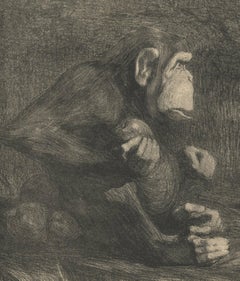
Art Nouveau Woman Praying - Original lithograph (1897/98)

Art Nouveau Woman Praying - Original lithograph (1897/98)

Located in Paris, IDF

Marcel Lenoir Art Nouveau Woman Praying (Invocation à la Madone d'onyx vert), 1897 Original lithograph (Champenois workshop) Printed signature in the plate On vellum, 40 x 31 cm (c....

Category

Art Nouveau 1890s Art
Materials

Lithograph

Woman with Bicycle: Two Views

Woman with Bicycle: Two Views

By Frank Duveneck

Located in Fairlawn, OH

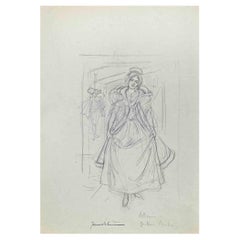
Woman with Bicycle: Two Views Graphite on paper, c. 1890 Unsigned Graphite study of standing female nude verso Provenance: Rookwood Pottery Factory Collection, Cincinnati Spanierman Gallery, New York (label) Drawings from the sketchbook are in the collections of the Munson Williams Proctor Institute in Utica, New York and the Picker Art Gallery, Colgate University, Hamilton, New York. A sister drawing from the same sketchbook was sold at Cowman’s Auction, Cincinnati, October 6, 2018. Accompanied by a letter from the Spanierman Gallery, dated 1997, stating that the drawing is from a sketchbook that was held in the Rookwood Factory Collection. Sister drawing provenance: Provenance: Terry DeLapp...

Category

American Realist 1890s Art

Materials

Graphite

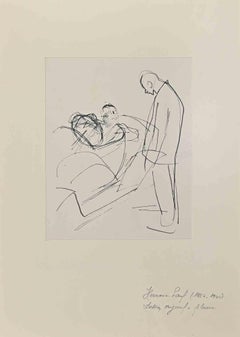
Retour (Homecoming)
Retour (Homecoming)

Retour (Homecoming)

By Georges De Feure

Located in Fairlawn, OH

Retour Color lithograph, 1897 Signed in the stone lower left edge of the image (see photo) As published in "L'Estampe Moderne" L'Estampe Moderne appeared each month as a portfolio of...

Category

Art Nouveau 1890s Art
Materials

Lithograph

A Day in June, Scene Eastchest, New York

A Day in June, Scene Eastchest, New York

By Edward B. Gay

Located in Missouri, MO

"A Day in June, Scene Eastchest, New York" 1898 Edward Gay (Irish, American, 1837-1928) Oil on Canvas Complimented by original frame in great condition Signed and Dated Lower Right T...

Category

Hudson River School 1890s Art

Materials

Canvas, Oil

Clay jug on a bench - The essence of the clay jar revealed by the sunlight -

Clay jug on a bench - The essence of the clay jar revealed by the sunlight -

By Hans Richard von Volkmann

Located in Berlin, DE

Hans Richard von Volkmann (1860 Halle (Saale) - 1927 ibid.), Clay jug on a bench. Pencil and Watercolour on paper. 20 x 26,7 cm (visible size), 37 x 45 cm (frame), dated and monogrammed lower left "Februar 1890 - HR. V. V." - Minimally tanned. Framed behind glass in a passepartout. About the artwork Using the technique of his early youth - pencil and watercolour - Hans Richard von Volkmann depicts a still life. However, this is not a conventional indoor still life, but an open-air depiction, painted outdoors and not in the studio. It is therefore an open-air painting, characteristic of von Volkmann's oeuvre, which could have been painted in the Willingshausen colony of painters, where open-air painting was programmatically practised there and the artist stayed there that year. And indeed, this painting is a manifesto of open-air painting. Von Volkmann demonstrates that leaving the studio for the light of nature leads to an entirely new quality of art. To prove this, he uses the genre of still life, which can be described as the studio subject par excellence. Moreover, light plays an essential role in the classical still life. It is the real protagonist of the still life. And it is precisely this moment, essential to the still life, that von Volkmann exploits to demonstrate the potential of plein-air painting: He presents the objects as they appear in the sunlight. The date of February and the bare branches in the foreground make it clear that this is a clear winter day in bright sunlight. The delicate plant in the foreground casts a clearly defined shadow, as does the jug. However, the shadow is most pronounced on the jug itself: The underside of the handle appears almost black, making the top, and therefore the jug itself, shine all the more brightly. The shining of the objects in the sunlight is also visible on the bench. As complementary phenomena to the shadow zones, light edges can be seen on the boards of the seats and the upper foot of the bench shines entirely in the light. To achieve this intensity of light, von Volkmann activated the bright white of the painting ground. By depicting the objects in glistening sunlight, von Volkmann demonstrates that this quality of light is only to be found outdoors. And this light leads to a new way of looking at the objects themselves. The jug on the bench seems like an accidental arrangement, as if the artist had stumbled upon this unintentional still life and captured it with fascination. And in this fascination there is a moment of realisation that refers to the objects themselves. It is only when they shine brightly in the sunlight that their true nature is revealed. In this way, sunlight allows the objects to come into their own, so to speak. Sunlight, which is not present in the studio, gives the still life an entirely new dimension of reality, which is also reflected in the colours interwoven by the sunlight: The bench and the jug stand in a harmonious grey-pink contrast to the green of the implied meadow. The emphasis on the jug as the central subject of the picture also implies that the watercolour has not been completed. This non finito inscribes a processuality into the picture, making it clear that something processual has been depicted, the temporality of which has been made artistically permanent. This is why von Volkmann signed the painting and dated it to the month. About the Artist Von Volkmann made his first artistic attempts at the age of 14. He painted many watercolours of his home town of Halle. This laid the foundation for his later outdoor painting. In 1880 his autodidactic beginnings were professionalised with his admission to the Düsseldorf Art Academy. There he studied under Hugo Crola, Heinrich Lauenstein, Johann Peter Theodor Janssen and Eduard von Gebhardt until 1888. Von Volkmann then moved to the Karlsruhe Academy, where he was Gustav Schönleber's master pupil until 1892. In 1883 he came for the first time to Willingshausen, Germany's oldest painters' colony, at the suggestion of his student friend Adolf Lins...

Category

Naturalistic 1890s Art

Materials

Watercolor

The Hudson River Sidewheel Steamer J.M.A.

The Hudson River Sidewheel Steamer J.M.A.

Located in Costa Mesa, CA

This small and finely painted piece depicts the sidewheel steamer J.M.A. underway carrying passengers along the Hudson River. With flags snapping in the wind and whitecaps on the riv...

Category

Other Art Style 1890s Art

Materials

Canvas, Oil

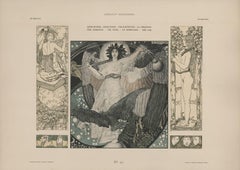
Gerlach's Allegorien Plate #51: "Summer" Lithograph

Gerlach's Allegorien Plate #51: "Summer" Lithograph

By Koloman Moser

Located in Palm Beach, FL

Koloman Moser (1868 –1918), AUSTRIAN Instead of applying his flair and art education solely to painting, Koloman Moser embodied the idea of Gesamt Kunstwerk (all-embracing art w...

Category

Vienna Secession 1890s Art

Materials

Lithograph

Side View Seated Female Nude

Side View Seated Female Nude

By Frank Duveneck

Located in Fairlawn, OH

Side View Seated Female Nude Graphite on paper, c. 1890's Unsigned Provenance: Rookwood Pottery Factory Collection, Cincinnati Spanierman Gallery, New York (label) Drawings from the...

Category

American Impressionist 1890s Art

Materials

Graphite

Preliminary Drawing for A Harvest Lunch, Graphite on Paper, Circa 1890

Preliminary Drawing for A Harvest Lunch, Graphite on Paper, Circa 1890

By Daniel Ridgway Knight

Located in Fairlawn, OH

Preliminary Drawing for A Harvest Lunch, c. 1890 Graphite on wove paper Unsigned c. 1890 Exhibited: Spanierman Galleries, In Praise of Women, Oct. 21-Nov. 20, 2010 Illustrated: Lisa N. Peters, In Praise of Women, Spanierman Galleries (see catalog entry in photos) Condition: Excellent Sheet size (sight): 14 1//2 x 10 5/16 inches Provenance: Spanierman Galleries, New York A preliminary drawing for the painting A Harvest Lunch Included in the catalogue raisonn of the artist's work published by Rehs Galleries, catalog raisonne no. SF1006. Sames pose in a wheat field, lacking picnic meal. The young woman is a known model for Knight. She is depicted in numerous paintings. The striped skirt and wooden shoes she wears also is repeated in Knight's oeuvre. "Daniel Ridgway Knight was born in Philadelphia to a Quaker family and studied at the Pennsylvania Academy of the Fine Arts from 1858 to 1861, the year he became a founding member of the Philadelphia Sketch Club. He went to Paris and studied at the Ecole des Beaux-Arts from 1861 to 1863 with Charles Gleyre (1808-1874) and Alexandre Cabanel (1823-1889), and attended the Accademia di San Lucca, then in Venice, in 1863. Knight returned to Philadelphia that year, married, and served in the Union Army during the Civil War. He went back to France in 1871 and lived there for the remainder of his long and successful career. He settled in Seine-et-Oise near Poissy to study with the noted academic painter Jean-Louis-Ernest Meissonier (1815-1891) in 1873, and the two artists became close friends. Influenced by his French contemporaries Jules Bastien-Lepage (1848-1884) and Jules- Adolphe-Aimé-Louis Breton...

Category

Abstract Impressionist 1890s Art

Materials

Graphite

Cendrillon

Cendrillon

By Emile Bertrand

Located in New York, NY

Émile Bertrand's poster for Jules Massenet's Cendrillon, advertising the première performance at the Théâtre National de l'Opéra-Comique, Paris. 1899. Color lithograph. On linen. De...

Category

Art Nouveau 1890s Art
Materials

Lithograph

A Set of Six Bust Portraits of Beauties - Jidai Kagami (Mirror of the Ages).

A Set of Six Bust Portraits of Beauties - Jidai Kagami (Mirror of the Ages).

By Yoshu Chikanobu

Located in London, London

CHIKANOBU, Yoshu (1838–1912) A Set of Six Bust Portraits of Beauties - Jidai Kagami (Mirror of the Ages). 1896-1898 A Set of Six oban tate-e woodblock prints of okubi-e (bust portraits) of beauties, titled Jidai kagami (Mirror of the Ages), documenting the fashions of former times (from the Keicho to the Meiji era) in chronological order, each sheet with a beautiful woman in sumptuous costume depicted at the lower section and a rectangular panel at the top which makes a reference to the era, some sheets with lacquer and embossed details, published by Matsuki Heikichi, variously dated Meiji 29, 30 and 31 (1896-8), all signed Yoshu Chikanobu. Each sheet approx. 36 x 23.7 cm (14 1/8 x 9 3/8 in). oyohara Chikanobu (1838–1912), better known to his contemporaries as Yōshū Chikanobu, was one of the most successful woodblock print artists of Japan's Meiji period. He lived at a time when Japan saw the reinstatement of the emperor as ruler and underwent rapid westernization. He worked both with traditional subjects, such as actors, courtesans, scenes of famous sites, beautiful women, and with topical subjects, such as the Satsuma Rebellion (1877) and the Sino-Japanese War (1894-1895). Chikanobu used the flat planes and decorative patterning of the ukiyo-e tradition to striking effect, adding brilliant colors, especially reds, purples, and blues to his compositions. More precisely, Ukiyo-e, or ukiyo-ye (in Japanese: "pictures of the floating world"), is a genre of woodblock prints and paintings that flourished in Japan from the 17th through 19th centuries. It was aimed at the prosperous merchant class in the urbanizing Edo period (1603–1867). Amongst the popular themes were depictions of beautiful women, as is the case here with these okubi-e prints (i.e. bust portraits); kabuki actors and sumo wrestlers; scenes from history and folk tales; travel scenes and landscapes; flora and fauna; and erotica. One of Chikanobu’s best series, A Mirror of the Ages shows women by fashion and hair style throughout history. Despite a sense of longing for the past, these prints are unmistakably modern and of their time. Each print depicts a beauty from a certain period in the lower part and customs at that time, in grisaille, in the upper part - a way to tell viewers about the latest fashion and historical backgroud at that time. The quality of printing is outstanding, especially in Chikanobu’s use of white for the rendering of the powdered faces. Indeed, Chikanobu was known as a master of bijinga (images of beautiful women), and for illustrating changes in women's fashion, including both traditional and Western clothing...

Category

Other Art Style 1890s Art

Materials

Wood

At the Buttes-Chaumont (Plate 169)

At the Buttes-Chaumont (Plate 169)

By Jules Chéret

Located in Greenwich, CT

At the Buttes-Chaumont (Plate 169) is an 1899 lithograph of Jules Chéret's poster, printed at Imprimerie Chaix by Jules Chéret and included in the famed collection of Belle Époque po...

Category

Art Nouveau 1890s Art
Materials

Paper, Lithograph