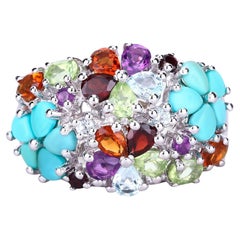
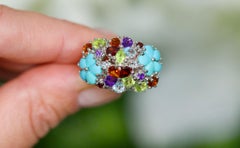
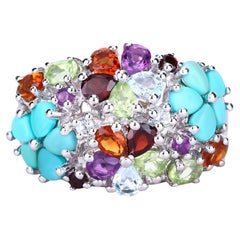
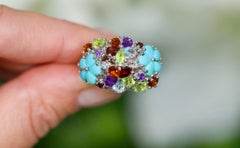
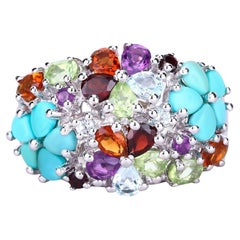
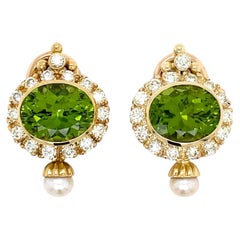
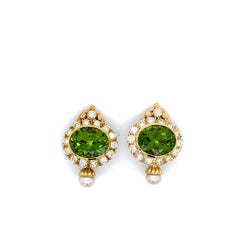
On 1stDibs, you can find the most appropriate 4 carat peridot for your needs in our varied inventory. Frequently made of
gold,
white gold and
14k gold, this item was constructed with great care. In our selection of items, you can find a vintage example as well as a contemporary version. If you’re looking for a 4 carat peridot from a specific time period, our collection is diverse and broad-ranging, and you’ll find at least one that dates back to the 19th Century while another version may have been produced as recently as the 21st Century. A 4 carat peridot from
Sunita Nahata,
Luigi Ferrara and
Roshe Jewels — each of whom created a beautiful version of this treasured accessory — is worth considering. A
cushion cut version of this piece has appeal, but there are also
oval cut and
round cut versions for sale. Finding a 4 carat peridot for sale for
women should be easy, but there are 42 pieces available to browse for unisex as well as
men, too.
Vividly colored. Relatively inexpensive. The striking green gemstone that is the star of the show in your vintage and antique peridot jewelry and watches is timeless and loved all over the world.
Suffering from nightmares? Try placing a peridot next to your pillow. In ancient Egypt, where the semiprecious stone was first discovered (and where it was referred to as the “gem of the sun”), it was believed to have magical powers, including the ability to protect people from evil spirits, including the ones responsible for bad dreams. Luckily for those wanting to test their efficacy against nighttime terrors, peridots are relatively inexpensive. Luckier still for August babies, whose birthstone it is, the vibrant green jewel in vintage peridot earrings, peridot rings and more goes beautifully with a summer wardrobe.
Peridot was mined in ancient times, perhaps as early as 1500 BC, on Topazos Island, today known as Zabargad or St. John’s Island, in the Red Sea. According to gemologist Edward Gübelin, “the occurrence of peridot on Zabargad is intimately related to the regional geology and the tectonic processes that on a larger scale were responsible for the formation of the Red Sea itself.”
Those ancient deposits have been exhausted. Today the largest and finest peridots come from Pakistan and Myanmar, while the San Carlos Apache Reservation in Arizona is the source of most of the stones used in mass-produced jewelry. Peridots are also found in Vietnam, Tanzania and China.
Zabargad is the source of the most famous large peridots, several of which are prized parts of public collections. The Natural History Museum in London owns a 146-carat step-cut stone, but it is the Smithsonian Institution in Washington, DC, that boasts the largest cut peridot, weighing 310 carats. Then there’s the Chicago Field Museum’s pear-shaped Green Goddess, weighing 154-carat and etched with the figure of a woman. It was acquired at the World’s Columbian Exposition in 1893, and In 2008, the renowned Chicago jeweler Lester Lampert designed an 18-karat yellow-gold setting for the stone, surrounding it with 3.24 carats of yellow diamonds.
Find vintage and antique peridot brooches, necklaces and other accessories on 1stDibs.