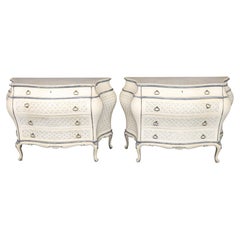
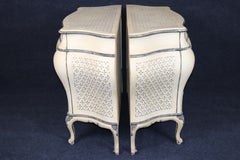
Choose from an assortment of styles, material and more with respect to the 4 drawer bombe chest you’re looking for at 1stDibs. Each 4 drawer bombe chest for sale was constructed with extraordinary care, often using
wood,
metal and
hardwood. There are many kinds of the 4 drawer bombe chest you’re looking for, from those produced as long ago as the 18th Century to those made as recently as the 21st Century. A 4 drawer bombe chest made by
Louis XV designers — as well as those associated with
Rococo — is very popular.
Baker Furniture Company,
Henredon and
Auffray Furniture each produced at least one beautiful 4 drawer bombe chest that is worth considering.
A 4 drawer bombe chest can differ in price owing to various characteristics — the average selling price 1stDibs is $4,250, while the lowest priced sells for $650 and the highest can go for as much as $37,500.
Rococo was an aesthetic movement in the fine and decorative arts in the 18th century that found its inspiration in nature and fostered an overall lightness and delicacy of form, construction and ornament in interior design. Rococo furniture, while greatly influenced by trends in Italy and Germany, is often called Louis XV style — the movement having reached its best expression during that sybaritic French king’s reign.
The term “rococo” is thought to be a portmanteau of the French words rocaille and coquilles — “rock” and “shells” — organic motifs frequently used in architecture and design of the style.
When it comes to authentic Rococo furniture's characteristics, it is above all sensuous and social. The furniture of earlier eras in Europe had been heavy in every sense; the Rococo period saw the appearance of light-framed upholstered armchairs, side chairs and occasional tables that could easily be moved to form conversational circles.
The signal detail of Rococo furniture design is the gently curved cabriole, or S-shaped chair-, table-, and cabinet-leg. It imitates the bend of a tree limb or a flower stem. In a further reference to nature, furnishings were often asymmetrical and painted white, or in soft, pastel shades. Rococo has become a timeless style, and as the furniture pieces presented on 1stDibs demonstrate, its playful, sculptural forms can provide visual excitement to contemporary, clean-lined spaces.
Shopping for a commode or a chest of drawers?
Commode is the French term for a low chest of drawers, but it is also sometimes used to denote any case piece with a particularly intricate design. The commode dates to circa 1700 France, where it was used as an alternative to a taller cabinet piece so as to not obscure paneled, mirrored or tapestried walls. Coffers, or chests, which were large wooden boxes with hinged lids and sometimes stood on ball feet, preceded chests of drawers, a fashionable cabinet furnishing that garnered acclaim for its obvious storage potential and versatility. The term commode was also used to refer to a piece of bedroom furniture — a washstand or nightstand that contained a chamber pot.
As time passed, French and British furniture makers led the way in the production of chests of drawers, and features like the integration of bronze and ornamental pulls became commonplace. Antique French commodes in the Louis XV style were sometimes crafted in mahogany or walnut, while an Italian marble top added a sophisticated decorative flourish. This specific type of case piece grew in popularity in the years that followed.
So, what makes a chest of drawers different from a common dresser? Dressers are short, and chests of drawers are overall taller pieces of furniture that typically do not have room on the top for a mirror as most dressers do. Tallboys and highboys are variations of the dresser form. Some chests of drawers have one column of four to six long drawers or three long drawers in their bottom section that are topped by a cluster of small side-by-side drawers on the top. To further complicate things, we sometimes refer to particularly short chests of drawers as nightstands.
Even though chests of drawers are commonly thought of as bedroom furniture to store clothing, these are adaptable pieces. A chest of drawers can house important documents — think of your walnut Art Deco commode as an upgrade to your filing cabinet. Nestle your chest near your home’s front door to store coats and other outerwear, while the top can be a place to drop your handbag. Add some flair to your kitchen, where this lovable case piece can hold pots, pans and even cookbooks.
When shopping for the right chest of drawers for your home, there are a few key things to consider: What will you be storing in it? How big a chest will you need?
Speaking of size, don’t dream too big. If your space is on the smaller side, a more streamlined vintage mid-century modern chest of drawers, perhaps one designed by Paul McCobb or T.H. Robsjohn-Gibbings, may best suit your needs.
At 1stDibs, we make it easy to add style and storage to your home. Browse our collection of antique and vintage commodes and chests of drawers today.