Ann Gardner
Recent Sales
21st Century and Contemporary Impressionist Still-life Paintings
Pastel, Board
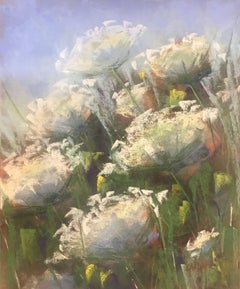
Dina Gardner for sale on 1stDibs
Dina Gardner has always been fascinated by how artists, whether they are painters, musicians, writers or anyone with artistic gifts, work through their creative process. She is fascinated that the process of 'creating' is different for every artist, regardless of their medium.
Her process for painting with pastels starts with music and her musical taste is wide and varied. Once the music is on in her studio, there is a lot of singing and dancing (neither done particularly well) that happens while she paints. She usually works from a photograph which she sketches on a sanded piece of pastel paper. She takes a lot of creative license, often adding or deleting objects in the photograph. Dina’s first layer, commonly referred to as the underpainting, is applied in dry pastel and then washed down with a paintbrush dipped in alcohol. Once this layer dries, she lays down layer upon layer of pastel, often letting the original underpainting peek through. Once in a while there are happy accidents. Sometimes there are tragic outcomes. But all the time she is grateful that she found this creative outlet at this stage of her life.
Dina’s paintings reflect objects she is drawn to: oceans and water, skies and clouds, trees, rock formations, marshes and meadows. When she paints from a photo reference or even when painting plein air, she is not painting what the subject looks like but rather what her response is to the subject.
Dina splits her time between Boston, MA, where she has lived for more than 40 years and her home in Manhattan Beach, CA, close to where she was raised. Both places provide her with inspiration and untold amounts of visual stimulation. Dina’s goal is to capture the beauty she observes around her and to express that beauty through her paintings.
A Close Look at Impressionist Art
Emerging in 19th-century France, Impressionist art embraced loose brushwork and plein-air painting to respond to the movement of daily life. Although the pioneers of the Impressionist movement — Claude Monet, Edgar Degas, Paul Cézanne, Berthe Morisot, Camille Pissarro, and Pierre-Auguste Renoir — are now household names, their work was a radical break with an art scene led and shaped by academic traditions for around two centuries. These academies had oversight of a curriculum that emphasized formal drawing, painting and sculpting techniques and historical themes.
The French Impressionists were influenced by a group of artists known as the Barbizon School, who painted what they witnessed in nature. The rejection of pieces by these artists and the later Impressionists from the salons culminated in a watershed 1874 exhibition in Paris that was staged outside of the juried systems. After a work of Monet’s was derided by a critic as an unfinished “impression,” the term was taken as a celebration of their shared interest in capturing fleeting moments as subject matter, whether the shifting weather on rural landscapes or the frenzy of an urban crowd. Rather than the exacting realism of the academic tradition, Impressionist paintings, sculptures, prints and drawings represented how an artist saw a world in motion.
Many Impressionist painters were inspired by the perspectives in imported Japanese prints alongside these shifts in European painting — Édouard Manet drew on ukiyo-e woodblock prints and depicted Japanese design in his Portrait of Émile Zola, for example. American artists such as Mary Cassatt and William Merritt Chase, who studied abroad, were impacted by the work of the French artists, and by the late 19th century American Impressionism had its own distinct aesthetics with painters responding to the rapid modernization of cities through quickly created works that were vivid with color and light.
Find a collection of authentic Impressionist art on 1stDibs.
Finding the Right Still-life-paintings for You
Still-life paintings work as part of the decor in nearly every type of space.
Still-life art, which includes work produced in media such as painting, photography, video and more, is a popular genre in Western art. However, the depiction of still life in color goes back to Ancient Egypt, where paintings on the interior walls of tombs portrayed the objects — such as food — that a person would take into the afterlife. Ancient Greek and Roman mosaics and pottery also often depicted food. Indeed, still-life paintings frequently feature food, flowers or man-made objects. By definition, still-life art represents anything that is considered inanimate.
During the Middle Ages, the still life genre was adapted by artists who illustrated religious manuscripts. A common theme of these paintings is the reminder that life is fleeting. This is especially true of vanitas, a kind of still life with roots in the Netherlands during the 17th century, which was built on themes such as death and decay and featured skulls and objects such as rotten fruit. In northern Europe during the 1600s, painters consulted botanical texts to accurately depict the flowers and plants that were the subject of their work.
Leonardo da Vinci’s penchant for observing phenomena in nature and filling notebooks with drawings and notes helped him improve as an artist of still-life paintings. Vincent van Gogh, an artist who made a couple of the most expensive paintings ever sold, carried out rich experiments with color over the course of painting hundreds of still lifes, and we can argue that Campbell’s Soup Cans (1961–62) by Andy Warhol counts as still-life art.
While early examples were primarily figurative, you can find still lifes that belong to different schools and styles of painting, such as Cubism, Impressionism and contemporary art.
As part of the wall decor in your living room, dining room or elsewhere, a still-life painting can look sophisticated alongside your well-curated decorative objects and can help set the mood in a space.
When shopping for a still-life painting, think about how it makes you feel and how the artist chose to represent its subject. When buying any art for your home, choose pieces that you connect with. If you’re shopping online, read the description of the work to learn about the artist and check the price and shipping information. Make sure that the works you choose complement or relate to your overall theme and furniture style. Artwork can either fit into your room’s color scheme or serve as an accent piece. Introduce new textures to a space by choosing an oil still-life painting.
On 1stDibs, find a collection of still-life paintings in a wide range of styles and subject matter.