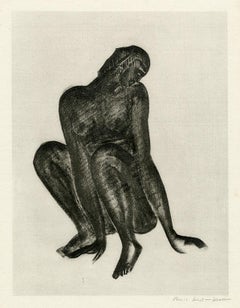
Art Deco Woman Crouching
1920s Art Deco Nude Prints
Lithograph

People Also Browsed
1990s Italian Mid-Century Modern Chandeliers and Pendants
Brass
21st Century and Contemporary Contemporary Figurative Paintings
Canvas, Ink, Mixed Media, Acrylic
Late 20th Century Contemporary Portrait Prints
Lithograph
1980s Art Deco Figurative Prints
Screen
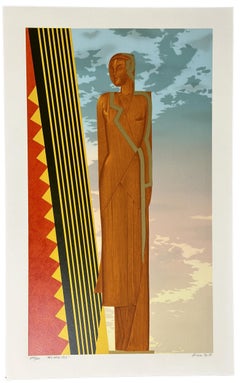
1980s Surrealist Nude Prints
Lithograph
1920s American Modern Figurative Prints
Lithograph
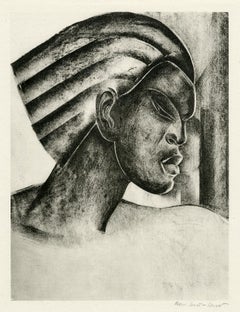
1970s Abstract Figurative Prints
Lithograph
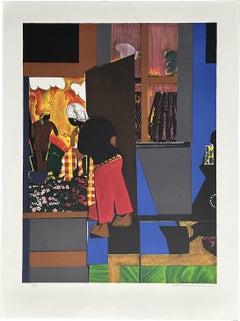
20th Century Realist Nude Paintings
Oil
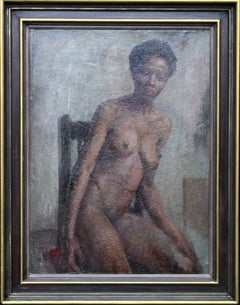
Antique 15th Century and Earlier Turkish Prehistoric Antiquities
Marble
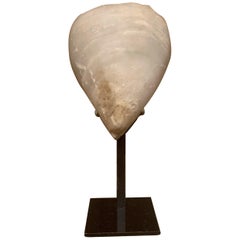
Early 2000s Modern Nude Prints
Lithograph
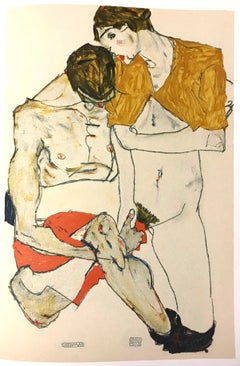
1920s Impressionist Abstract Prints
Lithograph
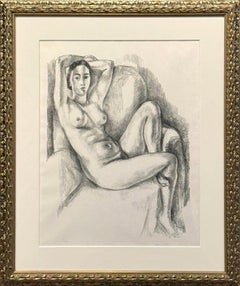
1920s Art Deco Figurative Prints
Lithograph
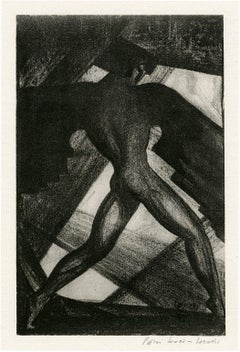
1920s Fauvist Figurative Prints
Lithograph
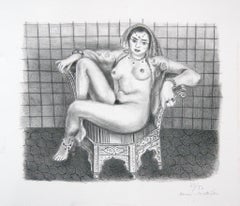
1920s Modern Portrait Paintings
Canvas, Oil
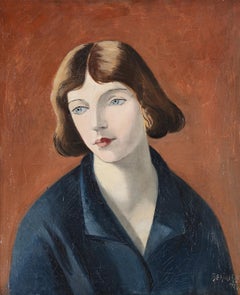
1920s Art Deco Figurative Prints
Lithograph
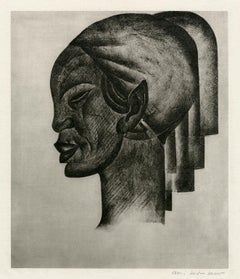
Art Deco Woman Crouching For Sale on 1stDibs
How Much is a Art Deco Woman Crouching?
Boris Lovet-Lorski for sale on 1stDibs
Boris Lovet-Lorski, sculptor, lithographer and painter, who contributed significantly to the American Art Deco movement, was born in Lithuania in 1894. Trained as an architect at the Royal Academy in Petrograd, throughout his career, Lovet-Lorski was acutely sensitive to volume and structural space. He also incorporated architectural backgrounds in the flattened aesthetic of his Art Deco neoclassicism, hallmarks of his elegant in a distinctly original style. Lovet-Lorski's idealized subject matter and masterful designs quickly won the young sculptor critical acclaim and led to his first one-man show in Boston in 1925, the year he became an American citizen. He was then invited to teach at the Milwaukee Institute of Art & Design, quickly developing a reputation that catapulted him into the New York artistic milieu. He exhibited on a regular basis with the Wildenstein Gallery from 1928 onward. Lovet-Lorski was a quintessentially Art Deco artist. His unique style was an amalgam of Modern, Tribal, Oriental, Archaic and Teutonic influences. His Slavic roots and eclecticism tempered his modernism with lyricism and a sense of mystery. His sculptures, in bronze or Black Belgian Marble, are sleek and gorgeously polished. The work from the 1920s and 1930s often featured exotic, allegorical nudes, stylized horses or busts. Lovet-Lorski was particularly noted for his female nudes with narrow hips, thoracic cages that broaden as they rise from waist to shoulder and wide-spread arms, with hands clasped and held behind or above classically modeled heads that were perched on their torsos like flowers on a stem. Lovet-Lorski's idealized vision coincided perfectly with the mechanization of the era, its gleaming, streamlined airplanes, automobiles and proud skyscrapers, that were the sacramentals of the inter-war period. He regularly worked in sumptuous and precious materials, onyx, jade and rare, fossilized wood essences, such as that taken from a 600-year old, Assyrian lemon tree. He tailored the subjects of his sculptures to suit the nature of his materials. The Belgian black marble of Head of a Woman is a dense and close-grained stone that complements the idealized features of the figure. God Unknown, one of the sculptor's best-known works was carved in pure white Carrara marble. His preferred exteriors were like polished silk,” adding to the serenity and timelessness that his sculptures convey. Lovet-Lorski’s style and the allure of his materials brought him commissions for portraits of high society and celebrated figures. By 1929, he was successful enough to maintain studios in New York, Rome and Paris. Wildenstein Gallery gave him a retrospective exhibit in 1940. His recognition was international and his sculptures were acquired by the permanent collections of over 20 major museums. The sculptor received the French Legion of Honor in 1950. He was a member of the National Academy of Design, the National Sculpture Society, the Society of Independent Artists and the Salons of Paris. His last major work was the Manila War Memorial. He attempted to complete the monument in 1957, but arthritis had crippled him to the point that he could no longer sculpt. He finished his career as a painter and his works continued to enjoy considerable success. Lovet-Lorski's works are held in the collections of the Musée de Luxembourg, Paris; the Bibliothèque Nationale, Paris; the Petit Palais, Paris; the British Museum, London; and many museums and galleries in the United States: the Metropolitan Museum of Art, New York; the Los Angeles Museum of Art; the Seattle Art Museum and the San Francisco Museum of Fine Arts. As an interesting footnote: in his youth, he had considerable success with the feminine sex that was so eloquently extolled in his art.
Finding the Right Prints-works-on-paper for You
Decorating with fine art prints — whether they’re figurative prints, abstract prints or another variety — has always been a practical way of bringing a space to life as well as bringing works by an artist you love into your home.
Pursued in the 1960s and ’70s, largely by Pop artists drawn to its associations with mass production, advertising, packaging and seriality, as well as those challenging the primacy of the Abstract Expressionist brushstroke, printmaking was embraced in the 1980s by painters and conceptual artists ranging from David Salle and Elizabeth Murray to Adrian Piper and Sherrie Levine.
Printmaking is the transfer of an image from one surface to another. An artist takes a material like stone, metal, wood or wax, carves, incises, draws or otherwise marks it with an image, inks or paints it and then transfers the image to a piece of paper or other material.
Fine art prints are frequently confused with their more commercial counterparts. After all, our closest connection to the printed image is through mass-produced newspapers, magazines and books, and many people don’t realize that even though prints are editions, they start with an original image created by an artist with the intent of reproducing it in a small batch. Fine art prints are created in strictly limited editions — 20 or 30 or maybe 50 — and are always based on an image created specifically to be made into an edition.
Many people think of revered Dutch artist Rembrandt as a painter but may not know that he was a printmaker as well. His prints have been preserved in time along with the work of other celebrated printmakers such as Pablo Picasso, Salvador Dalí and Andy Warhol. These fine art prints are still highly sought after by collectors.
“It’s another tool in the artist’s toolbox, just like painting or sculpture or anything else that an artist uses in the service of mark making or expressing him- or herself,” says International Fine Print Dealers Association (IFPDA) vice president Betsy Senior, of New York’s Betsy Senior Fine Art, Inc.
Because artist’s editions tend to be more affordable and available than his or her unique works, they’re more accessible and can be a great opportunity to bring a variety of colors, textures and shapes into a space.
For tight corners, select small fine art prints as opposed to the oversized bold piece you’ll hang as a focal point in the dining area. But be careful not to choose something that is too big for your space. And feel free to lean into it if need be — not every work needs picture-hanging hooks. Leaning a larger fine art print against the wall behind a bookcase can add a stylish installation-type dynamic to your living room. (Read more about how to arrange wall art here.)
Find fine art prints for sale on 1stDibs today.