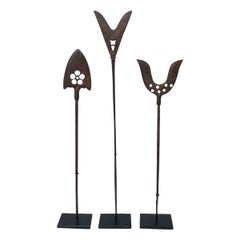
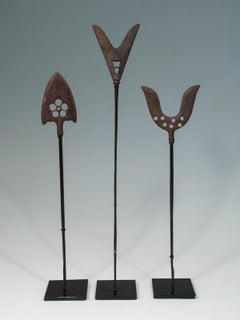
Set of Three Edo Period Arrowheads, Japan
Located in Point Richmond, CA
Edo Period Arrowheads on custom bases, Japan These arrowheads are called yashiri or yanone and
Category
Antique Late 18th Century Japanese Edo Mounted Objects
Materials
Steel
Set of Three Edo Period Arrowheads, Japan
Located in Point Richmond, CA
Edo Period Arrowheads on custom bases, Japan These arrowheads are called yashiri or yanone and
Steel
Edo furniture was created during a flourishing time for the decorative arts owing to the stability of the Tokugawa shogunate rule in Japan. Spanning from 1603 to 1867, this era of peace and economic growth supported artistic advancements in lacquer, woodblock printing, porcelain and other artisanal trades. Because the country was largely isolated, there was little outside influence, leading to centuries of exceptional attention to the design of its furnishings and the quality of its traditional arts.
Unlike during the Meiji period that followed, with an increase in domestic and international markets, furniture during the Edo period was predominately commissioned by the ruling class, although people from across social groups benefited from the burgeoning metropolitan hubs for artisanal trades. For instance, Kyoto became a major center for lacquer art. Most furniture pieces were made from wood such as cedar or ash, including the era’s sashimono cabinets, which involved fine joinery and were rooted in the Heian period.
Sashimono cabinets, which were built by master craftsmen in a range of different wood types owing to the various trees that populate Japan, occasionally featured a stack of slender drawers as well as sliding doors. They were popular with everyone from samurai to kabuki actors. Tansu storage chests crafted from wood with metal fittings were also common in Edo-period homes. Some were designed to be easily portable while others were made to double as staircases.
Painted folding screens, called byōbu, were also fashionable, with Japanese artists inspired by nature, literature and scenes of history and daily life to create vivid works. In Buddhist temples and the palatial homes of the aristocratic class, fusuma, or large sliding panels, would sometimes be adorned with gold or silver leaf. These dividers allowed interiors to change throughout the day, closing in small spaces for personal use or reflecting candlelight to illuminate communal spaces after dark.
Find a collection of Edo tables, lighting, decorative objects, wall decorations and more furniture on 1stDibs.
Styling your home with vintage, new and antique sculptures means adding a touch that can meaningfully transform the space. By introducing a sculptural work as a decorative finish to any interior, you’re making a statement, whether you tend toward the dramatic or prefer to keep things casual with modest, understated art.
A single, one-of-a-kind three-dimensional figurative sculpture mounted on your dining room wall is a guaranteed conversation piece, while a trio of abstract works arranged on your living room bookshelves can add spontaneity to the collection of first-edition novels or artist monographs you’re displaying as well as draw attention to them. Figurative sculptures are representational works that portray a specific person, animal or object. And while decorating with busts, which are sculpted or cast figurative works, hasn’t exactly topped the list of design trends every year, busts are back. According to designer Timothy Corrigan, “They give humanity in a way that a more abstract sculpture can’t give.” Abstract sculptures, on the other hand, are not meant to show something specific. Instead, they invoke a mood or scene without directly stating what they are portraying.
Busts made of stone or metal may not seem like a good fit for your existing decor. Fortunately, there are many ways for a seemingly incongruous piece to fit in with the rest of your room’s theme. You can embrace a dramatic piece by making it the focal point of the room, or you can choose to incorporate several elements made out of the same material to create harmony in your space. If an antique or more dramatic piece doesn’t feel like you, why not opt for works comprising plastic, fiberglass or other more modern materials?
When incorporating sculpture into the design of your home — be it the playful work of auction hero and multimedia visionary KAWS, contemporary fiber art from Connecticut dealer browngrotta arts or still-life sculpture on a budget — consider proper lighting, which can bring out the distinctive aspects of your piece that deserve attention. And make sure you know how the size and form of the sculpture will affect your space in whole. If you choose a sculpture with dramatic design elements, such as sharp angles or bright colors, for example, try to better integrate this new addition by echoing those elements in the rest of your room’s design.
Get started on decorating with sculpture now — find figurative sculptures, animal sculptures and more on 1stDibs today.