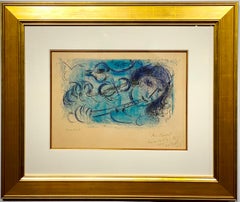
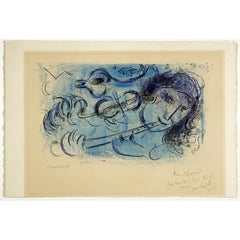
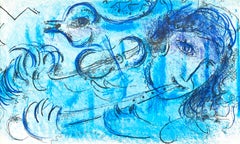
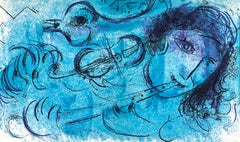
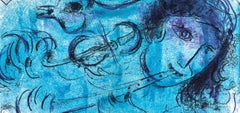
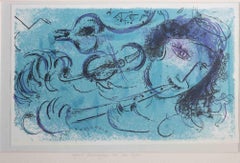
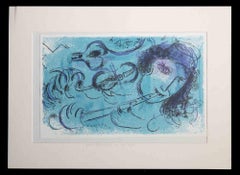
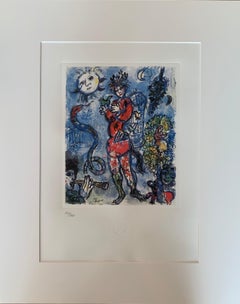
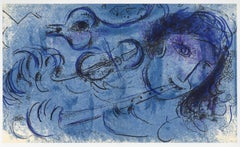
Described by art critic Robert Hughes as "the quintessential Jewish artist of the twentieth century," the Russian-French modernist Marc Chagall worked in nearly every artistic medium. Influenced by Symbolism, Fauvism, Cubism and Surrealism, he developed his own distinctive style, combining avant-garde techniques and motifs with elements drawn from Eastern European Jewish folk art.
Born Moishe Segal in 1887, in Belarus (then part of the Russian empire), Chagall is often celebrated for his figurative paintings, but he also produced stained-glass windows for the cathedrals of Reims and Metz, in France; for the United Nations, in New York; and for the Hadassah Hospital in Jerusalem, as well as book illustrations, stage sets, ceramics, tapestries and fine-art prints. Characterized by a bold color palette and whimsical imagery, his works are often narrative, depicting small-village scenes and quotidian moments of peasant life, as in his late painting The Flight into Egypt from 1980.
Before World War I, Chagall traveled between St. Petersburg, Paris and Berlin. When the conflict broke out, he returned to Soviet-occupied Belarus, where he founded the Vitebsk Arts College before leaving again for Paris in 1922. He fled to the United States during World War II but in 1947 returned to France, where he spent the rest of his life. His peripatetic career left its mark on his style, which was distinctly international, incorporating elements from each of the cultures he experienced.
Marc Chagall remains one of the past century’s most respected talents — find his art on 1stDibs.
Bring energy and an array of welcome colors and textures into your space by decorating with figurative fine-art prints and works on paper.
Figurative art stands in contrast to abstract art, which is more expressive than representational. The oldest-known work of figurative art is a figurative painting — specifically, a rock painting of an animal made over 40,000 years ago in Borneo. This remnant of a remote past has long faded, but its depiction of a cattle-like creature in elegant ocher markings endures.
Since then, figurative art has evolved significantly as it continues to represent the world, including a breadth of works on paper, including printmaking. This includes woodcuts, which are a type of relief print with perennial popularity among collectors. The artist carves into a block and applies ink to the raised surface, which is then pressed onto paper. There are also planographic prints, which use metal plates, stones or other flat surfaces as their base. The artist will often draw on the surface with grease crayon and then apply ink to those markings. Lithographs are a common version of planographic prints.
Figurative art printmaking was especially popular during the height of the Pop art movement, and this kind of work can be seen in artist Andy Warhol’s extensive use of photographic silkscreen printing. Everyday objects, logos and scenes were given a unique twist, whether in the style of a comic strip or in the use of neon colors.
Explore an impressive collection of figurative art prints for sale on 1stDibs and read about how to arrange your wall art.