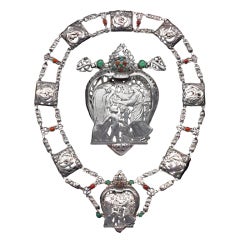
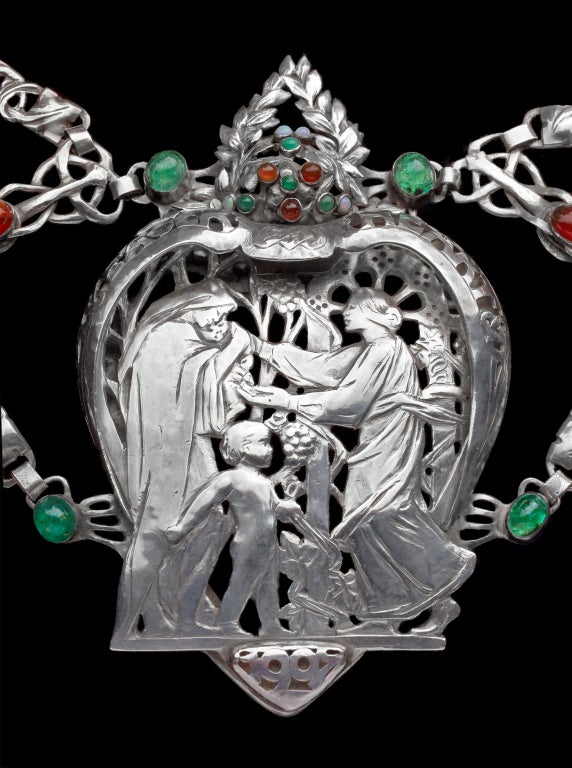
Art Nouveau — generally considered to have begun in the late 1800s and ended with the start of World War I — was a movement in the decorative arts that drew inspiration from natural forms, such as trees, flowers and, of course, the human figure. The three main themes present in Art Nouveau jewelry and watches were flora, fauna and women.
Art Nouveau, which reached its pinnacle in the year 1900, spawned from artists who rejected the historicism of their predecessors to create an entirely new visual vocabulary. As compared to Art Deco jewelry’s geometric patterns and sharp lines, the extravagant style of antique Art Nouveau jewelry is characterized by curvilinear forms and whiplash lines, vibrant materials and dramatic imagery.
The first art and design movement of the 20th century, Art Nouveau was also a reaction against the Industrial Revolution, and took its inspiration from the theories of the Symbolists, the art of the Pre-Raphaelites, the ideas of John Ruskin and his follower William Morris and, most importantly Japanese crafts. (The country was a fertile ground for inspiration after it was opened to the West in 1854.) The Art Nouveau style touched all manners of the arts, including the most exultant jewelry.
Nature was a favorite muse for artists going back to the 18th and 19th centuries, but in the hands of 20th-century artists, it was depicted in new ways. For example, a withering flower was considered just as beautiful as one in full bloom. Winged creatures, such as insects and birds, were also a popular subject. Dragonflies and butterflies were particular favorites because they morphed so dramatically in different life stages.
This was also a reference to women, whose role in society was evolving. It was not uncommon to see a piece of jewelry that would at once reference a woman as a winged creature (think René Lalique’s famous Dragonfly brooch, circa 1897–98, at the Gulbenkian Collection in Lisbon). However, just as women’s roles were ambiguous, so was their image, as the femmes nouvelle were simultaneously eroticized and romanticized.
In addition to Lalique, vital figures in Art Nouveau jewelry included Louis Comfort Tiffany in the United States, Vladimir Soloviev, who designed jewelry for Peter Carl Fabergé in Russia, Fuset Grau of Spain, Karl Rothmuller of Germany and Philippe Wolfers of Belgium.
Art Nouveau jewelers used every “canvas” imaginable, looking beyond brooches and necklaces to belt buckles, fans, tiaras, dog collars (a type of choker necklace), pocket watches, corsages and hair combs. Multicolored gems and enamel could complete this vision better than diamonds. Jewelers also favored pearls, particularly baroque pearls, for their large size and irregular shape. However, opal was the most popular stone — its iridescence harmonized perfectly with the enamel, and it could be carved into any shape. Art Nouveau jewelry was primarily set in yellow gold.
Find a range of antique Art Nouveau jewelry today on 1stDibs.
No one liked emeralds and emerald jewelry more than Elizabeth Taylor (or her alter ego, Cleopatra). Emeralds were first discovered in Egypt around 330 BC. The stone’s name originated from the ancient Greek word for green, “smaragdus.” According to the Gemological Institute of America, “Emeralds from what is now Colombia were part of the plunder when 16th-century Spanish explorers invaded the New World. The Incas had already been using emeralds in their jewelry and religious ceremonies for 500 years. The Spaniards, who treasured gold and silver far more than gems, traded emeralds for precious metals. Their trades opened the eyes of European and Asian royalty to emerald’s majesty.”
There are numerous myths attributed to the emerald’s spiritual powers, like placing an emerald under your tongue will allow you to see the future. But be careful not to swallow the birthstone for May, or that future won’t be so bright!
There are many important (read: large) emeralds in museum collections around the world. The Patricia Emerald, named after the miner’s daughter, is a 632-carat dihexagonal (or 12-sided) crystal that was discovered in Colombia in 1920 and now resides at the American Museum of Natural History in New York. The Smithsonian Museum of Natural History in Washington has in its possession the Hooker Emerald, a 75.47-carat Colombian stone. That emerald had been acquired in the 16th or 17th century by Spanish conquistadores and shipped to Europe. It later belonged to Abdul Hamid II, Sultan of the Ottoman Empire (1876–1909), who wore it on his belt buckle. Purchased at auction by Tiffany & Co. in 1911, the Hooker Emerald was set into a tiara and featured in the New York World’s Fair “House of Jewels” exhibit in 1940. Today, it is part of a brooch, also designed by the jewelry house.
On 1stDibs, find a range of antique and vintage emerald jewelry and watches that includes emerald rings, emerald necklaces and other accessories.
Vintage chain necklaces can make a statement on their own. What’s better than eye-catching chains of yellow gold or subtle silver to accessorize with everything from a designer evening dress to a comfortable sweatshirt?
Personal ornament in general has been around for eons. Ancient Egyptians designed jewelry and wore necklaces, rings and other accessories, and the excavation of King Tut’s burial chamber in 1922 had the greatest impact on Art Deco jewelry. When chain necklaces first took on some visibility in ancient civilizations, these items weren’t exactly democratic.
Chain necklaces were accessories that were relegated strictly to royal families and the upper class. In ancient times, pendant necklaces conferred prestige, for example. Wealthy Greeks and Romans opted for gold and silver necklaces that featured ornate pendants and semiprecious stones. By the Renaissance period, the pendant had replaced the brooch as the most worn type of jewelry. Pendant necklaces were commonplace, or pendants were simply strung on long gold chains.
Thankfully, jewelry became more accessible over time. And trends have come and gone, but the popularity of chain necklaces today owes in part to hip-hop culture. Big, chunky gold chains and diamond necklaces were the order of the day in publicity shoots and on album covers for rappers in the early 1980s onward, and a gold chain is still a mainstay in the ever-evolving and broadening hip-hop culture as we know it.
In our modern era, a number of chain-link necklaces are trending, worn alone or layered. The stylish links that have passed the test of time include oval links, paper-clip chains and more. The best way to discover your perfect fit is to zero in on a particular name and type of link.
While it was once key to accessorizing for a formal event, a vintage chain necklace now adds a fresh dynamic to any outfit at any time of day. Find yours on 1stDibs.