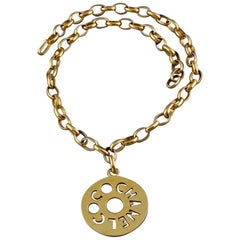
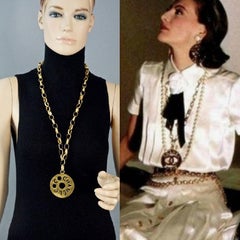
Vintage COCO CHANEL Cutout Openwork Logo Medallion Inès de la Fressange Necklace
By Chanel
Located in Kingersheim, Alsace
Vintage COCO CHANEL Cutout Openwork Logo Medallion Inès de la Fressange Necklace Measurements
Category
Vintage COCO CHANEL Cutout Openwork Logo Medallion Inès de la Fressange Necklace
By Chanel
Located in Kingersheim, Alsace
Vintage COCO CHANEL Cutout Openwork Logo Medallion Inès de la Fressange Necklace Measurements
In the years following the opening of her modest millinery shop, Gabrielle "Coco" Chanel became a pivotal designer of both fashionable casual wear and Paris haute couture as well as an icon and arbiter of 20th-century style with her bob haircut and pearls. Today vintage Chanel handbags, jackets and evening dresses are among the most sought-after clothing and accessories for fashion lovers all over the world.
The first Chanel shop was established in 1910 in Paris on rue Cambon by the young milliner Gabrielle Chanel (1883–1971), who had picked up the nickname “Coco” while working as a club singer. The boutique drew the attention of the Parisian fashion elite who popularized her wide-brimmed Chanel Modes hats. Soon she added a sportswear store in the Normandy resort town of Deauville, where Coco set the tone for her defining sense of style — traditionally masculine garments reimagined for feminine shapes, made from simple jersey fabric.
Effortless and elegant, Chanel's designs promoted comfort and grace in women’s wear that had been dominated in the previous century by complicated layers of fabric and cumbersome corsets. She followed this success with a couture house, opened in 1915 in Biarritz.
But Chanel was not born into a life of glamour. Following the death of her mother, her father left her in an orphanage where she lived until the age of 18. It was there that she learned to sew as well as appreciate the classic pairing of black and white as worn by the nuns.
In 1926, Chanel introduced her first little black dress, reclaiming a color that had once been reserved for mourning and working-class women. That same decade, she debuted her perfume, Chanel No. 5, as well as the Chanel suit with a fitted skirt, inspired by the boxy lines of men’s clothing and employing a sporty tweed.
Chanel closed her fashion operations during World War II, then returned to the industry in 1954 to design for the functional needs of modern women.
Structure and wearability endured in all of Chanel’s clothing and accessories, like the quilted leather 2.55 handbag — a 1955 update of a 1920s-era design — with its gold-chain shoulder strap that freed up a woman’s hands. The 1957 two-tone slingback pumps had a practical heel height while offering a bold statement in the black tip of the shoes. Her collarless jacket reacted against the constricting styles of Christian Dior's New Look, replacing them with a design that was timeless, an instant classic.
After Coco Chanel died in 1971, the brand underwent several changes in leadership, including fashion designer Karl Lagerfeld, who took over as artistic director in 1983. His collections for Chanel displayed his knack for synthesizing old and new, high and low. Lagerfeld revived Chanel ballet flats and thoroughly embraced the classic logo's interlocking CCs, which took the form of a clasp featured on so many of the rare Chanel bags that are much sought after today.
Vintage Karl Lagerfeld designs for Chanel dresses, coats and other clothing of the 1980s, '90s and 2000s riffed on its iconography, accenting a lexicon of Chanel-isms with tastes of the moment. And as the 1990s have become associated with styles adopted by today’s supermodels and influencers, vintage Chanel bags of the 1990s are among the most prized of the brand’s offerings.
Over the years, the company has continued to innovate, such as expanding into ready-to-wear fashion in 1978 and, in 2002, establishing a subsidiary company — Paraffection — dedicated to preserving the heritage skills of fashion artisan workshops. The House of Chanel still operates its flagship on rue Cambon in Paris, where it all began.
Browse vintage Chanel bags, evening dresses, shoes, jewelry and other clothing and accessories on 1stDibs.
Vintage chain necklaces can make a statement on their own. What’s better than eye-catching chains of yellow gold or subtle silver to accessorize with everything from a designer evening dress to a comfortable sweatshirt?
Personal ornament in general has been around for eons. Ancient Egyptians designed jewelry and wore necklaces, rings and other accessories, and the excavation of King Tut’s burial chamber in 1922 had the greatest impact on Art Deco jewelry. When chain necklaces first took on some visibility in ancient civilizations, these items weren’t exactly democratic.
Chain necklaces were accessories that were relegated strictly to royal families and the upper class. In ancient times, pendant necklaces conferred prestige, for example. Wealthy Greeks and Romans opted for gold and silver necklaces that featured ornate pendants and semiprecious stones. By the Renaissance period, the pendant had replaced the brooch as the most worn type of jewelry. Pendant necklaces were commonplace, or pendants were simply strung on long gold chains.
Thankfully, jewelry became more accessible over time. And trends have come and gone, but the popularity of chain necklaces today owes in part to hip-hop culture. Big, chunky gold chains and diamond necklaces were the order of the day in publicity shoots and on album covers for rappers in the early 1980s onward, and a gold chain is still a mainstay in the ever-evolving and broadening hip-hop culture as we know it.
In our modern era, a number of chain-link necklaces are trending, worn alone or layered. The stylish links that have passed the test of time include oval links, paper-clip chains and more. The best way to discover your perfect fit is to zero in on a particular name and type of link.
While it was once key to accessorizing for a formal event, a vintage chain necklace now adds a fresh dynamic to any outfit at any time of day. Find yours on 1stDibs.