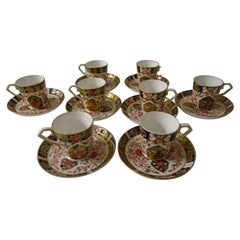
Founded in 1750 by Andrew Planche and William Duesbury in Derby, England, the Royal Crown Derby Porcelain Company is one of the oldest original English manufacturers of fine bone china. Dating to the Georgian era, it has operated for more than 265 years.
In 1761, the company, then called Derby Porcelain, created its first commemorative piece for the coronation of King George III. In 1775, King George III recognized the uniqueness and high quality of Derby Porcelain, giving the company the honor of using a crown on its back stamp. Queen Victoria gave further honors to the porcelain manufacturer in 1890, when she awarded the company a royal warrant and bestowed upon it the title of “The Royal Crown Derby Porcelain Company.”
In the years following the first royal appointment, the company employed some of its finest artistic creators, such as watercolor landscape painter Zachariah Boreman; flower painters William Billingsley, William Pegg and Walter Withers; and figure painters Richard Askew and James Banford. The company produced the most sought-after collectible pieces in its history under the direction of William Duesbury II. He died at 34 and his full vision for the company went unrealized; it subsequently entered a period of decline.
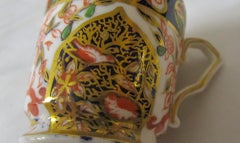
In 1811, Robert Bloor revived the company by employing excellent painters and producing exquisite serving pieces that featured the Japanese Imari style of bold colors and lavish details. The popular design continues to be produced today. Modern pieces such as the paperweight collection also remain in demand more than 40 years after their introduction.
Under the creative control of different partners over time, the company has had three main locations. Its current base of operations is in Derby, where it continues to produce fine ceramics and decorative collectibles.
On 1stDibs, find a selection of Royal Crown Derby Porcelain Company bowls and baskets, dinner plates, centerpieces and more.
Emerging in the 17th century, chinoiserie appropriated the aesthetics and imagery of popular East Asian design for European-made versions. Reflecting the exoticization of China, Japan and other countries in this era, the word directly translates from French to “Chinese-esque,” which reveals its shortcomings as a style of furniture and decor that often stereotypically and reductively mimics Asian culture rather than showcasing and paying tribute to its artistic traditions.
The enthusiastically decorative chinoiserie style was propelled by influential tastemakers including French King Louis XIV, whose Trianon de Porcelaine in 1670 was inspired by Chinese architecture. Expanded trade between the East and West led to a demand for porcelain, lacquer objects, silk and other goods, which further informed the fanciful furniture being crafted in Europe.
Artisans working in the chinoiserie style used materials and elements like pagoda shapes, bamboo, lacquer surfaces, bird and flower motifs and other interpretations of Asian design on pieces that were frequently set against vibrant wallcoverings. This whimsical approach yielded chinoiserie furniture that boasted dramatic flourishes drawing on the natural world and reflected the dominance of Rococo during the 18th century.
As chinoiserie was shaped by approximations of Asian design by European creators, it had regional variations, such as Chinese Chippendale in England where cabinets, chairs and tea tables had wooden fretwork designs and “japanned” surfaces intended to resemble lacquer work that was created in East Asia. In North America, furniture makers in Boston and New York integrated chinoiserie-painted scenes into Queen Anne furniture.
Antique chinoiserie furniture has continued to be fashionable, from its popularity with decorators of the Hollywood Regency era — James Mont, Tommi Parzinger, William Haines and Samuel Marx favored the style — to contemporary interior designers, although it brings with it a complex history.
Find a collection of chinoiserie bedroom furniture, cabinets, decorative objects and more on 1stDibs.
Today you’re likely to bring out your antique and vintage porcelain in order to dress up your dining table for a special meal.
Porcelain, a durable and nonporous kind of pottery made from clay and stone, was first made in China and spread across the world owing to the trade routes to the Far East established by Dutch and Portuguese merchants. Given its origin, English speakers called porcelain “fine china,” an expression you still might hear today. "Fine" indeed — for over a thousand years, it has been a highly sought-after material.
Meissen Porcelain, one of the first factories to create real porcelain outside Asia, popularized figurine centerpieces during the 18th century in Germany, while works by Capodimonte, a porcelain factory in Italy, are synonymous with flowers and notoriously hard to come by. Modern porcelain houses such as Maison Fragile of Limoges, France — long a hub of private porcelain manufacturing — keep the city’s long tradition alive while collaborating with venturesome contemporary artists such as illustrator Jean-Michel Tixier.
Porcelain is not totally clumsy-guest-proof, but it is surprisingly durable and easy to clean. Its low permeability and hardness have rendered porcelain wares a staple in kitchens and dining rooms as well as a common material for bathroom sinks and dental veneers. While it is tempting to store your porcelain behind closed glass cabinet doors and reserve it only for display, your porcelain dinner plates and serving platters can safely weather the “dangers” of the dining room and be used during meals.
Add different textures and colors to your table with dinner plates and pitchers of ceramic and silver or a porcelain lidded tureen, a serving dish with side handles that is often used for soups. Although porcelain and ceramic are both made in a kiln, porcelain is made with more refined clay and is stronger than ceramic because it is denser.
On 1stDibs, browse an expansive collection of antique and vintage porcelain made in a variety of styles, including Regency, Scandinavian modern and other examples produced during the mid-century era, plus Rococo, which found its inspiration in nature and saw potters crafting animal figurines and integrating organic motifs such as floral patterns in their work.