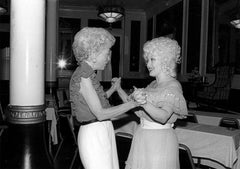
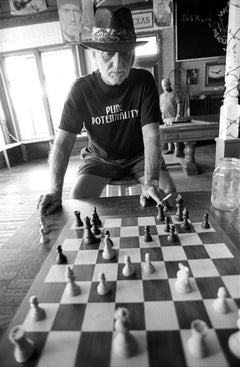
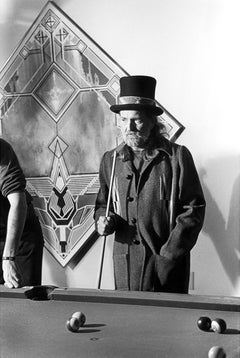
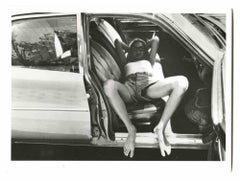
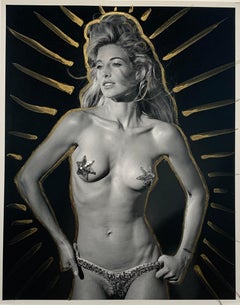
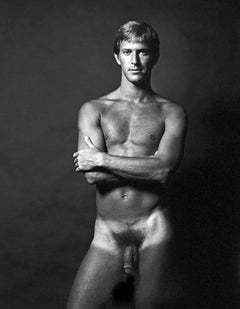
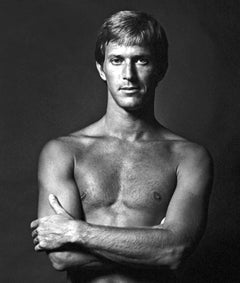
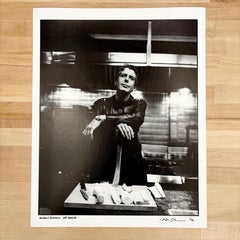
You are likely to find exactly the scott newton you’re looking for on 1stDibs, as there is a broad range for sale. Find
modern versions now, or shop for
modern creations for a more modern example of these cherished works. You’re likely to find the perfect scott newton among the distinctive items we have available, which includes versions made as long ago as the 18th Century as well as those made as recently as the 21st Century. Adding a scott newton to a room that is mostly decorated in warm neutral tones can yield a welcome change — find a piece on 1stDibs that incorporates elements of
black,
gray,
brown and more. Creating a scott newton has been a part of the legacy of many artists, but those crafted by
Sir Henry Raeburn,
Joni Sternbach and
Paul Earee are consistently popular. These artworks were handmade with extraordinary care, with artists most often working in
archival pigment print,
pigment print and
paint.
A direct challenge to Abstract Expressionism’s subjectivity and gestural vigor, Photorealism was informed by the Pop predilection for representational imagery, popular iconography and tools, like projectors and airbrushes, borrowed from the worlds of commercial art and design.
Whether gritty or gleaming, the subject matter favored by Photorealists is instantly, if vaguely, familiar. It’s the stuff of yellowing snapshots and fugitive memories. The bland and the garish alike flicker between crystal-clear reality and dreamy illusion, inviting the viewer to contemplate a single moment rather than igniting a story.
The virtues of the “photo” in Photorealist art — infused as they are with dazzling qualities that are easily blurred in reproduction — are as elusive as they are allusive. “Much Photorealist painting has the vacuity of proportion and intent of an idiot-savant, long on look and short on personal timbre,” John Arthur wrote (rather admiringly) in the catalogue essay for Realism/Photorealism, a 1980 exhibition at the Philbrook Museum of Art, in Tulsa, Oklahoma. At its best, Photorealism is a perpetually paused tug-of-war between the sacred and the profane, the general and the specific, the record and the object.
“Robert Bechtle invented Photorealism, in 1963,” says veteran art dealer Louis Meisel. “He took a picture of himself in the mirror with the car outside and then painted it. That was the first one.”
The meaning of the term, which began for Meisel as “a superficial way of defining and promoting a group of painters,” evolved with time, and the core group of Photorealists slowly expanded to include younger artists who traded Rolleiflexes for 60-megapixel cameras, using advanced digital technology to create paintings that transcend the detail of conventional photographs.
On 1stDibs, the collection of Photorealist art includes work by Richard Estes, Ralph Goings, Chuck Close, Audrey Flack, Charles Bell and others.
There’s a lot to love about black and white photography.
The unique and timeless quality of a black and white photograph accentuates any room. Some might argue that we’re naturally drawn to color photography because it’s the world we know best. This is a shared belief, particularly in the era of camera-phone photography, editing apps and the frenetic immediacy of sharing photos on social media. But when we look at black and white photography, we experience deep, rich shadows and tonal properties in a way that transfixes us. Composition and textures are crisp and engaging. We’re immediately drawn to the subjects of vintage street photography and continue to feel the emotional impact of decades-old photojournalism. The silhouettes of mountains in black and white landscape photography are particularly pronounced, while portrait photography and the skylines of urban cityscapes come to life in monochrome prints.
When decorating with fine photography, keep in mind that some color photographs may not be suitable for every space. However, you can be more daring with black and white photos. The gray tones are classic, sophisticated and generally introduce elegance to any corner of your home, which renders black and white prints amazingly versatile.
Black and white photography adapts to its surroundings like a chameleon might. A single large-scale black and white photograph above the sofa in your living room is going to work with any furniture style, and as some homeowners and designers today are working to introduce more muted tones and neutral palettes to dining rooms and bedrooms, the integration of black and white photography — a hallmark of minimalist decor — is a particularly natural choice for such a setting.
Another advantage to bringing black and white photography into your home is that you can style walls and add depth and character without worrying about disrupting an existing color scheme. Black and white photographs actually harmonize well with accent colors such as yellow, red and green. Your provocative Memphis Group lighting and bold Pierre Paulin seating will pair nicely with the black and white fine nude photography you’ve curated over the years.
Black and white photography also complements a variety of other art. Black and white photos pair well with drawings and etchings in monochromatic hues. They can also form part of specific color schemes. For example, you can place black and white prints in colored picture frames for a pop of color. And while there are no hard and fast rules, it’s best to keep black and white prints separate from color photographs. Color prints stand out in a room more than black and white prints do. Pairing them may detract attention from your black and white photography. Instead, dedicate separate walls or spaces to each.
Once you’ve selected the photography that best fits your space, you’ll need to decide how to hang the images. If you want to hang multiple photos, it’s essential to know how to arrange wall art. A proper arrangement can significantly enhance a living space.
On 1stDibs, explore a vast collection of compelling black and white photography by artists such as Mark Shaw, Jack Mitchell (a photographer you should know), Berenice Abbott and David Yarrow.