Torben Keramik

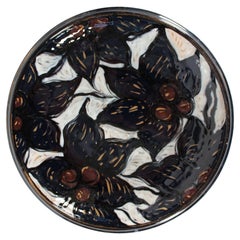
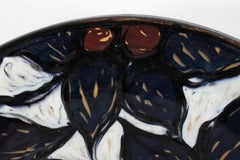
Large Ceramic Dish with Leaf Pattern by Torben Keramik Denmark Mid Century
By Herman A. Kahler Keramik
Located in Silkeborg, Silkeborg
Large ceramic dish by Torben Keramik in Denmark. The dish is decorated by hand with black, white
Category

Vintage 1950s Danish Art Nouveau Decorative Bowls

Materials

Ceramic

People Also Browsed

Moroccan Midcentury Side Table with Hexagonal Top and Mother-of-Pearl Inlay
Located in Atlanta, GA
A Moroccan side table from the mid 20th century, with inlaid star motif. Created in Morocco during the midcentury period, this side table features an hexagonal top adorned with a lar...
Category

Mid-20th Century Moroccan Side Tables

Materials

Mother-of-Pearl, Wood

Set of Five Chic Iron and Velvet Stools, France, circa 1940s
Located in Isle Sur La Sorgue, Vaucluse
Elegant set of five hammered iron Curule stools, the seats upholstered in blue and yellow velvet. Four of the stools have a black finish, and the fifth one has a gold finish with ora...
Category

Mid-20th Century French Art Deco Stools

Materials

Metal

Set of Five Chic Iron and Velvet Stools, France, circa 1940s
$1,201 / set
H 18.9 in W 19.69 in D 15.75 in
Two Art Deco Amsterdamse School Armchairs, by Frits Spanjaard, 1920s
By Frits Spanjaard
Located in Amsterdam, NL
Stunning and elegant pair of Art Deco Amsterdamse School armchairs. Design by Frits Spanjaard. Striking Dutch design from the 1920s. Solid oak frames with brown faux leather upholste...
Category

Vintage 1920s Dutch Art Deco Armchairs

Materials

Faux Leather, Oak

Pair of Sconces by Gilardi and Barzaghi, 1950s, Italy
By Gilardi & Barzaghi
Located in Hagenbach, DE
Pair of Sconces by Gilardi and Barzaghi, 1950s, Italy Lamps are in very good vintage condition. Purple Enameled brass and aluminium with brass piece. This lamp works with E14 li...
Category

Vintage 1950s Italian Mid-Century Modern Wall Lights and Sconces

Materials

Brass, Aluminum

Pair of Sconces by Gilardi and Barzaghi, 1950s, Italy
$2,126 / set
H 11.42 in W 6.7 in D 9.06 in
Amsterdam School Expressionist Chandelier, Netherlands, 1920s
Located in Antwerp, BE
A striking Dutch Art Deco chandelier from the 1920s, crafted in the expressive Amsterdam School style. This piece features hand-carved fruitwood paired with ebonized accents, delicat...
Category

Vintage 1920s Dutch Art Deco Chandeliers and Pendants

Materials

Wood, Silk, Fruitwood, Art Glass

1950s Wood Screen with Glass Inlays
Located in Toronto, CA
The 1950s four-panel wood screen with amber-hued glass windows is both architectural and whimsical. Featuring rich, patinated wood, brass hinges and a sturdy base - use it to divide ...
Category

Vintage 1950s Mexican Modern Screens and Room Dividers

Materials

Glass, Wood

1950s Wood Screen with Glass Inlays
$4,800
H 71.25 in W 17.75 in D 3 in
French Art Deco Cream EJ Ruhlmann Style Leather Swivelling Tub Desk Chair
Located in Reading, Berkshire
Chair 2025 1 AD French Art Deco Cream EJ Ruhlmann Style Leather Swivelling Tub Desk Chair With Rail Swept Arm Supports. With A Cast Iron Mechanism & Four Tapered Legs With Brass Fin...
Category

Early 20th Century French Art Deco Armchairs

Materials

Brass, Iron

Radiant Pair of Art Deco Revival Club Chairs in Magnificent French Cane
Located in Atlanta, GA
An exquisite restored pair of rattan Art Deco Revival club chairs, circa 1980. Fabulous rattan frame construction completely veneered in heavy French Cane. Design, quality and crafts...
Category

Vintage 1980s Unknown Art Deco Club Chairs

Materials

Cane, Rattan

An Arts and Crafts Glasgow Style Oak Sideboard Attributed to G M Ellwood
By George Montague Ellwood
Located in London, GB
An Arts and Crafts Glasgow style Oak sideboard attributed to G M Ellwood made by Bath Cabinet Makers, with stained glass panels to the upper right hand cupboard, and stylised floral ...
Category

Antique 1890s English Arts and Crafts Sideboards

Materials

Stained Glass, Oak

Original Vintage 1928 Avant Garde Art Exhibition Poster Kandinsky Picasso Klee
By Heinrich Campendonk
Located in London, GB
Original vintage art exhibition poster: Colour / Farbe Ausstellung im Kaiser-Wilhelm-Museum held at the Kaiser Wilhelm Museum in Krefeld Germany from 1-31 May 1928 presenting work by...
Category

Vintage 1920s German Posters

Materials

Paper

A Painted Drum Occasional Table
Located in London, GB
An unusual cylindrical painted drum occasional table, decorated with a continental crest, possibly the Hapsburg eagle, the top and bottom cross banded with painted shark’s tooth moti...
Category

Mid-20th Century Austrian Side Tables

Materials

Leather, Rope, Wood, Paint

A Painted Drum Occasional Table
$3,096
H 23.63 in Dm 15.36 in
1960s Atlanta Brass Zodiak Table Clock – Vintage Astrological Design
By Atlanta Electric, Atlanta Clock Co.
Located in Bad Säckingen, DE
This Atlanta brass Zodiak Table Clock from the 1960s is an exquisite piece of mid-century design that combines art and functionality. This clock features a solid brass body with a st...
Category

Vintage 1950s German Mid-Century Modern Table Clocks and Desk Clocks

Materials

Brass

Pair of Late 17th Century French Beechwood Long Benches
Located in Montreal, QC
Pair of late 17th century French beechwood long benches. Provenance: Frederick Cleveland Estate Morgan le Sabot Senneville. Bought at le Bon Marché Paris, 1929.
Category

Antique 17th Century French Benches

Pair of Late 17th Century French Beechwood Long  Benches
On Hold
$4,800 / set
H 19 in W 58 in D 5 in
Wall sculpture of the Madonna and Child, circa 1930
Located in Praha, CZ
The statue is made of plaster, shows signs of use, has chips in some places (see photo) Original condition
Category

Vintage 1930s Czech Art Deco Figurative Sculptures

Materials

Plaster

Wall sculpture of the Madonna and Child, circa 1930
$672
H 15.36 in W 4.34 in D 1.58 in
rare minimalist brass and plexiglass Stilnovo Style Wall Light, Italy 1950s
By Stilnovo, Gio Ponti
Located in Kirchlengern, DE
Article: brass and plexiglass theatre wall light Origin: Italy Age: 1950s This modernist light was produced in Italy in the 1950s in Italy. It is made of brass and metal w...
Category

Late 20th Century Italian Mid-Century Modern Wall Lights and Sconces

Materials

Metal, Brass

Art Deco walnut and Nickel-Plated Metal Gueridon, attributed to Djo Bourgeois
By Georges Djo-Bourgeois
Located in Saint-Ouen, FR
Art Deco gueridon in walnut and nickel-plated metal, attributed to Djo Bourgeois
Category

Vintage 1930s French Art Deco Gueridon

Materials

Silver Plate

Get Updated with New Arrivals
Save "Torben Keramik", and we’ll notify you when there are new listings in this category.

A Close Look at Art-nouveau Furniture

In its sinuous lines and flamboyant curves inspired by the natural world, antique Art Nouveau furniture reflects a desire for freedom from the stuffy social and artistic strictures of the Victorian era. The Art Nouveau movement developed in the decorative arts in France and Britain in the early 1880s and quickly became a dominant aesthetic style in Western Europe and the United States.

ORIGINS OF ART NOUVEAU FURNITURE DESIGN

CHARACTERISTICS OF ART NOUVEAU FURNITURE DESIGN

  • Sinuous, organic and flowing lines
  • Forms that mimic flowers and plant life
  • Decorative inlays and ornate carvings of natural-world motifs such as insects and animals 
  • Use of hardwoods such as oak, mahogany and rosewood

ART NOUVEAU FURNITURE DESIGNERS TO KNOW

ANTIQUE ART NOUVEAU FURNITURE ON 1STDIBS

Art Nouveau — which spanned furniture, architecture, jewelry and graphic design — can be easily identified by its lush, flowing forms suggested by flowers and plants, as well as the lissome tendrils of sea life. Although Art Deco and Art Nouveau were both in the forefront of turn-of-the-20th-century design, they are very different styles — Art Deco is marked by bold, geometric shapes while Art Nouveau incorporates dreamlike, floral motifs. The latter’s signature motif is the "whiplash" curve — a deep, narrow, dynamic parabola that appears as an element in everything from chair arms to cabinetry and mirror frames.

The visual vocabulary of Art Nouveau was particularly influenced by the soft colors and abstract images of nature seen in Japanese art prints, which arrived in large numbers in the West after open trade was forced upon Japan in the 1860s. Impressionist artists were moved by the artistic tradition of Japanese woodblock printmaking, and Japonisme — a term used to describe the appetite for Japanese art and culture in Europe at the time — greatly informed Art Nouveau. 

The Art Nouveau style quickly reached a wide audience in Europe via advertising posters, book covers, illustrations and other work by such artists as Aubrey Beardsley, Henri de Toulouse-Lautrec and Alphonse Mucha. While all Art Nouveau designs share common formal elements, different countries and regions produced their own variants.

In Scotland, the architect Charles Rennie Mackintosh developed a singular, restrained look based on scale rather than ornament; a style best known from his narrow chairs with exceedingly tall backs, designed for Glasgow tea rooms. Meanwhile in France, Hector Guimard — whose iconic 1896 entry arches for the Paris Metro are still in use — and Louis Majorelle produced chairs, desks, bed frames and cabinets with sweeping lines and rich veneers. 

The Art Nouveau movement was known as Jugendstil ("Youth Style") in Germany, and in Austria the designers of the Vienna Secession group — notably Koloman Moser, Josef Hoffmann and Joseph Maria Olbrich — produced a relatively austere iteration of the Art Nouveau style, which mixed curving and geometric elements.

Art Nouveau revitalized all of the applied arts. Ceramists such as Ernest Chaplet and Edmond Lachenal created new forms covered in novel and rediscovered glazes that produced thick, foam-like finishes. Bold vases, bowls and lighting designs in acid-etched and marquetry cameo glass by Émile Gallé and the Daum Freres appeared in France, while in New York the glass workshop-cum-laboratory of Louis Comfort Tiffany — the core of what eventually became a multimedia decorative-arts manufactory called Tiffany Studios — brought out buoyant pieces in opalescent favrile glass. 

Jewelry design was revolutionized, as settings, for the first time, were emphasized as much as, or more than, gemstones. A favorite Art Nouveau jewelry motif was insects (think of Tiffany, in his famed Dragonflies glass lampshade).

Like a mayfly, Art Nouveau was short-lived. The sensuous, languorous style fell out of favor early in the 20th century, deemed perhaps too light and insubstantial for European tastes in the aftermath of World War I. But as the designs on 1stDibs demonstrate, Art Nouveau retains its power to fascinate and seduce.

There are ways to tastefully integrate a touch of Art Nouveau into even the most modern interior — browse an extraordinary collection of original antique Art Nouveau furniture on 1stDibs, which includes decorative objects, seating, tables, garden elements and more.

Finding the Right Decorative-bowls for You

Vintage, new and antique decorative bowls have been an important part of the home for centuries, although their uses have changed over the years. While functional examples of bowls date back thousands of years, ornamental design on bowls as well as baskets likewise has a rich heritage, from the carved bowls of the Maya to the plaited river-cane baskets of Indigenous people in the Southeast United States.

Decorative objects continue to bring character and art into a space. An outdoor gathering can become a sophisticated garden party with the addition of a few natural-fiber baskets to hold blankets or fruit on a table, as demonstrated in the interior design work by firms such as Alexander Design.

Elsewhere, Richard Haining’s reclaimed wood vases and bowls can express eco-consciousness. Sculptural handmade cast concrete bowls like those made by the Oakland, California–based UMÉ Studio introduce compelling textures to your dining room table.

Minimalist ceramic decorative bowls of varying colors can evoke a feeling of human connectedness through their association with handmade craftsmanship, such as in the rooms envisioned by South African interior designer Kelly Hoppen. And you can elevate any space with ceramic bowls that match the color scheme.

Browse the 1stDibs collection of decorative bowls and explore the endless options available.