Wick Antiques For Sale on 1stDibs
At 1stDibs, there are several options of wick antiques available for sale. Frequently made of
metal,
silver and
sterling silver, all wick antiques available were constructed with great care. There are all kinds of wick antiques available, from those produced as long ago as the 18th Century to those made as recently as the 20th Century. Wick antiques are generally popular furniture pieces, but
Georgian style is often sought at 1stDibs. Many wick antiques are appealing in their simplicity, but
George Wickes,
Jonathan Hayne and
Thomas Wallis II produced popular wick antiques that are worth a look.
How Much are Wick Antiques?
Wick antiques can differ in price owing to various characteristics — the average selling price at 1stDibs is $2,321, while the lowest priced sells for $99 and the highest can go for as much as $7,124.
Jonas Lie for sale on 1stDibs
A painter best known for views of New York City and the New England coast, Jonas Lie worked in a vigorous, colorful style reflecting the influence of French Impressionism and the realism of the Ashcan School. He was born in Moss, Norway, the son of a Norwegian engineer and his American wife.
When his father died in 1892, Lie's life changed abruptly. He was sent to live for three months with Christian Skredvig, a painter who resided near Oslo. Then, he was sent to live with his uncle in Paris. Lie found himself at the center of a community of expatriated Scandinavian literary figures. Among those who visited his uncle's home were the Norwegian composer Edvard Grieg and the Norwegian playwright Hendrik Ibsen. After learning of his interest in drawing, Lie's uncle enrolled him in a private art school and took him on visits to the Louvre.
Lie's life changed again in 1893, when he was reunited with his mother and sisters in New York. After graduating, Lie was faced with the responsibility of supporting his family and took a job as designer of textile patterns at Manchester Mills, New York. During the evenings he attended classes at the National Academy of Design, Cooper Union, and the Art Students League. He spent his Sundays painting in his Manhattan studio and sketching at Rockaway Beach. His role model during his early New York years was Fritz Thaulow, a Norwegian painter who worked in an Impressionist style.
After leaving his job in 1906 to concentrate on art, Lie became influenced by the works of the Eight, the group of American artists who were focusing on urban subjects, which they painted in a realist fashion with dark tonalities and vigorous brushwork. Lie embraced the ideology of the Eight and adopted their bold techniques.
In 1909, Lie returned to Paris, spending three months painting along the Seine. Upon returning to America Lie expanded his subject matter to include views of mountainous countrysides and shores. He began to paint along the New England coast and in the Adirondacks, subjects he focused on throughout the rest of his career.
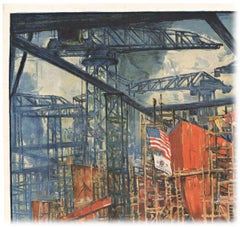
In 1913, Lie traveled to Panama, where he observed and recorded the construction of the Panama Canal. Lie's Panama Canal series brought him a significant amount of renown.
In the years after his return from Panama, Lie was a popular and outspoken figure in the New York art scene. In 1919, he led a protest against the jury system of the National Academy of Design that ended in a revolt by a group of prominent artists. This group, which included Paul Manship, George Bellows, and Joseph Pennell, established the American Painters, Sculptors, and Gravers Society. Despite his participation in a separatist group, Lie did not resign from the National Academy. Remaining a member of the Academy, he helped to initiate changes in the organization's policies, and in 1934, he was elected president of the Academy, a post he held until 1939.
Finding the Right Prints-works-on-paper for You
Decorating with fine art prints — whether they’re figurative prints, abstract prints or another variety — has always been a practical way of bringing a space to life as well as bringing works by an artist you love into your home.
Pursued in the 1960s and ’70s, largely by Pop artists drawn to its associations with mass production, advertising, packaging and seriality, as well as those challenging the primacy of the Abstract Expressionist brushstroke, printmaking was embraced in the 1980s by painters and conceptual artists ranging from David Salle and Elizabeth Murray to Adrian Piper and Sherrie Levine.
Printmaking is the transfer of an image from one surface to another. An artist takes a material like stone, metal, wood or wax, carves, incises, draws or otherwise marks it with an image, inks or paints it and then transfers the image to a piece of paper or other material.
Fine art prints are frequently confused with their more commercial counterparts. After all, our closest connection to the printed image is through mass-produced newspapers, magazines and books, and many people don’t realize that even though prints are editions, they start with an original image created by an artist with the intent of reproducing it in a small batch. Fine art prints are created in strictly limited editions — 20 or 30 or maybe 50 — and are always based on an image created specifically to be made into an edition.
Many people think of revered Dutch artist Rembrandt as a painter but may not know that he was a printmaker as well. His prints have been preserved in time along with the work of other celebrated printmakers such as Pablo Picasso, Salvador Dalí and Andy Warhol. These fine art prints are still highly sought after by collectors.
“It’s another tool in the artist’s toolbox, just like painting or sculpture or anything else that an artist uses in the service of mark making or expressing him- or herself,” says International Fine Print Dealers Association (IFPDA) vice president Betsy Senior, of New York’s Betsy Senior Fine Art, Inc.
Because artist’s editions tend to be more affordable and available than his or her unique works, they’re more accessible and can be a great opportunity to bring a variety of colors, textures and shapes into a space.
For tight corners, select small fine art prints as opposed to the oversized bold piece you’ll hang as a focal point in the dining area. But be careful not to choose something that is too big for your space. And feel free to lean into it if need be — not every work needs picture-hanging hooks. Leaning a larger fine art print against the wall behind a bookcase can add a stylish installation-type dynamic to your living room. (Read more about how to arrange wall art here.)
Find fine art prints for sale on 1stDibs today.