Barbara Latham Prints and Multiples

American, 1896-1989
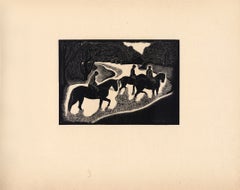
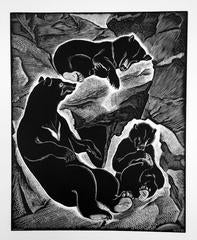
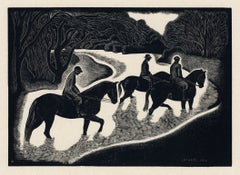
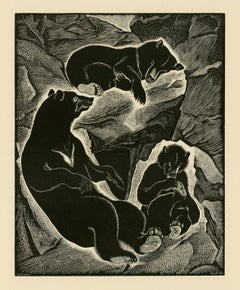
Beginning her career as a commercial artist, Barbara Latham travelled to Taos in 1925 seeking material for a greeting card. Serendipitously, she also found her life partner, Howard Cook, who was similarly looking for ideas for illustrations. Perhaps both were fueled in their quest by the tales of their mutual teacher, Andrew Dasburg, who knew of the energy and stimulation of this artist community. Observing local people and customs, Latham created genre scenes that offer a window into this now-vanished time and place. Her lively illustrations for numerous children’s books are a significant contribution to that graphic art in the mid-20th century. Born in Walpole, Massachusetts, Latham’s student days included Norwich Art School and Pratt Institute in Brooklyn; but it was contact with the charismatic Dasburg at the Art Students League in Woodstock that opened her world and her view of art. Getting work with companies like Norcross Publishing and Forum magazine, she eventually made her way to Taos. Among all the spirited young artists gathered there, she met Howard Cook, who was designing illustrations for Willa Cather’s Death Comes to the Archbishop. The two married in Santa Fe and began a nomadic life together. The young couple made their way to Paris, a likely destination for modernist artists. Upon receiving a Guggenheim to study fresco painting in 1932, Cook, along with Latham, took an alternative direction and headed to Taxco, Mexico. At this time, Mexican muralists, such as Diego Rivera, were capturing the attention of progressive artists. During the Depression, both Cook and Latham aligned themselves with a populist ideal. Latham contributed work, such as Fording the Stream and Bear Family, to the American Artists Group, which was founded to produce original prints at affordable prices. When Latham settled in Taos, she was committed to an art of and for the people. Rather than a romanticized re-creation, her choice of subjects was based in common everyday activities, favoring those which brought people together. Providing a livelihood, Latham’s illustrations for children’s books reflected her heartfelt belief in the availability of art for all, and her style of open brushwork contributed to a modernist transformation of this graphic art. After World War II, Latham experimented with Surrealism and abstraction. Many of her painted genre scenes of the fifties simplify forms in order to intensify the interplay of color and shapes. With minimal background, figures are elegantly drawn to an essence, which seems to both capture their actions and take them out of time. Riders on horses have the same linear classicism of Parthenon sculptures, and the brilliance of figure groupings separate them from the background like a frieze. Latham and Cook had a long-lived marriage, which was grounded in keeping their creative life separate. Latham even confessed that she did not recognize some of her husband’s work upon exhibition. In 1976, the couple moved to Santa Fe, which became their final home. ©David Cook Galleries, LLC
to
4
Overall Width
to
Overall Height
to
4
4
1,567
1,074
932
659
4
3
4
4
2
2
2
1
1
1
3
1
1
1
4
Artist: Barbara Latham
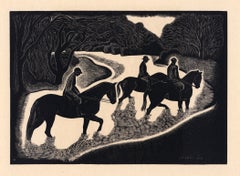
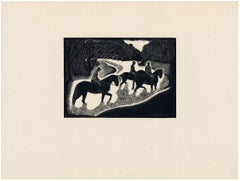
Fording the Stream — 1936 Taos Regionalist Wood Engraving, Woman Artist

Fording the Stream — 1936 Taos Regionalist Wood Engraving, Woman Artist

By Barbara Latham

Located in Myrtle Beach, SC

Barbara Latham, 'Fording the Stream', wood engraving, edition not stated, 1936. Signed and dated in the block, lower right. A fine, richly-inked impression, on cream wove Japan paper...

Category

1930s American Modern Barbara Latham Prints and Multiples

Materials

Woodcut

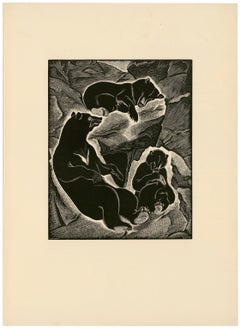
Bear Family — 1937 Original Wood Engraving

Bear Family — 1937 Original Wood Engraving

By Barbara Latham

Located in Myrtle Beach, SC

Barbara Latham, 'Bear Family', wood engraving, edition not stated, 1937. Signed in the block, lower left. Dated in the block, lower right. A fine, richly-inked impression, on cream w...

Category

1930s American Modern Barbara Latham Prints and Multiples

Materials

Woodcut

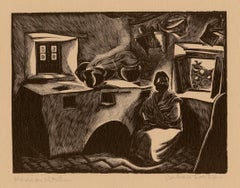
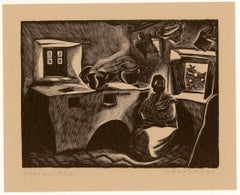
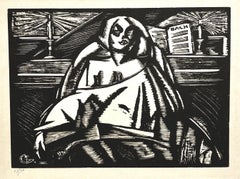
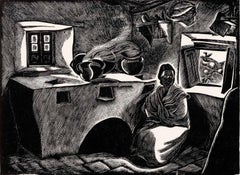
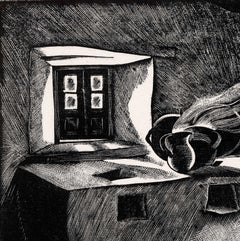
Our Mexican Kitchen — 1932 Signed Wood Engraving, Woman Artist

Our Mexican Kitchen — 1932 Signed Wood Engraving, Woman Artist

By Barbara Latham

Located in Myrtle Beach, SC

Barbara Latham, 'Our Mexican Kitchen', wood engraving, edition not stated but small, 1932. Signed and titled in pencil. A fine richly-inked impression, on tan wove paper, with full margins (5/8 to 7/8 inch), in excellent condition. Matted to museum standards, unframed. Image size: 5 5/8 x 7 5/8 inches (143 x 194 mm); sheet size 7 1/4 x 9 inches (184 x 229 mm). An impression of this work is held in the collection of the Metropolitan Museum of Art. ABOUT THIS WORK During the late 1920s and early 1930s, Latham traveled extensively with her husband, the artist–printmaker Howard Cook, working for periods in Mexico, Europe, and the American South. These experiences broadened her artistic vision while reinforcing her commitment to creating modernist works rooted in direct observation. 'Mexican Kitchen' (also known as 'Our Mexican Kitchen') exemplifies Latham's technical mastery and assured compositional sense. Transforming an ordinary domestic interior into a compelling modernist composition, she employs strong structural rhythms, subtle tonal contrasts, and carefully balanced forms to create a dynamic space imbued with an intimate sense of everyday life. ABOUT THE ARTIST Barbara Latham (1896–1989) was an American printmaker, painter, and illustrator whose work is closely associated with the Regionalist movement and the broader development of American graphic art in the first half of the twentieth century. Born in Walpole, Massachusetts, she pursued her early studies at the School of the Museum of Fine Arts, Boston, and later in New York, where she became part of a generation of artists committed to depicting American subjects with unembellished clarity and conviction. Latham's formation as an artist coincided with a period of renewed interest in printmaking as a primary medium of expression. Working principally in lithography and wood engraving, she developed a disciplined approach grounded in draftsmanship and strong compositional integrity. Her work reflects direct engagement with the American scene, particularly the rural environments of New England, the American South, and later the Southwest, where she worked from direct observation. By the 1930s and 1940s, Latham had established a distinctive voice within American Regionalism. Her prints depict landscapes, village life, and shared human experience with an unusual balance of modernist design and emotional accessibility. Rather than romanticizing rural subjects, Latham approached them with empathy and quiet humanism, finding dignity and beauty in ordinary moments. This combination of formal restraint and genuine warmth remains one of the defining qualities of her work. Technically, Latham's lithographs are notable for their subtle tonal gradations and ability to evoke atmosphere without sacrificing clarity. Her wood engravings demonstrate a decisive economy of line, simplified forms, and masterful control of black and white to create compositions of remarkable graphic strength. Across both media, her work reflects exceptional technical expertise anchored by a deep commitment to balanced design and visual integrity. In addition to her work as a fine artist, Latham enjoyed a distinguished career as an illustrator. She designed greeting cards for the Norcross Publishing Company and contributed illustrations to such publications as Forum magazine and The New York Times Sunday Magazine. She also earned widespread recognition as a children's book illustrator. Her book 'Maggie' was selected by the American Institute of Graphic Arts as one of the outstanding illustrated books produced between 1945 and 1950, reflecting the same clarity of design and sympathetic observation that characterize her prints. Following her move to Taos, New Mexico, Latham became associated with the community of artists known as the Taos Moderns. There she expanded her work in painting, producing luminous landscapes and scenes of Southwestern life that complemented her achievements in printmaking. Her New Mexico paintings...

Category

1930s American Modern Barbara Latham Prints and Multiples
Materials

Woodcut

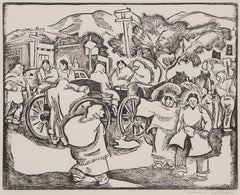
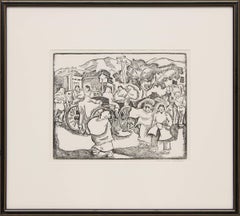
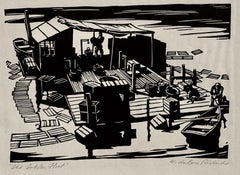
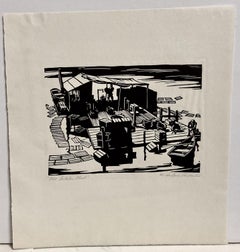
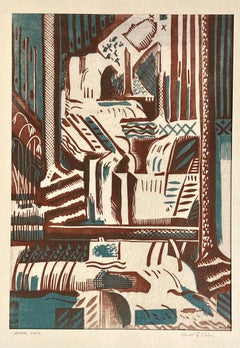
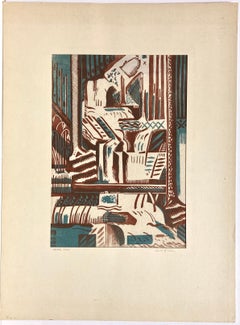
Barbara Latham 1950s Modernist Linocut “Saturday Morning, Taos Plaza”

Barbara Latham 1950s Modernist Linocut “Saturday Morning, Taos Plaza”

By Barbara Latham

Located in Denver, CO

A vibrant celebration of Taos life and culture, Saturday Morning (Market, Taos Plaza, New Mexico) is a striking 1950s modernist linocut print by acclaimed New Mexico artist Barbara L...

Category

Mid-20th Century American Modern Barbara Latham Prints and Multiples

Materials

Linocut

Related Items
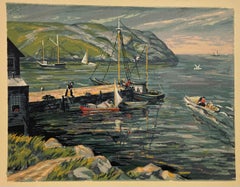
Harry Shokler, Island Harbor

Harry Shokler, Island Harbor

By Harry Shokler

Located in New York, NY

Harry Shokler used serigraphy to great advantage in this landscape. It's colorful and detailed. It is signed in the image at the lower left. When printmakers began making serigraphs...

Category

1940s American Modern Barbara Latham Prints and Multiples

Materials

Screen

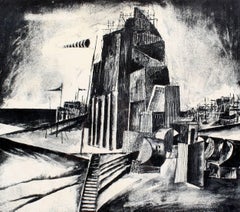
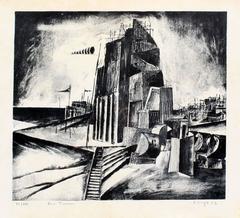
Modern American Industrial Landscape

Modern American Industrial Landscape

Located in Buffalo, NY

An original woodblock print dated 1965, titled "Our Town" but signed illegibly.

Category

1960s American Modern Barbara Latham Prints and Multiples

Materials

Paper, Woodcut

Oscar Weissbuch, Westchester Hills (NY), New Deal, WPA-era wood engraving

Oscar Weissbuch, Westchester Hills (NY), New Deal, WPA-era wood engraving

Located in New York, NY

New York City native Oscar Weissbuch (1904-1948), attended the Yale University School of Fine Arts and the Art Students League, NY. He participated in the NYC-WPA printmaking project...

Category

1930s American Modern Barbara Latham Prints and Multiples

Materials

Woodcut

Samuel Chamberlain, The Public Gaol, Williamsburg (Virginia)

Samuel Chamberlain, The Public Gaol, Williamsburg (Virginia)

By Samuel Chamberlain

Located in New York, NY

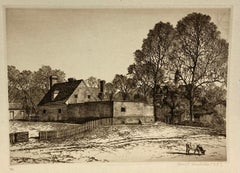
Samuel Chamberlain was a superb draftsman and his architectural images are often very complex. This image is, by contrast, quiet and understated: serene to the point of lonely. It's ...

Category

1930s American Modern Barbara Latham Prints and Multiples

Materials

Drypoint

John Muench, The Road to Stow

John Muench, The Road to Stow

Located in New York, NY

John Muench was a master at drawing on a lithographic stone. He was a New Englander and this is a classic subject both for him and for the area. The...

Category

Mid-20th Century American Modern Barbara Latham Prints and Multiples

Materials

Lithograph

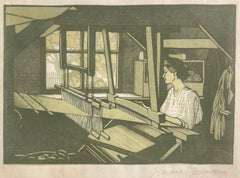
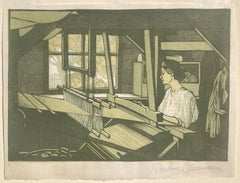
THE RUG WEAVER
THE RUG WEAVER

Gustave BaumannTHE RUG WEAVER, 1910

$2,250

H 9 in W 13.125 in

THE RUG WEAVER

By Gustave Baumann

Located in Santa Monica, CA

GUSTAVE BAUMANN (1881 – 1971) THE RUG WEAVER, 1910 (Chamberlain 26) Color woodcut signed in pencil. Unnumbed from an edition 100 as published in the Hills o’ Brown...

Category

1910s American Modern Barbara Latham Prints and Multiples

Materials

Woodcut

Amos
Amos

Leonard BaskinAmos, 1960

$950

H 23 in W 27 in D 0.75 in

Amos

By Leonard Baskin

Located in San Francisco, CA

This artwork titled "Amos" 1960 is an original woodcut on paper by noted American artist Leonard Baskin, 1922-2000. It is hand signed, titled and numbered 35/50in pencil by the artis...

Category

Mid-20th Century American Modern Barbara Latham Prints and Multiples

Materials

Woodcut

Walter DuBois Richards, The Lobster Float

Walter DuBois Richards, The Lobster Float

By Walter DuBois Richards

Located in New York, NY

Ohio-born Walter DuBois Richards (1907-2006) was educated at the Cleveland School of Art. He re-located to New York around 1933 where he had a successful career as a commercial artis...

Category

1930s American Modern Barbara Latham Prints and Multiples

Materials

Woodcut

Harold E. Keeler, Water Fall

Harold E. Keeler, Water Fall

Located in New York, NY

Harold E. Keeler worked in Hollywood as a set designer. That seems especially important here because the Water Fall looks a little as though it could be a w...

Category

1930s American Modern Barbara Latham Prints and Multiples

Materials

Linocut

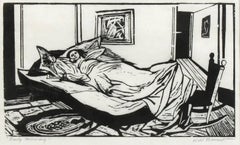
Early Morning
Early Morning

Will BarnetEarly Morning, 1939

$7,500

H 9 in W 15 in

Early Morning

By Will Barnet

Located in Buffalo, NY

A nice rare woodcut by the noted American Artist Will Barnet. This woodcut is from 1939 and is titled and pencil signed on the base "Early Morning", Will...

Category

1930s American Modern Barbara Latham Prints and Multiples

Materials

Paper, Woodcut

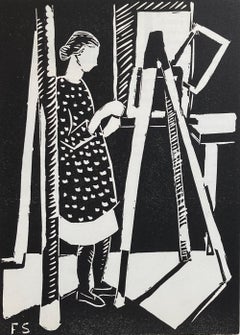
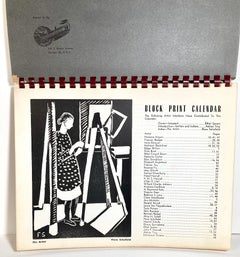
Flora Schofield, Chicago Block Print Calendar, 1942, mid-century

Flora Schofield, Chicago Block Print Calendar, 1942, mid-century

Located in New York, NY

As this is a calendar for 1942, the prints were no doubt made in 1941. All images are wood engravings by members of the Chicago Society of Artists. With essay by Ernest F. Detterer, Custodian, Newberry Library, Chicago. The outside measurements are 8 1/2 x 11 x 1 inches. The cover image and most of the additional works are 5 x 7 inches. The edition was planned for 2000 copies but it is extremely unlikely that that number was ever printed and this item is now scarce. There is one image per week. The stamp 'Labor (?) World Press Printers, 508 S. Kedzie Avenue, Chicago,' is on the inside cover. The first word is partly obliterated. Among the additional artists are Ethel Spears (cover image), Kathleen Blackshear, Fritizi Brod, Elise Donaldson, Frances Foy, Rowena Fry...

Category

1940s American Modern Barbara Latham Prints and Multiples

Materials

Woodcut

Heinrich Glintenkamp, (Woman at Piano - Bach)

Heinrich Glintenkamp, (Woman at Piano - Bach)

By Heinrich Glintenkamp

Located in New York, NY

An American painter, printmaker, and illustrator. His work was featured in "The Masses" and at the Metropolitan Museum of Art and Pennsylvania Academy of the Fine Arts. This wood en...

Category

Mid-20th Century American Modern Barbara Latham Prints and Multiples

Materials

Woodcut

Previously Available Items
Fording the Stream — 1936 Southwest Regionalist Wood Engraving

Fording the Stream — 1936 Southwest Regionalist Wood Engraving

By Barbara Latham

Located in Myrtle Beach, SC

Barbara Latham, 'Fording the Stream', wood engraving, edition not stated, 1936. Signed and dated in the block, lower right. A fine, richly-inked impression, on cream wove paper, with full margins (2 3/4 to 4 3/4 inches); in the original American Artists Group folder–mat. Slight toning at the sheet edges; a paper imperfection in the bottom center margin, well away from the image, otherwise in good condition. Unframed. Image size: 6 x 8 1/2 inches (152 x 216 mm); sheet size 13 1/2 x 18 inches (343 x 457 mm). ABOUT THIS WORK During the 1930s, Latham increasingly turned to rural American subjects, distilling scenes of everyday life into compelling compositions. In Fording the Stream, three mounted riders quietly crossing shallow water become the focus of a work that is both dramatic and inviting. Strong contrasts of black and white, together with the sweeping curves of the stream and overhanging trees, create a dynamic modernist composition while conveying a sense of shared purpose, quiet companionship, and the enduring rhythms of rural life. ABOUT THE ARTIST Barbara Latham (1896–1989) was an American printmaker, painter, and illustrator whose work is closely associated with the Regionalist movement and the broader development of American graphic art in the first half of the twentieth century. Born in Walpole, Massachusetts, she pursued her early studies at the School of the Museum of Fine Arts, Boston, and later in New York, where she became part of a generation of artists committed to depicting American subjects with unembellished clarity and conviction. Latham's formation as an artist coincided with a period of renewed interest in printmaking as a primary medium of expression. Working principally in lithography and wood engraving, she developed a disciplined approach grounded in draftsmanship and strong compositional integrity. Her work reflects direct engagement with the American scene, particularly the rural environments of New England, the American South, and later the Southwest, where she worked from direct observation. By the 1930s and 1940s, Latham had established a distinctive voice within American Regionalism. Her prints depict landscapes, village life, and shared human experience with an unusual balance of modernist design and emotional accessibility. Rather than romanticizing rural subjects, Latham approached them with empathy and quiet humanism, finding dignity and beauty in ordinary moments. This combination of formal restraint and genuine warmth remains one of the defining qualities of her work. Technically, Latham's lithographs are notable for their subtle tonal gradations and ability to evoke atmosphere without sacrificing clarity. Her wood engravings demonstrate a decisive economy of line, simplified forms, and masterful control of black and white to create compositions of remarkable graphic strength. Across both media, her work reflects exceptional technical expertise anchored by a deep commitment to balanced design and visual integrity. In addition to her work as a fine artist, Latham enjoyed a distinguished career as an illustrator. She designed greeting cards for the Norcross Publishing Company and contributed illustrations to such publications as Forum magazine and The New York Times Sunday Magazine. She also earned widespread recognition as a children's book illustrator. Her book 'Maggie' was selected by the American Institute of Graphic Arts as one of the outstanding illustrated books produced between 1945 and 1950, reflecting the same clarity of design and sympathetic observation that characterize her prints. Following her move to Taos, New Mexico, Latham became associated with the community of artists known as the Taos Moderns. There she expanded her work in painting, producing luminous landscapes and scenes of Southwestern life that complemented her achievements in printmaking. Her New Mexico paintings...

Category

1930s American Modern Barbara Latham Prints and Multiples
Materials

Woodcut

Our Mexican Kitchen
Our Mexican Kitchen

Our Mexican Kitchen

By Barbara Latham

Located in New Orleans, LA

Barbara Latham created this wood engraving of the kitchen in the Taxco, Mexico home she shared with her husband, artist Howard Cook. The house that Barbara and Howard Cook rented from John Evans, the son of Mabel Dodge Luhan, is shown with the Mexican cook who worked for them. It also shows the lemon tree outside their window. Painter, print maker, and children's book illustrator Barbara Latham was born in Walpole, Massachusetts, in 1896. She was raised in Norwich, Connecticut, and studied at the Norwich Free Academy and then attended Pratt Institute from 1915 to her graduation in 1919. She then studied with Andrew Dasburg at the Art Students League's summer school in Woodstock, New York. She spent the early part of her career in New York, where she worked for the Norcross Publishing Company and did illustrations for Forum magazine and the New York Times Sunday magazine. In 1925, Latham went to Taos, New Mexico, for the first time to seek material for illustrations for a greeting card company. She met artist Howard Cook, who was in the process of developing illustrations for Willa Cather's Death Comes to the Archbishop. The couple married in 1927. From 1928 to 1935, they traveled widely including to Mexico; Springfield, Massachusetts; Paris; and Connecticut. In 1933, the couple made their home near Taos. In 1976, they settled in Santa Fe. Latham created prints and paintings of New Mexico subjects: the Taos landscape, views of the town and genre scenes depicting the seasons of rural life including that of the Taos Indians. She also illustrated children's books and did pencil drawings. Latham's illustrations for children's books included those for Pedro, Nina and Perrito, 1939, and Maggie, which was chosen as one of the best books from the period of 1945 to 1950 by the American Institute of Graphic Arts. One of her paintings, Approaching Storm, c. 1930, is an expressive painting emphasizing the orange of the earth and green of trees against the dark, stormy sky. In style, the painting is a blend of the characteristics of the New Mexico landscape, the colorful approach to landscape developed by the original Taos painters...

Category

1930s American Modern Barbara Latham Prints and Multiples
Materials

Wood, Engraving

Bear Family

Bear Family

By Barbara Latham

Located in New York, NY

Barbara Latham (1896-1988), Bear Family, 1937, wood engraving, unsigned [signed and dated in the block]. Published by American Artists Group. In excellent condition, on an ivory wove paper, the full sheet with full margins, 10 x 8, the sheet 13 x 18 inches. Window matting, with archival board, unattached mylar hinging. A fine impression of this charming image. The American Artists Group was formed in 1934, during the Great Depression, with the express purpose of providing unsigned inexpensive prints which were to be widely distributed. AAG published prints by Ganso, Spruance, Meissner, Ruzicka and Lankes, among many other noted artists. Although the prices of these prints was minimal, sales were sluggish in that economy and editions werenot sold out; most printingswere under 200...

Category

1930s American Realist Barbara Latham Prints and Multiples
Materials

Woodcut

Barbara Latham prints and multiples for sale on 1stDibs.
Find a wide variety of authentic Barbara Latham prints and multiples available for sale on 1stDibs. You can also browse by medium to find art by Barbara Latham in linocut and more. Much of the original work by this artist or collective was created during the 20th century and is mostly associated with the modern style. Not every interior allows for large Barbara Latham prints and multiples, so small editions measuring 18 inches across are available. Customers who are interested in this artist might also find the work of Lawrence Wilbur, Louis Conrad Rosenberg, and Samuel Chamberlain. Barbara Latham prints and multiples prices can differ depending upon medium, time period and other attributes. On 1stDibs, the price for these items starts at $795 and tops out at $795, while the average work can sell for $795.