By Cristalleries De Baccarat
Located in Long Island City, NY, NY
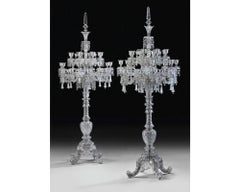
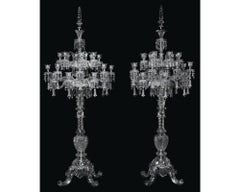
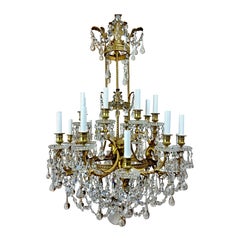
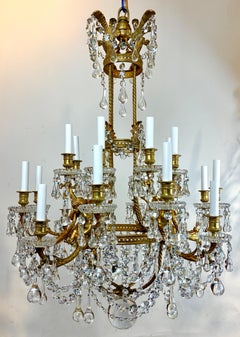
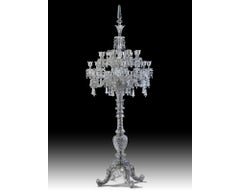
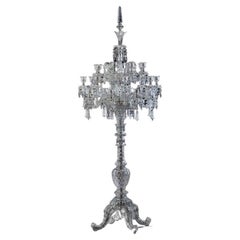
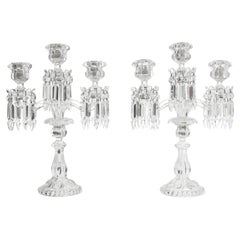
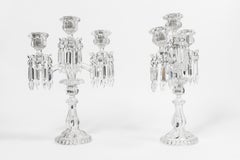
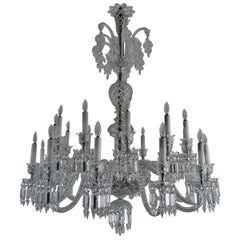
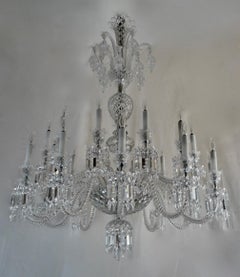
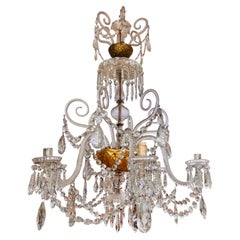
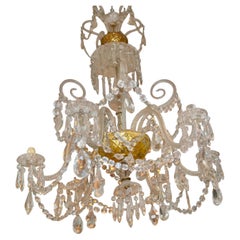
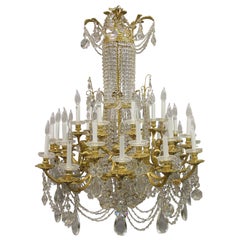
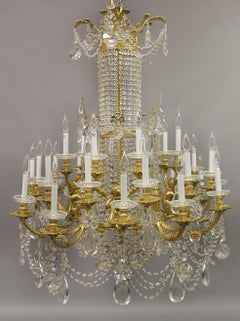
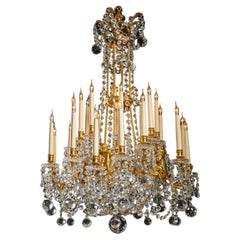
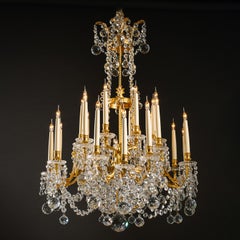
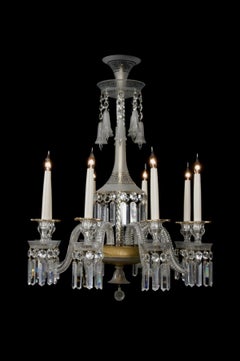
Cristalleries De Baccarat, A Large French Cut-Crystal Twenty-Four Light Tsarine Torcheres, Standing Floor Chandelier.
"A Magnificent Chandelier"
Each central stem issuing twenty-four out-scrolled candle branches suspending prisms and bell-flowers, on four splayed supports, in the Indian Maharaja style, stamped BACCARAT throughout.
86" high x 33" wide
Wired for electricity. In overall excellent condition. The torchère is fully complete and there are no damages associated.Ready to place.
Comparative Literature:
Lerch, Moscou, Splendeurs des Romanov, Exhibition catalogue, 11 July – 13 September 2009, Monaco, pp. 214-217.
M. Lerch, Baccarat: la légende du cristal, Exhibition catalogue, 15 October 2014 – 4 January 2015, Paris, pp.68-69.
D. Sautot, The Story of Baccarat, Paris, 1993.
Cristalleries de Baccarat:
The origins of the manufacture, also known as the Compagnie des Cristalleries de Baccarat, can be traced to 1764. On this year, King Louis XV accorded to the Bishop of Metz permission to establish a glass factory on his land, in the small village of Baccarat in Lorraine, in order to compete with the celebrated Bohemian production. Lorraine is traditionally a glass-making region, due to the abundance of silica in the soil and due to its large forests, which supplied the wood to fuel the ovens. Francois-Eugène de Fontenay, who joined the company in 1841, discovered that the addition of nickel oxide in the manufacturing process resulted in a perfectly clear product, 'crystal glass', that was free of discoloration and that imitated precious rock crystal. For this discovery, the Baccarat company was awarded a gold medal at the French Expositions des Produits de l'Industrie in 1844. Continually experimenting with their manufacturing process, the quality of Baccarat's 'crystal glass' improved, reaching the highest level by the end of the century.
The Baccarat manufacture rapidly became a leading producer with highly skilled maître-verriers. In 1823, Baccarat participated for the first time at the National Exhibition. Louis XVIII was seduced by the quality of the pieces presented, which received the praise of the jury and the first gold medal. As a result of their success and innovations, the manufacture gradually consolidated its reputation, which allowed it to dominate the French market.
The Russian fascination for Baccarat:
In 1867, Tsar Alexander II visited the Exposition Universelle in Paris and fell in awe in the sight of Baccarat’s stand...
Category
20th Century French Cristalleries De Baccarat Furniture