Located in SANT ADRIÀ DE BESÒS, ES
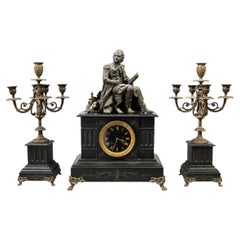
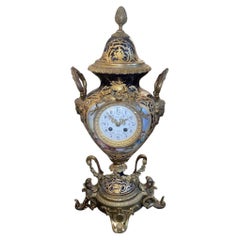
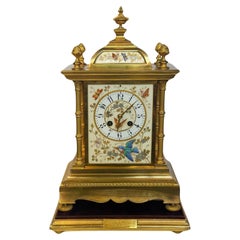
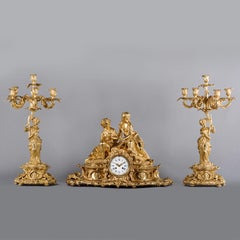
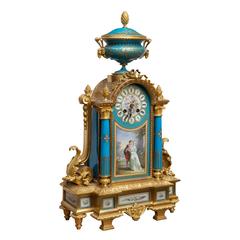
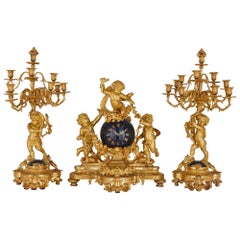
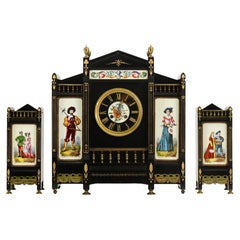
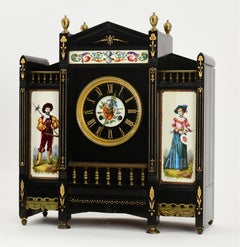
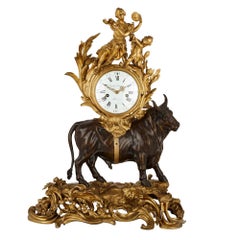
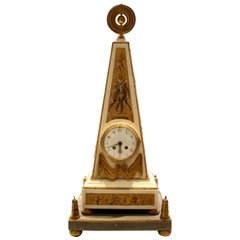
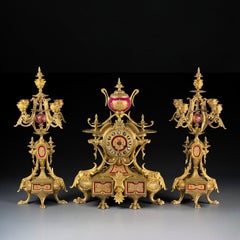
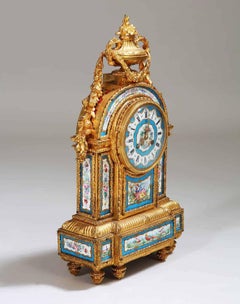
A highly unusual and richly conceived three-piece clock garniture, probably French and dating from the late 19th century, comprising a substantial mantel clock and a pair of matching five-light candelabra.
The ensemble is distinguished by an exceptionally coherent decorative program centered on griffins and fantastical chimerical creatures. Sculptural griffin forms flank the body of the clock, further griffin heads appear beneath the lateral platforms, while a prominent fantastical mask forms the central element of the lower case. The same imagery is repeated throughout the hand-decorated porcelain panels, creating a remarkable visual relationship between the sculptural mounts and the ceramic decoration.
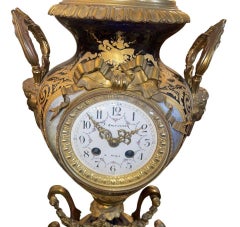
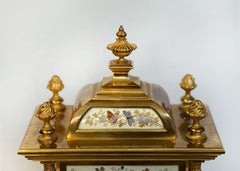
The clock is surmounted by a large polychrome porcelain vessel held within an elaborate gilt-metal mount and decorated in a vivid palette of deep raspberry, turquoise, violet, red and gold. Similar colors and fantastical creatures appear throughout the numerous inset porcelain plaques and on the central dial. Individual black Roman-numeral cartouches surround the dial, contributing to the highly architectural character of the composition.
The pair of tall matching candelabra continue the same elaborate decorative vocabulary, with five-light arrangements, scrolling branches, architectural finials, polychrome porcelain elements and griffin-form supports.
Stylistically, the garniture belongs to the eclectic Historicist vocabulary of the later 19th century, combining Neo-Gothic and Renaissance Revival elements with a more exotic Orientalist or Japonisant sensibility. The pronounced use of fantastical animals, vivid color and elaborate architectural metalwork distinguishes the ensemble considerably from more conventional porcelain-mounted French clock garnitures of the period.
Of particular interest, inspection of the porcelain components revealed at least three concealed handwritten inscriptions apparently reading “Gallé” on reverse or interior surfaces. These inscriptions are hidden once the components are assembled and appear to have served a workshop or production-related purpose.
The inscriptions are recorded exactly as observed. No definitive documentary attribution to Émile Gallé or the Maison Gallé has presently been established, and any such attribution remains preliminary. Their repetition on several separate porcelain components is nevertheless noteworthy and merits further research.
The garniture is exceptionally substantial in construction. The clock alone weighs approximately 10 kg, while each candelabrum weighs approximately 4 kg.
The mechanical movement was tested continuously for approximately 24 hours prior to listing. During this test, the clock remained in operation and the striking mechanism functioned correctly. The movement was therefore found to be in good working order at the time of testing.
As with any antique mechanical clock...
Category
19th Century French Gothic Revival Antique Mantel Clocks