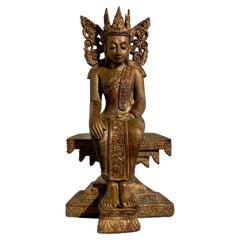
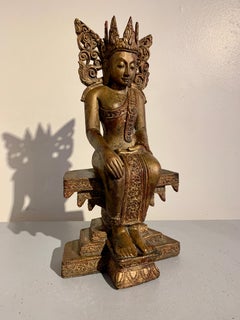
A sublime Burmese carved, lacquered and gilt hardwood crowned Buddha seated in a "western pose", early to mid 20th century, Burma (Myanmar).
The elegant and graceful Buddha is portrayed wearing an elaborate six pointed crown with two large "wings" to the side, and a simple robe wrapped around the body and draped over one shoulder. He is seated upon a high stepped throne, his feet resting upon a double lotus pedestal.
The Buddha's face is serene. He stares out in the distance calmly, with eyes slightly downcast, and a slight smile on his face. His long, pendulous earlobes blend in with the wings of the elaborate crown upon his head. A lotus bud finial would originally have surmounted the head, but is now missing. He holds one hand in his lap, palm up in a meditative gesture. His other hand rests gently on his knee.
This pose, with the Buddha seated upon a raised throne, with both legs planted on the floor, is often referred to as a "western pose". The pose is most often associated with the Bodhisattva Maitreya...
Category
Mid-20th Century Burmese Lacquer Decorative Objects
MaterialsHardwood, Lacquer