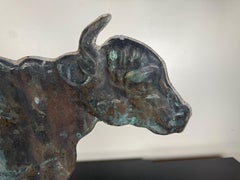
A rare large and most impressive rustic midcentury Japanese Ainu hand carved Ussuri Brown Bear sculpture.
Indigenous Ainu Peoples, probably Ashikawa, Hokkaido, Japan's northernmost island, mid-20th century, anonymous artist.
This exceptional example of traditional Kibori Kuma (木彫り熊) was finely hand carved, chiseled, sculpted and painted from a massive block of solid Japanese hardwood, using old primitive techniques with customized knives and chisels, the artisan would sit on the hut floor, using their feet as a vice to hold the block of wood, carefully manipulating and turning, wood chips flying, skillfully carving to create this beautiful piece of art!
This massive scale realistic rendering showcases the artisan's exemplary skills, workmanship, and artistry, the bears aggressive naturalistic appearance comes to life, evoking power, strength, and natural bounty, lending to its fierce dramatic presence.
Modeled as a wild Ussuri brown bear standing on four legs, head slightly tilted up as if about to expel a ferocious roaring growl, having inset black glass eyes, mouth agape with jagged teeth exposed, the bold muscular body with distinct richly textured chip-carved fur, this sculpture captures the essence of Ainu reverence for nature, this sacred animal, and their deep connection to the land. No apparent signatures, typical of folk art work.
- DIMENSIONS: (approx)
19.5" Wide x 11.375" Tall x 13.25" Deep;
Wight: 18.75lbs
- HISTORY / BACKGROUND:
The Ainu are an aboriginal hunter/gatherer/fisher people who once inhabited many of the islands that bound the southern half of the Sea of Okhotsk north of the main Japanese island of Honshu and Southern Russia.
Their land was contested by the Japanese Empire and the USSR for centuries, with the Meiji era Japan colonisation of Hokkaido taking place in the 19th century.
Colonisation dispossessed the native Ainu people of their lands and property. Widespread discrimination enforced against them, including their forced relocation into mountain areas and the prohibition of the use of the Ainu language decimated their economy with the eventual aim of the extinction of Ainu culture and its replacement by Yamato Japanese culture.
The history of the Ainu bear...
Category
Mid-20th Century Japanese Black Forest Hand-Crafted Folk Art
MaterialsArt Glass, Hardwood, Paint