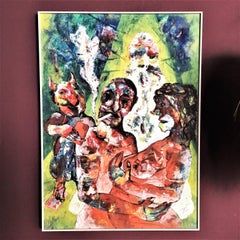
By Jackson Pollock
Located in New York City, NY
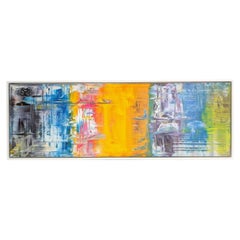
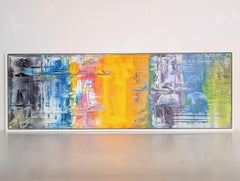
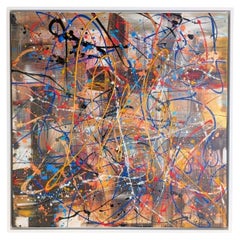
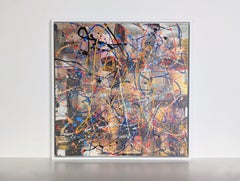
Steven Colucci is a perfectionist. As a painter, he describes himself as “a dictator, a controlling ballet master with a stick,” dispassionately choreographing his composition to achieve the exact result he desires. The paintings of the “Sea Series,” largely completed in 2010, are actually the culmination of 4-5 years of practice for the artist, during which he consistently developed and refined the language and formal elements that visually distinguish the series, sometimes repeating the same image for months until he was satisfied.
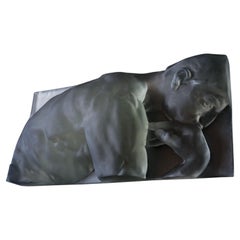
Colucci’s methods and philosophy reflect his experience with movement as a performing art. While he studied with and admires Vito Acconci, Colucci is no proponent of conceptualism, finding his voice in the intense discipline of traditional forms, explaining, “If you don’t practice art like a classical pianist, every day, you can’t execute your concepts.” After completing his studies at New York’s School of Visual Arts, he moved to Paris, where he studied and performed mime and ballet, working closely with Marcel Marceau, who also painted, and Etienne Decroux, a sculptor as well as the originator of the form “classical mime,” which has roots in the sculpture of Rodin.
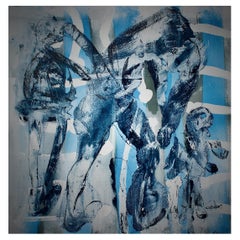
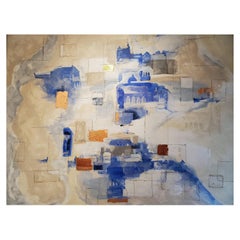
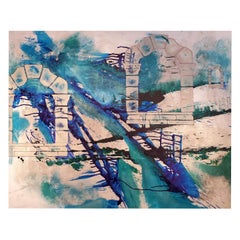
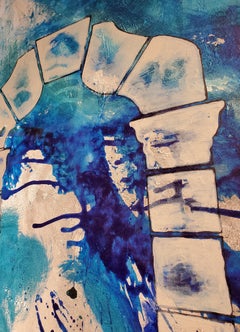
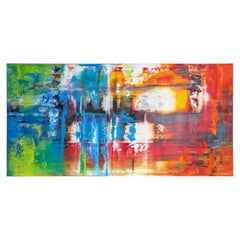
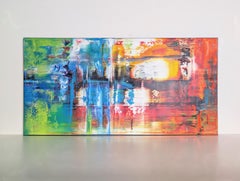
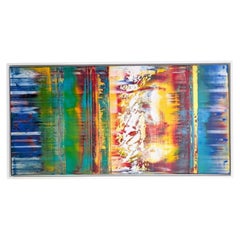
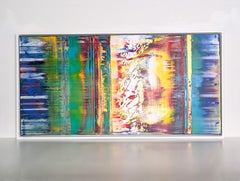
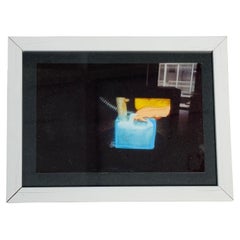
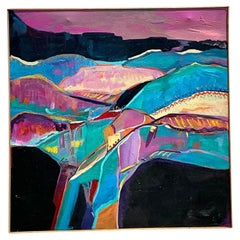
If the word “sea” in the title of a painting conjures for you images of little easels and landscape canvases featuring sandy beaches, waves, and vast horizons, think again – Colucci’s oceanic visions are experiential, viewing them you are often looking down at the sea, within it, or even dreaming of the ocean. Water, deep or shallow, still or fast-moving, rules how we see light and subjects, as the artist works to reflect what he calls “the spirit, the soul of the water.” In “Deep Blue,” he conjures this anima via a window through levels of roiling currents of rich dark waves and dancing highlights, inviting the viewer to experience the sea as a vibrant and enveloping sensual entity.
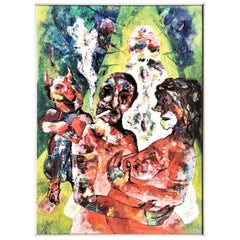
Colors, too, differ from the subdued palette of the seaside afternoon painter. Often his choices originate in what Colucci describes as the rhythm of color present in Afro-Carribean art and design. In the paintings, these hues express the water’s likeness to the seamless flow of the Dominican culture’s music and dance, which he so enjoys during frequent visits to Upper Manhattan’s El Barrio district, a movement with the melodic line that he so simply and perfectly employs in the delightfully sexy “Swimming with the Fish.”
As our bodies, like the sea, are largely water, Colucci’s water visions...
Category
2010s Plastic Wall Decorations