Study of Five Heads - Original Etching by J.-J. Boissieu
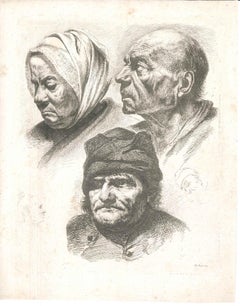
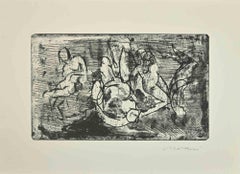
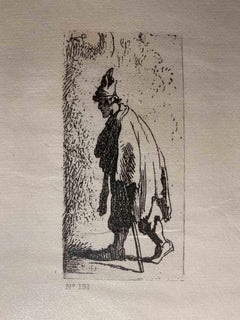
Study of Five Heads is a beautiful black and white etching with drypoint interventions on paper, realized at the end of XVIII century by the French artist Jean-Jacques de Boissieu (Lyon, 1736- 1810).
Five study of heads of which two profiles (a female and a male) are lightly sketched with the drypoint technique, and we could appreciate the incredible draftsmanship. Instead, the bigger three portraits are very detailed and etched with a superb technique. Although the subjects are drawn in different scales and with different degrees of finish, each portrait has the dignity of a unique piece and the composition is very balanced.
In particular on the lower margin at the center there is the portrait of "Le Père Cotrot, Garçon Teinturier à Lyon'", an elderly man, toothless and with a large-nosed, slightly turned to left, with a hat and unbuttoned jacket over waistcoat, shows all his wrinkles in a very realistic way.
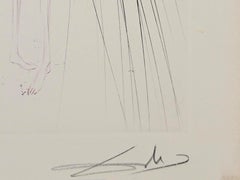
Signed on plate on lower right margin “De Boissieu”.
This old master’s original print with fresh impressions, is in very good conditions, except for a usual yellowing of the paper above all on the edges and some signs of the time and light foxing along the margins, do not affect the image.
Jean-Jacques de Boissieu (Lyon,1736 –1810)
Jean-Jacques de Boissieu was a French artist studied at the École de Dessin in Lyon, but he was mostly self-taught.
His first prints were realized between 1758–64. When he went to Italy in the retinue of the ambassador and Duc de la Rochefoucauld d’Enville, he had the lifechanging encounter: he met Voltaire and he entered in the world of luminaries, he had the opportunity of realizing some plates for the Diderot-d’Alembert’s Encyclopèdie. Then he continued to produce prints in Lyon, Boissieu made many etchings of the Roman and Dutch countryside, as well as the French countryside around Lyon, which earned him a reputation as the last representative of the older etching...
Category
Late 18th Century Old Masters Art by Medium: Engraving
MaterialsDrypoint, Etching

![Untitled (Pair of Figures) [Couple: Combing Hair on the Beach]](https://a.1stdibscdn.com/jared-french-prints-works-on-paper-untitled-pair-of-figures-couple-combing-hair-on-the-beach-for-sale/a_9323/1588562472007/02_French_JFRE0011_Pair_of_Figures_Couple_Combing_Hair_PLATE_ONLY_1200_master.jpg?width=240)