By Rafael Duran Benet
Located in Sitges, Barcelona
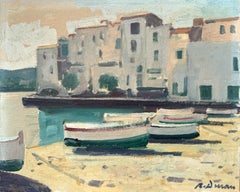
Cadaqués Costa Brava Mediterranean Harbor with Fishing Boats and Whitewashed Village
Artist: Rafael Durán Benet (1931–2015)
Medium: Oil on canvas laid on cardboard
Dimensions: 13 x 16.1 in (33 x 41 cm)
Frame: Unframed
Origin: Spain
Subject: Cadaqués, Costa Brava, Mediterranean harbor, fishing boats, whitewashed village
Style: Post-Impressionist, Mediterranean Modernism
Period: Mid-20th century
Condition: Good vintage condition, with minor signs of age consistent with an original period artwork. Please refer to the photographs for full details.
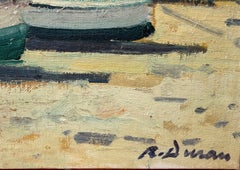
Signature: Signed lower right “R. Duran”
Description
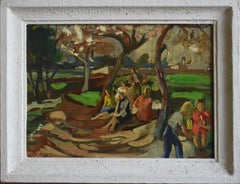
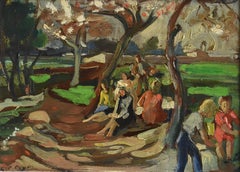
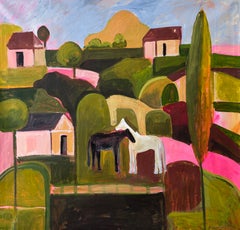
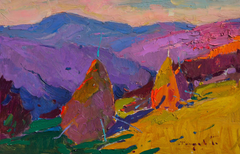
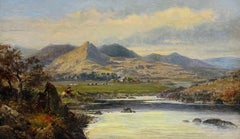
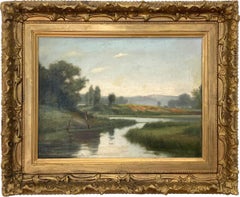
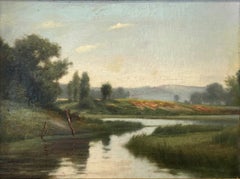
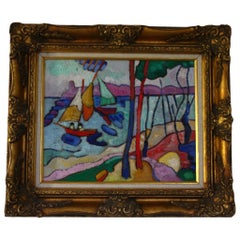
A highly atmospheric Mediterranean coastal scene by Rafael Durán Benet, depicting the unmistakable visual world of Cadaqués on the Costa Brava, with traditional fishing boats resting in the foreground and a cluster of luminous whitewashed houses rising behind the harbor.
The composition combines several of the most desirable subjects in 20th-century Catalan painting: Cadaqués, the Costa Brava, Mediterranean architecture, fishing boats and brilliant coastal light.
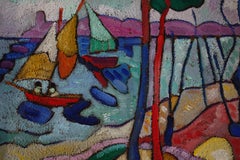
Durán Benet constructs the scene with broad, confident brushwork and a sophisticated palette of turquoise, ivory, ochre, green and deep violet. The boats are reduced to strong, elegant shapes, while the white façades of the village dissolve into soft planes of light and color.
Rather than pursuing photographic detail, the artist captures the atmosphere of Cadaqués through rhythm, light and simplified form. The turquoise water creates a luminous horizontal band across the composition, while the boats and architecture establish a balanced sequence of shapes characteristic of his mature Mediterranean landscapes.
The painting evokes the quiet charm of the historic fishing village of Cadaqués, one of the most iconic artistic destinations on the Costa Brava and one of the great recurring subjects of modern Catalan art.
Biography
Rafael Durán Benet was born in Terrassa, Catalonia, in 1931 and died in Barcelona in 2015. He was the nephew of Rafael Benet i Vancells, the important Catalan painter, critic and art historian, who played a significant role in his early artistic development.
During the 1950s Durán Benet settled in Cadaqués, on the Costa Brava, where the Mediterranean landscape became one of the defining themes of his career. The village, its harbor, whitewashed architecture, fishing boats and surrounding coastline provided him with an enduring visual vocabulary.
Cadaqués was also one of the great artistic meeting points of 20th-century Europe. During his years there, Durán Benet moved within the cultural environment associated with figures such as Salvador Dalí, Marcel Duchamp and Pablo Picasso.
His first solo exhibition was held in 1958 at Sala Vayreda in Barcelona. He later exhibited extensively in Barcelona, Madrid and Cadaqués, as well as internationally in cities including Paris, London, Houston and Los Angeles. He also maintained a longstanding relationship with the prestigious Sala Parés in Barcelona.
In 1980, Durán Benet received the Henri Forman Prize from the Société Nationale des Beaux-Arts in Paris. In 2011, the city of Terrassa honored him with a retrospective exhibition at the Sala Muncunill.
His paintings are immediately recognizable for their luminous Mediterranean palette, simplified architecture, expressive brushwork and ability to transform everyday coastal scenes into poetic studies of light and atmosphere.
Artistic Inspiration
This work belongs directly to the great tradition of Mediterranean and Costa Brava landscape painting that shaped modern Catalan art during the 20th century.
The subject of Cadaqués places the painting within a particularly important artistic context. The village became internationally associated with artists including Salvador Dalí, Pablo Picasso and Marcel Duchamp, while its extraordinary light, rocky coastline, fishing boats and whitewashed architecture attracted generations of painters.
Durán Benet interprets this world through a personal post-impressionist language. His broad brushwork, simplified forms and flattened perspective give the composition a modern character, while his sensitivity to atmosphere preserves the intimacy and authenticity of traditional Mediterranean landscape painting.
A particularly appealing example of Spanish and Catalan Mediterranean painting, combining several highly searchable and collectible subjects: Cadaqués, Costa Brava, Mediterranean harbor, fishing boats, whitewashed village and Spanish modern art.
Cadaqués paintings are especially sought after for their association with the artistic heritage of the Costa Brava and with figures such as Salvador Dalí, Picasso and Duchamp. This work offers that cultural connection while retaining the decorative immediacy and color that make Mediterranean paintings especially attractive in contemporary interiors.
Its compact 13 x 16.1 inch format makes it particularly versatile for collectors and interior designers seeking authentic European art with strong regional identity.
Ideal for collectors of Spanish Modern Art, Catalan Painting, Cadaqués Painting, Costa Brava Art, Mediterranean Landscape, Harbor Painting, Marine Painting, Fishing Boat Art, Post-Impressionism and Mid-Century European Painting.
Cadaqués, Cadaques painting, Costa Brava, Costa Brava painting, Spanish painting, Catalan painting, Mediterranean painting, Mediterranean landscape, Mediterranean harbor, harbor painting, fishing boats, fishing boat painting...
Category
1980s Post-Impressionist Landscape Paintings