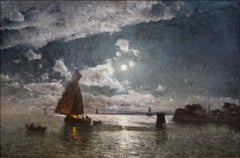
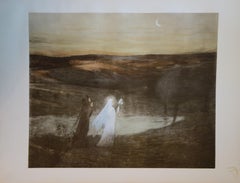
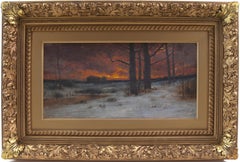
Louis Douzette was a prominent German landscape painter whose artistic practice bridged late Romanticism and early Naturalism. He became especially known for his evocative nocturnal scenes illuminated by moonlight, a recurring subject that defined his mature style. These works reveal a fascination with the interplay of night sky, reflected water, and atmospheric tone. Often described as lyrical or meditative, they draw the viewer into a quiet world of natural reflection and stillness.
Douzette’s early training in Berlin under the marine painter Hermann Eschke grounded him in Romantic landscape traditions, but he soon developed his own voice. He found deep inspiration in the moonlit river scenes of Dutch Golden Age painters such as Aert van der Neer and Jacob van Ruisdael. His commitment to nocturnes emerged in the 1860s, a theme he returned to with increasing focus throughout his career. By the late 1870s, exposure to the Barbizon School and plein-air techniques enriched his approach, infusing his nightscapes with greater realism and atmospheric complexity. This synthesis of romantic mood and naturalist observation defines much of his later output.
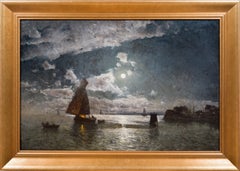
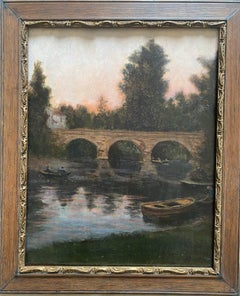
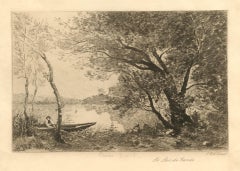
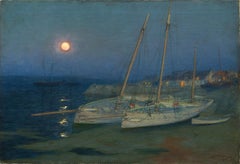
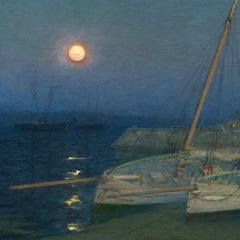
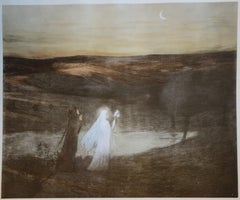
The present work, Moonlit Landscape with Rowboat, captures the artist’s refined handling of tone and light on an unusually intimate scale. Measuring just over 13 by 17 centimetres, the panel presents a tranquil night scene in exquisite detail. A full moon, partially veiled by drifting clouds, casts its reflection over the surface of a river. The silver light falls across the water in rhythmic bands, leading the eye toward a gently moored rowboat. A wooded shoreline flanks the composition on the right, while the distant horizon reveals faint silhouettes of trees beneath a softly glowing sky.
Despite the painting’s modest format, it conveys a remarkable sense of depth and atmosphere. The sky is built with expressive, layered brushwork that suggests subtle variations in cloud density and moonlight diffusion. The reflective water is handled with delicacy, echoing the sky’s luminosity in more muted, rippling form. Dark foliage anchors the composition without overpowering it, creating a gentle contrast that enhances the nocturnal glow. The rowboat, placed with quiet purpose, introduces a human element without breaking the silence of the scene.
Douzette’s contribution to 19th-century German painting...
Category
Romantic 1890s Art