1940s Art

5,715 Results
to
1,123
3,028
1,187
1,081
424
270
Overall Width
to
Overall Height
to
7,669
21,557
166,493
236,901
2,161
2,346
4,732
6,581
6,014
15,887
21,222
26,533
19,338
14,180
5,479
2,132
476
399
265
160
115
86
76
47
22
8
2
2
3,420
2,336
168
3,150
1,476
1,184
1,043
1,007
579
436
432
413
369
288
271
265
246
212
193
166
162
156
145
2,077
1,384
1,319
1,124
741
133
108
106
57
54
1,700
958
3,800
2,193
Period: 1940s
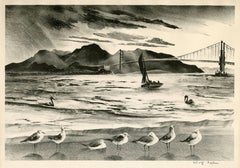
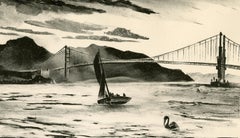
The Golden Gate
The Golden Gate

The Golden Gate

By Adolf Arthur Dehn

Located in Fairlawn, OH

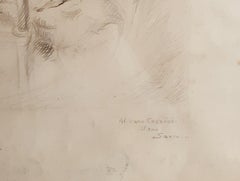
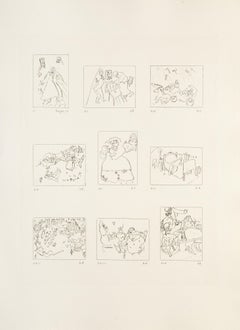
The Golden Gate Lithograph on wove paper watermarked GC, 1940 Signed in pencil by the artist (see photo) Publisher: Associated American Artists Edition: 189, unnumbered The image depicts The Golden Gate Bridge which connects San Francisco and Marin County, California References And Exhibitions: Illustrated: Adams, The Sensuous Life of Adolf Dehn, Fig. 13.17, page 324 Reference: L & O 325 AAA Index 391 Adolf Dehn, American Watercolorist and Printmaker, 1895-1968 Adolf Dehn was an artist who achieved extraordinary artistic heights, but in a very particular artistic sphere—not so much in oil painting as in watercolor and lithography. Long recognized as a master by serious print collectors, he is gradually gaining recognition as a notable and influential figure in the overall history of American art. In the 19th century, with the invention of the rotary press, which made possible enormous print runs, and the development of the popular, mass-market magazines, newspaper and magazine illustration developed into an artistic realm of its own, often surprisingly divorced from the world of museums and art exhibitions, and today remains surprisingly overlooked by most art historians. Dehn in many regards was an outgrowth of this world, although in an unusual way, since as a young man he produced most of his illustrative work not for popular magazines, such as The Saturday Evening Post, but rather for radical journals, such as The Masses or The Liberator, or artistic “little magazines” such as The Dial. This background established the foundation of his outlook, and led later to his unique and distinctive contribution to American graphic art. If there’s a distinctive quality to his work, it was his skill in introducing unusual tonal and textural effects into his work, particularly in printmaking but also in watercolor. Jackson Pollock seems to have been one of many notable artists who were influenced by his techniques. Early Years, 1895-1922 For an artist largely remembered for scenes of Vienna and Paris, Adolf Dehn’s background was a surprising one. Born in Waterville, Minnesota, on November 22, 1895, Dehn was the descendent of farmers who had emigrated from Germany and homesteaded in the region, initially in a one-room log cabin with a dirt floor. Adolf’s father, Arthur Clark Dehn, was a hunter and trapper who took pride that he had no boss but himself, and who had little use for art. Indeed, during Adolf’s boyhood the walls of his bedroom and the space under his bed were filled with the pelts of mink, muskrats and skunks that his father had killed, skinned and stretched on drying boards. It was Adolf’s mother, Emilie Haas Dehn, a faithful member of the German Lutheran Evangelical Church, who encouraged his interest in art, which became apparent early in childhood. Both parents were ardent socialists, and supporters of Eugene Debs. In many ways Dehn’s later artistic achievement was clearly a reaction against the grinding rural poverty of his childhood. After graduating from high school in 1914 at the age of 19—an age not unusual in farming communities at the time, where school attendance was often irregular—Dehn attended the Minneapolis School of Art from 1914 to 1917, whose character followed strongly reflected that of its director, Munich-trained Robert Kohler, an artistic conservative but a social radical. There Dehn joined a group of students who went on to nationally significant careers, including Wanda Gag (later author of best-selling children’s books); John Flanagan (a sculptor notable for his use of direct carving) Harry Gottlieb (a notable social realist and member of the Woodstock Art Colony), Elizabeth Olds (a printmaker and administrator for the WPA), Arnold Blanch (landscape, still-life and figure painter, and member of the Woodstock group), Lucille Lunquist, later Lucille Blanch (also a gifted painter and founder of the Woodstock art colony), and Johan Egilrud (who stayed in Minneapolis and became a journalist and poet). Adolf became particularly close to Wanda Gag (1893-1946), with whom he established an intense but platonic relationship. Two years older than he, Gag was the daughter of a Bohemian artist and decorator, Anton Gag, who had died in 1908. After her husband died, Wanda’s mother, Lizzi Gag, became a helpless invalid, so Wanda was entrusted with the task of raising and financially supporting her six younger siblings. This endowed her with toughness and an independent streak, but nonetheless, when she met Dehn, Wanda was Victorian and conventional in her artistic taste and social values. Dehn was more socially radical, and introduced her to radical ideas about politics and free love, as well as to socialist publications such as The Masses and The Appeal to Reason. Never very interested in oil painting, in Minneapolis Dehn focused on caricature and illustration--often of a humorous or politically radical character. In 1917 both Dehn and Wanda won scholarships to attend the Art Students League, and consequently, in the fall of that year both moved to New York. Dehn’s art education, however, ended in the summer of 1918, shortly after the United States entered World War I, when he was drafted to serve in the U. S. Army. Unwilling to fight, he applied for status as a conscientious objector, but was first imprisoned, then segregated in semi-imprisonment with other Pacifists, until the war ended. The abuse he suffered at this time may well explain his later withdrawal from taking political stands or making art of an overtly political nature. After his release from the army, Dehn returned to New York where he fell under the spell of the radical cartoonist Boardman Robinson and produced his first lithographs. He also finally consummated his sexual relationship with Wanda Gag. The Years in Europe: 1922-1929 In September of 1921, however, he abruptly departed for Europe, arriving in Paris and then moving on to Vienna. There in the winter of 1922 he fell in love with a Russian dancer, Mura Zipperovitch, ending his seven-year relationship with Wanda Gag. He and Mura were married in 1926. It was also in Vienna that he produced his first notable artistic work. Influenced by European artists such as Jules Pascin and Georg Grosz, Dehn began producing drawings of people in cafes, streets, and parks, which while mostly executed in his studio, were based on spontaneous life studies and have an expressive, sometimes almost childishly wandering quality of line. The mixture of sophistication and naiveté in these drawings was new to American audiences, as was the raciness of their subject matter, which often featured pleasure-seekers, prostitutes or scenes of sexual dalliance, presented with a strong element of caricature. Some of these drawings contain an element of social criticism, reminiscent of that found in the work of George Grosz, although Dehn’s work tended to focus on humorous commentary rather than savagely attacking his subjects or making a partisan political statement. Many Americans, including some who had originally been supporters of Dehn such as Boardman Robinson, were shocked by these European drawings, although George Grocz (who became a friend of the artist in this period) admired them, and recognized that Dehn could also bring a new vision to America subject matter. As he told Dehn: “You will do things in America which haven’t been done, which need to be done, which only you can do—as far at least as I know America.” A key factor in Dehn’s artistic evolution at this time was his association with Scofield Thayer...

Category

American Realist 1940s Art
Materials

Lithograph

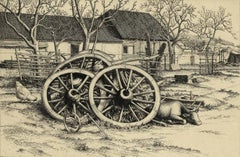
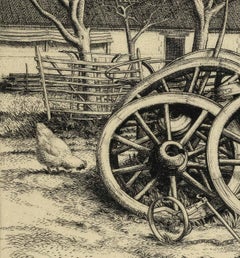
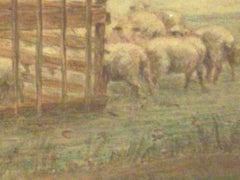
Hambleden Orchard (Farm with chicken, ox and oxcart)

Hambleden Orchard (Farm with chicken, ox and oxcart)

Located in New Orleans, LA

This engraving is from an edition of 60. It is signed and dedicated. A farmyard scene with barn, chicken and ox. It is in excellent condition and is a fine impression. There is a stain in the lower bottom margin away from the image and well below the mat line Wilfred Fairclough...

Category

Modern 1940s Art

Materials

Engraving

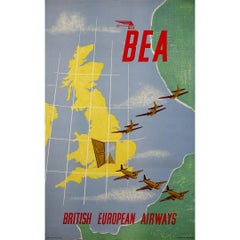
1948 original travel poster by William Henry for BEA – British European Airways

1948 original travel poster by William Henry for BEA – British European Airways

Located in PARIS, FR

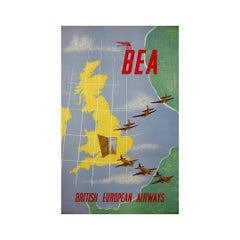
This elegant 1948 original travel poster by Henry William promotes BEA – British European Airways, the airline that would later become part of British Airways. Created in the early years of commercial aviation’s post-war expansion, the poster captures the optimism and modernity associated with air travel at the dawn of the jet age. The design presents a stylised map of the British Isles, over which a fleet of aircraft flies in formation, visually suggesting speed, connection, and a new era of European mobility. The small open window revealing a London landmark subtly links the national identity of Britain with the promise of international horizons. Stylistically, the poster reflects the refined modernism of late-1940s graphic design. Clear geometry, soft yet confident colour blocks, and simplified forms replace pre-war ornamentation. The calm blues and greens evoke sky and sea, while the bold red BEA lettering anchors the composition with corporate strength and clarity. Rather than relying on dramatic imagery, Henry William constructs a vision of reliability and elegance, perfectly aligned with the aspirations of a public rediscovering leisure, travel, and technological progress after years of conflict. Beyond its role as advertising, this poster stands today as a historical document of early post-war aviation culture. It reflects a moment when airlines were not only transporting passengers, but shaping dreams of freedom, discovery, and a newly interconnected Europe. With its balanced composition and confident modern style, this BEA poster...

Category

1940s Art

Materials

Paper, Lithograph

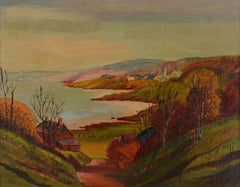
Mid Century Autumn Valley Landscape

Mid Century Autumn Valley Landscape

Located in Soquel, CA

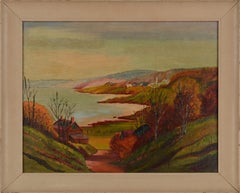
Charming mid century folk art painting of an autumn valley by Farris (American, 20th Century)Signed "Farris" lower left. Tag on verso from Ohio frame shop ...

Category

American Impressionist 1940s Art

Materials

Canvas, Oil, Cardboard

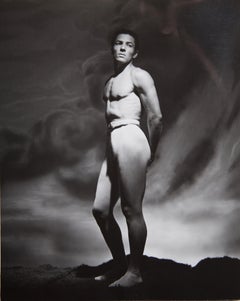
George Platt Lynes Vintage 1949 Photograph #10 of dancer Francisco Moncion

George Platt Lynes Vintage 1949 Photograph #10 of dancer Francisco Moncion

By George Platt Lynes

Located in Glenford, NY

George Platt Lynes Photograph #10 of dancer Francisco Moncion 1949. George Platt Lynes rare original vintage 1949 gelatin silver photograph of dancer Francisco Moncion. Stamped on verso - GEORGE PLATT LYNES. Photo is 7 3/4 x 9 1/2 inches, glossy finish in excellent condition. This photograph is #10 from a collection of 12 different poses in this series taken in Platt Lynes's NYC studio in 1949 (as per the NY Public Library archives). The cloud backdrop is recognizable in other Platt Lynes photographs. Moncion was a personal friend of Platt Lynes and this photograph is from Moncion's personal photographic collection. George Platt Lynes (1907–1955), was a gregarious American portrait, dance, fashion, and male nude photographer whose career spanned the late 1920s through the early 1950s. From age eighteen, Lynes entered the cosmopolitan world of the American expatriate community in Paris when he became acquainted with the salon of Gertrude Stein and Alice B. Toklas. He began photographing authors like Stein, Jean Cocteau, André Gide, and Colette and soon established himself as one of the premier fashion photographers in the Condé Nast stable, documenting the ballet companies of George Balanchine/Lincoln Kirstein, and pursuing a private obsession with seductive images of young male nudes rarely published in his lifetime. Platt Lynes photographs are in the collections of every major art museum and university archive including the Metropolitan Museum of Art, Museum of Modern Art, Yale Art Museum, and the Smithsonian. Francisco Moncion (July 6, 1918 – April 1, 1995) was a charter member of the New York City Ballet. Over the course of his forty year career, choreographers George Balanchine, and Jerome Robbins in the New York City Ballet created 22 major roles for Moncion including the Dark Angel in Orpheus, Death in La Valse, Prince Ivan in Firebird, and the Boy in Afternoon of a Faun. He was also a choreographer and a talented painter who exhibited alongside Miro, Picasso and Carrado Cagli. Moncion was a popular model for many famed mid-century (late 1930s, 1940s - 1950s) figure photographers including Platt Lynes, Carl van Vechten, Maurice Seymour...

Category

Post-War 1940s Art

Materials

Silver Gelatin

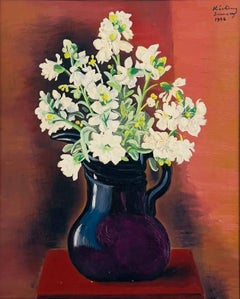
Framed Bouquet of Stocks, Oil on Canvas, Signed, Circa 1948

Framed Bouquet of Stocks, Oil on Canvas, Signed, Circa 1948

Located in OPOLE, PL

Moïse Kisling (1891-1953) - Bouquet de giroflées Oil on canvas from 1948. Unique work. Dimensions of work: 41 x 33 cm. Hand signed. Accompanied by certificate by Marc Ottavi fro...

Category

Modern 1940s Art

Materials

Oil, Canvas

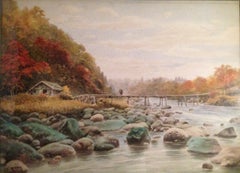
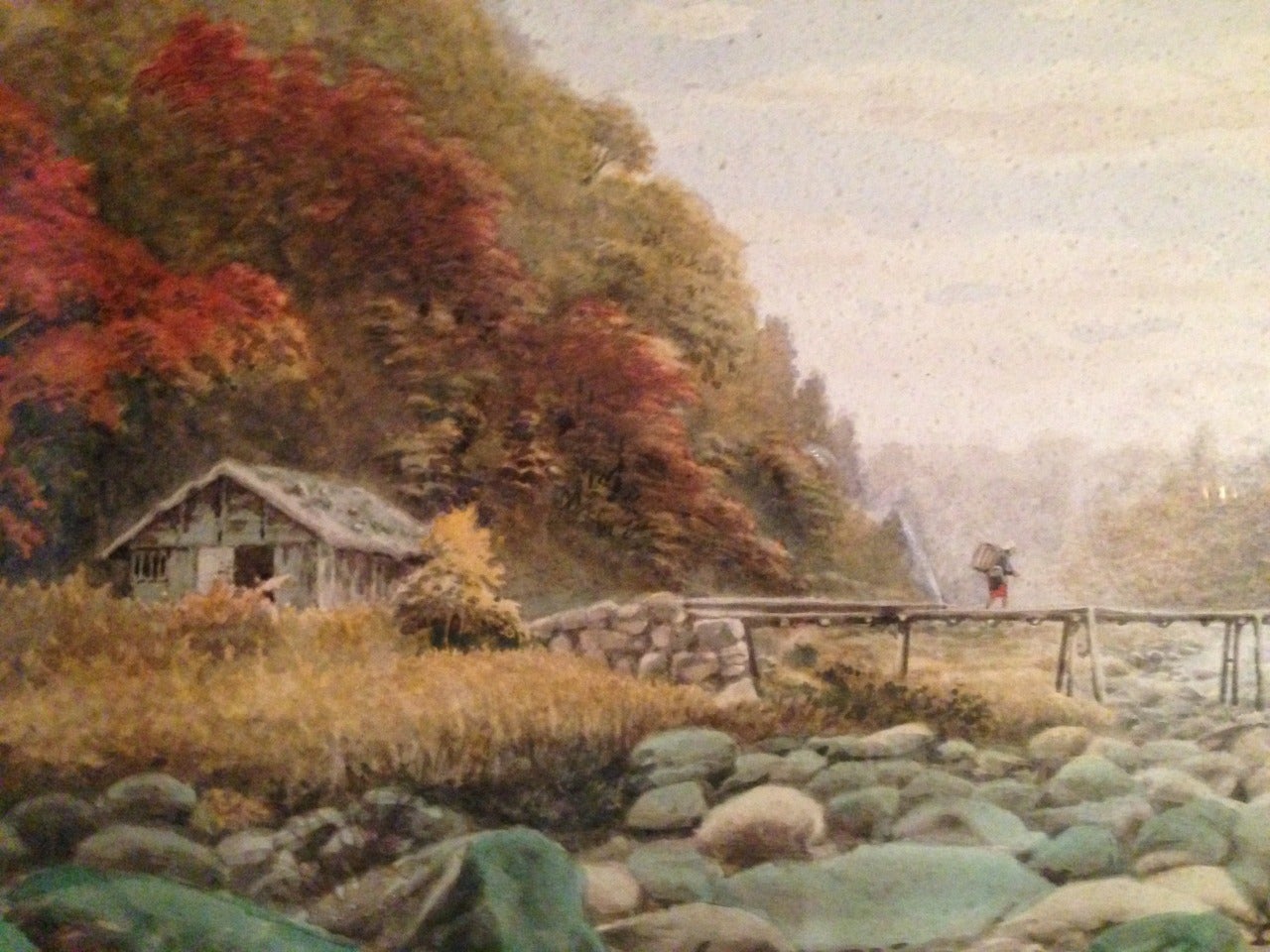
"Wooden River Bridge"

"Wooden River Bridge"

By Shigesaburo Ishida

Located in Southampton, NY

Circa 1940 Signed lower left Sight size 19 x 26 in Overall 27.5 x 34.5 in original period frame

Category

Academic 1940s Art

Materials

Watercolor, Paper

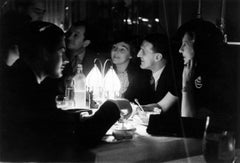
At The Embassy

At The Embassy

By Bert Hardy

Located in London, GB

A group of people at the Embassy Club in London during World War II 1941. (Photo Bert Hardy) A beautiful Limited Edition (ed size 300) silver gelatin fibre darkroom print made ...

Category

Modern 1940s Art

Materials

Silver Gelatin

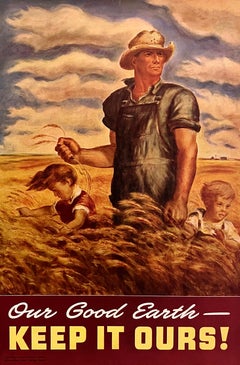
Original Vintage WWII Precision Training Means Precision Bombing Air Force Poste

Original Vintage WWII Precision Training Means Precision Bombing Air Force Poste

Located in Boca Raton, FL

Precision Training Means Precision Bombing' is an American WWII poster created for training purposes. It shows a then state-of-the-art bomber plane completing a successful factory bo...

Category

1940s Art

Materials

Lithograph

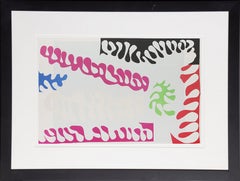
Le Lagon III from the Jazz Portfolio, Modern Lithograph after Henri Matisse

Le Lagon III from the Jazz Portfolio, Modern Lithograph after Henri Matisse

By (after) Henri Matisse

Located in Long Island City, NY

Le Lagon III (Lagoon) Henri Matisse (After) French (1869–1954) Portfolio: Jazz Date: Of Original: 1947 Year Printed: 1983 Lithograph Size: 15.25 x 23.5 in. (38.74 x 59.69 cm) Fram...

Category

Modern 1940s Art

Materials

Lithograph

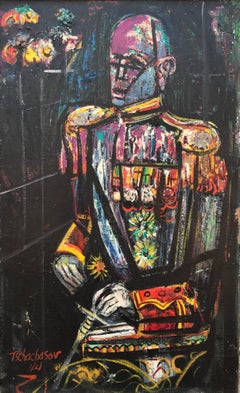
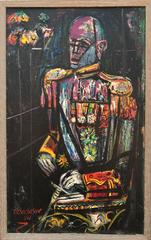
"The General"
"The General"

Nahum Tschacbasov"The General", 1944

$9,600Sale Price|20% Off

"The General"

By Nahum Tschacbasov

Located in Southampton, NY

Oil on canvas painting by the well known Russian/American artist, Nahum Tschacbasov. Done with a thick impasto paint the artist portrays the powerful yet colorful nature of the general...

Category

American Modern 1940s Art

Materials

Canvas, Oil

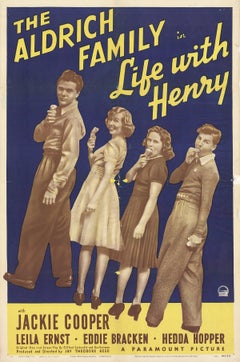
1940 Unknown 'The Aldrich Family in "Life with Henry"'

1940 Unknown 'The Aldrich Family in "Life with Henry"'

Located in Brooklyn, NY

Paper Size: 41 x 27 inches ( 104.14 x 68.58 cm ) Image Size: 39 x 25.25 inches ( 99.06 x 64.135 cm ) Framed: No Condition: D: Heavy signs of wear, Torn, Damaged. SOLD AS IS. Price...

Category

Contemporary 1940s Art

Materials

Offset

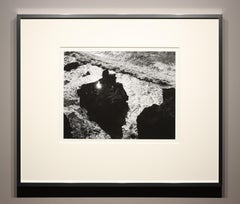
Sunlight on Water
Sunlight on Water

Sunlight on Water

By Harry Callahan

Located in Pacific Grove, CA

This silver gelatin contact print with margins (4 x 4 7/8 in) is signed in ink and numbered '7' in pencil on the front of the mount. Credited, titled and dated on gallery label affix...

Category

Abstract 1940s Art

Materials

Silver Gelatin

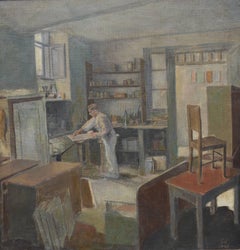
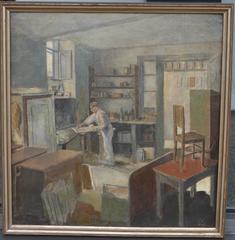
The Artists Studio
The Artists Studio

The Artists Studio

Located in West Hollywood, CA

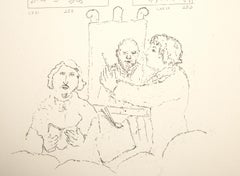
Presenting a wonderful oil on heavy jute canvas, "The Artists Studio." The painting depicts an artist preparing his canvases for painting. "The Artist...

Category

Art Deco 1940s Art

Materials

Oil

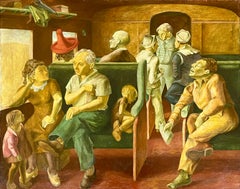
Third Class Carriage (Down South)

Third Class Carriage (Down South)

Located in Los Angeles, CA

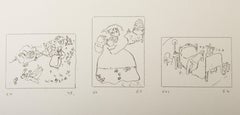
Third Class Carriage (Down South), c. 1942 - 45, oil on canvas, 24 x 29 inches, labels verso read: "Painting by Mervin Honig [with address included]" and inscribed verso: "Title: Thi...

Category

American Realist 1940s Art
Materials

Canvas, Oil

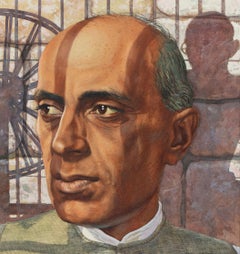
Nehru of India and Gandhi Time Magazine Cover Original Art Signed

Nehru of India and Gandhi Time Magazine Cover Original Art Signed

Located in Miami, FL

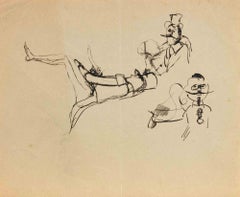
India's Nehru (Jawaharlal Nehru) is featured on the cover of Time Magazine, when Time was the most prestigious and important go-to resource for world news. Nehru is shown in 1942, wh...

Category

American Realist 1940s Art
Materials

Pastel, Gouache, Board

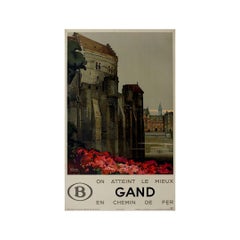
1942 original travel poster Belgian National Railway (SNCB) to Ghent

1942 original travel poster Belgian National Railway (SNCB) to Ghent

By Herman Verbaere

Located in PARIS, FR

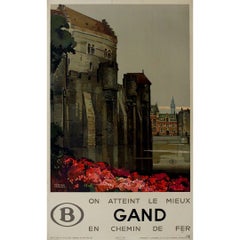
This 1942 original travel poster, designed by Herman Verbaere, was commissioned by the Belgian National Railway (SNCB) to promote Ghent (Gand) as a premier travel destination accessi...

Category

1940s Art

Materials

Paper, Lithograph

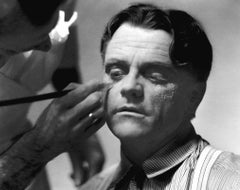
'James Cagney Make Up' 1941

'James Cagney Make Up' 1941

Located in London, GB

THE STRAWBERRY BLONDE, James Cagney, having black eye applied by makeup artist Perc Westmore, on-set, 1941/ Everett Collection. 20x16 " inches paper siz...

Category

Modern 1940s Art

Materials

Silver Gelatin

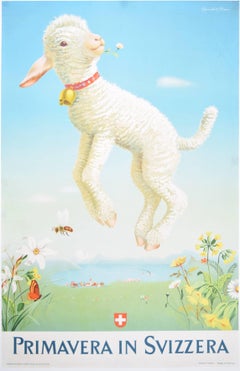
Travel Poster: Donald Brun Primavera in Svizzera Spring in Switzerland: Lamb

Travel Poster: Donald Brun Primavera in Svizzera Spring in Switzerland: Lamb

By Donald Brun

Located in London, GB

To see our other original vintage travel posters, many of which are from Switzerland, scroll down to "More from this Seller" and below it click on "See all from this Seller" - or send us a message if you cannot find the poster you want. Donald Brun...

Category

Modern 1940s Art

Materials

Lithograph

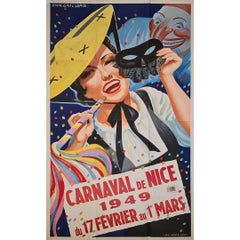
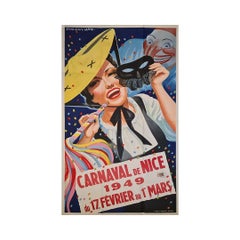
Original 1949 "Carnaval de Nice" Poster by E. Gaillard

Original 1949 "Carnaval de Nice" Poster by E. Gaillard

Located in PARIS, FR

This vibrant original poster created by E. Gaillard for the 1949 Carnaval de Nice perfectly captures the joy, elegance and festive spirit of one of Europe's most celebrated winter ev...

Category

1940s Art

Materials

Paper, Lithograph

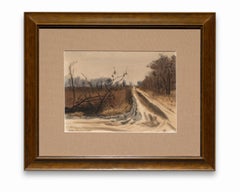
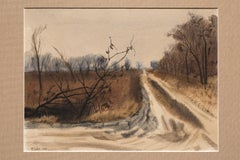
Charles Culver Landscape Winter Road Watercolor Signed & Dated

Charles Culver Landscape Winter Road Watercolor Signed & Dated

By Charles Culver

Located in Detroit, MI

The idyllic atmosphere of this country scene falls within a couple of styles one being regionalism, an American realist modern art movement that included paintings, murals, lithographs, and illustrations depicting scenes of rural and small-town America primarily in the Midwest and frequently associated with Grant Wood and Thomas Hart Benton. The other style is romanticism wherein the scene depicted is a more desired or dramatic version of what actually is. “Untitled (Winter Road)” is a quiet country scene depicting a road leading into the distance either going to or coming from a local farm. The snow does not particularly seem fresh suggesting a melt and the coming of spring. This piece has been professionally reframed with acid-free matting and conservator glass. In a 1952 Detroit Free Press article, entitled “Artist Explains His Work,” Culver was asked why he painted the way he did. He stated: “I try to ‘see’ though not too exactly; I try to think though not too ponderously; I feel emotion yet I try not to become overwrought. I interpret rather than describe, and design rather than depict. I work with values, not light and shade; hence, when I am successful, I achieve substance rather than three-dimensional form, and this satisfies me as being wholly sufficient. In my work I wish to be serious without becoming a bore, exuberant without being frivolous, humorous without being silly. I believe that good paintings are conceived, not contrived; and I am interested in art much more than in pictures.” Charles...

Category

Naturalistic 1940s Art

Materials

Paper, Watercolor

The Farmer
The Farmer

The Farmer

By Ron Blumberg

Located in West Hollywood, CA

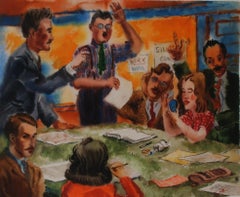
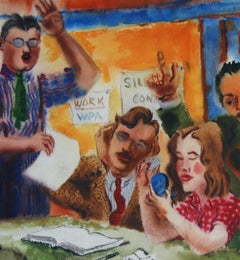
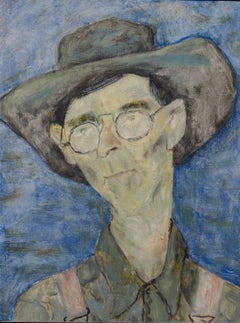
Presenting a rare early oil painting from the, "WPA" period, 1941, by American artist Ron Blumberg, “The Farmer” After his classical training in Paris, Blu...

Category

American Modern 1940s Art

Materials

Oil

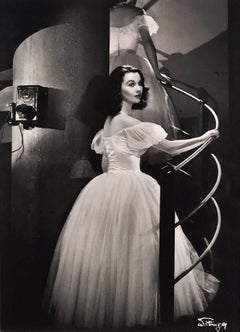
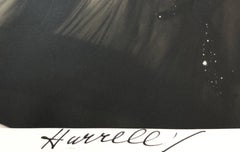
Rita Hayworth
Rita Hayworth

Rita Hayworth

By George Hurrell

Located in Chatsworth, CA

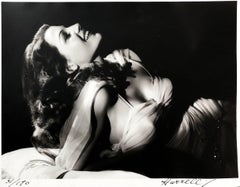
This piece is an original photograph shot by George Hurrell in 1941 and printed at a later date. This image depicts Rita Hayworth, an American actress an...

Category

Modern 1940s Art

Materials

Photographic Paper

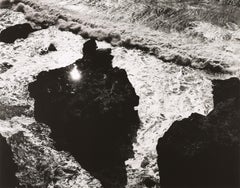
Sun In Rock
Sun In Rock

Sun In Rock

By Minor White

Located in Pacific Grove, CA

The print is signed and dated in pencil on the front of the mount; titled, dated, stamped and labelled on the back of the mount. This rare vintage enlargement comes from the Museum...

Category

Modern 1940s Art

Materials

Silver Gelatin

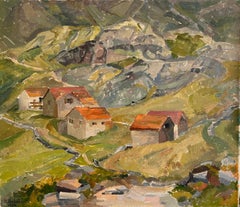
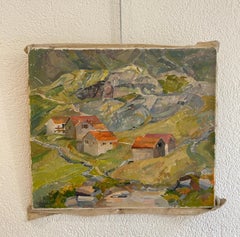
Mountain Village Oil Painting, Impressionist, Circa 1940, Unframed

Mountain Village Oil Painting, Impressionist, Circa 1940, Unframed

Located in Genève, GE

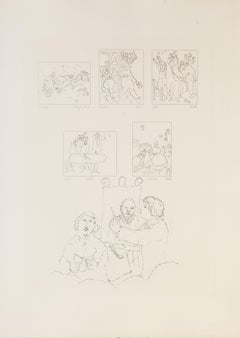
This captivating work depicts a rural mountain landscape with a timeless allure. Using a palette of earthy, nuanced colours, the artist succeeds in creating an atmosphere that is bot...

Category

Impressionist 1940s Art
Materials

Oil

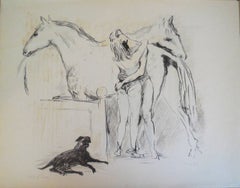
Circus Lovers (Horse & Dog)

Circus Lovers (Horse & Dog)

By Marcel Vertès

Located in Surfside, FL

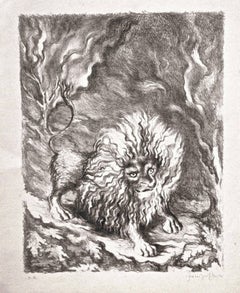
This is an original hand signed (I believe it is also hand colored but i am not positive) Artists Proof Lithograph of a Circus scene. This depicts a trapeze artist an acrobat on the ...

Category

Art Deco 1940s Art
Materials

Lithograph

Autograph Letter Signed by Filippo de Pisis - 1947

Autograph Letter Signed by Filippo de Pisis - 1947

By Filippo De Pisis

Located in Roma, IT

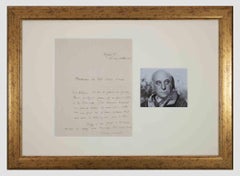
A Autograph Letter Signed by Filippo de Pisis accompanies a b/w photographic portrait (cm 11 x 9) of the young Italian artist, with his Basque-hat on his head, smoking a pipe and with his parrot on his shoulder. This composition, in perfect condition, is mounted under passepartout, plexiglass, and gilded frame (cm 40.5 x 2 x 54.5). The manuscript is addresses to Gaetano Chiurazzi. Venice, January 20th 1947. One page, single-sided. On letterhead paper “Ne nous embarbouillons pas dans les métaphores” (Balzac). cm 23 x 14.5. In 16°. In Italian. Signed “F. de Pisis”. Excellent condition, except for usual folds. Perfectly readable An affectionate greeting letter written with a rapid calligraphy by the artist had just returned to Italy, to Venice, after a short stay in Paris, with the first symptoms of a disease that will lead him to death. The artist writes to his friend, the Italian gallerist, Gaetano Chiurazzi (Naples,1899- Rome,1967), best-known as "Tanino". This letter will be delivered to Tanino by a great admirer and collector of de Pesis. A manuscript demonstrates how de Pisis spent his life: between Rome, Paris and Venice, living a very extravagant lifestyle; he had a pet parrot named Coco, and in Venice he was one of a handful of residents at the time who used a gondola. He had two personal gondoliers on 24-hour duty, who wore black-and-gold livery. Filippo de Pisis (born Luigi Filippo Tibertelli, Ferrara 1896 – Brugherio 1956) When he was 20 years old, the young painter from Ferrara had a meeting that changed his life. During his military service, he met the "Dioscuri", the brothers De Chirico and then Carrà. He was sure impressed by their way of seeing painting and, at the beginning, shared the metaphysical style. After a short stay in Rome and Paris, at the beginning of the 1920's, he started to rework his style, made of suggestions and original subjects, where the pictorial line is fragmented and, therefore, defined by Eugenio Montale as "fly-paw painting". The friendship with Julius Evola...

Category

Modern 1940s Art
Materials

Paper