1940s Art

to
1,287
2,904
1,167
1,043
412
267
Overall Width
to
Overall Height
to
7,581
21,453
163,150
226,015
2,003
2,272
4,953
6,507
5,817
14,927
20,601
25,681
18,591
14,025
5,363
2,199
414
306
219
172
118
83
70
50
20
9
2
2
3,353
2,208
156
3,024
1,462
1,178
925
896
569
392
358
357
356
286
267
264
262
228
192
163
151
148
146
2,058
1,463
1,288
1,019
710
114
111
83
57
46
1,583
937
3,761
1,861
Period: 1940s
"Alaskan Pollock II"

"Alaskan Pollock II"

Located in Detroit, MI

SALE ONE WEEK ONLY This painting of four different species of fish that can be found in South Korea is from the mid-20th century Korean artist Kim Kyung. Seafood from both the seas that surround the peninsula and from its rivers are an integral part of the livelihood and cuisine of Koreans. Kim Kyung (in Hanja, 金耕, in Hangul 김경) was born in South Korea, his real name, under the current Revised Romanization was Kim Gyeong-Eun (in Hanja 金萬斗, in Hangul 김경은). His name follows the East Asian convention of family name first, though some Western galleries choose to reorder his name with the Western convention as Kyung Kim. He was born in Hadong, Gyeongnam during the Imperial Japanese occupation, as the eldest son of a poor farm family, and at the age of 18 he entered the art department of Japan University. In 1943, he returned to his hometown to escape being drafted into the Japanese army...

Category

Modern 1940s Art

Materials

Canvas, Oil

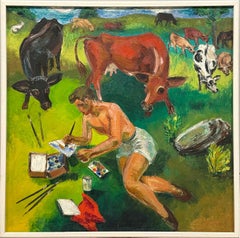
'Sketching Wisconsin' original oil painting, Signed

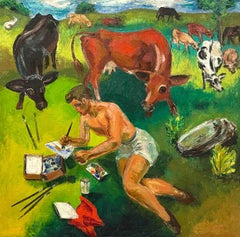
'Sketching Wisconsin' original oil painting, Signed

By John Steuart Curry

Located in Milwaukee, WI

John Steuart Curry "Sketching Wisconsin," 1946 oil on canvas 31.13 x 28 inches, canvas 39.75 x 36.75 x 2.5 inches, frame Signed and dated lower right Overall excellent condition Presented in a 24-karat gold leaf hand-carved wood frame John Steuart Curry (1897-1946) was an American regionalist painter active during the Great Depression and into World War II. He was born in Kansas on his family’s farm but went on to study art in Chicago, Paris and New York as young man. In Paris, he was exposed to the work of masters such as Peter Paul Rubens, Eugène Delacroix and Jacques-Louis David. As he matured, his work showed the influence of these masters, especially in his compositional decisions. Like the two other Midwestern regionalist artists that are most often grouped with him, Grant Wood (American, 1891-1942) and Thomas Hart Benton (American, 1889-1975), Curry was interested in representational works containing distinctly American subject matter. This was contrary to the popular art at the time, which was moving closer and closer to abstraction and individual expression. Sketching Wisconsin is an oil painting completed in 1946, the last year of John Steuart Curry’s life, during which time he was the artist-in-residence at the University of Wisconsin in Madison. The painting is significant in Curry’s body of work both as a very revealing self-portrait, and as a landscape that clearly and sensitively depicts the scenery of southern Wisconsin near Madison. It is also a portrait of the artist’s second wife, Kathleen Gould Curry, and is unique in that it contains a ‘picture within a picture,’ a compositional element that many early painting masters used to draw the eye of the viewer. This particular artwork adds a new twist to this theme: Curry’s wife is creating essentially the same painting the viewer is looking at when viewing Sketching Wisconsin. The triangular composition of the figures in the foreground immediately brings focus to a younger Curry, whose head penetrates the horizon line and whose gaze looks out towards the viewer. The eye then moves down to Mrs. Curry, who, seated on a folding stool and with her hand raised to paint the canvas on the easel before her, anchors the triangular composition. The shape is repeated in the legs of the stool and the easel. Behind the two figures, stripes of furrowed fields fall away gently down the hillside to a farmstead and small lake below. Beyond the lake, patches of field and forest rise and fall into the distance, and eventually give way to blue hills. Here, Curry has subverted the traditional artist’s self-portrait by portraying himself as a farmer first and an artist second. He rejects what he sees as an elitist art world of the East Coast and Europe. In this self-portrait he depicts himself without any pretense or the instruments of his profession and with a red tractor standing in the field behind him as if he was taking a break from the field work. Here, Curry’s wife symbolizes John Steuart Curry’s identity as an artist. Compared with a self-portrait of the artist completed a decade earlier, this work shows a marked departure from how the artist previously presented and viewed himself. In the earlier portrait, Curry depicted himself in the studio with brushes in hand, and with some of his more recognizable and successful canvases behind him. But in Sketching Wisconsin, Curry has taken himself out of the studio and into the field, indicating a shift in the artist’s self-conception. Sketching Wisconsin’s rural subject also expresses Curry’s populist ideals, that art could be relevant to anyone. This followed the broad educational objectives of UW’s artist-in-residence program. Curry was appointed to his position at the University of Wisconsin in 1937 and was the first person to hold any such position in the country, the purpose of which was to serve as an educational resource to the people of the state. He embraced his role at the University with zeal and not only opened the doors of his campus studio in the School of Agriculture to the community, but also spent a great deal of time traveling around the state of Wisconsin to visit rural artists who could benefit from his expertise. It was during his ten years in the program that Curry was able to put into practice his belief that art should be meaningful to the rural populace. However, during this time he also struggled with public criticism, as the dominant forces of the art market were moving away from representation. Perhaps it was Curry’s desire for public acceptance during the latter part of his career that caused him to portray himself as an Everyman in Sketching Wisconsin. Beyond its importance as a portrait of the artist, Sketching Wisconsin is also a detailed and sensitive landscape that shows us Curry’s deep personal connection to his environment. The landscape here can be compared to Wisconsin Landscape of 1938-39 (the Metropolitan Museum of Art), which presents a similar tableau of rolling hills with a patchwork of fields. Like Wisconsin Landscape, this is an incredibly detailed and expressive depiction of a place close to the artist’s heart. This expressive landscape is certainly the result of many hours spent sketching people, animals, weather conditions and topography of Wisconsin as Curry traveled around the state. The backdrop of undulating hills and the sweeping horizon, and the emotions evoked by it, are emphatically recognizable as the ‘driftless’ area of south-central Wisconsin. But while the Metropolitan’s Wisconsin Landscape conveys a sense of uncertainty or foreboding with its dramatic spring cloudscape and alternating bands of light and dark, Sketching Wisconsin has a warm and reflective mood. The colors of the foliage indicate that it is late summer and Curry seems to look out at the viewer approvingly, as if satisfied with the fertile ground surrounding him. The landscape in Sketching Wisconsin is also revealing of what became one of Curry’s passions while artist-in-residence at UW’s School of Agriculture – soil conservation. When Curry was a child in Kansas, he saw his father almost lose his farm and its soil to the erosion of The Dust Bowl. Therefore, he was very enthusiastic about ideas from UW’s School of Agriculture on soil conservation methods being used on Wisconsin farms. In Sketching Wisconsin, we see evidence of crop rotation methods in the terraced stripes of fields leading down the hillside away from the Curry’s and in how they alternate between cultivated and fallow fields. Overall, Sketching Wisconsin has a warm, reflective, and comfortably pastoral atmosphere, and the perceived shift in Curry’s self-image that is evident in the portrait is a positive one. After his rise to favor in the art world in the 1930’s, and then rejection from it due to the strong beliefs presented in his art, Curry is satisfied and proud to be farmer in this self-portrait. Curry suffered from high blood...

Category

American Realist 1940s Art

Materials

Canvas, Oil

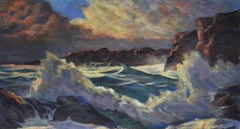
Monet like Impressionist Seascape by Nagy

Monet like Impressionist Seascape by Nagy

Located in San Francisco, CA

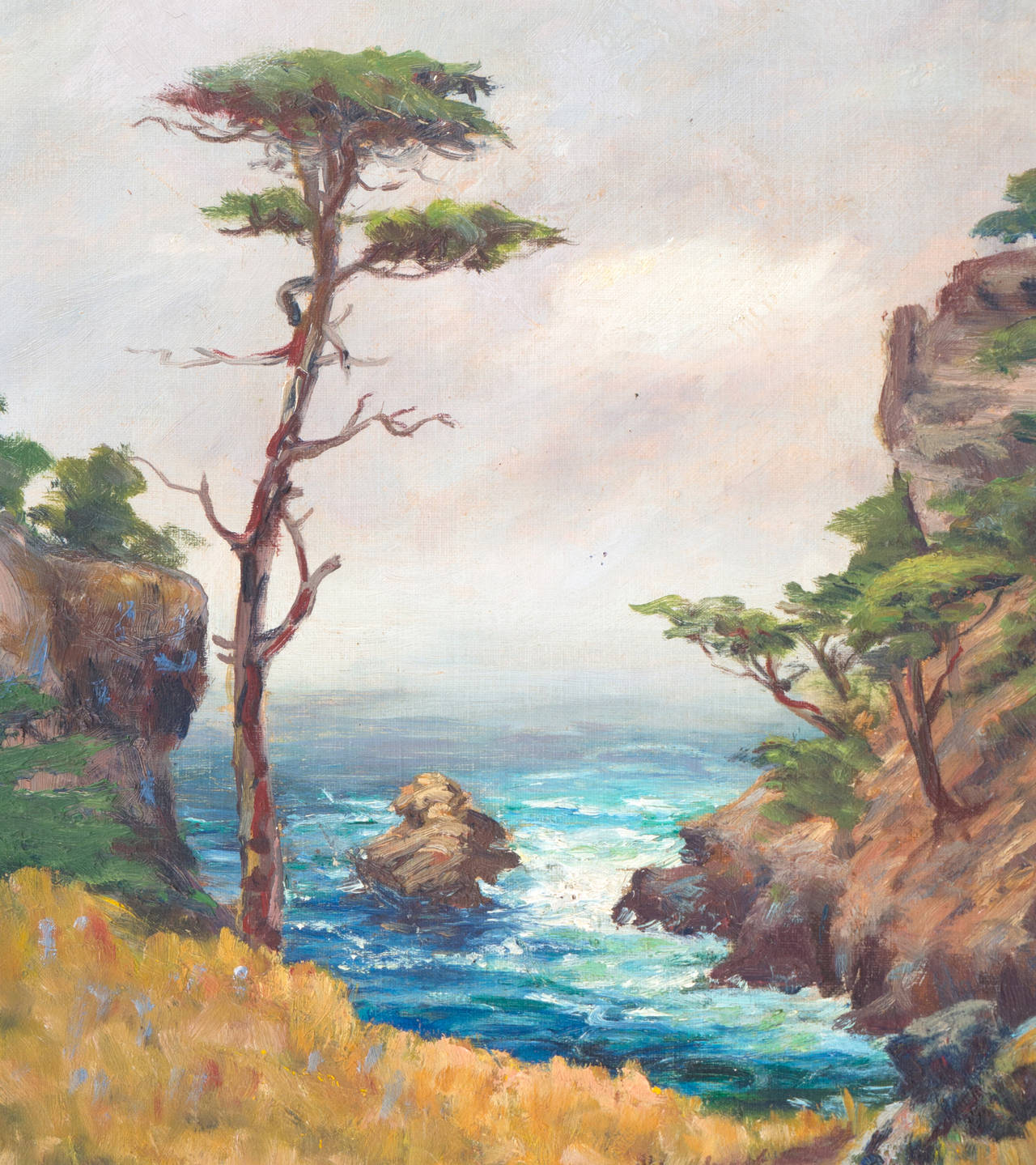
One of the finest impressionistic seascapes we have owned. It really does remind me of Monet. It is signed Nagy and there are a number of well listed artists with that last name. We ...

Category

Impressionist 1940s Art

Materials

Oil

The Grand Canyon, vibrant mid-20th century western landscape

The Grand Canyon, vibrant mid-20th century western landscape

By Andreas Roth

Located in Beachwood, OH

Andreas Roth (American, 1871-1949) Grand Canyon, 1943 Oil on canvas Signed and dated lower right 24 x 34 inches 29.5 x 39 inches, framed Andreas Roth was a German painter. Son of th...

Category

1940s Art

Materials

Oil

Hanging Clothes to Dry, Post Cover

Hanging Clothes to Dry, Post Cover

By John Philip Falter

Located in Fort Washington, PA

The Saturday Evening Post, April 7, 1945, Cover Illustration. Stated on page 4 of the Post: Just to show you how cover artists work, we asked John Falter to send us one of his early...

Category

1940s Art

Materials

Oil

Ecole de Paris Mid 20th Century, A City Street Scene

Ecole de Paris Mid 20th Century, A City Street Scene

By Henri Miloch

Located in Cirencester, Gloucestershire

Paris, France: A City Street Scene by Henri Miloch (1898-1979) unsigned watercolour and gouache painting on artist's paper, unframed sheet 9.75 x 12.25 inches Very nicely execu...

Category

Impressionist 1940s Art

Materials

Watercolor, Gouache

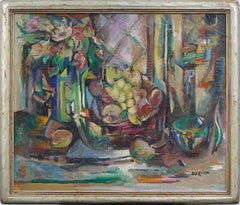
Table de Miro
Table de Miro

Table de Miro

By Robert McIntosh

Located in West Hollywood, CA

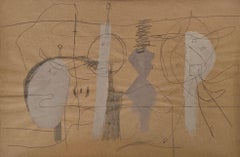
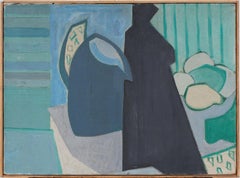
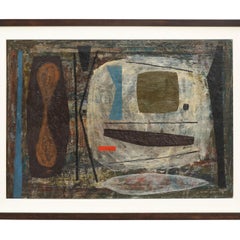
Just discovered within the archives of American artist Robert McIntosh(1916-2010), we present for the first time, a magnificent mixed media painting, Table de Miro. Table de Miro, i...

Category

Cubist 1940s Art

Materials

Mixed Media

Surrealist composition

Surrealist composition

By (after) Joan Miró

Located in Henderson, NV

Medium: collotype (after the Miro lithograph). Printed in 1947 in an edition of 1500 by Meriden Gravure and published by Curt Valentin for "The Prints of Joan Miro" portfolio. Size: ...

Category

Surrealist 1940s Art
Materials

Photogravure

Original etching for Alternance

Original etching for Alternance

By Henri Matisse

Located in Henderson, NV

Medium: original etching. Printed in 1946 at the atelier Lacouriere on BFK Rives paper and published in a limited edition of 300 for the "Alternance" portfolio (a collective art and ...

Category

1940s Art

Materials

Etching

pochoir

pochoir

By (after) Edgar Degas

Located in Henderson, NV

Medium: pochoir (after the painting). A soft and delicate impression, printed in Paris in 1948 and published in an edition of 1200 by Braun et Cie. Size: 6 1/2 x 4 1/2 inches (164 x ...

Category

Impressionist 1940s Art

Materials

Lithograph, Stencil

Edgar Degas, Dancer at the Barre, 1945 (after)

Edgar Degas, Dancer at the Barre, 1945 (after)

By Edgar Degas

Located in Southampton, NY

This exquisite lithograph after Edgar Degas (1834–1917), titled Danseur au bar (Dancer at the Barre), originates from the 1945 folio Degas, Ten Ballet Sketches. Published by The Studio Publications, Inc., New York, rendered and printed by Albert Carman, City Island, 1945, this work reflects Degas’s sensitive mastery of line, movement, and the intimate psychological nuances of the ballet studio. Executed as a lithograph and pochoir on velin paper, this work measures 13 x 17 inches (33.02 x 43.18 cm). Signed in the plate and unnumbered as issued. Rendered and printed by Albert Carman, City Island. Artwork Details: Artist: After Edgar Degas (1834–1917) Title: Danseur au bar (Dancer at the Barre), from Degas, Ten Ballet Sketches, 1945 Medium: Lithograph and pochoir on velin paper Dimensions: 13 x 17 inches (33.02 x 43.18 cm) Inscription: Signed in the plate and unnumbered as issued Date: 1945 Publisher: The Studio Publications, Inc., New York Printer: Albert Carman, City Island Condition: Well preserved, consistent with age and medium Provenance: From the 1945 folio Degas, Ten Ballet Sketches, published by The Studio Publications, Inc., New York Notes: Excerpted from the album, Born in Paris in 1834, Edgar Degas lived, and surely loved the life of that city during most of his years. These continued somewhat sadly beyond those of most of his friends— into the debacle of the first World War, during which he died in 1917. Judging by the frequency with which he used them as models, he must have had an especial admiration for the ballet girls who followed a profession that at the time brought none of the glory and prosperity which attend it today. New aspects of the human body, revealed in movement, fascinated him. But his occupation with the simply anatomical side of his subjects never resulted in a cold interpretation. On the contrary there is a warmth and sympathy that pervades all of his work. The drawings here represent the painter in one important phase of his multi-sensitive view of life; and permit an insight which a more ambitious work might not do-into the operation of the creative process, the artist's transformation of reality as it passes through the mesh of his sensibilities. The Edition of this Portfolio is limited to MMMD examples. Rendered by Albert Carman. About the Publication: Degas, Ten Ballet Sketches (1945) is one of the earliest and most significant American postwar fine art portfolios devoted to Edgar Degas’s intimate works on paper. Published by The Studio Publications, Inc., New York, and rendered and printed by Albert Carman at City Island, the album sought to faithfully reproduce a group of Degas’s ballet-related drawings through a combination of lithography and hand-applied pochoir coloring. This hybrid technique allowed the edition to preserve the immediacy, tonal subtlety, and gestural delicacy central to Degas’s draftsmanship. Conceived as a fine art publication rather than a commercial book, the portfolio provided American audiences unprecedented access to Degas’s private, spontaneous studies—images that reveal the artist’s fascination with movement, anatomy, and the psychological atmosphere of the rehearsal studio. The album exemplifies the mid-20th-century revival of pochoir as a means of recreating the texture and coloristic nuance of original works on paper, and it remains an important document of how Degas’s legacy was translated into high-quality printed form for collectors, museums, and connoisseurs. About the Artist: Edgar Degas (1834–1917) was a French painter, draughtsman, printmaker, and sculptor whose groundbreaking fusion of classical draftsmanship, modern experimentation, and psychological depth helped define the trajectory of Western art, positioning him as one of the most influential figures of the nineteenth and early twentieth centuries; renowned for his depictions of ballet dancers, racehorses, theater scenes, cafe life, domestic interiors, milliners, laundresses, and women at their toilette, Degas reimagined observational realism through radical compositional innovation—employing extreme cropping, asymmetrical framing, oblique viewpoints, and dramatic lighting that anticipated photographic and cinematic language long before these technologies shaped visual culture, and although associated with Impressionism, he rejected plein-air spontaneity in favor of studio-based discipline rooted in the linear precision of Jean-Auguste-Dominique Ingres, the expressive chromaticism of Eugene Delacroix, and the modernity of Edouard Manet while also drawing inspiration from Japanese ukiyo-e prints, classical sculpture, and early photography; his independent artistic philosophy resonated with and helped shape the innovations of Pablo Picasso, Alexander Calder, Alberto Giacometti, Salvador Dali, Joan Miro, Wassily Kandinsky, Marcel Duchamp, and Man Ray, whose explorations of movement, form, dream logic, abstraction, and conceptualism all find antecedents in Degas’s investigations into seriality, temporality, and the fragmented figure, and his pioneering use of pastel, monotype, and wax sculpture fundamentally transformed each medium, influencing artists from Henri Matisse, Francis Bacon, Lucian Freud, and Giacomo Manzu to Paula Rego, contemporary realists, experimental photographers, and choreographers; his works are held in nearly every major museum collection worldwide—including the Musee dOrsay, the Louvre, the Metropolitan Museum of Art, the National Gallery of Art, the Art Institute of Chicago, the Courtauld Institute, and the National Gallery, London—affirming his central place in the history of art, and the highest auction record for Degas was achieved at Sothebys London on February 3, 2015, when Danseuses en Bleu sold for 37,033,000 GBP, cementing his status as one of the most sought-after and enduringly significant artists of the Western canon. Degas pochoir, Degas lithograph...

Category

Impressionist 1940s Art

Materials

Lithograph

Hudson River School Style - The Homestead and Grist Mill 1942

Hudson River School Style - The Homestead and Grist Mill 1942

By A. Mathieu

Located in Soquel, CA

Hudson River School Style - The Homestead and Grist Mill 1942 In the Hudson River School style by A (K) Mathieu (American, 19th-20th C). Harvest time at the Homestead with a hay wago...

Category

Hudson River School 1940s Art

Materials

Oil, Illustration Board, Stretcher Bars

Boats - Original Pencil on Paper - 1947

Boats - Original Pencil on Paper - 1947

Located in Roma, IT

Paris is an original drawing in pencil on paper realized by an anonymous artist of the XX century. The State of preservation is very good. Sheet dime...

Category

1940s Art

Materials

Pencil

Henri Matisse, Icarus, from Verve, Revue Artistique, 1945

Henri Matisse, Icarus, from Verve, Revue Artistique, 1945

By Henri Matisse

Located in Southampton, NY

This exquisite lithograph by Henri Matisse (1869–1954), titled Icarus, from Verve, Revue Artistique et Litteraire, Vol. IV, No. 13, originates from the 1945 issue published by Editio...

Category

Fauvist 1940s Art

Materials

Lithograph

Untitled (Modernist Three-Panel Screen)

Untitled (Modernist Three-Panel Screen)

Located in Los Angeles, CA

Untitled (Modernist Three-Panel Screen), 1948, mixed media on paperboard mounted into a three-section screen, 58 x 45 inches, signed and dated on each panel upper right This work is part of our exhibition America Coast to Coast: Artists of the 1940s. Charles Malcolm Campbell...

Category

Cubist 1940s Art

Materials

Board

Market Day in Piazza Grande Locarno Switzerland

Market Day in Piazza Grande Locarno Switzerland

Located in London, GB

'Market Day in Piazza Grande, Locarno, Switzerland', oil on board, by unknown artist (1947-48). Locarno is an utterly charming Italian-speaking resort located on the northern shore o...

Category

Expressionist 1940s Art

Materials

Oil, Board

original lithograph

original lithograph

By Yves Tanguy

Located in Henderson, NV

Medium: original lithograph. Printed in Paris by Mourlot and published by Pierre à Feu and Maeght Editeur for the Marcel Duchamp / André Breton project "Surréalisme en 1947". Issued ...

Category

Surrealist 1940s Art
Materials

Lithograph

Abstract Composition

Abstract Composition

By Louis Schanker

Located in Wiscasett, ME

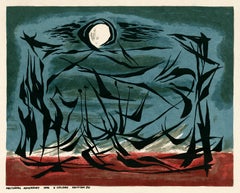
Tempura on heavy paper, signed and dated 1945 lower left. The piece measures 23" x 30" including the frame and presents very well overall. Provenance: Willard Gallery, NYC Brad...

Category

Abstract 1940s Art

Materials

Tempera, Watercolor

Que Font Ces Gens - Ink Drawing by Salvador Dalì - 1945

Que Font Ces Gens - Ink Drawing by Salvador Dalì - 1945

By Salvador Dalí­

Located in Roma, IT

Que font ces gens is a beautiful modern artwork realized by Salvador Dalì in 1945. China Ink Drawing on paper. Original outstanding drawing realized to illustrate the book "The Labyrinth" by Maurice Sandoz, published in 1945. Signed and dated on the lower right recto. Executed on thick cream wove paper, not laid down and taped to the mount along the upper edge. The upper, right and lower edges are slightly unevenly cut. There are two pinholes towards the upper right and upper left corners. The sheet is time stained and there is a spot of foxing beneath the lower edge of the drawing. There are some remnants from previous mounting at the upper two corners not visible when framed. There are handling marks to the perimeter of the sheet. The ink is strong and well preserved. The artwork is accompanied by authentication of Robert P. Descharnes, Paris 2003, reference archive: D-3461. Prov. Sotheby's Impressionist & Modern Art Sale...

Category

Surrealist 1940s Art
Materials

Paper, Ink

Mid Century Colorado River Landscape

Mid Century Colorado River Landscape

By Wilfred A. Readio

Located in Soquel, CA

Beautiful mid century impressionist landscape of Colorado River and hills by Wilfred A. Readio (American, 1895-1961), c.1940. Unsigned; purchased as part of collection of artist's wo...

Category

Tonalist 1940s Art

Materials

Masonite, Oil

Important Early American School Abstract Geometric Precisionist Signed Painting

Important Early American School Abstract Geometric Precisionist Signed Painting

Located in Buffalo, NY

Step into the enigmatic world of abstract art with this captivating original oil painting from 1945. This masterpiece, signed with a mysterious monogram by an unknown artist, embodie...

Category

Abstract 1940s Art

Materials

Canvas, Oil

Sterling Strauser Signed Vintage American Surreal Figural Framed Oil Painting

Sterling Strauser Signed Vintage American Surreal Figural Framed Oil Painting

Located in Buffalo, NY

Vintage American modernist surreal oil painting by Sterling Strauser (1907-1995) . Oil on board. Signed. Framed. Provenance from a Sag Harbor, NY collection. Handsomely framed in mod...

Category

Modern 1940s Art

Materials

Oil

Vintage American Modernist Abstract Framed Landscape Signed Oil Painting

Vintage American Modernist Abstract Framed Landscape Signed Oil Painting

Located in Buffalo, NY

Vintage American modernist abstract landscape oil painting. Oil on canvas. Framed. Signed. Measuring: 14 by 21 inches overall, and 9 by 16 painting alone.. In excellent original co...

Category

Modern 1940s Art

Materials

Canvas, Oil

Antique Chinese Junk Reverse  Oil Painting on Glass 1940

Antique Chinese Junk Reverse Oil Painting on Glass 1940

Located in Douglas Manor, NY

5-3537 Reverse oil painting on glass with gilt detailing. Set in a gilt wood frame Image size 9.5x7.5"

Category

1940s Art

Materials

Oil

'Cheerleader' — Mid-century American Surrealism, Chicago Avant-garde

'Cheerleader' — Mid-century American Surrealism, Chicago Avant-garde

By Robert Vale Faro

Located in Myrtle Beach, SC

Robert Vale Faro, 'Cheerleader', wood engraving, 1945, edition 15. Signed, dated, titled, and numbered '104' (the artist's inventory number) and '8/15' in pencil. A fine, black impression, with full margins (1 1/2 inches), on heavy, cream wove paper, in excellent condition. Scarce. Matted to museum standards, unframed. ABOUT THE ARTIST Robert Vale Faro (1902-1988) was a well-known modernist architect and artist associated with the Chicago Bauhaus...

Category

Surrealist 1940s Art
Materials

Woodcut

CALLE EX CONVENTO, TASCO.

CALLE EX CONVENTO, TASCO.

Located in Portland, ME

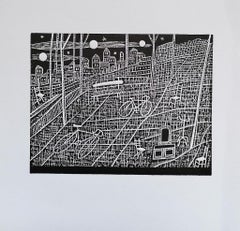
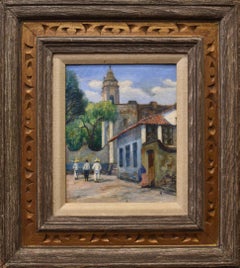
Pappe, Carl. CALLE EX CONVENTO, TASCO. Woodcut, c.1940s-60s. Edition unstated. This print is one of a series of 16 images, all of scenes in Taxco, distinguished by the strength of the carving and the richness of the blacks. 12 x 14 1/4 inches (image), 13 1/2 x 15 3/4 (sheet). Titled and signed in pencil. In excellent condition. Carl Pappe...

Category

1940s Art

Materials

Woodcut

Underwater — Mid-century Modern

Underwater — Mid-century Modern

By Charles Quest

Located in Myrtle Beach, SC

Charles Quest, 'Underwater', 1948, chiaroscuro wood engraving, edition 12. Signed, titled, dated and numbered '3/12' in pencil. A fine, richly-inked impression, in dark brown and warm black, on off-white wove paper, with full margins (5/8 to 1 1/2 inch), in excellent condition. Scarce. ABOUT THE ARTIST Charles Quest, painter, printmaker, and fine art instructor, worked in various mediums, including mosaic, stained glass, mural painting, and sculpture. Quest grew up in St. Louis, his talent evident as a teenager when he began copying the works of masters such as Michelangelo on his bedroom walls. He studied at the Washington University School of Fine Arts, where he later taught from 1944 to 1971. He traveled to Europe after his graduation in 1929 and studied at La Grande Chaumière and Academie Colarossi, Paris, continuing to draw inspiration from the works of the Old Masters. After returning to St. Louis, Quest received several commissions to paint murals in public buildings, schools, and churches, including one from Joseph Cardinal Ritter, to paint a replica of Velasquez's Crucifixion over the main altar of the Old Cathedral in St. Louis. Quest soon became interested in the woodcut medium, which he learned through his study of J. J. Lankes' A Woodcut Manual (1932) and Paul Landacre's articles in American Artist magazine ‘since no artists in St. Louis were working in wood’ at that time. Quest also revealed that for him, wood cutting and engraving were ‘more enjoyable than any other means of expression.’ In the late 1940s, his graphic works began attracting critical attention—several of his woodcuts won prizes and were acquired by major American and European museums. His wood engraving entitled ‘Lovers’ was included in the American Federation of Art's traveling print exhibition in 1947. Two years later, Quest's two prize-winning prints, ‘Still Life with Grindstone’ and ‘Break Forth into Singing’, were exhibited in major American museums in a traveling show organized by the Philadelphia Print Club. His work was included in the Chicago Art Institute's exhibition, ‘Woodcut Through Six Centuries’, and the print ‘Still Life with Vise’ was purchased by the Museum of Modern Art in New York. In 1951 he was invited by artist-Curator Jacob Kainen to exhibit thirty wood engravings and color woodcuts in a one-person show at the Smithsonian's National Museum (now known as the American History Museum). Kainen's press release praised the ‘technical refinement’ of Quest's work: ‘He obtains a great variety of textural effects through the use of the graver, and these dense or transparent grays are set off against whites or blacks to achieve sparkling results. His work has the handsome qualities characteristic of the craftsman and designer.’ At the time of the Smithsonian exhibition, Quest's work was represented by three New York galleries in addition to one in his home town. He had won 38 prizes, and his prints were in the collections of the Library of Congress, the Chicago Art Institute, the Metropolitan Museum, and the Philadelphia Museum of Art. In cooperation with the Art in Embassies program, his color woodcuts were displayed at the American Embassy in Paris in 1951. Recognition at home came in 1955 with his first solo exhibition in St. Louis. Press coverage of the show heralded the ‘growth of graphic arts toward rivaling painting and sculpture as a major independent medium’. An exhibition of his prints at the Bethesda Art Gallery in 1983 attracted Curator Emeritus Joseph A. Haller, S.J., who began purchasing his work for Georgetown University's collection. In 1990 Georgetown University Library's Special Collections Division was the recipient of a large body of Quest's work, including prints, drawings, paintings, sculpture, stained glass, and his archive of correspondence and professional memorabilia. These extensive holdings, including some 260 of his fine prints, provide a rich opportunity for further study and appreciation of this versatile and not-to-be-forgotten mid-Western American artist...

Category

American Modern 1940s Art

Materials

Woodcut

Original 1942 "CASABLANCA" vintage Academy Award winning movie poster

Original 1942 "CASABLANCA" vintage Academy Award winning movie poster

Located in Spokane, WA

Original 1942 CASABLANCA vintage movie poster. Archival linen backed in very good condition, ready to frame. The original production fold marks have been touched up and restored. This is an authentic vintage 1942 issue of Casablanca for sale. "Casablanca" is widely regarded as one of the greatest films in cinema history. It received critical acclaim upon its release and won three Academy Awards, including Best Picture, Best Director for Michael Curtiz, and Best Adapted Screenplay. The cast's performances, memorable dialogue, and timeless romance have contributed to the film's enduring popularity. "Casablanca" remains a cultural touchstone and is often referenced in popular media. • Rick Blaine (Humphrey Bogart): The owner of Rick's Café Américain, an establishment known for its lively atmosphere. Rick is initially portrayed as detached and cynical, but his past is revealed as the story progresses. • Ilsa Lund (Ingrid Bergman): A Norwegian woman with a complicated history with Rick. She is caught in a love triangle between Rick and her husband, Victor Laszlo. • Captain Louis Renault (Claude Rains): The corrupt and witty French police captain in Casablanca. He adds a layer of humor to the film and undergoes a moral transformation as the story unfolds. Over the years, the Casablanca poster...

Category

American Realist 1940s Art
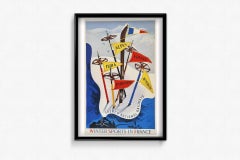
Materials

Offset

Rocky Inlet, Monhegan, Maine

Rocky Inlet, Monhegan, Maine

By George Adomeit

Located in Fairlawn, OH

Rocky Inlet, Monhegan, Maine Oil on canvas mounted on phenolic resin, c. 1940 Unsigned Signed with the estate stamp on the reverse (see photo) Condition: Excellent, recently cleaned ...

Category

American Impressionist 1940s Art

Materials

Oil

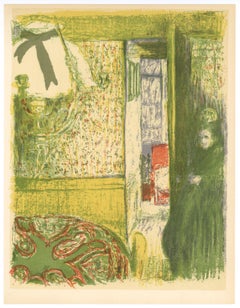
"La Partie de dames" lithograph

"La Partie de dames" lithograph

Located in Henderson, NV

Medium: lithograph (after the original Edouard Vuillard lithograph). Printed on Renage wove paper in 1948 by the atelier Mourlot and published in an edition of 2500. Size: 12 3/8 x 9...

Category

1940s Art

Materials

Lithograph

Life Magazine Satirical Society Cartoon Illustration

Life Magazine Satirical Society Cartoon Illustration

Located in Wilton Manors, FL

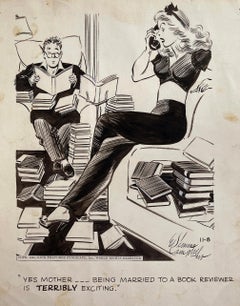
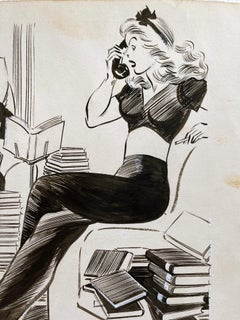
Barbara Shermund (1899-1978). Society Satirical Cartoon, ca. 1940s. Gouache on heavy illustration paper, image measures 17 x 14 inches; 23 x 20 inches in matting. Signed lower left. Very good condition but matting panel should be replaced. Unframed. Provenance: Ethel Maud Mott Herman, artist (1883-1984), West Orange NJ. For two decades, she drew almost 600 cartoons for The New Yorker with female characters that commented on life with wit, intelligence and irony. In the mid-1920s, Harold Ross, the founder of a new magazine called The New Yorker, was looking for cartoonists who could create sardonic, highbrow illustrations accompanied by witty captions that would function as social critiques. He found that talent in Barbara Shermund. For about two decades, until the 1940s, Shermund helped Ross and his first art editor, Rea Irvin, realize their vision by contributing almost 600 cartoons and sassy captions with a fresh, feminist voice. Her cartoons commented on life with wit, intelligence and irony, using female characters who critiqued the patriarchy and celebrated speakeasies, cafes, spunky women and leisure. They spoke directly to flapper women of the era who defied convention with a new sense of political, social and economic independence. “Shermund’s women spoke their minds about sex, marriage and society; smoked cigarettes and drank; and poked fun at everything in an era when it was not common to see young women doing so,” Caitlin A. McGurk wrote in 2020 for the Art Students League. In one Shermund cartoon, published in The New Yorker in 1928, two forlorn women sit and chat on couches. “Yeah,” one says, “I guess the best thing to do is to just get married and forget about love.” “While for many, the idea of a New Yorker cartoon conjures a highbrow, dry non sequitur — often more alienating than familiar — Shermund’s cartoons are the antithesis,” wrote McGurk, who is an associate curator and assistant professor at Ohio State University’s Billy Ireland Cartoon Library & Museum. “They are about human nature, relationships, youth and age.” (McGurk is writing a book about Shermund. And yet by the 1940s and ’50s, as America’s postwar focus shifted to domestic life, Shermund’s feminist voice and cool critique of society fell out of vogue. Her last cartoon appeared in The New Yorker in 1944, and much of her life and career after that remains unclear. No major newspaper wrote about her death in 1978 — The New York Times was on strike then, along with The Daily News and The New York Post — and her ashes sat in a New Jersey funeral...

Category

Realist 1940s Art
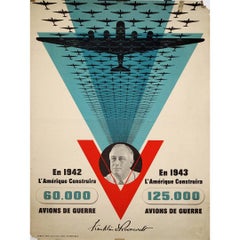
Materials

Gouache

“Can Can Girls”
“Can Can Girls”

“Can Can Girls”

Located in Southampton, NY

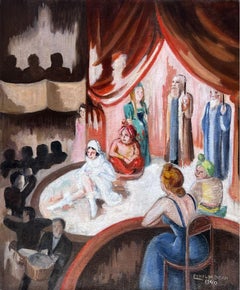
Original oil on wooden panel painting of a lively interior scene composed of two colorfully dressed can can girls preforming in front of a packed house of interested spectators. Signed lower left “N. Barerra”. Circa 1945. Condition is very good. Recently professionally cleaned and varnished. The painting is housed in a new custom gold leaf frame. Overall framed measurements are 16.5 by 19.5 inches. Provenance: A Bellport, Long Island collector. Nicolas Barerra is a painter born in Russia, now Ukraine in 1919. He studied at the Leningrad Academy of Fine Arts. He was a war correspondent and published drawings for American newspapers. After the war, he settled in Marseille where he worked as an illustrator and made a living from the sale of his paintings. He was a friend of Albert Camus and Patricia...

Category

Post-Impressionist 1940s Art
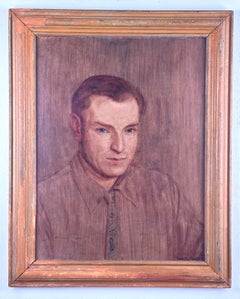
Materials

Oil, Board

"Coney Island" Brooklyn NYC Amusement Park Mid-century American Scene WPA Modern

"Coney Island" Brooklyn NYC Amusement Park Mid-century American Scene WPA Modern

By Ludwig Bemelmans, 1898-1962

Located in New York, NY

"Coney Island" Brooklyn NYC Amusement Park Mid-century American Scene WPA Modern Ludwig Bemelmans (1898 – 1962), “Coney Island" 35 x 27 inches Oil on board Signed lower right Origi...

Category

American Modern 1940s Art

Materials

Oil, Board

Watercolor Painting American Modern Painting Bridge Harbor Female Artist 1950

Watercolor Painting American Modern Painting Bridge Harbor Female Artist 1950

Located in Buffalo, NY

Dorothy Rivo Untitled (Bridge Tower), c. 1960s–70s Acrylic on paper, floated in a mat Framed dimensions: 30 in. H × 24 in. W Contemporary walnut or black wood frame with white archiv...

Category

American Modern 1940s Art

Materials

Archival Ink, Watercolor, Archival Paper, Acrylic

pochoir

pochoir

By (after) Edgar Degas

Located in Henderson, NV

Medium: pochoir (after the drawing). A soft and delicate impression, printed in Paris in 1948 and published in an edition of 1200 by Braun et Cie. Size: 6 1/2 x 4 1/2 inches (164 x 1...

Category

Impressionist 1940s Art
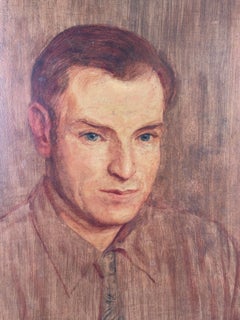
Materials

Lithograph, Stencil