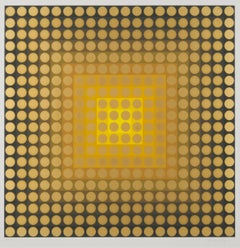
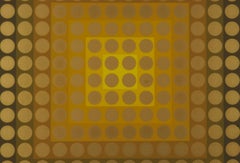
TallerOr
Located in Fairlawn, OH
TallerOr Screen print printed on "card board" (cream poster board), 1968 Signed and numbered in pencil Edition: 150 (54/150), plus 11 for the Vasarely Fou...
Category
1960s Op Art
Materials
Screen
The Op art movement emerged in the 1960s, mirroring the counterculture of the time in its embrace of visual trickery, graphic shapes and bright colors.
Spreading across Europe and the Americas, the style — whose name is short for “optical art” — influenced advertising, fashion and interior design before fading in the early ’70s.
Op art remained significant, however, for artists and scientists interested in the nature of perception. And today, it’s seeing a resurgence of interest from collectors and interior designers.
Op artists played with the principles of perception, manipulating line, shape, patterns and color to create the illusion of depth and movement. They drew on and evolved methods developed by past movements, from Impressionism to Abstract Expressionism, to produce intense visual experiences.
All the Op artists shared a focus on the gap between what is and what we perceive. Each, however, had a distinct approach to the issue and a unique visual style.
On 1stDibs, find a collection of Op art that includes works by Josef Albers, Bridget Riley, Jesús Rafael Soto and more.
TallerOr
Located in Fairlawn, OH
TallerOr Screen print printed on "card board" (cream poster board), 1968 Signed and numbered in pencil Edition: 150 (54/150), plus 11 for the Vasarely Fou...
Screen
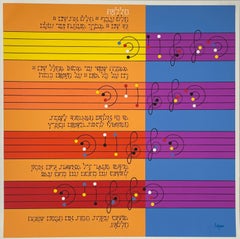
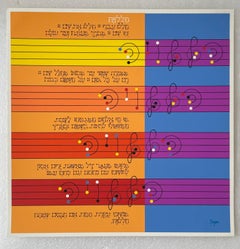
Agam Silkscreen Jerusalem Lithograph Hand Signed Israeli Kinetic Op Art Print
By Yaacov Agam
Located in Surfside, FL
Yaacov Agam, Israeli (b. 1928) Hand signed, not individually numbered but from edition of 180. I can include a copy of the title sheet with the edition size and his signature if you ...
Lithograph, Screen
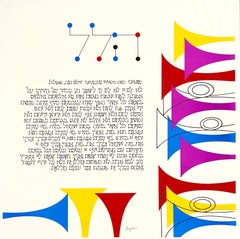
Agam Silkscreen Jerusalem Lithograph Hand Signed Israeli Kinetic Op Art Print
By Yaacov Agam
Located in Surfside, FL
Yaacov Agam, Israeli (b. 1928) Hand signed, not individually numbered but from edition of 180. I can include a copy of the title sheet with the edition size and his signature if you ...
Lithograph, Screen
$2,800Sale Price|30% Off
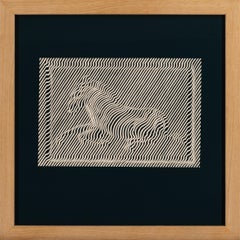
Victor Vasarely "Zebres 1" 1976 French Op Art Serigraph, Hand Signed & Numbered
Located in Miami, FL
VICTOR VASARELY – "ZEBRES 1" ⚜ Serigraph ⚜ Hand Signed and Numbered ⚜ Edition of 120 VASARELY’S ICONIC ZEBRAS Created in 1976 and published by the Foundation Vasarely in an edition ...
Screen
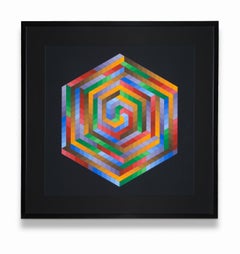
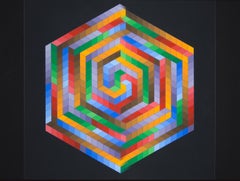
Victor Vasarely Screen Print Abstract, Geometric Squares Cubes Hexagon
Located in Detroit, MI
Victor Vasarely born in 1906 was a Hungarian-French artist, who is widely accepted as a "grandfather" and leader of the Op Art movement. Op Art is a form of abstract art that gives the illusion of movement by the precise use of pattern and color, or in which conflicting patterns emerge and overlap. Victor Vasarely and Brigit Riley are its most famous exponents. In its visual balancing act of color and movement from a flat plane to developed continuous flow “Untitled” is a complex arrangement of squares and colors that visually expand and contract. It is one of Vasarely’s most successful Op Art abstract works. The piece is signed on the lower right and number 20/150 on the lower left. The print is behind glass and matted. Vasarely was born in Pecs and grew up in Slovakia and Budapest, where in 1925, he took up medical studies. Abandoning medicine he turned to traditional academic painting at the private Podolini-Volkmann Academy. In 1928/1929, he enrolled at Sandor Bortnyik’s private art school widely recognized as Budapest's centre of Bauhaus studies. His studies concentrated on applied graphic art and typographical design. In 1929, he painted his Blue Study and Green Study. In 1930, he married his fellow student Claire Spinner (1908–1990). Together they had two sons, Andre and Jean-Pierre. Vasarely became a graphic designer and a poster artist during the 1930s combining patterns and organic images with each other. Vasarely utilized geometric shapes and colorful graphics, the artist created compelling illusions of spatial depth, as seen in his work Vega-Nor (1969). Vasarely’s method of painting borrowed from a range of influences, including Bauhaus design principles, Wassily Kandinsky, and Constructivism. In the late 1920s, Vasarely enrolled at the Muhely Academy in Budapest, where the syllabus was largely based on Walter Gropius’s Bauhaus school in Germany. After settling in Paris in 1930, Vasarely worked in advertising agencies to support himself as a graphic artist while creating many works including Zebra (1937), which is considered by some to be one of the earliest examples of Op Art. The artist experimented in a style based in Surrealism and Abstract Expressionism during the 1940s, before arriving at his hallmark checkerboard...
Paper, Screen
$1,800
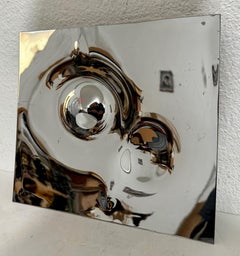
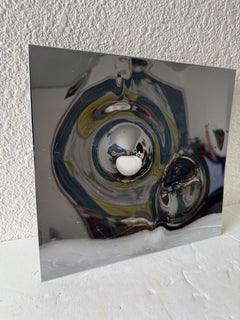
Swiss Op Art Mirror Polished Metal Stainless Steel Sculpture Relief Will Weber
Located in Surfside, FL
Willy Weber, (Swiss, 1933-1998) Verchromte Platte Stainless steel sculptural construction, dated 1977, signed to the steel. Dimensions: 12" ht. x 13" wd. Sculpted chrome sheet Hand ...
Steel
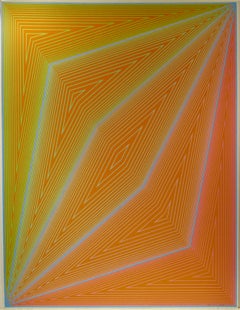
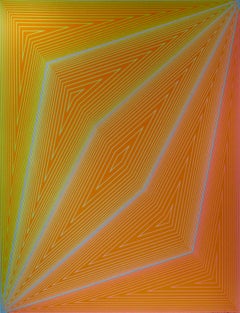
Inward Eye
Located in San Francisco, CA
This artwork titled "Inward Eye" 1970, is an original colors screen print by renown artist Richard Anuszkiewicz, 1930-2020. It is hand signed in pencil by the artist. The image size ...
Screen
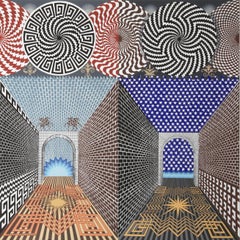
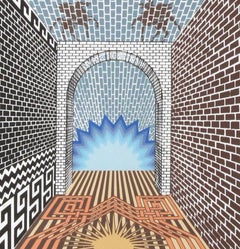
Encuentro de Dos Mundos, Op Art Screenprint by Pedro Friedeberg
Located in Long Island City, NY
A serigraph print by Pedro Friedeberg from 1987. A optical abstract image of a surrealist interior. Artist: Pedro Friedeberg, Mexican (1936 - ) Title: Encuentro de dos Mundos Year:...
Screen
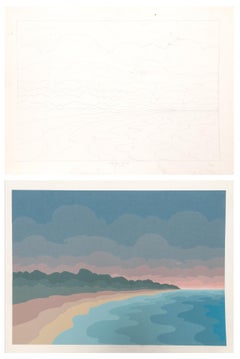
Lands End, Signed Op Art Pencil on paper by Roy Ahlgren
By Roy Ahlgren
Located in Long Island City, NY
Lands End by Roy Ahlgren, 1927 - 2011 Date: 1986 Medium: Pencil on paper, and screenprint, both signed in pencil Size: 22 x 30 in. (55.88 x 76.2 cm), Each
Pencil, Screen
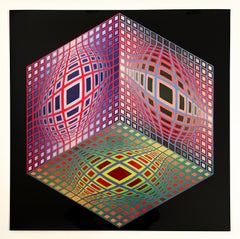
"Test 2"
Located in Henderson, NV
Medium: offset lithograph (after Vasarely). Printed in 1972 in Neuchatel, Switzerland on thick, high-gloss paper and published by Editions du Griffon for the "Vasarely Progressions 1...
Offset
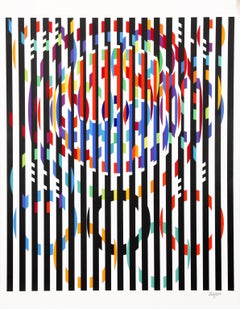
Message of Peace, Op Art Geometric Screenprint by Yaacov Agam
By Yaacov Agam
Located in Long Island City, NY
Artist: Yaacov Agam Title: Message of Peace Year: 1988 Medium: Silkscreen, signed and numbered in pencil Edition: 300, HC Paper Size: 40 x 31 inches
Screen
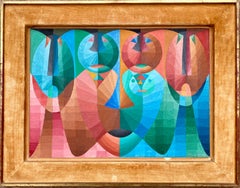
Jewel coloured vibrant op art abstract geometric painting French 1960s
Located in Norwich, GB
A fabulous example of 1960s geometric/op art, displaying all the fun, playfulness and vibrancy of the style. Op art, short for optical art, is a style of visual art that uses optical illusions. Typically, they give the viewer the impression of movement, hidden images and vibrating patterns. Its roots can be traced back to Cubism, Futurism, Constructivism and Dada. The maker of this stunning piece is Tony Gonnet (1909-2004) an artist close to those who shaped modern art and its history. Working in Casablanca in 1940 he met André Breton and Saint-Exupéry, who were both on their way to America. Unable to obtain a visa for himself, Gonnet returned to Paris in January of 1942. Living on Rue de Seine, he became one of the figures of Saint-Germain-des-Prés and numbered amongst his many friends Jean-Paul Sartre, Simone de Beauvoir, Jean Genet – who prefaced his first Parisian exhibition in 1952 – as well as Albert Camus, Simone Signoret, Boris Vian, Jacques and Pierre Prévert and many others. In 1941, in the ennui of Casablanca, Tony Gonnet had started to draw, and then paint, in a Surrealist style. In 1946 he abandoned figurative surrealism in favour of abstraction, making sole use from then on of geometric forms and shaded tones, in his own unique style. His works aim to achieve harmony of shapes and colours, and thus to bring joy. Tony Gonnet loved life, and said that each of his works was an offering made to it. With solo shows in major Paris galleries...
Oil, Board

$10,000Sale Price|33% Off
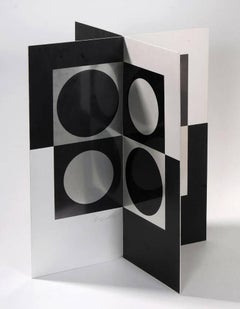
Image-miroir (Mirror Image), 1965
Located in Palo Alto, CA
Created in 1965, this sculpture is hand signed by Victor Vasarely (1906 – 1997) in black ink on one of the aluminum panels in the lower right (nearest to the center cross-section); f...
Metal
$3,200Sale Price|20% Off
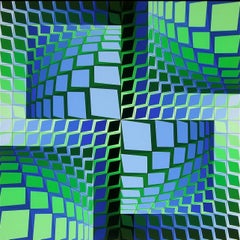
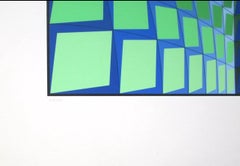
THEZ, Victor Vasarely
Located in Fairfield, CT
Artist: Victor Vasarely (1908-1997) Title: THEZ Year: 1982 Medium: Silkscreen on Arches paper Edition: 248/250, plus proofs Size: 36.5 x 30 inches Condition: Good Inscription: Signed...
Screen
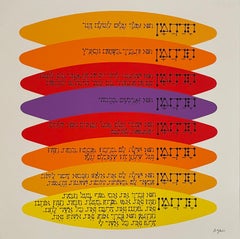
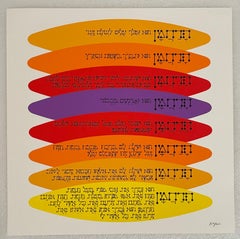
Agam Silkscreen Jerusalem Lithograph Hand Signed Israeli Kinetic Op Art Print
By Yaacov Agam
Located in Surfside, FL
Yaacov Agam, Israeli (b. 1928) Hand signed, not individually numbered but from edition of 180. I can include a copy of the title sheet with the edition size and his signature if you ...
Lithograph, Screen
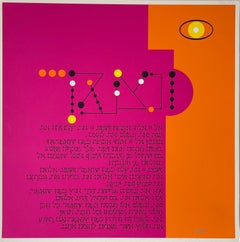
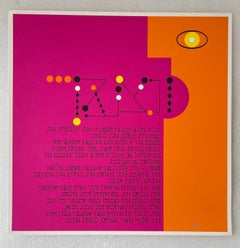
Agam Silkscreen Jerusalem Lithograph Hand Signed Israeli Kinetic Op Art Print
By Yaacov Agam
Located in Surfside, FL
Yaacov Agam, Israeli (b. 1928) Hand signed, not individually numbered but from edition of 180. I can include a copy of the title sheet with the edition size and his signature if you ...
Lithograph, Screen
$720
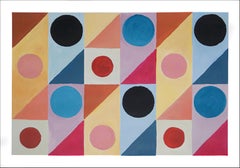
Mid-Tone Diagonal Transparency, Geometric Patchwork, Pink, Purple, Black Circles
Located in Barcelona, ES
This series of paintings by Natalia Roman gathers its inspiration from geometric, minimalist shapes and paintings from the beginning of Modernism, with a special emphasis on Art Deco...
Acrylic, Paper
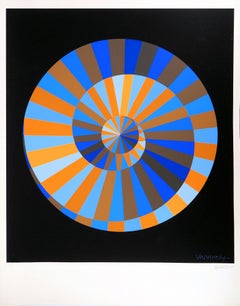
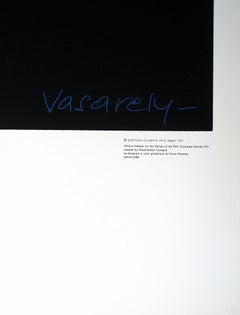
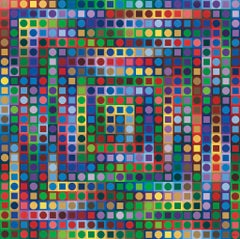
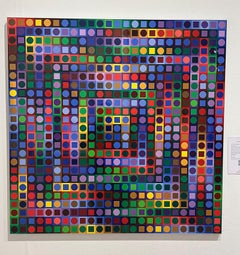
Olympia : Sky and Sun (Op Art Spiral) - Original Screen Print, 1971
Located in Paris, IDF
Victor Vasarely Olympia : Sky and Sun (Op art spiral), 1971 Original 15 colors screenprint Printed signature in the plate On paper 100 x 78 cm (c. 40 x 31 in) REFERENCES : Catalog...
Screen
$20,000Sale Price|20% Off
Majus II
Located in Palo Alto, CA
Victor Vasarely Majus II, 1974 is a screenprint on polyester on metal that is hand-signed by Victor Vasarely (Hungary, 1906 – France, 1997) in pen and ink the lower right margin and...
Metal
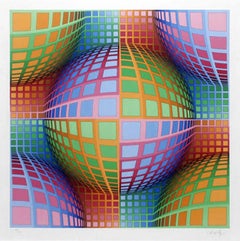
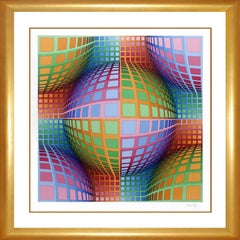
Rivotril, 1990
Located in Palo Alto, CA
Created in 1990, this original color serigraph is hand signed by Victor Vasarely (Pécs, 1906 - Paris, 1997) in pencil in the lower right margin. Numbered 270/300, this piece was prin...
Screen
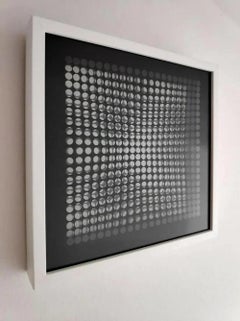
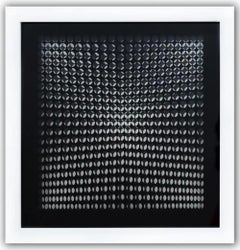
VICTOR VASARELY - OEUVRES PROFONDES CINETIQUES VII
Located in Pembroke Pines, FL
Artist: Victor Vasarely Title: Profound Works VII Year: 1973 Not signed or numbered, as published Dimensions: 12 in. by 12 in. Framed Edition: From the Rare Limited Edition Publisher...
Screen
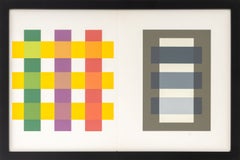
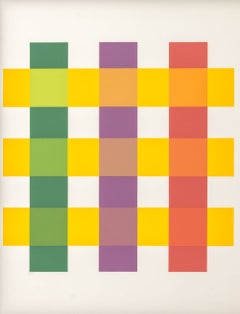
"The Interaction of Color Plate XI-3", Screenprint in Colors, 1973
By Josef Albers
Located in Astoria, NY
Josef Albers (German/American, 1888-1976), "The Interaction of Color Plate XI-3", Screenprint in Colors on Paper, 1973, published by Josef Keller Verlag Starnberg, black frame. Ima...
Screen

$1,500
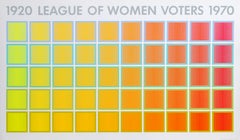
1920 League of Women Voters, OP Art Screenprint by Richard Anuszkiewicz
Located in Long Island City, NY
The 50th Anniversary of the League of Women Voters Screenprint Poster from 1970, designed by Richard Anuszkiewicz (1930 - 2020) printed in 1969,...
Screen
$4,900
Three Pattern Interference- 1960s Op Art Photograph, Geometric, Blue, Orange
Located in New York, NY
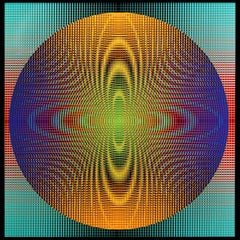
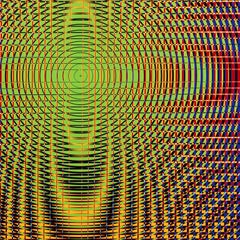
Limited edition of 5. Printed on Hahnemuhle Fine Art Baryta 325g Archival Paper. Dated and signed with the certificate of authenticity. This vibrant Op Art photograph from 1969 captures the essence of movement and color through its intricate, circular patterns created by three pattern interference. The pulsating gradients of orange, blue, and green add depth and energy, making it a perfect centerpiece for a contemporary interior. Inspired by the 1960s Op Art movement, this work by a pioneering photographer brings a geometric and modern aesthetic to any space, creating a dynamic focal point. Its vibrant composition adds both vibrancy and sophistication to living rooms, offices, or modern interiors. Enzo Ragazzini...
Archival Paper, Giclée
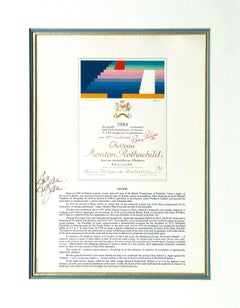
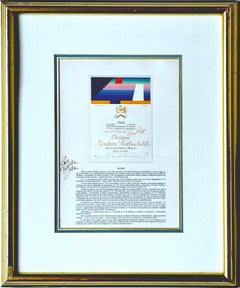
Chateau Mouton Rothschild label (hand signed)
By Yaacov Agam
Located in New York, NY
Chateau Mouton Rothschild label (hand signed), 1984 Offset lithograph Autographed twice in black and red by the artist on the front Frame Inc...
Offset
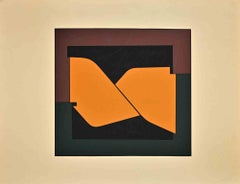
Kandahar Screen Print, Op Art, Signed, Edition of 100, 1955
Located in Roma, IT
Kandahar is a contemporary artwork realized by Victor Vasarely in 1955. Screen print on wove paper after a painting of 1951. Hand signed and numbered on the lower margin. Edition ...
Screen
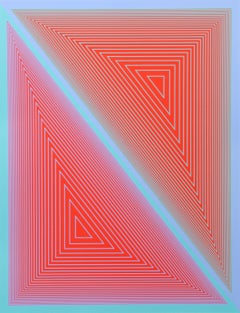
Inward Eye, #3 Geometric Abstract OP Art Screenprint by Richard Anuszkiewicz
Located in Long Island City, NY
Richard Anuszkiewicz (American, 1930 - ) created the "Inward Eye" portfolio after a conversation with a friend who said that Anuszkiewcz's works reminded him of William Blake's work....
Screen
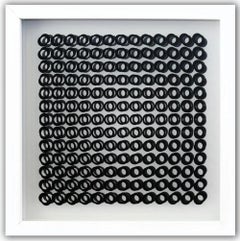
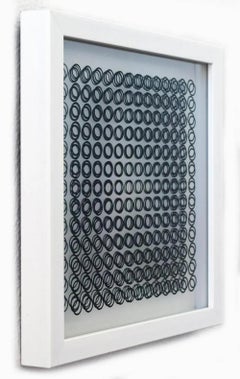
VICTOR VASARELY - OEUVRES PROFONDES CINETIQUES - 1973
Located in Pembroke Pines, FL
Artist: Victor Vasarely Title: Profound Works Year: 1973 Not signed or numbered, as published Dimensions: 12 in. by 12 in. Framed Edition: From the Rare Limited Edition Publisher: Ed...
Screen
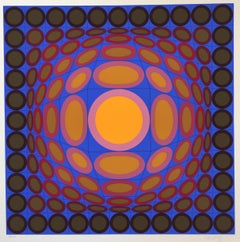
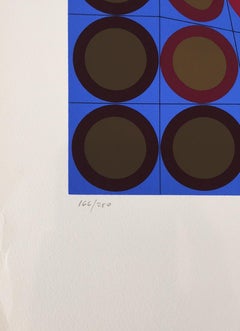
Tri-Vega
Located in Miami, FL
TECHNICAL INFORMATION Victor Vasarely Tri-Vega 1975 Silkscreen on Arches paper 33 1/4 x 30 1/8 in. Edition 166 of 250 Pencil signed & numbered Condition: This work is in e...
Screen
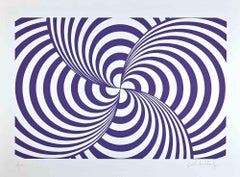
Violet Composition - Screen Print by Victor Debach - 1970s
Located in Roma, IT
Screen print on paper realized by Victor Debach in 1970s. Hand signed and numbered in pencil. Edition of 100. Very good condition.
Screen
$656Sale Price|20% Off
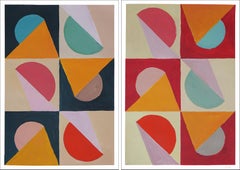
Line Study For Angles and Curves, Duo of Art Deco Shapes, Pastel Palette Rouge
Located in Barcelona, ES
These series of paintings by Natalia Roman gather their inspiration from geometric, minimalist shapes and paintings from the beginning of Modernism, with a special emphasis on Art Deco shapes of the 30's, 40's and 50's. The subtle but chic color combinations will combine beautifully with both vintage and modern furniture without overtaking spaces that are carefully crafted by designers. Natalia Roman was born in 1984 in Girona, Spain. She has exhibited in galleries across Europe and her colorful, abstract paintings are part of private collections all over the world. Details: Title: Line Study...
Acrylic, Paper
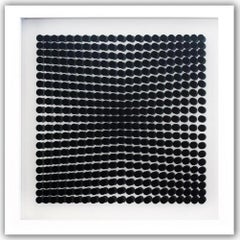
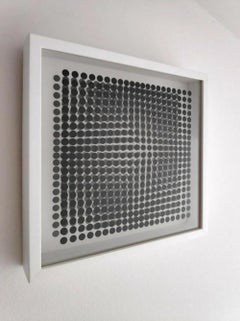
VICTOR VASARELY - OEUVRES PROFONDES CINETIQUES I - 1973
Located in Pembroke Pines, FL
Artist: Victor Vasarely Title: Profound Works I Year: 1973 Not signed or numbered, as published Dimensions: 12 in. by 12 in. Framed Edition: From the Rare Limited Edition Publisher: Editions du Griffon Neuchatel Suite: Profound Works Medium: 3D, Serigraph on Acitate Over Serigraph on Paper Condition: Excellent Victor Vasarely (French/Hungarian, 1906–1997) is known as the father of the Op Art movement. As a painter, he created intricate abstractions that suggested depth and dimensionality using a variety of optical illusions, with surfaces seeming to bulge out of the canvas. His works present color, form, and pattern as a single interconnected element—a concept that was critical to the foundation of the Op Art movement and the focus of his mature works. Vasarely initially studied medicine at the Budapest University in his early 20s, only to abandon his medical studies to attend to the Muhely Academy, the center of the Bauhaus movement in Budapest. While there, he was profoundly influenced by the work of color theorist and artist Josef Albers, as well as the Constructivist methods promoted by artists such as Wassily Kandinsky. While Vasarely’s earlier work was concerned more with color theory, during the 1950s and 1960s his work became more focused on the optical potential of the two-dimensional surface. He began to use complex and colorful patterns to actively engage the viewer’s eye, and to convey a sense of kinetic energy across the two-dimensional surface. Vasarely’s work was heavily influenced by his time spent at Breton Beach of Belle Isle...
Screen
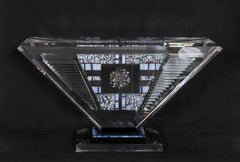
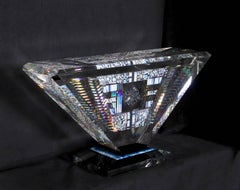
Island Jewel, Unique Cut Glass OP Art Sculpture by Jon Kuhn
By Jon Kuhn
Located in Long Island City, NY
A polished glass sculpture by Joh Kuhn from 1992. A spectacular sculpture of crystal clear glass that forms a complicated prism in which light is reflected in a multitude of optical ...
Glass
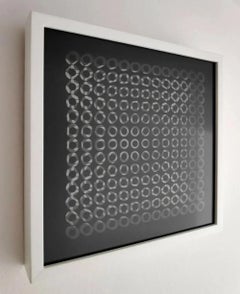
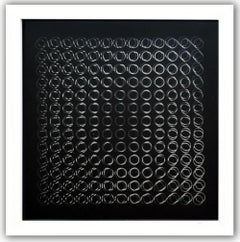
VICTOR VASARELY - OEUVRES PROFONDES CINETIQUES III - 1973
Located in Pembroke Pines, FL
Artist: Victor Vasarely Title: Profound Works III Year: 1973 Not signed or numbered, as published Dimensions: 12 in. by 12 in. Framed Edition: From the Rare Limited Edition Publisher...
Screen
$155Sale Price|37% Off
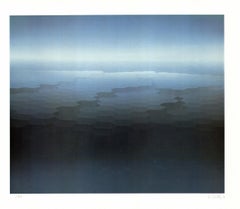
Untitled (Geometric Composition, Vasarely, Op-Art) (~38% OFF)
Located in Kansas City, MO
Nikolaus von Georgi Untitled (Geometric Composition, Vasarely, Op-Art) Color Offset Lithograph Year: 1978 Size: 19.7×23.6 on 23.6×27.6in Edition: 180 Signed, numbered and dated by ...
Lithograph, Offset
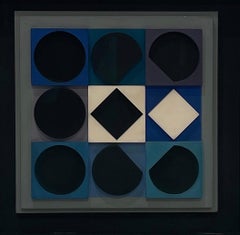
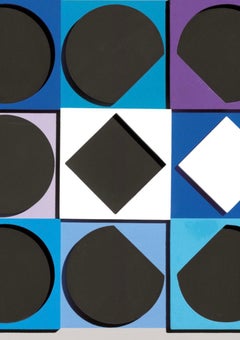
Topaze Noir Négatif, Op Art Mixed Media Relief, Signed, Edition 37/50
Located in PARIS, FR
Matt acrylic-painted wood relief Éditions Denise Rene Paris Edition n° 37/50, Signed. Presented at the exhibition “Vasarely - Le partage des Formes”, in 2019 at the Centre Pompidou. ...
Wood, Acrylic
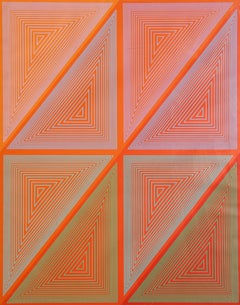
Inward Eye, #7 Geometric Abstract OP Art Screenprint by Richard Anuszkiewicz
Located in Long Island City, NY
Richard Anuszkiewicz (American, 1930 - ) created the "Inward Eye" portfolio after a conversation with a friend who said that Anuszkiewcz's works reminded him of William Blake's work....
Screen
$2,500
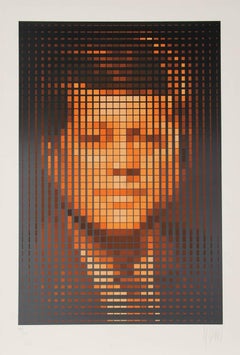
John F. Kennedy, Op Art Screenprint Portrait by Yvaral
By Yvaral (Jean-Pierre Vasarely)
Located in Long Island City, NY
Artist: Jean-Pierre Vasarely - "Yvaral", French (1934 - 2002) Title: John F. Kennedy Year: circa 1979 Medium: Screenprint, signed and numbered in pencil Edition: 177/200 Size: 41 in...
Screen
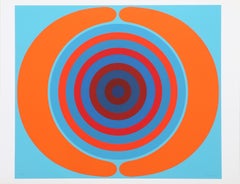
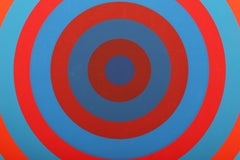
Spiral, Signed Screenprint by Kyohei Inukai
Located in Long Island City, NY
Spiral Kyohei Inukai (aka Earle Goodenow), American (1913–1985) Screenprint, signed and numbered in pencil Edition of 50 Image Size: 21.5 x 25.5 inches Size: 23 x 29.75 in. (58.42 x ...
Screen
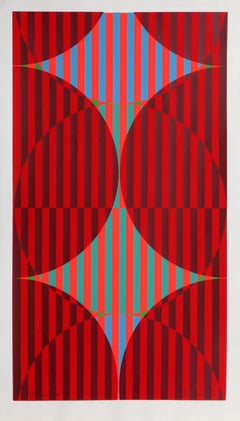
Aberration, Signed Op Art Screenprint by Shirley Penman
By Shirley Penman
Located in Long Island City, NY
Aberration by Shirley Penman Screenprint, signed and numbered in pencil 'Penman' Edition of 50 Size: 29 in. x 17 in. (73.66 cm x 43.18 cm)
Screen
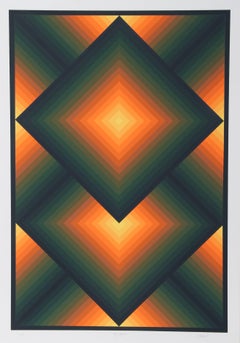
Top Square, Op Art Geometric Abstract Screenprint by Jurgen Peters
Located in Long Island City, NY
Artist: Jurgen Peters, German (1936 - ) Title: Top Square Year: 1981 Medium: Serigraph, signed and numbered in pencil Edition: 250, AP Image Size: 31.5 x 21.5 inches Size...
Screen
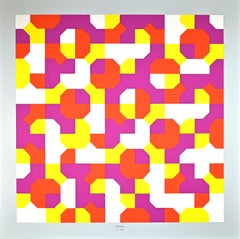
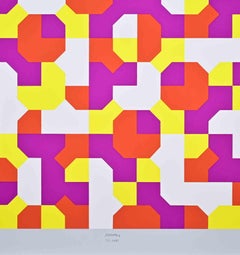
Peano Curves - Screen Print by Bruno Munari - 1991
By Bruno Munari
Located in Roma, IT
Screen print realized by Bruno Munari in 1991. Hand-signed and numbered in pencil. Edition of 100. Excellent condition. Bruno Munari (October 24, 1907 in Milan – September 30, 1...
Screen
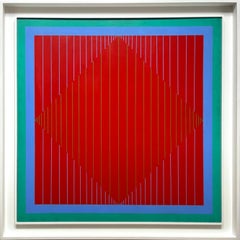

Richard Anuszkiewicz Metallic Water 1960s Op Art painting Art Institute Chicago
Located in New York, NY
Richard Anuszkiewicz Metallic Water, 1964 Painting with Liquitex on canvas. (1964 Art Institute of Chicago Exhibition and J.L. Hudson Gallery) Signed boldly and dated 1964 on the ver...
Mixed Media, Acrylic, Canvas
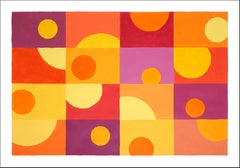
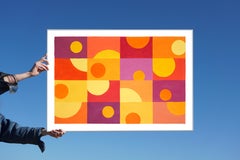
Sixteen Sunsets Tiles, Abstract Geometric Painting in Warm Tones on Paper
Located in Barcelona, ES
"Sixteen Sunset" is a hand-painted acrylic painting on high-quality 300g paper by artist Ryan Rivadeneyra. These painting, influenced by modernist artists of the 50's, 60's, and 70'...
Acrylic, Paper
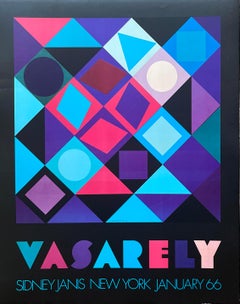
Rare historic Sidney Janis Gallery silkscreen exhibition poster
Located in New York, NY
Victor Vasarely Sidney Janis Gallery Exhibition Poster, 1974 Silkscreen poster on glossy thick paper Bears copyright stamp, printer name and ...
Screen
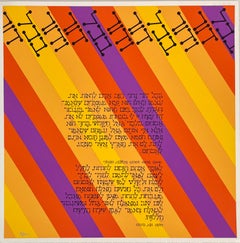
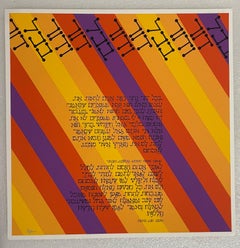
Agam Silkscreen Jerusalem Lithograph Hand Signed Israeli Kinetic Op Art Print
By Yaacov Agam
Located in Surfside, FL
Yaacov Agam, Israeli (b. 1928) Hand signed, not individually numbered but from edition of 180. I can include a copy of the title sheet with the edition size and his signature if you ...
Lithograph, Screen
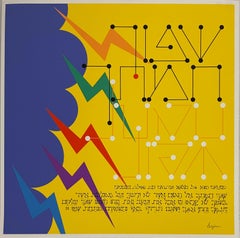
Agam Silkscreen Jerusalem Lithograph Hand Signed Israeli Kinetic Op Art Print
By Yaacov Agam
Located in Surfside, FL
Yaacov Agam, Israeli (b. 1928) Hand signed, not individually numbered but from edition of 180. I can include a copy of the title sheet with the edition size and his signature if you ...
Lithograph, Screen
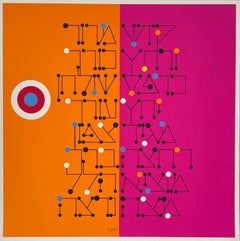
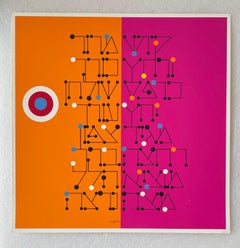
Agam Silkscreen Jerusalem Lithograph Hand Signed Israeli Kinetic Op Art Print
By Yaacov Agam
Located in Surfside, FL
Yaacov Agam, Israeli (b. 1928) Hand signed, not individually numbered but from edition of 180. I can include a copy of the title sheet with the edition size and his signature if you ...
Lithograph, Screen

$550
FACE, from Portfolio 9m Classic 1960s Op Art lithograph signed/n renowned artist
Located in New York, NY
Henry Pearson FACE, from Portfolio 9, 1964 Color lithograph with deckled edges Signed, titled, and numbered 84/100 in graphite pencil on the front; with publishers' blind stamp 17 1/2 × 22 1/10 inches Publisher Irwin Hollander, with blindstamp Hand Signed and Numbered 84/100 with Irwin Hollander (printer) Blindstamp Unframed Henry Pearson's iconic Pop Art lithograph "Face" from the mid-Sixties is in the permanent Collection of the Museum of Modern Art as well as other public institutions. This Classic Sixties psychedelic designed Op Art lithograph was created as part of the legendary 'Portfolio 9' in 1967 - one of the most influential eras in 20th century art. It was housed in a gray cloth-colored box with maroon paper inner panels and a large maroon "9" designed by Richard Lindner on the cover. Portfolio 9 featured nine of the most important artists of the era, representative of the three major trends: Pop Art, Minimalism and Abstract Expressionism: Roy Lichtenstein, Saul Steinberg, Richard Lindner, Robert Motherwell, Henry Pearson, Louise Nevelson, Sam Francis, Willem de Kooning- and Ellsworth Kelly. The Introduction to the portfolio was written by Una E. Johnson, Curator of Prints & Drawings, The Brooklyn Museum. Johnson wrote in 1967 for the colophon page: "The artists were selected to demonstrate the great diversity and character of lithography in the United States today... the dialogue of diverse forms and many faceted idioms that compose this graphic journal mirror the eloquence and delight the strengths and caprices of a period. Furthermore, they reflect in fine measure the creative achievements of artists attuned to their time." The lithograph offered here has superb provenance: it comes directly from 'Portfolio 9', numbered 84/100. This is the very first time since 1967 that this hand signed & numbered print will be separated from the original portfolio presentation box. According to the description of this print in the catalogue raisonne, "Organized as a celebration of Irwin Hollander's collaboration with American artists working in the medium of lithography, the Portfolio 9 is a compendium of images by nine of Hollander's artist collaborators. Henry Pearson Biography: Henry Pearson was born in Kinston, North Carolina in 1914. He studied art at the University of North Carolina where he received his B. A. and later at Yale University where he received an M. F. A. Pearson spent over eleven years in the army during and after WWII. On one tour of duty in Japan he was assigned to interpret topographical maps due to his past training in Theatrical Set Design. He returned to Japan on another tour after the war in order to immerse himself more fully in the culture. Pearson returned to the United States in 1953 and enrolled at the Art Students League in New York where he studied with Reginald Marsh. The Op-Art Movement was beginning to gain popularity and Pearson...
Lithograph, Pencil
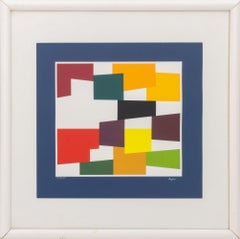
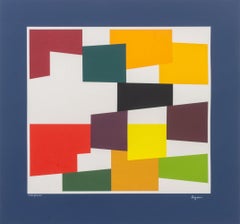
"Composition I" Screenprint in Colors, Signed, circa 1975
By Yaacov Agam
Located in Astoria, NY
Yaacov Agam (Israeli, b. 1928), "Composition I", Screenprint in Colors, circa 1975, signed in white ink lower right, numbered edition "CXXIII/CLXXX" [123/180] lower left, white frame...
Screen
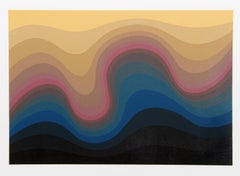
Fiesta, Signed Op Art Screenprint by Roy Ahlgren
By Roy Ahlgren
Located in Long Island City, NY
Artist: Roy Ahlgren, American (1927 - 2011) Title: Fiesta Year: circa 1970 Medium: Screenprint, signed and numbered in pencil Edition: 130 Image Size: 18 x 26 inches Size: 22 x 30 in...
Screen
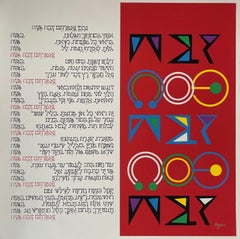
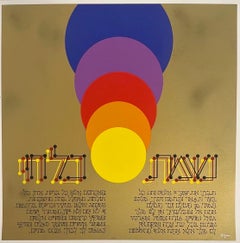
Agam Silkscreen Jerusalem Lithograph Hand Signed Israeli Kinetic Op Art Print
By Yaacov Agam
Located in Surfside, FL
Yaacov Agam, Israeli (b. 1928) Hand signed, not individually numbered but from edition of 180. I can include a copy of the title sheet with the edition size and his signature if you ...
Lithograph, Screen
$750
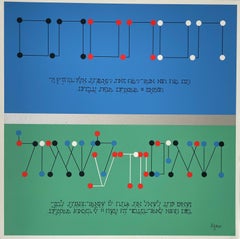
Agam Silkscreen Mod Judaica Lithograph Hand Signed Israeli Kinetic Op Art Print
By Yaacov Agam
Located in Surfside, FL
Yaacov Agam Israeli (b. 1928) Hand signed, not individually numbered but from edition of 180. I can include a copy of the title sheet with the edition size and his signature if you r...
Lithograph, Screen
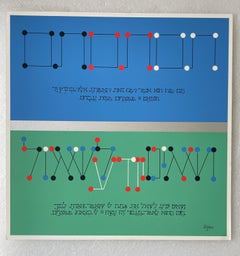
Agam Silkscreen Jerusalem Lithograph Hand Signed Israeli Kinetic Op Art Print
By Yaacov Agam
Located in Surfside, FL
Yaacov Agam, Israeli (b. 1928) Hand signed, not individually numbered but from edition of 180. I can include a copy of the title sheet with the edition size and his signature if you ...
Lithograph, Screen
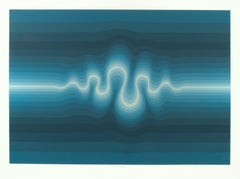
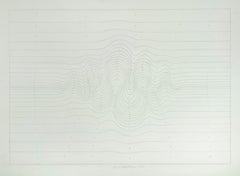
Oscillation
By Roy Ahlgren
Located in Fairlawn, OH
11 color screen print Signed, dated, titled and numberedin pencil Edition: 150 (9/150) Provenance: Estate of the Artist By Decent
Screen
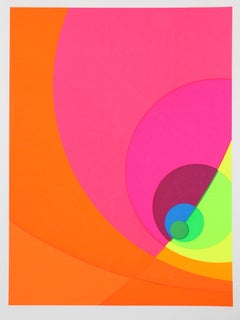

Split Infinity #9BS, OP Art Geometric Abstract Screenprint by Herbert Aach
By Herbert Aach
Located in Long Island City, NY
This screenprint was created by German Op artist Herbert Aach. Aach's prints play with geometry and form, and trick the viewer's eyes by juxtaposing bright neon colors. This print is...
Screen
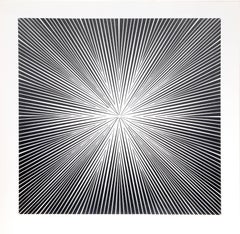
Energia 1, Op Art Screenprint by Roy Ahlgren
By Roy Ahlgren
Located in Long Island City, NY
Artist: Roy Ahlgren, American (1927 - 2011) Title: Energia I Year: 1969 Medium: Silkscreen, Signed and numbered in pencil Edition: 100, AP Image Size: 17 x 17 inches Size: 20 x 20 in...
Screen
$550
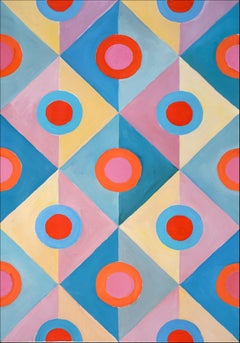
Art Deco Pastel Mirrors, Turquoise and Pink Geometric Tiles Patterns, Symmetry
Located in Barcelona, ES
These series of paintings by Natalia Roman gather their inspiration from geometric, minimalist shapes and paintings from the beginning of Modernism, with a special emphasis on Art Deco shapes of the 30's, 40's and 50's. The subtle but chic color combinations will combine beautifully with both vintage and modern furniture without overtaking spaces that are carefully crafted by designers. Natalia Roman was born in 1984 in Girona, Spain. She has exhibited in galleries across Europe and her colorful, abstract paintings are part of private collections all over the world. Details: Title: Art Deco Pastel...
Acrylic, Paper
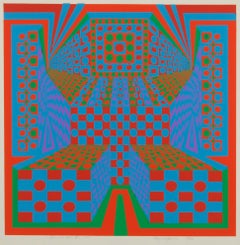
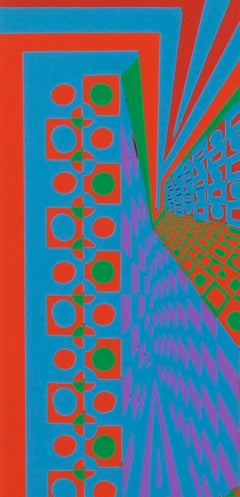
Desert Icon II
By Roy Ahlgren
Located in Fairlawn, OH
Desert Icon II Screen print, c. 1968 Signed, titled and numbered in pencil (see photos) Edition 100 (17/100) Printed by the artist This image is the most elaborate of three color var...
Screen
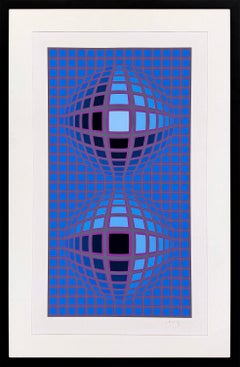
Kardoe, Hand Signed Serigraph, Op Art, Circa 1970, 47 x 30 in. Framed
Located in Aventura, FL
Serigraph in colors on paper. Hand signed lower right by Victor Vasarely. Hand numbered 43/325 lower left. Sheet Size: 43 x 26.5 inches. Image size: 34 x 18.5 inches. Frame size...
Paper, Screen