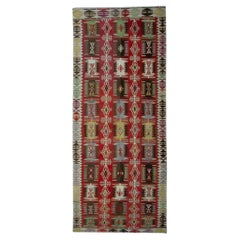
Choose from an assortment of styles, material and more with respect to the designer rug used you’re looking for at 1stDibs. A designer rug used — often made from
fabric,
wool and
cotton — can elevate any home. Your living room may not be complete without a designer rug used — find older editions for sale from the 20th Century and newer versions made as recently as the 21st Century. A designer rug used made by
Scandinavian Modern designers — as well as those associated with
Mid-Century Modern — is very popular. You’ll likely find more than one designer rug used that is appealing in its simplicity, but
Eva Brummer,
Gianni Versace and
Ingrid Dessau produced versions that are worth a look.
Prices for a designer rug used can differ depending upon size, time period and other attributes — at 1stDibs, they begin at $500 and can go as high as $64,500, while the average can fetch as much as $3,375.
The California-born style of Hollywood Regency, also known as Regency Moderne, emerged during the Golden Era of cinema from the 1920s to the ’50s. Decadent and bold, vintage Hollywood Regency furniture and interiors playfully mix colors like jewel tones and hot pinks with lacquered walls, gilded accents, mirrored surfaces and metallic finishes for maximalist spaces.
Although it involved elements of the coinciding Art Deco movement, such as a preference for clean lines, Hollywood Regency was much more opulent, inspired by glamorous movie stars and the lavish set designs for films being made in Tinseltown. Furniture designers associated with the style embraced an eclectic range of influences, including throwbacks to previous styles of grandeur, such as Rococo, neoclassical and chinoiserie, as well as materials, from bamboo dining chairs to lucite bar carts to sunburst mirrors made from gilded resin. Hollywood Regency end tables, floor lamps, chandeliers and other pieces tended to be small-scale, fitting into an overall design rather than serving as a focal point.
Interior decorator Dorothy Draper led the shaping of the Hollywood Regency style and also designed iconic pieces like the España chest, which was manufactured by Henredon. Virginia native William “Billy” Haines, a furniture designer who started as an actor, contrasted hand-painted wallpaper with Chinese ceramics and Chippendale chairs, while architect John Elgin Woolf imbued his Beverly Hills designs with theatrical details. Paul Revere Williams, a trailblazing African-American architect, was pivotal in defining the look through his commercial projects, such as the 1940s Beverly Hills Hotel and bespoke homes that mixed everything from Louis XV paneling to Georgian architecture.
Find a collection of vintage Hollywood Regency bedroom furniture, tables, seating and other pieces on 1stDibs.
Antique and vintage Turkish rugs, with their ruby reds and misted blues, their entwined botanical designs and rhythmic geometries, are as beloved today as they were in the 13th century, when the Turks of the Seljuk Empire began weaving these vibrant carpets in Anatolia.
A Turkish rug is simply one made in Turkey or the former Ottoman empire, employing the region’s unique traditional methods and weaves. Varieties range from flat-woven kilims to lush knotted rugs, known as hali, many of which are created with Ghiordes, or Turkish, knots. Whereas in other knots, the weft (crosswise) yarn is wrapped around one warp (lengthwise) yarn, in Ghiordes knots, it is wrapped around two, imparting lushness and durability. In addition to knotting techniques, Turkish rugs differ in their motifs — naturalistic or stylized, geometric or figurative — which often reflect the region where they were made.
The main types of Turkish rugs, as Milan-based carpet dealer Alfredo Levi explains it, are kilim, typified by a plain slit-tapestry weave, which leaves a gap, or slit, between sections woven with different yarns in different colors; sumak, made with weft wrapping, for a sturdier flat-woven carpet; and cicim, which he describes as “a type of sumak with extra brocade techniques typical of the tribes and villages of central Anatolia.
Within each type, there are various regional styles. Among these are Bergama carpets, characterized by bright reds and strong medallions; thick-piled Tulu rugs; and Konya rugs, which Marco Polo is said to have called “the most beautiful in the world.” With their strong tribal motifs and hot-red wefts of especially luxurious wool, Konya carpets are especially prized by collectors.
Also treasured are Oushak (or Ushak) rugs, with their complex, intricate designs and warm earth tones of saffron, cinnamon, blue, ivory and gold; and Hereke carpets, originally created exclusively for Ottoman sultans, using the finest silk. For Jason Nazmiyal, of New York carpet dealer Nazmiyal Antique Rugs, “a good Turkish rug is when the colors are harmonious.” This is true of both modern and antique Turkish rugs, but the hues have changed over the centuries, thanks to both technology and changes in culture and taste.
Patterns, too, have evolved. Although many weavers continue to produce traditional designs, others reinterpret their cultural heritage in contemporary terms, with bolder ornamentation and more geometric motifs. Contemporary Turkish rugs also are seldom made by hand and often incorporate synthetics into the weave, for cost-effectiveness and a durability suited to 21st-century life.
Find antique and vintage Turkish rugs for your home on 1stDibs. At The Study, read about how to take care of your antique or vintage rug as well as how to choose the right rug for your space.