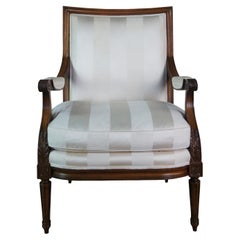
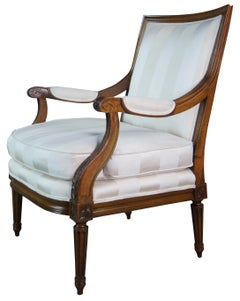
Owing to the company’s collaborations with many leading designers and artists over time, vintage Baker furniture is consistently sought after today. The heritage brand’s chairs, dining tables, desks and other pieces are widely known to collectors and design enthusiasts for their fine craftsmanship and durability.
Within a few decades of its launch, Baker Furniture Company evolved into one of the largest and most important furniture manufacturers in the United States and became known for its high-quality production standards. Siebe Baker and business partner Henry Cook founded the original iteration of Baker Furniture Company in 1890 in Allegan, Michigan, after immigrating to the United States from the Netherlands. Allegan is a small town west of Grand Rapids, which, at that time was home to Widdicomb Furniture Co. and more and was known as America’s furniture capital. The company manufactured doors and interior moldings and introduced a combination desk and bookcase in 1893. In the early 1900s, Siebe became the sole owner of the business.
Among others, stage designer Joseph Urban and modernist designer Kem Weber contributed designs to Baker in the 1920s. In 1932, under the leadership of Siebe’s son, Hollis, who started at the company as a salesman but took the reins when his father passed in 1925, Baker Furniture introduced bedroom pieces and debuted its Manor House collection, which made reproductions of European furnishings available to the American market. (Hollis was an avid traveler and procured antiques overseas for the company to reproduce in the United States.) Soon, Baker Furniture Company moved to Holland, Michigan, and eventually opened showrooms in Grand Rapids and elsewhere.
Pioneering Scandinavian designer Finn Juhl created a Danish modern line for Baker in 1951, and the company produced his award-winning Chieftain chair for a short time. In the late 1950s, Baker introduced the Milling Road label to reach a younger audience with stylish but less costly furnishings like console tables, walnut dining chairs and more, and in 1961, British furniture designer T.H. Robsjohn-Gibbings introduced a modern neoclassical line at Baker.
The 1960s and ’70s saw the introduction of historic reproduction furniture lines such as Woburn Abbey and the Historic Charleston collection, which remain very popular to this day. In 1990, Baker was licensed to produce a furniture line from Colonial Williamsburg. That same year, the Smithsonian Museum introduced Baker’s Chippendale chair into its permanent collection and the Grand Rapids Art Museum dedicated an exhibition to Baker’s 100th anniversary, a showcase that included 150 pieces of furniture Siebe Baker had collected as part of a larger assortment that had served as inspiration for his designs.
Today, vintage Baker furniture, such as its elegant mahogany nightstands and teak credenzas — particularly those crafted by Finn Juhl — sees high demand online and elsewhere. The company continues to produce contemporary collections with well-known designers such as Bill Sofield, Barbara Barry and Kara Mann and remains on par with some of the highest quality furniture in the industry.
Browse vintage Baker armchairs, sofas, coffee tables and other furniture on 1stDibs.
Reflecting the final era of royal opulence before the upheaval of the French Revolution, antique Louis XVI furniture features more angular shapes than the Rococo curves of the Louis XV style, harkening back to the imposing grandeur of Louis XIV.
Dating between 1750 and 1800, an era that overlapped with the last king of France whose reign was cut short by the guillotine, Louis XVI furniture, known as the goût grec, is emblematic of the neoclassical revision that French furniture underwent during the second half of the 18th century.
Authentic Louis XVI furniture characteristics include clean lines and carved details such as scrolls and acanthus flourishes that were inspired by ancient Greece and Rome. This was informed by a burgeoning interest in antiquity in the 18th century, owing to new archaeological excavations at sites including Pompeii and Herculaneum. It largely eclipsed the more East Asian–influenced ornamentation of Louis XV for something more geometric and symmetrical.
The Louis XVI style was defined by what was being created for the palatial rooms at Versailles and Fontainebleau, particularly for the queen, with cabinetmaker Jean-Henri Riesener being a favorite of Marie-Antoinette’s for his luxurious pieces accented with gilded bronze and marquetry. Furniture maker Jean-Baptiste-Claude Sené was also a major designer of the period, with his pieces for the royal residences adorned with giltwood and neoclassical touches like tapered columns for chair legs and laurel leaf carvings. Cabinetmaker Adam Weisweiler occasionally incorporated into his furniture porcelain panels produced by Sèvres, a popular manufacturer of European ceramics that served the crown with serveware, vases and other decorative objects.
Find a collection of antique Louis XVI seating, tables, cabinets and other furniture on 1stDibs.
Armchairs have run the gamut from prestige to ease and everything in between, and everyone has an antique or vintage armchair that they love.
Long before industrial mass production democratized seating, armchairs conveyed status and power.
In ancient Egypt, the commoners took stools, while in early Greece, ceremonial chairs of carved marble were designated for nobility. But the high-backed early thrones of yore, elevated and ornate, were merely grandiose iterations of today’s armchairs.
Modern-day armchairs, built with functionality and comfort in mind, are now central to tasks throughout your home. Formal dining armchairs support your guests at a table for a cheery feast, a good drafting chair with a deep seat is parked in front of an easel where you create art and, elsewhere, an ergonomic wonder of sorts positions you at the desk for your 9 to 5.
When placed under just the right lamp where you can lounge comfortably, both elbows resting on the padded supports on each side of you, an upholstered armchair — or a rattan armchair for your light-suffused sunroom — can be the sanctuary where you’ll read for hours.
If you’re in the mood for company, your velvet chesterfield armchair is a place to relax and be part of the conversation that swirls around you. Maybe the dialogue is about the beloved Papa Bear chair, a mid-century modern masterpiece from Danish carpenter and furniture maker Hans Wegner, and the wingback’s strong association with the concept of cozying up by the fireplace, which we can trace back to its origins in 1600s-era England, when the seat’s distinctive arm protrusions protected the sitter from the heat of the period’s large fireplaces.
If the fireside armchair chat involves spirited comparisons, your companions will likely probe the merits of antique and vintage armchairs such as Queen Anne armchairs, Victorian armchairs or even Louis XVI armchairs, as well as the pros and cons of restoration versus conservation.
Everyone seems to have a favorite armchair and most people will be all too willing to talk about their beloved design. Whether that’s the unique Favela chair by Brazilian sibling furniture designers Fernando and Humberto Campana, who repurposed everyday objects to provocative effect; or Marcel Breuer’s futuristic tubular metal Wassily lounge chair; the functionality-first LC series from Charlotte Perriand, Le Corbusier and Pierre Jeanneret; or the Eames lounge chair of the mid-1950s created by Charles and Ray Eames, there is an iconic armchair for everyone and every purpose. Find yours on 1stDibs right now.