Greek silversmith Sotirios Voulgaris arrived in Rome in 1881 and set up his own shop there in 1884, calling it Bulgari, an Italianization of his last name (in the brand's logo, it's styled BVLGARI, using the classical Latin alphabet in a nod to ancient Roman culture). In 1905, he opened the company’s flagship boutique on Rome’s Via dei Condotti. Since then, Bulgari has looked to Rome as a source of reference for its fanciful and decidedly romantic designs for necklaces, bracelets, earrings and other accessories.
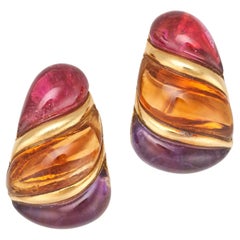
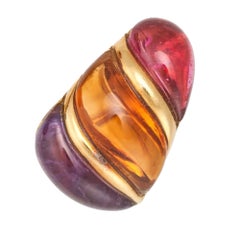
Although the iconic jewelry house found success with its silverwork and Art Deco designs, popular through the 1920s, Bulgari’s signature style — bold, often using yellow gold embellished with big colorful gemstones — began to emerge when Sotirios’s sons inherited the business, in 1932.
The brand truly hit its stride in the dolce vita era of the 1950s and ’60s, when the founder’s grandsons Paolo, Gianni and Nicola Bulgari decisively departed from demure traditional styles to develop the house’s exuberant multi-gem looks, attracting celebrity collectors like Elizabeth Taylor.
In the 1940s, Bulgari debuted perhaps its most famous design, the Serpenti bracelet watch. The piece’s snakelike coils were made possible by the tubogas jewelry technique, which links a flexible series of thin horizontal bands. Both the sleek, modern tubogas construction and the sinuous snake motif continue to be synonymous with the Bulgari brand.
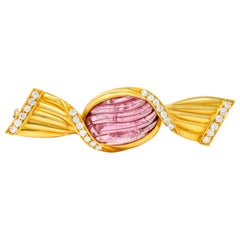
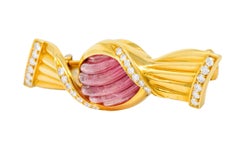
On 1stDibs, the collection of vintage Bulgari jewelry includes rings, pendant necklaces, watches and other accessories.
Very few gems dazzle quite in the manner that tourmaline does — vintage and antique tourmaline jewelry is a showstopper, and you can blame this on its wide range of spectacular colors. In fact, when Dutch traders brought stones back home from Sri Lanka that they couldn't identify, they called them "toramalli," a Sinhalese term for "mixed gems."
If you could transform the ocean to a gem, this is what it would look like: a clear, translucent azure, bordering on turquoise, hypnotizing in its depth and sparkling in the sun.
There is, in fact, such a stone, although it comes from deep in the copper-rich mountains of Paraíba, Brazil, and not from the oceans along its coast. Far rarer than diamonds, Paraíba tourmaline, a kind of tourmaline discovered only in the 1980s, is treasured as much for its extraordinary color as its scarcity, both of which contribute to its high value.
While diamonds generally sell for about $6,000 per carat, a carat of Paraíba tourmaline is likely to fetch about $16,000. Fans of the gem are said to include singer Taylor Swift and actress Zooey Deschanel, as well as some of the finest jewelers.
“No other stone can have a color as magnetic and captivating as Paraíba tourmaline,” says Vania Leles of VanLeles Diamonds, who combines the stone with diamonds and other gems in several of her designs.
You don't have to stop at Paraíba tourmaline jewelry — on 1stDibs, find the most extraordinary antique and vintage tourmaline rings, tourmaline and diamond earrings and other accessories.