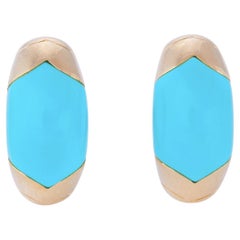
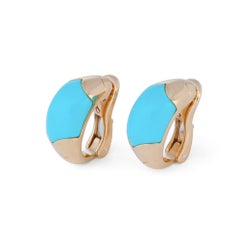
Greek silversmith Sotirios Voulgaris arrived in Rome in 1881 and set up his own shop there in 1884, calling it Bulgari, an Italianization of his last name (in the brand's logo, it's styled BVLGARI, using the classical Latin alphabet in a nod to ancient Roman culture). In 1905, he opened the company’s flagship boutique on Rome’s Via dei Condotti. Since then, Bulgari has looked to Rome as a source of reference for its fanciful and decidedly romantic designs for necklaces, bracelets, earrings and other accessories.
Although the iconic jewelry house found success with its silverwork and Art Deco designs, popular through the 1920s, Bulgari’s signature style — bold, often using yellow gold embellished with big colorful gemstones — began to emerge when Sotirios’s sons inherited the business, in 1932.
The brand truly hit its stride in the dolce vita era of the 1950s and ’60s, when the founder’s grandsons Paolo, Gianni and Nicola Bulgari decisively departed from demure traditional styles to develop the house’s exuberant multi-gem looks, attracting celebrity collectors like Elizabeth Taylor.
In the 1940s, Bulgari debuted perhaps its most famous design, the Serpenti bracelet watch. The piece’s snakelike coils were made possible by the tubogas jewelry technique, which links a flexible series of thin horizontal bands. Both the sleek, modern tubogas construction and the sinuous snake motif continue to be synonymous with the Bulgari brand.
On 1stDibs, the collection of vintage Bulgari jewelry includes rings, pendant necklaces, watches and other accessories.
The thought of vintage and antique turquoise jewelry often conjures up images of striking Navajo bracelets and necklaces worn with a denim shirt and cowboy boots. This all-American look has been celebrated by fashion designers like Ralph Lauren and Tommy Hilfiger on their runways and in ad campaigns. In the October 2016 issue of Vogue magazine, Tom Ford said he only wears turquoise jewelry at his Santa Fe ranch. So what is it about this gorgeous blue-green stone that makes us wish that we were born in December?
It’s not surprising that turquoise is abundant in New Mexico and Arizona because, according to the Gemological Institute of America (GIA), it needs to be in “dry and barren regions where acidic, copper-rich groundwater seeps downward and reacts with minerals that contain phosphorus and aluminum.
Turquoise is not found in a single crystal but is a combination of microcrystals. Its appearance, waxy and opaque, is attributed to its structure and composition. “It’s an aggregate of microscopic crystals that form a solid mass. If the crystals are packed closely together, the material is less porous, so it has a finer texture. Fine-textured turquoise has an attractive, waxy luster when it’s polished. Turquoise with a less-dense crystal structure has higher porosity and coarser texture, resulting in a dull luster when it’s polished,” notes the GIA. Since no one wants to set a dull piece of turquoise, porous turquoise is often treated to make the stone more attractive.
In the United States, there have been discoveries of turquoise from 200 B.C. It is not just loose turquoise stones that have been found, but entire suites of jewelry from prehistoric times. In the late 19th-century, the Navajo Indians, who learned silversmithing from the Spanish, started to make beads out of turquoise and eventually combined it with silver around the 1880s. Initially this jewelry was for ceremonial purposes, but it became fashionable once the tourism in the Southwest picked up in the beginning of the 20th century.
Find antique and vintage turquoise rings, necklaces, bracelets and other accessories on 1stDibs.
Crafted to match every color palette, mood or whim, a luxurious pair of vintage clip-on earrings, like any pair of earrings, goes a long way toward completing a look and contributing to the rich form of self-expression that is accessorizing with your favorite jewelry.
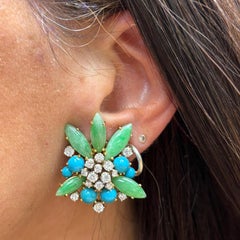
Everyone loves a glamorous pair of earrings, but not everyone wants their ears pierced. That’s where a dazzling pair of clip-ons comes in.
Wearing earrings goes back thousands of years, but ear piercing didn’t really become popular in the United States until the 1950s and ’60s. Over the years, jewelry designers have endeavored to create all kinds of clip-on earrings to provide jewelry lovers with a way to express themselves by wearing their favorite adornments without having to undergo the piercing process.
Whether it’s the extravagant diamond clip-on drop earrings or chandelier earrings that flappers donned during Art Deco’s heyday — short hair was in style during the era, so women favored big, bold earrings — or if subdued pearl earrings, platinum earrings (a particularly versatile choice) or a contemporary variety is your thing, clip-on earrings have been made in all kinds of styles over the years.
Clip-on earrings continue to be a comfortable alternative to the traditional iteration, and these accessories are as stylish and adaptable to both casual and formal wear as they’ve ever been.
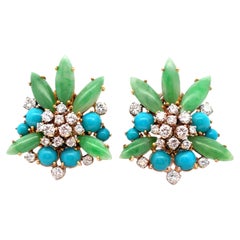
Explore a vast range of vintage clip-on earrings on 1stDibs now, and find the perfect pair for any ensemble. Our collection includes striking clip-on earrings by David Webb, Tiffany & Co., Van Cleef & Arpels and others.