Ebonized Writing Desk

to
10
82
36
106
16
1
18
15
8
7
6
5
3
3
2
2
1
1
1
1
6
55
45
17
14
15
3
2
6
1
5
4
2
115
73
38
38
36
88
53
19
17
14
123
108
112
2
2
2
2
1
RARE - Camphor Wood Campaign Writing Box w/ Ebonized Lines Set on a Bronze Stand

RARE - Camphor Wood Campaign Writing Box w/ Ebonized Lines Set on a Bronze Stand

Located in Chapel Hill, NC

RARE military officers' campaign writing box in camphor wood with ebonized line details. The box is bound with brass around the top and down the four corners as well as mounted with ...

Category

Antique Early 19th Century Indian Campaign Desks

Materials

Brass, Bronze

19th Century Rosewood & Inlay Stationary Writing Slope With Leather Interior

19th Century Rosewood & Inlay Stationary Writing Slope With Leather Interior

Located in Reading, Berkshire

19th Century Victorian Rosewood Decorative Inlaid Writing Slope With An Engraved Shield. Stationary Compartments and Storage Space. The item has black ebonised decorative accents &a...

Category

Antique 19th Century British Victorian Desk Sets

Materials

Rosewood

OPENING WRITING TABLE SECOND HALF OF THE 19th CENTURY

OPENING WRITING TABLE SECOND HALF OF THE 19th CENTURY

Located in Firenze, FI

Elegant writing table for the center entirely veneered in fruit wood. This refined piece of furniture stands out for its arched band and slightly curved legs, enriched by feet decora...

Category

Antique Late 19th Century Italian Desks

Materials

Fruitwood

Antique Italian Ebonized Dining Table or Writing Desk with Iron Stretcher

Antique Italian Ebonized Dining Table or Writing Desk with Iron Stretcher

Located in Hopewell, NJ

Elegant Italian dining table, console table or writing desk with stunning wrought-iron stretchers in a wonderful size.

Category

Antique 19th Century Italian Rustic Dining Room Tables

Materials

Iron

Ebonized Oak Wood and Cork Chair Dining or Writing Desk Chair Porto Chair

Ebonized Oak Wood and Cork Chair Dining or Writing Desk Chair Porto Chair

By Alabama Sawyer

Located in Birmingham, AL

The Porto chair embraces the fusion of timeless elegance and functional minimalism. This streamlined chair complements your urban wood dining table or writing desk in the office. Wit...

Category

2010s American American Craftsman Chairs

Materials

Wood

19th Century Papier-mâché Mache Writing Desk and Games Table

19th Century Papier-mâché Mache Writing Desk and Games Table

Located in Nantwich, GB

A superb quality Victorian papier-mâché mache writing slope and games table with an ebonised background and inlaid with mother of peal. The lid opens to reveal the original velvet l...

Category

Antique 1840s English Victorian Game Tables

Materials

Silver

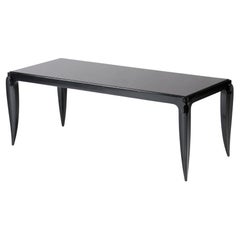
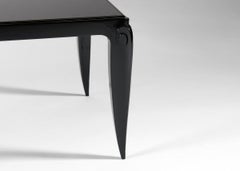
Jean Pascaud, Ebonized Writing Desk with Tapered Legs, France, 1940s

Jean Pascaud, Ebonized Writing Desk with Tapered Legs, France, 1940s

By Jean Pascaud

Located in New York, NY

The elegance of this desk can be attributed to the essential quality of its form—with little more than some well placed lines, Pascaud evokes a great deal more than is to be expected...

Category

Vintage 1940s French Art Deco Desks and Writing Tables

Materials

Metal

Jean Pascaud, Ebonized Lacquered Coffee Table, France, 1940s

Jean Pascaud, Ebonized Lacquered Coffee Table, France, 1940s

By Jean Pascaud

Located in New York, NY

Low, black table with glass top and gently tapering legs characteristic of the French Deco master.

Category

Vintage 1940s French Art Deco Desks and Writing Tables

Materials

Metal

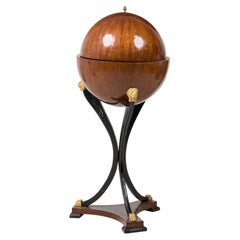
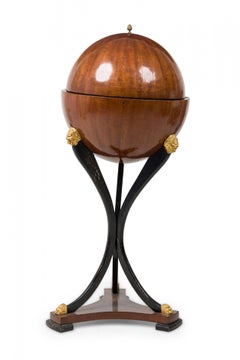
Biedermeier Mahogany Ebonized and Parcel-Gilt Globe Form Work Desk

Biedermeier Mahogany Ebonized and Parcel-Gilt Globe Form Work Desk

Located in Queens, NY

Biedermeier (19th Century) globe-form work desk with a mahogany structure that opens to reveal a several small compartments, with parcel gilt and ebonized detail, with applied lions'...

Category

Antique 19th Century Biedermeier Desks and Writing Tables

Materials

Wood, Mahogany, Giltwood

  • 1
Get Updated with New Arrivals
Save "Ebonized Writing Desk", and we’ll notify you when there are new listings in this category.

Ebonized Writing Desk For Sale on 1stDibs

Choose from an assortment of styles, material and more with respect to the ebonized writing desk you’re looking for at 1stDibs. Frequently made of wood, metal and brass, every ebonized writing desk was constructed with great care. If you’re shopping for a ebonized writing desk, we have 409 options in-stock, while there are 14 modern editions to choose from as well. You’ve searched high and low for the perfect ebonized writing desk — we have versions that date back to the 18th Century alongside those produced as recently as the 21st Century are available. A ebonized writing desk is a generally popular piece of furniture, but those created in Louis XVI, Mid-Century Modern and Louis XV styles are sought with frequency. Maison Jansen, Baker Furniture Company and Milo Baughman each produced at least one beautiful ebonized writing desk that is worth considering.

How Much is a Ebonized Writing Desk?

Prices for a ebonized writing desk can differ depending upon size, time period and other attributes — at 1stDibs, they begin at $815 and can go as high as $125,000, while the average can fetch as much as $5,327.

Finding the Right Desks-writing-tables for You

Choosing the perfect writing desk or writing table is a profoundly personal journey, one that people have been embarking upon for centuries.

Queen Atossa of Persia, from her writing table circa 500 B.C., is said to have been the originator of the art of handwritten letters. Hers was reportedly the first in a long and colorful history of penned correspondence that grew in popularity alongside literacy. The demand for suitable writing desks, which would serve the composer of the letters as well as ensure the comfort of the recipient naturally followed, and the design of these necessary furnishings has evolved throughout history.

Once people began to seek freedom from the outwardly ornate styles of the walnut and rosewood writing desks and drafting tables introduced in the name of Queen Victoria and King Louis XV, radical shifts occurred, such as those that materialized during the Art Nouveau period, when designers longed to produce furniture inspired by the natural world’s beauty. A prime example is the work of the famous late-19th-century Spanish architect Antoni Gaudí — his rolltop desk featured deep side drawers and was adorned with carved motifs that paid tribute to nature. Gaudí regularly combined structural precision with decorative elements, creating beautiful pieces of furniture in wood and metal.

Soon afterward, preferences for sleek, geometric, stylized forms in furniture that saw an emphasis on natural wood grains and traditional craftsmanship took hold. Today, Art Deco desks are still favored by designers who seek to infuse interiors with an air of luxury. One of the most prominent figures of the Art Deco movement was French decorator and furniture designer Émile-Jacques Ruhlmann. With his use of neoclassical motifs as well as expensive and exotic materials such as imported dark woods and inlays of precious metals for his writing desks, Ruhlmann came to symbolize good taste and modernity.

The rise in appreciation for Scandinavian modernism continues to influence the design of contemporary writing desks. It employs the “no fuss” or “less is more” approach to creating a tasteful, sophisticated space. Sweden’s master cabinetmaker Bruno Mathsson created gallery-worthy designs that are as functional as they are beautiful. Finnish architect Alvar Aalto never viewed himself as an artist, but, like Mathsson, his furniture designs reflected a fondness for organic materials and a humanistic approach. Danish designers such as Hans Wegner introduced elegant shapes and lines to mid-century desks and writing tables, often working in oak and solid teak.

From vintage desks to contemporary styles, 1stDibs offers a broad spectrum of choices for conducting all personal and business writing and reading activities.