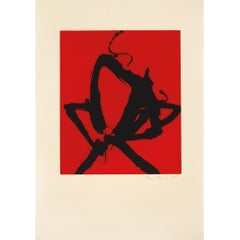
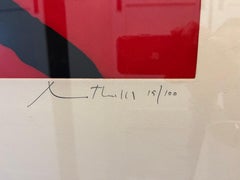
Red Sea I
By Robert Motherwell
Located in New York, NY
paper. Signed and numbered 15/100 by Motherwell. There are 20 artist proofs, numbered I/XX-XX/XX
Category
1970s Abstract Expressionist Abstract Prints
Materials
Etching, Aquatint
Red Sea I
By Robert Motherwell
Located in New York, NY
paper. Signed and numbered 15/100 by Motherwell. There are 20 artist proofs, numbered I/XX-XX/XX
Etching, Aquatint
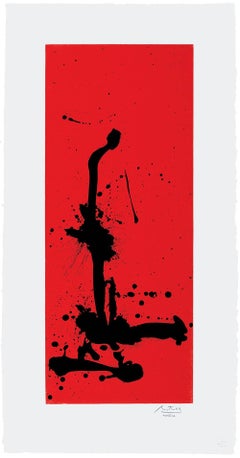
Red Sea III
By Robert Motherwell
Located in London, GB
Aquatint and lift-ground etching on Georges Duchêne Hawthorne of Larroque handmade paper, Edition of 70 1983 90.2 x 46.4 cms (35 1/2 x 18 1/4 ins)
Etching, Aquatint
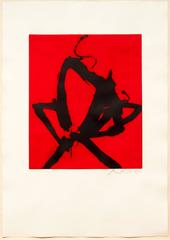
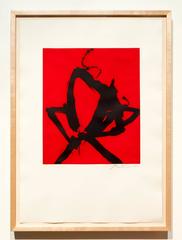
Red Sea I
By Robert Motherwell
Located in Santa Monica, CA
Red Sea I, 1976 Aquatint 41 1/2 x 29 1/16 inches Edition of 100 Signed and numbered MOTX158C
Etching, Aquatint
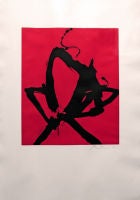
Red Sea I
By Robert Motherwell
Located in Los Angeles, CA
Edition of 100 plus 20 artist's proofs Signed and numbered in pencil
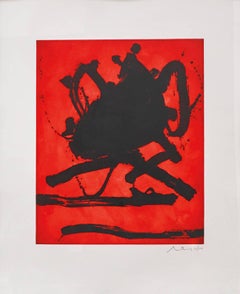
Red Sea II
By Robert Motherwell
Located in Boston, MA
Artist: Motherwell, Robert Title: Red Sea II Date: 1979 Medium: Color Etching with Aquatint on
Etching
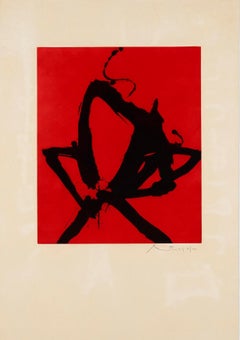
Red Sea I
By Robert Motherwell
Located in New York, NY
paper. Signed and numbered 8/100 by Motherwell. Printed by Catherine Mosley at the artist's studio
Etching, Aquatint
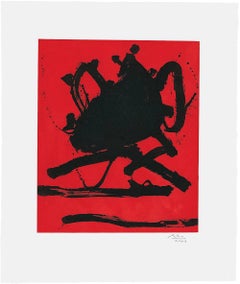

Red Sea II
By Robert Motherwell
Located in London, GB
87.6 x 37.7 cms (34.5 x 29 ins) Edition of 100
Color, Etching
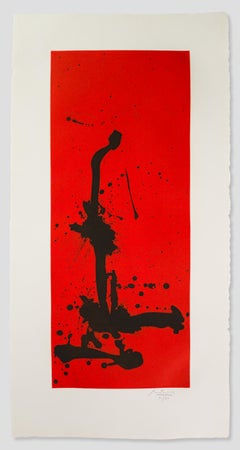
Red Sea III
By Robert Motherwell
Located in Santa Fe, NM
Red Sea III is a 1983 aquatint and etching by Robert Motherwell. Red Sea is III is from an edition
Etching, Aquatint

Red Sea I
By Robert Motherwell
Located in Santa Monica, CA
Robert MOTHERWELL (1915-1991) Red Sea I, 1976 Aquatint in red and black Image: 23 9/16 x 19 3/4

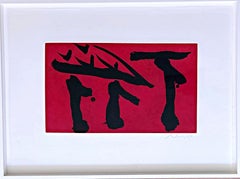
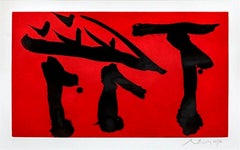
Untitled
By Cleve Gray
Located in New York, NY
A very good impression of this large, scarce print, color aquatint on white wove Fabriano paper. Artist's proof, aside from the edition of 35. Signed and inscribed "artist's proof" ...
Color, Aquatint
$25,000
H 23 in W 31 in D 2 in
Pull Out All Flags, iconic Abstract Expressionist etching aquatint, SIgned 33/50
By Robert Motherwell
Located in New York, NY
Robert Motherwell Pull Out All Flags (Engberg, Banach 263), 1980 Aquatint and etching in colors, on German Etching paper, with full margins Hand-signed by artist, Pencil signed and n...
Etching, Aquatint
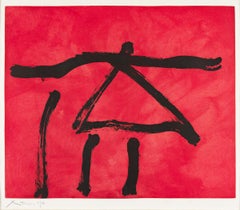
Dance III (Red)
By Robert Motherwell
Located in New York, NY
A very good impression of this color aquatint on J. B. Green paper. Signed and numbered 5/50 in pencil by Motherwell. Printed by Catherine Mousley in the artist's studio, Greenwich, ...
Color, Aquatint
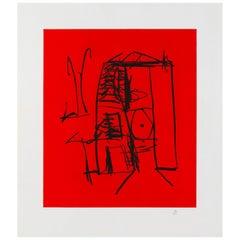
Seaside Studio
By Robert Motherwell
Located in Toronto, Ontario
Robert Motherwell (1915-1991), alongside Jackson Pollock, Mark Rothko, and Willem de Kooning, made up the quartet of American abstract painters that radically defined abstraction and...
Etching, Aquatint
The name of painter, printmaker and writer Robert Motherwell (1915–91) is often taken as synonymous with the New York School, whose name he coined. Motherwell was the youngest of this group of Abstract Expressionists working in art, dance, poetry and music in 1950s and '60s New York City, which included Jackson Pollock, Willem de Kooning, Philip Guston, Helen Frankenthaler and Mark Rothko.
Born in Aberdeen, Washington, in 1915, Motherwell had perhaps the broadest and best education of any of the New York School coterie, with an extensive background in philosophy, literature and art history. He earned a BA in philosophy in 1937 from Stanford University and was working toward a PhD in the subject at Harvard when he interrupted his studies for a yearlong trip to Europe, where he fell in love with European modernism.
After returning, in 1940 he enrolled Columbia to study art history. It was there that he met a group of exiled Parisian Surrealists, and encounter that proved influential on his style. Motherwell began to integrate the idea of “automatism” — unmediated gestures that reflect deeper psychological impulses — into his work, pioneering a new form of Abstract Expressionism that came to characterize the New York School.
Works like the 1967 Beside the Sea no. 45, an acrylic on canvas, and the 1966 lithograph New York International epitomize Motherwell’s use of simple shapes in boldly contrasting colors, executed in quick, gestural strokes that occasionally evoke figures, suggesting a latent narrative despite their obvious abstraction.
Throughout his career, Motherwell taught painting at Hunter College, in New York, and at Black Mountain College, in North Carolina, where his work influenced the likes of Cy Twombly, Robert Rauschenberg and Kenneth Noland. His influence as one of the founding fathers of American Abstract Expressionism remains profound.
Decorating with fine art prints — whether they’re figurative prints, abstract prints or another variety — has always been a practical way of bringing a space to life as well as bringing works by an artist you love into your home.
Pursued in the 1960s and ’70s, largely by Pop artists drawn to its associations with mass production, advertising, packaging and seriality, as well as those challenging the primacy of the Abstract Expressionist brushstroke, printmaking was embraced in the 1980s by painters and conceptual artists ranging from David Salle and Elizabeth Murray to Adrian Piper and Sherrie Levine.
Printmaking is the transfer of an image from one surface to another. An artist takes a material like stone, metal, wood or wax, carves, incises, draws or otherwise marks it with an image, inks or paints it and then transfers the image to a piece of paper or other material.
Fine art prints are frequently confused with their more commercial counterparts. After all, our closest connection to the printed image is through mass-produced newspapers, magazines and books, and many people don’t realize that even though prints are editions, they start with an original image created by an artist with the intent of reproducing it in a small batch. Fine art prints are created in strictly limited editions — 20 or 30 or maybe 50 — and are always based on an image created specifically to be made into an edition.
Many people think of revered Dutch artist Rembrandt as a painter but may not know that he was a printmaker as well. His prints have been preserved in time along with the work of other celebrated printmakers such as Pablo Picasso, Salvador Dalí and Andy Warhol. These fine art prints are still highly sought after by collectors.
“It’s another tool in the artist’s toolbox, just like painting or sculpture or anything else that an artist uses in the service of mark making or expressing him- or herself,” says International Fine Print Dealers Association (IFPDA) vice president Betsy Senior, of New York’s Betsy Senior Fine Art, Inc.
Because artist’s editions tend to be more affordable and available than his or her unique works, they’re more accessible and can be a great opportunity to bring a variety of colors, textures and shapes into a space.
For tight corners, select small fine art prints as opposed to the oversized bold piece you’ll hang as a focal point in the dining area. But be careful not to choose something that is too big for your space. And feel free to lean into it if need be — not every work needs picture-hanging hooks. Leaning a larger fine art print against the wall behind a bookcase can add a stylish installation-type dynamic to your living room. (Read more about how to arrange wall art here.)
Find fine art prints for sale on 1stDibs today.