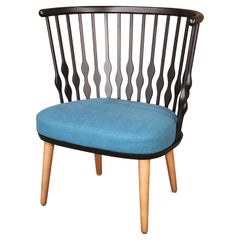
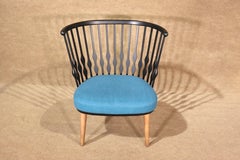
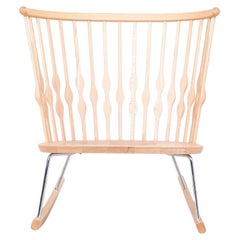
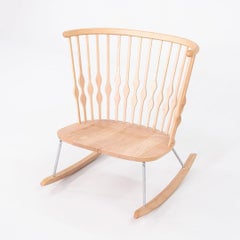
Spanish-born, Milan-based architect Patricia Urquiola doesn’t lack for commissions these days, and, unlike the work of many other high-concept architects, her projects tend to get constructed, envelope-pushing though they sometimes are. And when she’s not imagining covetable creations for contemporary furniture houses — including B&B Italia, Driade and Cassina, where she was named art director in 2015 — Urquiola makes headlines by designing some of the world’s most aesthetically ambitious hotels, such as 2016’s Il Sereno on Lake Como in Lombardy, Italy.
Born in Oviedo, in northern Spain, Urquiola grew up in a family that valued creativity. Everyone in the house, she says, talked and cared about design. She fondly remembers her mother going to London in the 1960s and ’70s and coming back home with a Mary Quant this, a David Hicks that. When it came time to go to university, Urquiola decided that her place was architecture school, first at the Polytechnic University of Madrid and then at the Polytechnic University of Milan, where she completed her design thesis — a felt carpet with a panel that connected to a home’s electricity source and telephone line so that you could plug, say, a table lamp and your phone into it — under the direction of legendary Italian industrial designer Achille Castiglioni.
Today, Urquiola has become a go-to when it comes to avant-garde product, hospitality and retail design, working with such blue-chip international furniture, fashion and hotel companies as Alessi, Baccarat, Salvatore Ferragamo, Kvadrat, Mandarin Oriental, Panerai, Rosenthal, W Hotels and Louis Vuitton, among many others. Her residential projects, meanwhile, though few and far between, stretch from such far-flung locations as Punta del Este, Uruguay, and Melbourne, Australia, to closer-to-home Udine, in northeastern Italy, where she designed the two-story, largely open-plan glass-and-cedar home of Patrizia Moroso, creative director of the family-owned design company that bears her last name.
Over the course of a long-term and highly productive collaboration spanning some 20 years, Urquiola has created dozens and dozens of Moroso-branded products. A chair from her 2001 Fjord line of seating, tables and poufs for the company sits in the collection of New York’s Museum of Modern Art, and Moroso debuted (love me) Tender, her modular sofa system upholstered in jersey, during Milan’s Salone Internazionale del Mobile in April of 2014.
Find Patricia Urquiola furniture on 1stDibs.
While this specific seating is known to all for its comfort and familiar form, the history of how your favorite antique or vintage lounge chair came to be is slightly more ambiguous.
Although there are rare armchairs dating back as far as the 17th century, some believe that the origins of the first official “lounge chair” are tied to Hungarian modernist designer-architect Marcel Breuer. Sure, Breuer wasn’t exactly reinventing the wheel when he introduced the Wassily lounge chair in 1925, but his seat was indeed revolutionary for its integration of bent tubular steel.
Officially, a lounge chair is simply defined as a “comfortable armchair,” which allows for the shape and material of the furnishings to be extremely diverse. Whether or not chaise longues make the cut for this category is a matter of frequent debate.
The Eames lounge chair, on the other hand, has come to define somewhat of a universal perception of what a lounge chair can be. Introduced in 1956, the Eames lounger (and its partner in cozy, the ottoman) quickly became staples in television shows, prestigious office buildings and sumptuous living rooms. Venerable American mid-century modern designers Charles and Ray Eames intended for it to be the peak of luxury, which they knew meant taking furniture to the next level of style and comfort. Their chair inspired many modern interpretations of the lounge — as well as numerous copies.
On 1stDibs, find a broad range of unique lounge chairs that includes everything from antique Victorian-era seating to vintage mid-century modern lounge chairs by craftspersons such as Hans Wegner to contemporary choices from today’s innovative designers.