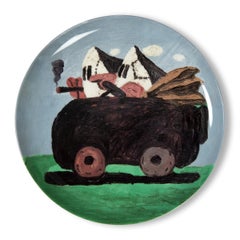
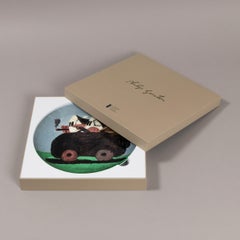
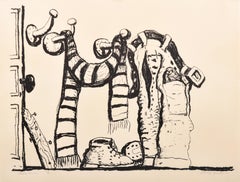
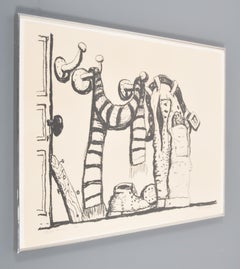
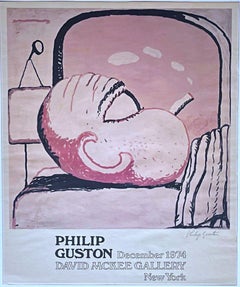
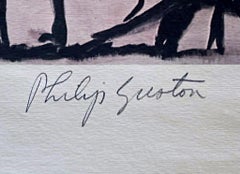
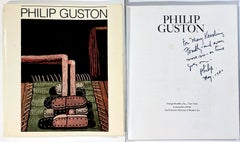
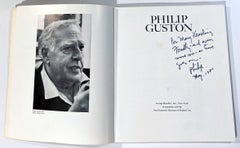
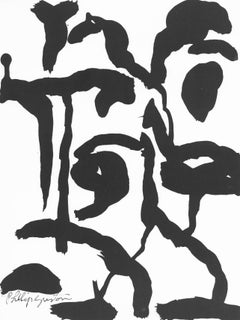
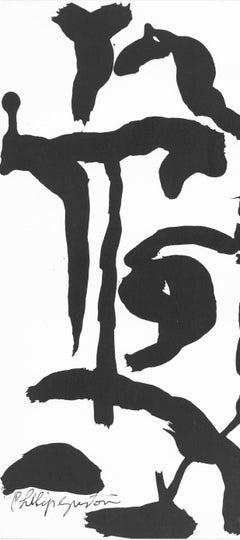
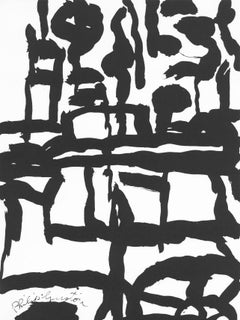
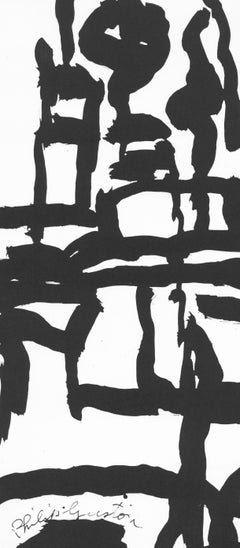
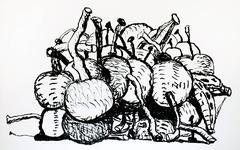
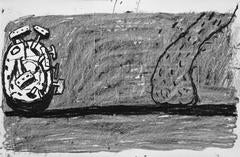
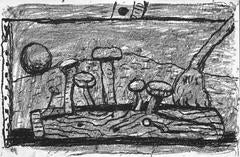
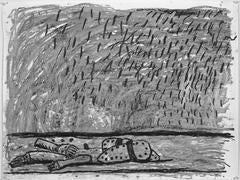
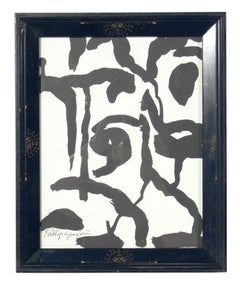
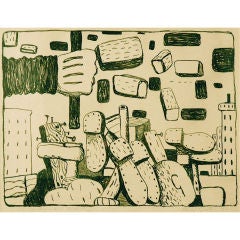
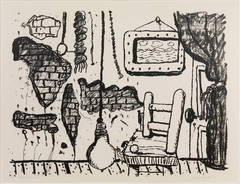
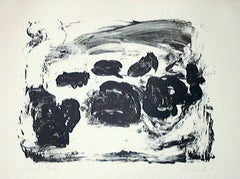
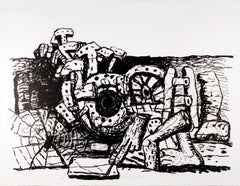
There is a broad range of philip guston prints for sale on 1stDibs. Finding the perfect
modern,
abstract or
street art examples of these works for your space is difficult — today, we have a vast range of variations and more on offer. There are many variations of these items available, from those made as long ago as the 20th Century to those made as recently as the 21st Century. Adding a colorful piece of art to a room that is mostly decorated in warm neutral tones can yield a welcome change — see the philip guston prints on 1stDibs that include elements of
black,
gray,
silver,
beige and more.
Fred McDarrah,
Emily Cheng,
Fred W. McDarrah,
Jill Moser and
Ivan Schwebel took a thoughtful approach to this subject that are worth considering. The range of these distinct pieces — often created in
silver gelatin print,
paper and
paint — can elevate any room of your home.
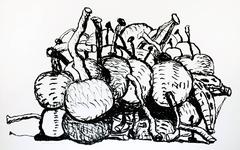
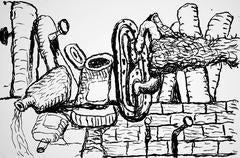
Philip Guston (1913–1980) was an influential American artist whose career evolved from social realism to abstract expressionism and finally to a unique form of figurative painting. Born in Montreal, Canada, to Russian-Jewish immigrant parents, Guston grew up in Los Angeles, where he was introduced to art and politics at a young age. His early years were marked by personal tragedy, including his father’s suicide, an event that profoundly influenced his later work.
In the 1930s, Guston began his artistic career as a muralist under the Federal Art Project, inspired by the social realism of Mexican muralists like Diego Rivera. During this time, his work conveyed strong political and social messages, reflecting the struggles of the working class and the political tensions of the era. By the 1940s, Guston moved to New York, where he became associated with the burgeoning Abstract Expressionist movement alongside artists like Jackson Pollock and Willem de Kooning. His abstract works from this period were characterized by lush, painterly surfaces and a focus on emotional resonance.
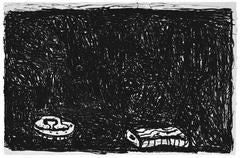
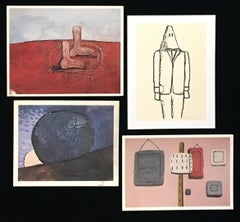
Despite his success as an Abstract Expressionist, Guston grew increasingly dissatisfied with abstraction’s limitations in addressing personal and societal concerns. In the late 1960s, he made a dramatic shift back to representational imagery, a move that shocked the art world. His later works incorporated cartoonish, symbolic figures—hooded Ku Klux Klan-like characters, shoes, lightbulbs, and disembodied heads—depicting themes of existential angst, political corruption, and personal reflection. These provocative images, such as in The Studio (1969), addressed racism, violence, and the complexities of human identity with biting humour and raw emotion.
Critics initially derided Guston’s return to figuration, but his bold departure from abstraction ultimately cemented his legacy as a pioneering figure who challenged conventions and explored deeply personal and political themes. His work resonates with an unflinching honesty and continues to influence contemporary artists grappling with societal issues and the human condition.
Guston died in 1980, leaving behind a body of work that defies categorization yet remains profoundly impactful. Today, he is celebrated as an artist who pushed boundaries and redefined what painting could be, inspiring generations with his fearless creativity and commitment to authenticity.
Decorating with fine art prints — whether they’re figurative prints, abstract prints or another variety — has always been a practical way of bringing a space to life as well as bringing works by an artist you love into your home.
Pursued in the 1960s and ’70s, largely by Pop artists drawn to its associations with mass production, advertising, packaging and seriality, as well as those challenging the primacy of the Abstract Expressionist brushstroke, printmaking was embraced in the 1980s by painters and conceptual artists ranging from David Salle and Elizabeth Murray to Adrian Piper and Sherrie Levine.
Printmaking is the transfer of an image from one surface to another. An artist takes a material like stone, metal, wood or wax, carves, incises, draws or otherwise marks it with an image, inks or paints it and then transfers the image to a piece of paper or other material.
Fine art prints are frequently confused with their more commercial counterparts. After all, our closest connection to the printed image is through mass-produced newspapers, magazines and books, and many people don’t realize that even though prints are editions, they start with an original image created by an artist with the intent of reproducing it in a small batch. Fine art prints are created in strictly limited editions — 20 or 30 or maybe 50 — and are always based on an image created specifically to be made into an edition.
Many people think of revered Dutch artist Rembrandt as a painter but may not know that he was a printmaker as well. His prints have been preserved in time along with the work of other celebrated printmakers such as Pablo Picasso, Salvador Dalí and Andy Warhol. These fine art prints are still highly sought after by collectors.
“It’s another tool in the artist’s toolbox, just like painting or sculpture or anything else that an artist uses in the service of mark making or expressing him- or herself,” says International Fine Print Dealers Association (IFPDA) vice president Betsy Senior, of New York’s Betsy Senior Fine Art, Inc.
Because artist’s editions tend to be more affordable and available than his or her unique works, they’re more accessible and can be a great opportunity to bring a variety of colors, textures and shapes into a space.
For tight corners, select small fine art prints as opposed to the oversized bold piece you’ll hang as a focal point in the dining area. But be careful not to choose something that is too big for your space. And feel free to lean into it if need be — not every work needs picture-hanging hooks. Leaning a larger fine art print against the wall behind a bookcase can add a stylish installation-type dynamic to your living room. (Read more about how to arrange wall art here.)
Find fine art prints for sale on 1stDibs today.