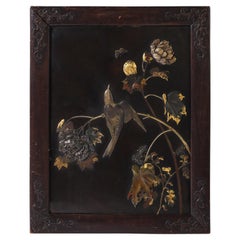
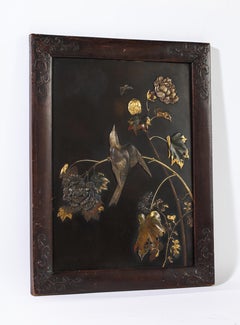
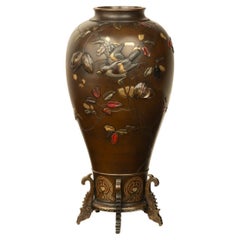
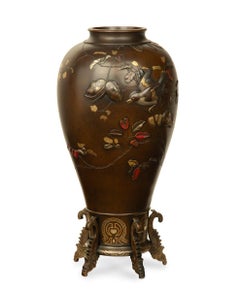
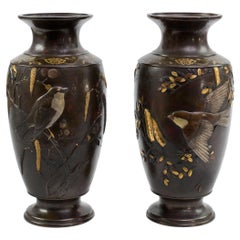
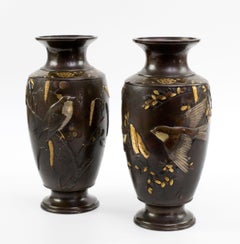
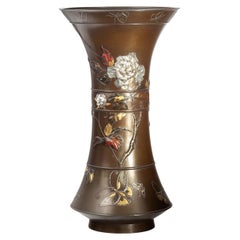
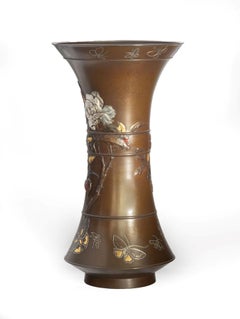
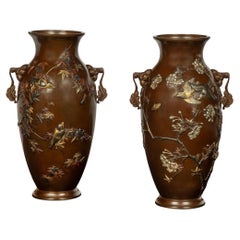
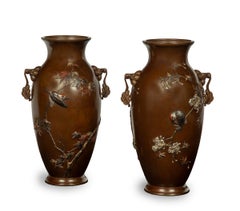
From 1868 to 1912, Emperor Mutsuhito oversaw an era of transformation in Japan. Formerly a country of feudalism and isolation, Japan entered an age of modernization influenced by newly established trade and exchange with the West. The Meiji period, or period of “enlightened rule,” also saw the global impact of the East Asian country’s culture. Japanese Meiji furniture was exhibited at expositions from Paris to San Francisco and created for export.
Prior to the Meiji era, furniture was mostly made by commission for the ruling class; now there were new domestic and international markets. European styles like Japonisme appropriated Japanese design while craftsmen in places like Wales and England employed japanning, a varnishing technique that approximated the appearance of lacquer for the surfaces of furnishings.
Meiji furniture made for Japanese homes and buildings constructed in Western styles resulted in taller tables, chairs, cabinets with large drawers and other features. The government invested in areas such as transportation and communication, and because people could freely choose occupations after the restrictions of feudalism, industries of various types were energized by expressive new ideas during those years. Art schools were formed and, for the first time, design was an area of study in the country, leading to the evolution of professional design as a career by the 1890s.
The work of Japanese designers was transmitted widely through lavishly illustrated pattern books that included designs for screens and lacquerware for the home. While screens today may be of use as decorative accents or partitions to ensure privacy in one’s space, Japanese screens were adorned with paintings and were featured in performing arts such as concerts, tea ceremonies and more. The color illustrations that characterize Meiji woodblock prints, a genre of Japanese art that grew out of 17th-century developments in printing and book publishing, depicted the sweeping changes that the era brought to East Asia.
Although it was a time of societal and cultural shifts, a bolstered interest in art and design elevated Japanese craft traditions. From colorful porcelain table lamps with silk shades and hardwood tables decorated with dark lacquer to cabinets featuring iron hardware and inlaid with mother-of-pearl, Meiji furniture showcased Japan’s artistic heritage to the world.
Find a collection of antique Japanese Meiji period case pieces and storage cabinets, decorative objects, wall decorations and more furniture on 1stDibs.
From Japanese handmade earthenware pottery, originating circa 14,500 B.C. and adorned with elaborate corded patterns known as jōmon, to natural elm case pieces and storage cabinets built in Qing dynasty–era China to mid-century Thai rice-paper charcoal rubbings, antique and vintage Asian art and furniture make for wonderful additions to all kinds of contemporary interiors.
Eastern elements elevate any home’s decor. Introduce zen sensibility to your living room, dining room and bedroom with the neutral color palettes and the natural materials such as rattan, bamboo and elm that we typically associate with traditional Asian furniture. Decorative handwoven embroideries and textiles originating from India and elsewhere on the continent, which can be draped over a bed or sofa or used as a wall hanging, can be as practical as they are functional, just as you wouldn’t seek out Japanese room-divider screens — often decorated with paintings but constructed to be lightweight and mobile — merely for privacy.
With everything from blanket chests to lighting fixtures to sculptures and carvings, it’s easy to tastefully bring serenity to your living space by looking to the treasures for which the East has long been known.
For British-born furniture designer Andrianna Shamaris, the Japanese concept of beauty in imperfection isn’t limited to her Wabi Sabi collection. She embraces it in her New York City apartment as well. In the living area, for instance, she retained the fireplace’s original black marble while swathing its frame and the rest of the room in bright white.
“We left the fireplace very clean and wabi-sabi, so that it blended into the wall,” says Shamaris, who further appointed the space with a hand-carved antique daybed whose plush pillows are upholstered in antique textiles from the Indonesian island of Sumba.
In the growing antique and vintage Asian art and furniture collection on 1stDibs, find ceramics from China, antiquities from Cambodia and a vast range of tables, seating, dining chairs and other items from Japan, India and other countries.