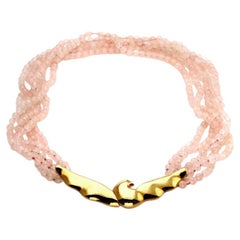
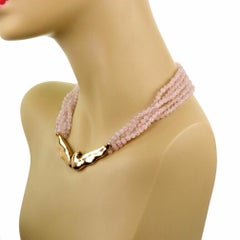
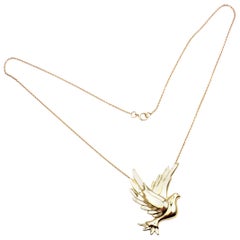
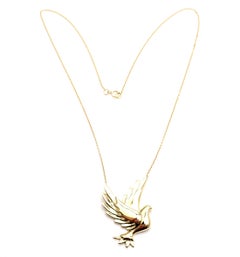
When thinking about the colorful gemstones and flashy forms that so frequently characterized 1980s jewelry, it is impossible not to conjure images of the expressive confections that Paloma Picasso created for legendary American luxury house Tiffany & Co. For iconic work such as the Loving Heart ring and the Love & Kisses brooch, Picasso mined what she admired about urban street art in New York City’s grungy subways and brought it to fine jewelry-making on a global stage.
The daughter of artists Pablo Picasso and Françoise Gilot, Paloma was destined for creative success. She was determined to succeed on her own, however, and didn’t rely on her parents' renown. Picasso graduated from the Université de Paris in Nanterre, where she studied jewelry design and costuming. She spent a short period in the late 1960s as a fashion designer and a jewelry stylist for a Parisian theater company, an experience that essentially ignited Picasso’s career. Critics took notice, and her friend and French fashion designer Yves Saint-Laurent commissioned her to make costume jewelry for his runway collections.
Picasso designed a collection of necklaces and bracelets for the Greek jewelry firm Zolotas in the early 1970s, and her success with Saint-Laurent led to an important connection between Picasso and Tiffany & Co. design director John Loring. Picasso jumped at Loring’s request to present a table setting at a 1979 Tiffany & Co. exhibition, and within a single year, Loring commissioned her to design jewelry for the brand. Her first proper collection, Paloma's Graffiti, is her best-known work for the company.
Paloma had joined the illustrious ranks of Elsa Peretti and Angela Cummings — both revered jewelry designers who’d signed contracts with Tiffany just before her. Her Graffiti collection, which initially comprised a range of both slender and bubble-letter-like scribbles, X’s, O’s and other figures in 18-karat gold and palladium, was an extraordinary debut for her. Finding inspiration in Keith Haring’s Pop art as well as the street art that covered Manhattan subway cars of the era, Picasso introduced a graphic quality to her inaugural Tiffany line.
“In the ‘70s, people were starting to tag subways and walls, which had everyone outraged,” Picasso explained of the concepts behind her vibrant rings, earrings and necklaces. “I wanted to look at graffiti differently and try to make something positive out of it.”
Picasso would later draw on nature for her sterling silver-and-pearl Olive Leaf accessories at Tiffany and frequently created gold necklaces and bracelets that were set with a striking mix of colorful semi-precious stones.
Throughout her career, Picasso has garnered acclaim from many institutions such as the Fashion Group International and was presented with an award in 1988 by the Hispanic Designers Council. She has been recognized the National Museum of Women in the Arts, and her work is held in the collections of the Smithsonian National Museum of Natural History and the Field Museum in Chicago.
Find vintage Paloma Picasso Tiffany & Co. brooches, bracelets and other jewelry on 1stDibs.
We are fortunate to know much of the world’s long and dazzling history of necklaces, as this type of jewelry was so treasured that it was frequently buried with its owners. Today, Van Cleef necklaces, Tiffany necklaces and Cartier necklaces are some of the most popularly searched designer necklaces on 1stDibs.
Lapis lazuli beads adorned necklaces unearthed from the royal graves at the ancient Iraqi civilization of Sumer, while the excavation of King Tut’s burial chamber revealed a sense of style that led to a frenzy of Art Deco designs, with artisans of the 1920s seeking to emulate the elegant work crafted by Ancient Egypt’s goldsmiths and jewelry makers.
In ancient times, pendant necklaces worn by royalty and nobles conferred wealth and prestige. Today, wearing jewelry is about personal expression: Luxury diamond necklaces exude confidence and can symbolize the celebratory nature of a deep romantic relationship, while paper-clip chain-link necklaces designed by the likes of goldsmith Faye Kim are firmly planted in the past as well as the present. Kim works exclusively with eco-friendly gold, and these fashionable, fun accessories owe to the design of 19th-century watch fobs.
For some, necklaces are thought of as being a solely feminine piece, but this widely loved accessory has been gender-neutral for eons. In fact, just as women rarely took to wearing a single necklace during the Renaissance, men of the era layered chains and valuable pendants atop their bejeweled clothing. In modern times, the free-spirited hippie and counterculture movements of the 1960s saw costume-jewelry designers celebrating self-expression through colorful multistrand necklaces and no shortage of beads, which were worn by anyone and everyone.
Even after all of these years, the necklace remains an irrefutable staple of any complete outfit. Although new trends in jewelry are constantly emerging, the glamour and beauty of the past continue to inform modern styles and designs. In a way, the cyclical history of the necklace differs little from its familiar looped form: The celebrated French jewelry house Van Cleef & Arpels found much inspiration in King Tut, and, now, their Alhambra collection is a go-to for modern royals. Vintage David Webb necklaces — whose work landed him on the cover of Vogue in 1950, two years after opening his Manhattan shop — were likely inspired by the ornamental styles of ancient Greece, Mesopotamia and Egypt.
On 1stDibs, browse top designers like Dior, Chanel and Bulgari, or shop by your favorite style, from eye-catching choker necklaces to understated links to pearl necklaces and more.