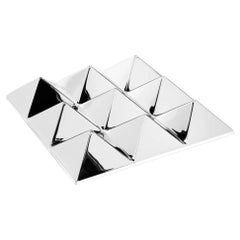
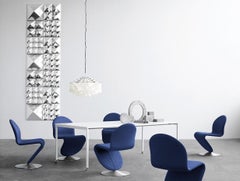
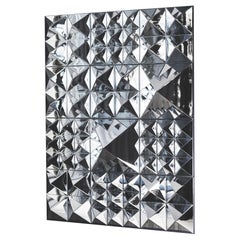
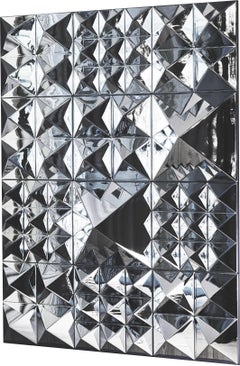
Verner Panton introduced the word “groovy” — or at least its Danish equivalent — into the Scandinavian modern design lexicon. He developed fantastical, futuristic forms and embraced bright colors and new materials such as plastic, fabric-covered polyurethane foam and steel-wire framing for the creation of his chairs, sofas, floor lamps and other furnishings. And Panton’s ebullient Pop art sensibility made him an international design star of the 1960s and ’70s. This radical departure from classic Danish modernism, however, actually stemmed from his training under the greats of that design style.
Born on the largely rural Danish island of Funen, Panton studied architecture and engineering at Copenhagen’s Royal Danish Academy of Fine Arts, where the lighting designer Poul Henningsen was one of his teachers. After graduating, in 1951, Panton worked in the architectural office of Arne Jacobsen, and he became a close friend of Hans Wegner's.
Henningsen taught a scientific approach to design; Jacobsen was forever researching new materials; and Wegner, the leader in modern furniture design using traditional woodworking and joinery, encouraged experimental form.
Panton opened his own design office in 1955, issuing tubular steel chairs with woven seating. His iconoclastic aesthetic was announced with his 1958 Cone chair, modified a year later as the Heart Cone chair. Made of upholstered sheet metal and with a conical base in place of legs, the design shocked visitors to a furniture trade show in Copenhagen.
Panton went on to successive bravura technical feats. His curving, stackable Panton chair, his most popular design, was the first chair to be made from a single piece of molded plastic.
Panton had been experimenting with ideas for chairs made of a single material since the late 1950s. He debuted his plastic seat for the public in the design magazine Mobilia in 1967 and then at the 1968 Cologne Furniture Fair. The designer’s S-Chair models 275 and 276, manufactured during the mid-1960s by August Sommer and distributed by the bentwood specialists at Gebrüder Thonet, were the first legless chairs crafted from a single piece of plywood.
Panton would spend the latter half of the 1960s and early ’70s developing all-encompassing room environments composed of sinuous and fluid-formed modular seating made of foam and metal wire. He also created a series of remarkable lighting designs, most notably his Fun chandeliers — introduced in 1964 and composed of scores of shimmering capiz-shell disks — and the Space Age VP Globe pendant light of 1969.
Panton’s designs are made to stand out and put an eye-catching exclamation point on even the most modern decor.
Find vintage Verner Panton chairs, magazine racks, rugs, table lamps and other furniture on 1stDibs.
Vintage mirrors have long been a measure of craftsmanship, from gilded Rococo frames to the sunburst shapes that became a signature of mid-century design.
Styles to Know
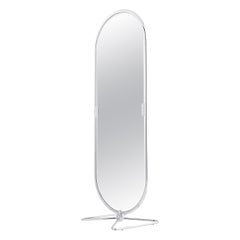
An arched or sunburst mirror reads more decorative, while a plain rectangular frame lets the room around it stand out. Hang one above a vintage vanity or a mid-century modern dresser, or lean a larger floor mirror against the wall as a standalone piece.
How to Choose the Right Vintage Mirror
Foxing and an aged frame usually read as character rather than damage, worth weighing against a listing's condition notes. For placement ideas, our 12 dramatic mirrors feature is a good place to start. Each piece comes from a vetted 1stDibs seller, with era and designer on record, and the 1stDibs Promise covers each purchase.