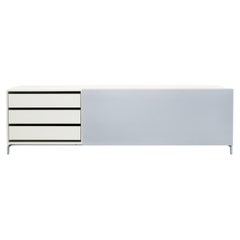
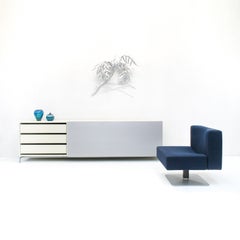
Dutch furniture company UMS Pastoe was established in 1913 by German-Jewish entrepreneur Frits Loeb and became rapidly successful largely owing to its reputation for well-made tables and chairs. Today, however, the brand is best known by collectors for the modular sideboards, storage cabinets and other spare, streamlined case pieces that it produced during the postwar years.
Influential mid-century modernist designer Cees Braakman had been creating furniture since his teenage years when he was promoted to head of design at Pastoe in 1948. The Utrecht-born designer took over for his father, Dirk Braakman, who had by then been managing the company for more than 20 years and had designed a variety of furnishings for the manufacturer by himself. A year before he assumed his new role at Pastoe, Cees visited the United States where he became enamored with the designs of Charles and Ray Eames and the other creative minds associated with legendary American furniture manufacturer Herman Miller.
While many Dutch designers who are now celebrated by vintage furniture collectors — names like Gerrit Rietveld and Friso Kramer are in this list — found inspiration in Piet Mondrian and the country’s De Stijl art movement, they also looked to Scandinavian modernists such as Alvar Aalto and Americans such as the Eameses. Cees Braakman was no different.
Braakman’s 1940s-era tour to the States included a visit to the Herman Miller factory in Zeeland, Michigan. At the time, architect-designer-journalist George Nelson was director of design at the firm and had enlisted a range of designers to collaborate with Herman Miller and create what are now icons of mid-century modernism. Braakman took notice of industrial manufacturing techniques at HM and in particular, the company’s innovations in furniture design owing to experimentation with molded plywood and fiberglass-reinforced plastic.
The Dutch designer introduced the first line of modern furniture at UMS Pastoe thereafter — a table, a chair, a bed and more created in molded plywood and featuring oak veneers, specifically tailored for smaller living spaces. Braakman was convinced that Pastoe should move on from the restrictions that a collection or set of furniture presented to consumers. Furniture for a bedroom, for example, should be practical and built as individual pieces that could be adapted as more space became available. New production methods and creative marketing came into focus under Braakman’s leadership, and his own lines of oak and birch furniture — which were created around cupboards that could be reconfigured as needed, or armchairs that could be combined to form a sofa — earned acclaim and were commercially very successful.
UMS Pastoe was recognized for its innovative furniture at the Milan Triennial in 1957 and Le Signe d’Or in Belgium, and Cees Braakman’s work can today be found at the Stedelijk Museum in Amsterdam. Over the years, designers such as Jan van Grunsven, Radboud Van Beekum and Rob Eckhardt collaborated with UMS Pastoe.
Find vintage UMS Pastoe furniture on 1stDibs.
A revival in the popularity of authentic Minimalist furniture is rooted in history while reflecting the needs and tastes of the 21st century. Designer Ludwig Mies van der Rohe’s aphorism that “less is more” influenced the evolution of 20th-century interiors with an emphasis on function and order. This was a shift from the 19th century, with its lavish Victorian decorating, and was spread around the world through design styles including Bauhaus and brutalism.
Yet Minimalism was present in furniture design long before the clean lines of modernism, such as in the simple and elegant utility of Shaker furniture. Although the Minimalist art movement of the 1960s and ’70s had little crossover with furniture design, artist Donald Judd was inspired by the Shakers in creating his own spare daybeds and tables from sturdy wood. (Judd, whose advocacy of symmetry also informed his architectural projects, furnished his Manhattan loft with unassuming but poetic works by iconic modernist designers such as Gerrit Rietveld and Alvar Aalto.)
Understatement rather than ornamentation and open space instead of clutter are central themes for a Minimalist living room and bedroom. As opposed to Maximalism, the focus for Minimalist furniture and decor is on simplicity and considering the design and purpose of every object.
Furnishings are usually made in neutral or monochrome colors and pared down to their essentials — think nesting coffee tables, sectional sofas and accent pieces such as ottomans. And Minimalist ceramics can help achieve a decor that is both timeless and of the moment. The organic textures and personalization of handmade craftsmanship associated with these works have served as a sort of anti-Internet to screen-weary decorators. That said, while the thoughtful ergonomics of Scandinavian modern furniture, with its handcrafted teak frames, are at home in Minimalist spaces, so are the quietly striking pieces by Japanese designer Naoto Fukasawa that employ industrial materials like stainless steel, aluminum and plastic.
Minimalist furniture is not for making flashy statements; it boasts subdued appeal and excels at harmonizing with any room. And, as it encompasses many different movements and eras of design, it also never goes out of style, owing to its tasteful refinement.
Find a collection of Minimalist tables, seating, lighting and more furniture on 1stDibs.
Mid-century modern credenzas descend from the Renaissance-era sideboard, once used to serve and store food and dishware. The clean-lined, low-profile version prized today emerged from Italian and Scandinavian design in the mid-20th century, defined by tapered legs and warm walnut or teak veneers.
Styles to Know
Mid-century modern credenzas are one of the most searched storage silhouettes on 1stDibs. Sliding-door and open-shelf configurations serve different needs: books and displayed objects suit open shelving, while electronics and linens are better behind doors. A matching mid-century modern dresser extends the look to the bedroom, or an apothecary cabinet offers more drawer storage in a smaller footprint.
How to Choose the Right Vintage Credenza
Hardware and veneer condition vary considerably from piece to piece, so listing photographs deserve a close look; our guide to case pieces covers what else to look for in construction. Every credenza comes from a vetted 1stDibs seller, with era, designer and condition on record, and the 1stDibs Promise stands behind every purchase.