Joan Miró Art

Catalan, 1893-1983

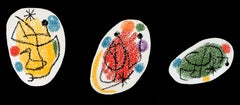
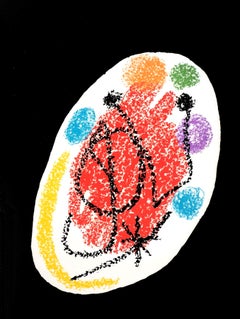
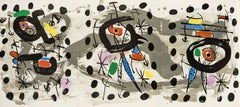
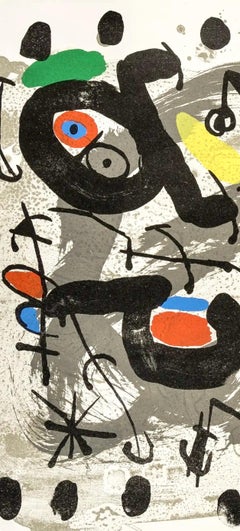
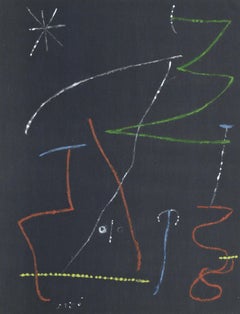
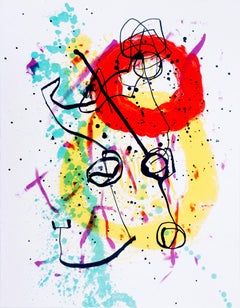
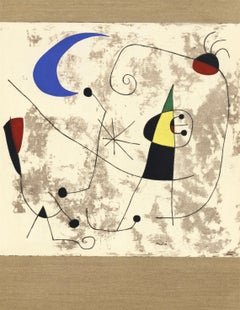
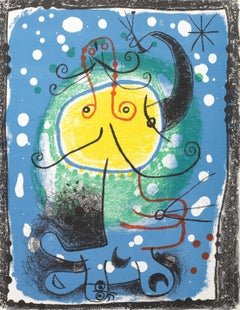
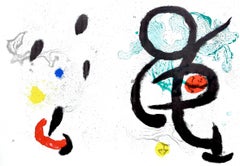
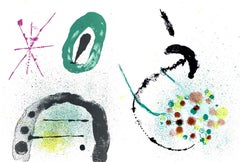
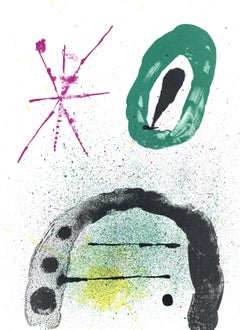
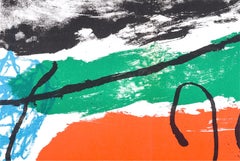
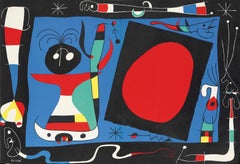
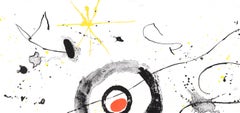
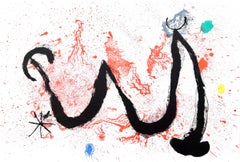
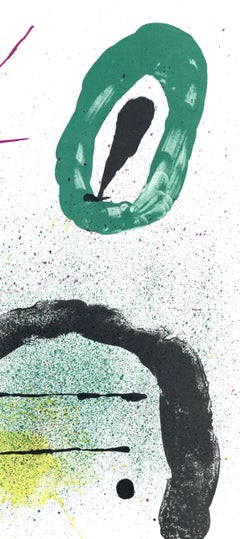
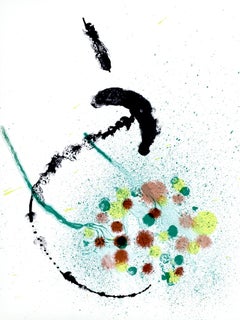
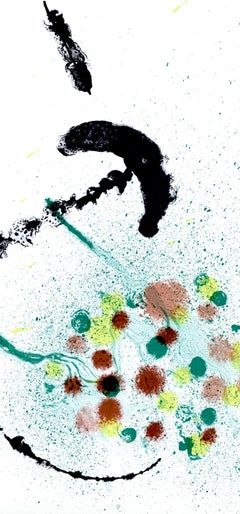
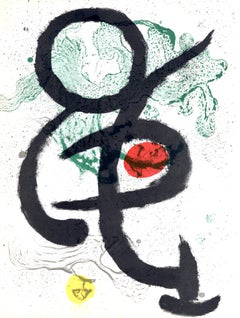
With his wide-ranging oeuvre, comprising strikingly original paintings, prints, ceramics, sculptures, metal engravings and murals, Catalan modernist Joan Miró was a critical force in moving 20th-century art toward complete abstraction. Although often considered an early Surrealist because of his nonobjective imagery and evocation of the subconscious, he defies neat categorization.

Miró’s identity is largely rooted in the city of his birth: Barcelona. To this day, a number of his public artworks can be found there, including the 72-foot-tall statue Dona i Ocell (Woman and Bird), 1983. Female and avian forms, along with bright colors and the theme of Catalan pride, are recurring elements in his work.

The radical visual world Miró created with his expressive lines, signature symbols and biomorphic shapes influenced such American Abstract Expressionists as Jackson Pollock and Color Field painters like Mark Rothko and Barnett Newman.

Mirò continued to work and experiment until his death at the age of 90 in 1983. Five years before that, he was quoted saying, “I painted these paintings in a frenzy, with real violence so that people will know that I am alive, that I’m breathing, that I still have a few more places to go. I’m heading in new directions.”

Find a collection of original Joan Miró art on 1stDibs.

to
248
271
223
119
50
25
Overall Width
to
Overall Height
to
4
682
2
13
5
75
203
314
53
2
281
185
125
2
1
452
234
2
55
39
16
16
11
10
10
10
7
5
5
5
3
3
2
2
2
2
2
2
597
68
46
25
9
719
11,660
2,882
2,492
1,600
188
92
506
136
Artist: Joan Miró
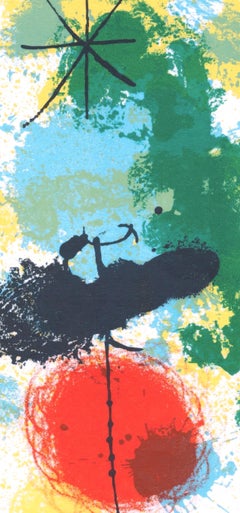
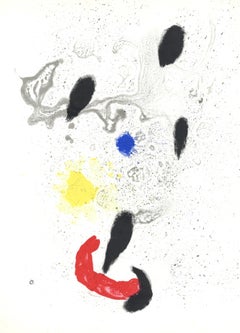
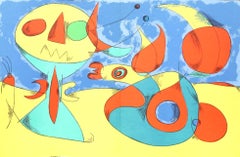
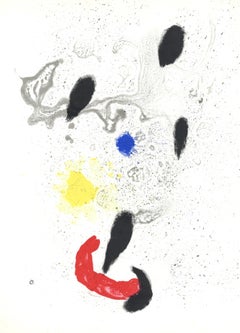
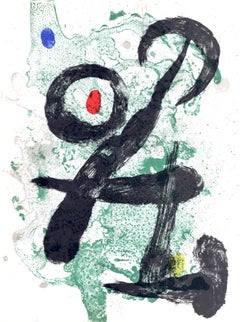
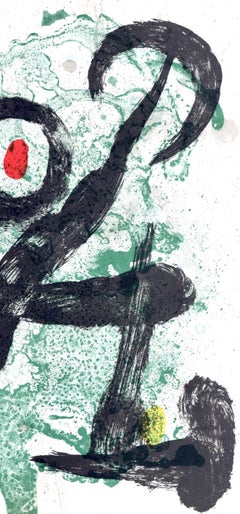
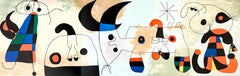
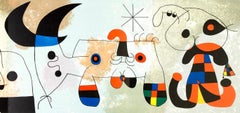
Joan Miro, The Acid Melody, from La Melodie acide, 1980

Joan Miro, The Acid Melody, from La Melodie acide, 1980

By Joan Miró

Located in Southampton, NY

This exquisite lithograph by Joan Miro (1893–1983), titled La Melodie acide (The Acid Melody), from the folio 14 original lithographs by Joan Miro "La Melodie acide" (The Acid Melody...

Category

1980s Modern Joan Miró Art

Materials

Lithograph

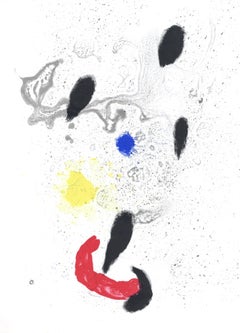
Joan Miro, The Acid Melody, from La Melodie acide, 1980

Joan Miro, The Acid Melody, from La Melodie acide, 1980

By Joan Miró

Located in Southampton, NY

This exquisite lithograph by Joan Miro (1893–1983), titled La Melodie acide (The Acid Melody), from the folio 14 original lithographs by Joan Miro "La Melodie acide" (The Acid Melody...

Category

1980s Modern Joan Miró Art

Materials

Lithograph

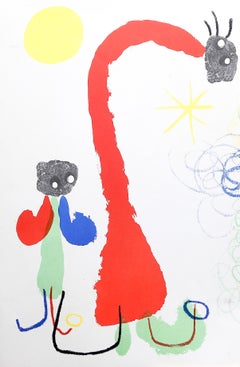
Joan Miro, Woman and Bird II/X, from Women, 1965

Joan Miro, Woman and Bird II/X, from Women, 1965

By Joan Miró

Located in Southampton, NY

This exquisite heliogravure by Joan Miro (1893–1983), titled Femme et Oiseau II/X (Woman and Bird II/X), from the folio Joan Miro, Femmes (Women), originates from the 1965 edition pu...

Category

1960s Modern Joan Miró Art

Materials

Lithograph

Joan Miro, Limestone Fault, from Memories and Portraits of Artists, 1972

Joan Miro, Limestone Fault, from Memories and Portraits of Artists, 1972

By Joan Miró

Located in Southampton, NY

This exquisite lithograph by Joan Miro (1893–1983), titled Faillie du calcaire (Limestone Fault), originates from the 1972 edition published by Editions A. C. Mazo et Cie., Paris, in...

Category

1970s Surrealist Joan Miró Art

Materials

Lithograph

Joan Miro, Untitled, from Prints from the Mourlot Press, 1964

Joan Miro, Untitled, from Prints from the Mourlot Press, 1964

By Joan Miró

Located in Southampton, NY

This exquisite lithograph by Joan Miro (1893–1983), titled Sans titre (Untitled), from the album Prints from the Mourlot Press, exhibition sponsored by the French Embassy, circulated...

Category

1960s Surrealist Joan Miró Art

Materials

Lithograph

Joan Miro, Blue Bird, from Derriere le Miroir, 1964

Joan Miro, Blue Bird, from Derriere le Miroir, 1964

By Joan Miró

Located in Southampton, NY

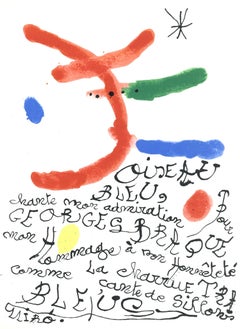
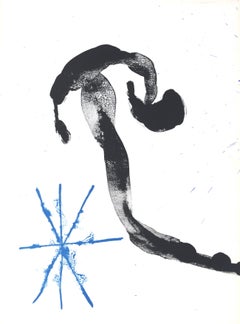
This exquisite lithograph by Joan Miro (1893–1983), titled Oiseau Bleu (Blue Bird), originates from the 1963 folio Derriere le Miroir, published by Maeght Editeur, Paris, under the direction of Aime Maeght, and printed by Mourlot Freres, Paris. Executed during the height of Miro’s mature period, this poetic composition embodies the artist’s fascination with the interplay between form, color, and cosmic symbolism. Through his lyrical use of line and vibrant hues, Miro transforms the image of the bird—a recurring motif in his visual language—into a jubilant expression of freedom and imagination. Oiseau Bleu exemplifies Miro’s capacity to merge spontaneity and precision, creating a timeless dialogue between abstraction and dreamlike vision. Executed on velin paper, this lithograph measures 22 x 15 inches (55.9 x 38.1 cm), as issued. Signed in the plate and unnumbered, as issued. The edition reflects Miro’s mastery of both color and gesture, fusing Surrealist spontaneity with the refined craftsmanship of the Mourlot ateliers. Artwork Details: Artist: Joan Miro (1893–1983) Title: Oiseau Bleu (Blue Bird), from Derriere le Miroir, 1963 Medium: Lithograph on velin paper Dimensions: 22 x 15 inches (55.9 x 38.1 cm), as issued Inscription: Signed in the plate and unnumbered, as issued Date: 1963 Publisher: Maeght Editeur, Paris Printer: Mourlot Freres, Paris Catalogue Raisonne Reference: Cramer, Patrick, and Joan Miro. Joan Miro, Catalogue Raisonne des Livres Illustres. P. Cramer, Geneva, 1989, illustration 87 Condition: Well preserved, consistent with age and medium Provenance: From the 1963 folio Derriere le Miroir, published by Maeght Editeur, Paris Notes: Excerpted from the folio (translated from French): Taken from this special issue of “Behind the Mirror,” CCCL examples on velin de Rives were numbered, constituting the original deluxe edition of Derriere le Miroir. The lithographs for this issue were printed in the ateliers of Mourlot Editeur, Levallois. The text was printed by Fequet et Baudier, typographers. Finished printing 1963. About the Publication: Derriere le Miroir (translated as "Behind the Mirror") was an iconic French art periodical published from 1946 to 1982 by Maeght Editeur, one of the most influential art publishers of the 20th century. Founded by Aime Maeght in Paris, the publication was conceived as a visual and literary collaboration between leading modern artists, poets, and critics. Each issue functioned as both an exhibition catalogue and a work of art in itself—featuring original lithographs printed directly from the artists' stones or plates, alongside essays, poems, and critical commentary. Over the course of 36 years, Derriere le Miroir produced more than 250 issues and showcased an extraordinary roster of artists including Henri Matisse, Marc Chagall, Joan Miro, Georges Braque, Alexander Calder, Fernand Leger, Pierre Bonnard, Alberto Giacometti, Eduardo Chillida, Ellsworth Kelly, Francis Bacon, Paul Rebeyrolle, Claude Garache, Antoni Tapies, Bram van Velde, Pierre Alechinsky, Pol Bury, Shusaku Arakawa, and Gerard Titus-Carmel. Printed in the ateliers of Mourlot, Arte, and Imprimerie Moderne du Lion, the periodical set new standards for quality in color lithography, combining fine art printing with elegant typography and poetic text. Beyond its visual brilliance, Derriere le Miroir also became a cultural chronicle of postwar European modernism. Each issue coincided with exhibitions held at Galerie Maeght, providing a collectible and widely accessible record of groundbreaking shows. Its integration of image, text, and philosophy created a dialogue between art and literature that elevated the modern art book to new aesthetic heights. Today, Derriere le Miroir remains one of the most sought-after and historically significant art publications, prized by collectors and scholars alike for its craftsmanship, influence, and its role in defining the visual language of 20th-century modernism. The Maeght Foundation in Saint-Paul-de-Vence continues to honor this legacy through exhibitions and archival preservation of the series, affirming Derriere le Miroir's enduring place in the history of modern art and fine art publishing. About the Artist: Joan Miro (1893–1983) was a Catalan painter, sculptor, and ceramicist whose imaginative, dreamlike vision helped spearhead the Surrealist movement and left an indelible mark on modern art. Born in Barcelona and deeply rooted in Catalan culture, Miro moved to Paris in the early 1920s where his playful shapes, cosmic motifs, and childlike yet sophisticated abstractions broke new ground alongside the great innovators of his time. His artistic dialogue aligned with contemporaries such as Pablo Picasso, Henri Matisse, Alexander Calder, Marc Chagall, Salvador Dali, Jackson Pollock, Georges Braque, Wassily Kandinsky, Marcel Duchamp, and Man Ray, each of whom challenged the conventions of form, color, and symbolism. Miro distilled these ideas into a uniquely poetic visual vocabulary—birds, stars, and bold spectral forms emerging from flat planes of color—that has inspired scores of artists and continues to influence modern and contemporary masters including Banksy, Damien Hirst, Jeff Koons, Andy Warhol, and Jasper Johns. His works are represented in leading museums worldwide, including MoMA, the Guggenheim, the Tate, and the Centre Pompidou, and remain highly sought after by collectors. The highest price ever paid for a Joan Miro artwork is approximately $37.06 million USD, achieved in June 2012 at Sotheby’s London for Peinture (Etoile Bleue) (1927). Joan Miro Oiseau...

Category

1960s Surrealist Joan Miró Art

Materials

Lithograph

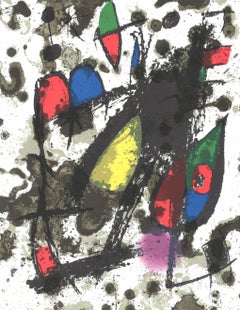
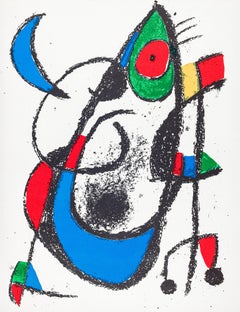
Joan Miro, Lithograph IX, from Lithographs II, 1975

Joan Miro, Lithograph IX, from Lithographs II, 1975

By Joan Miró

Located in Southampton, NY

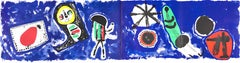
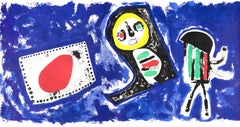
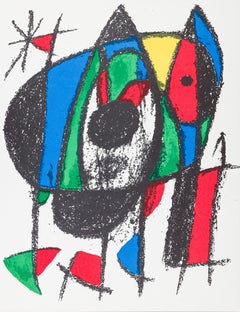
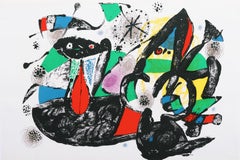
This exquisite lithograph by Joan Miro (1893–1983), titled Lithograph IX, from the album Joan Miro Lithographs, Volume II, originates from the 1975 edition published by Leon Amiel, New York, and printed by Mourlot Freres, Paris, 1975. Lithograph IX reflects Miros poetic mastery of line, movement, and color, capturing his lifelong pursuit of visual rhythm and lyrical abstraction. Combining spontaneity and control, this composition embodies Miros signature balance of playful geometry and poetic energy—translating instinct and imagination into a harmonious field of motion and light. Executed as a lithograph on velin paper, this work measures 12.5 x 19.25 inches, with centerfold as issued. Unsigned and unnumbered as issued. The edition exemplifies the refined craftsmanship and technical mastery of Mourlot Freres, Paris, one of the foremost printmaking ateliers of the 20th century. Artwork Details: Artist: Joan Miro (1893–1983) Title: Lithograph IX, from the album Joan Miro Lithographs, Volume II, 1975 Medium: Lithograph on velin paper Dimensions: 12.5 x 19.25 inches (31.8 x 48.9 cm), with centerfold as issued Inscription: Unsigned and unnumbered as issued Date: 1975 Publisher: Leon Amiel, New York Printer: Mourlot Freres, Paris Catalogue raisonne references: Cramer, Patrick, and Joan Miro. Joan Miro, Catalogue Raisonne Des Livres Illustres. P. Cramer, 1989, illustration 198. Cramer, Patrick. Joan Miro: Lithographs Volume V 1972–1975. Maeght, 1992, illustration 1045. Condition: Well preserved, consistent with age and medium Provenance: From the album Joan Miro Lithographs, Volume II, published by Leon Amiel, New York; printed by Mourlot Freres, Paris, 1975 Notes: Excerpted from the album, The original Joan Miro lithographs were printed by Mourlot, the illustrations by Arte Adrien Maeght, and the text by Imprimerie Union, Paris, France. V̅ examples of this English-language edition, numbered I-V̅, have been printed. A deluxe French edition of CL examples, numbered I-CL, with II additional original lithographs signed by Joan Miro, and LXXX suites, numbered I-LXXX, containing the XIII original lithographs on velin with wide margins and with each lithograph signed by the artist, have also been printed. About the Publication: Joan Miro Lithographs, Volume II, published in 1975 by Leon Amiel, New York, with lithographs printed by Mourlot Freres, Paris, is the second installment in the monumental four-volume series documenting Miros complete lithographic work. The project was conceived as both an artistic and scholarly endeavor, uniting Miro’s technical innovation with comprehensive cataloguing of his print oeuvre. Volume II chronicles an essential period in Miros career—from 1950 to 1956—when his exploration of symbolic abstraction, vibrant color, and gestural spontaneity reached new levels of expressive freedom. The collaboration between Miro and the master lithographers at Mourlot resulted in works of exceptional brilliance and vitality, capturing the artist’s playful yet deeply spiritual sensibility. The album was produced with meticulous attention to detail, printed on the highest-quality velin paper, and accompanied by essays and documentation that provide historical and artistic context. Issued in English and French-language editions, Joan Miro Lithographs, Volume II stands as a landmark in 20th-century printmaking—testament to the enduring creative partnership between Miro, Mourlot, and the publishers Maeght and Amiel. About the Artist: Joan Miro (1893–1983) was a Catalan painter, sculptor, printmaker, and ceramicist whose visionary imagination and lyrical abstraction made him one of the most influential and beloved artists of the 20th century. Born in Barcelona, Miro drew inspiration from Catalan folk art, Romanesque frescoes, and the luminous landscapes of Mont-roig del Camp, developing a deep connection to nature that infused his work with vitality and symbolism. After formal training at the Escola d'Art in Barcelona, he absorbed the lessons of Post-Impressionism and Cubism before moving to Paris in the early 1920s, where he became a leading figure in the Surrealist movement. There, Miro forged a personal visual language of biomorphic shapes, floating symbols, and radiant color harmonies that reflected both spontaneity and spiritual depth. In creative dialogue with peers such as Alexander Calder, Alberto Giacometti, Salvador Dali, Wassily Kandinsky, Marcel Duchamp, and Man Ray, he helped revolutionize modern art by dissolving the boundaries between abstraction and dream imagery. Miros inventive approach extended far beyond painting, embracing sculpture, ceramics, and monumental public commissions that redefined how art could interact with space and emotion. His expressive freedom and gestural abstraction profoundly influenced later artists including Jackson Pollock, Mark Rothko, Alexander Calder, Jean Dubuffet, Antoni Tapies, and Joan Mitchell, inspiring generations who sought to merge instinct, color, and imagination. Today, Miros work remains a cornerstone of modernism, prized by collectors and celebrated in major museums worldwide. His highest auction record was achieved by Peinture (Etoile Bleue) (1927), which sold for 23,561,250 GBP (approximately 37 million USD) at Sotheby's, London, on June 19, 2012. Joan Miro Lithograph IX, Miro Lithographs Volume II, Miro Leon Amiel, Miro Mourlot...

Category

1970s Surrealist Joan Miró Art

Materials

Lithograph

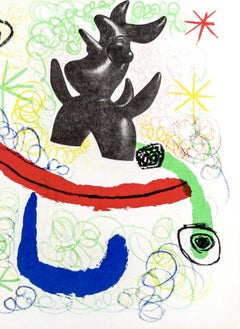
Joan Miro, Bouquet of Dreams for Leila, from XXe siecle, 1964

Joan Miro, Bouquet of Dreams for Leila, from XXe siecle, 1964

By Joan Miró

Located in Southampton, NY

This exquisite lithograph by Joan Miro (1893–1983), titled Bouquet de reves pour Leila, Poemes d'Yvan Goll (Bouquet of Dreams for Leila, Poems by Yvan Goll), from the album XXe siecl...

Category

1960s Surrealist Joan Miró Art

Materials

Lithograph

Joan Miro, Tribute to Aime Maeght, from Derriere le Miroir, 1982

Joan Miro, Tribute to Aime Maeght, from Derriere le Miroir, 1982

By Joan Miró

Located in Southampton, NY

This exquisite lithograph by Joan Miro (1893–1983), titled Hommage a Aime Maeght (Tribute to Aime Maeght), originates from the historic 1982 folio Derriere le Miroir, No. 250, Hommag...

Category

1980s Surrealist Joan Miró Art

Materials

Lithograph

Joan Miro, Homage to San Lazzaro, from San Lazzaro et ses Amis, 1975

Joan Miro, Homage to San Lazzaro, from San Lazzaro et ses Amis, 1975

By Joan Miró

Located in Southampton, NY

This exquisite lithograph by Joan Miro (1893–1983), titled Hommage a San Lazzaro (Homage to San Lazzaro), from the album San Lazzaro et ses Amis, Hommage au fondateur de la revue XXe...

Category

1970s Surrealist Joan Miró Art

Materials

Lithograph

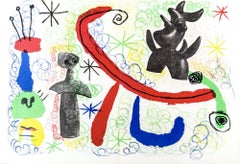
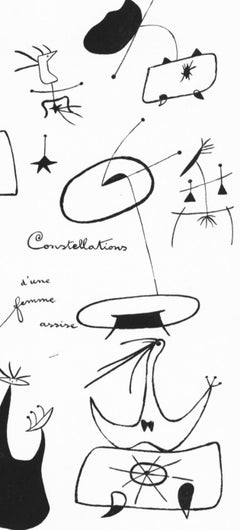
Joan Miro, Constellations of a Seated Woman, from XXe siecle, 1939

Joan Miro, Constellations of a Seated Woman, from XXe siecle, 1939

By Joan Miró

Located in Southampton, NY

This exquisite lithograph by Joan Miro (1893–1983), titled Constellations d'une femme assise (Constellations of a Seated Woman), from the album XXe siecle, Chroniques du jour, 13 rue...

Category

1930s Surrealist Joan Miró Art

Materials

Lithograph

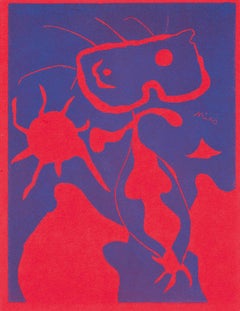
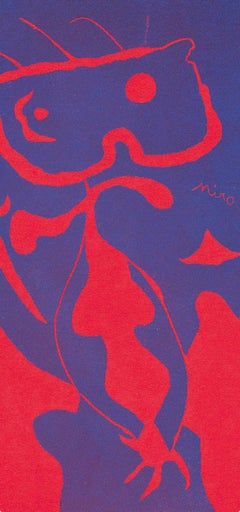
Joan Miro, Woman, from XXe siecle, 1938

Joan Miro, Woman, from XXe siecle, 1938

By Joan Miró

Located in Southampton, NY

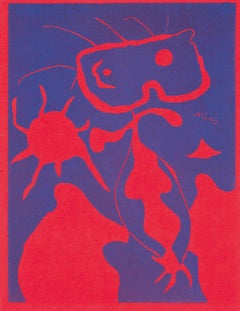
This exquisite linocut by Joan Miro (1893–1983), titled Femme (Woman), from the album XXe siecle, Chroniques du jour, 13 rue Valette (5e), Directeur G. di San Lazzaro, Sommaire du no...

Category

1930s Surrealist Joan Miró Art

Materials

Linocut

Joan Miro, Summer, from Verve, Revue Artistique, 1937

Joan Miro, Summer, from Verve, Revue Artistique, 1937

By Joan Miró

Located in Southampton, NY

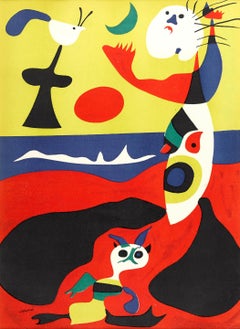
This exquisite lithograph by Joan Miro (1893–1983), titled L'Ete (Summer), from Verve, Revue Artistique et Litteraire, Vol. I, No. 1, originates from the 1937 issue published by Editions de la revue Verve, Paris, under the direction of Teriade, Editeur, Paris, and printed by Mourlot Freres, Paris, 1937. This early and vibrant composition captures Miro's poetic vision of nature and the cosmos, rendered through biomorphic forms and rhythmic abstraction. L'Ete reflects Miro's fascination with the cyclical harmony of life and his belief in art as an extension of natural forces. Through his distinctive visual language—combining organic shapes, symbolic gestures, and luminous color—Miro conveys a profound sense of vitality and dreamlike wonder, embodying the spirit of renewal that defines his oeuvre. Executed as a lithograph on velin du Marais paper, this work measures 14 x 10.5 inches. Signed in the plate and unnumbered as issued. The edition exemplifies the superb craftsmanship of the Mourlot Freres atelier, renowned for its collaborations with the leading modernists of the 20th century. Artwork Details: Artist: Joan Miro (1893–1983) Title: L'Ete (Summer), from Verve, Revue Artistique et Litteraire, Vol. I, No. 1, 1937 Medium: Lithograph on velin du Marais paper Dimensions: 14 x 10.5 inches Inscription: Signed in the plate and unnumbered as issued Date: 1937 Publisher: Editions de la revue Verve, Paris, under the direction of Teriade, Editeur, Paris Printer: Mourlot Freres, Paris Catalogue raisonne reference: Miro, Joan, et al. Miro, L'oeuvre Graphique: Musee d'art moderne de la ville de Paris, 1974, illustration 395. Condition: Well preserved, consistent with age and medium Provenance: From Verve, Revue Artistique et Litteraire, Vol. I, No. 1, published by Editions de la revue Verve, Paris, 1937 About the Publication: Verve, Revue Artistique et Litteraire was one of the most influential art periodicals of the 20th century, founded in Paris in 1937 by the visionary Greek-born publisher Teriade (Stratis Eleftheriades). Conceived as a synthesis of art and literature, Verve brought together the greatest modern artists and writers of its time—Henri Matisse, Pablo Picasso, Marc Chagall, Georges Braque, Joan Miro, Fernand Leger, and others—alongside poets and philosophers such as Paul Eluard, Albert Camus, and Jean-Paul Sartre. Each issue was a work of art in itself, luxuriously printed by master lithographers such as Mourlot Freres and produced in collaboration with leading typographers and designers. Verve became a platform for avant-garde creativity, publishing original lithographs and essays that reflected the evolving spirit of modernism. Matisse collaborated closely with Teriade from the magazine's inception, producing some of its most iconic issues, including those devoted to his paper cut-outs. The final Verve issue of 1958, which featured La Tristesse du Roi and the Nu Bleu series, stands as a testament to Matisse's enduring genius and to the publication's legacy as the definitive meeting of art, poetry, and printing craftsmanship in 20th-century France. About the Artist: Joan Miro (1893–1983) was a Catalan painter, sculptor, printmaker, and ceramicist whose visionary imagination and lyrical abstraction made him one of the most influential and beloved artists of the 20th century. Born in Barcelona, Miro drew inspiration from Catalan folk art, Romanesque frescoes, and the luminous landscapes of Mont-roig del Camp, developing a deep connection to nature that infused his work with vitality and symbolism. After formal training at the Escola d'Art in Barcelona, he absorbed the lessons of Post-Impressionism and Cubism before moving to Paris in the early 1920s, where he became a leading figure in the Surrealist movement. There, Miro forged a personal visual language of biomorphic shapes, floating symbols, and radiant color harmonies that reflected both spontaneity and spiritual depth. In creative dialogue with peers such as Alexander Calder, Alberto Giacometti, Salvador Dali, Wassily Kandinsky, Marcel Duchamp, and Man Ray, he helped revolutionize modern art by dissolving the boundaries between abstraction and dream imagery. Miro's inventive approach extended far beyond painting, embracing sculpture, ceramics, and monumental public commissions that redefined how art could interact with space and emotion. His expressive freedom and gestural abstraction profoundly influenced later artists including Jackson Pollock, Mark Rothko, Alexander Calder, Jean Dubuffet, Antoni Tapies, and Joan Mitchell, inspiring generations who sought to merge instinct, color, and imagination. Today, Miro's work remains a cornerstone of modernism, prized by collectors and celebrated in major museums worldwide. His highest auction record was achieved by Peinture (Etoile Bleue) (1927), which sold for £23,561,250 (approximately $37 million) at Sotheby's, London, on June 19, 2012. Joan Miro L'Ete, Miro Verve...

Category

1930s Surrealist Joan Miró Art

Materials

Lithograph

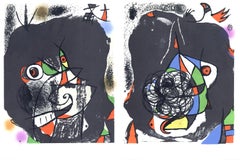
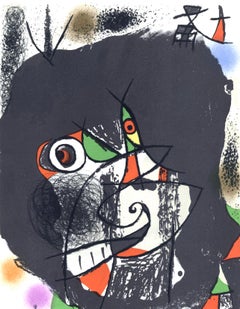
Joan Miro, Figures, The Stage Revolutions, from XXe Siecle, 1975

Joan Miro, Figures, The Stage Revolutions, from XXe Siecle, 1975

By Joan Miró

Located in Southampton, NY

These exquisite lithographs by Joan Miro (1893–1983), titled Personnages (Figures), from the album Les Revolutions Sceniques du XXe Siecle, originate from the 1975 edition published ...

Category

1970s Surrealist Joan Miró Art

Materials

Lithograph

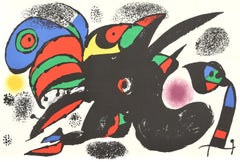
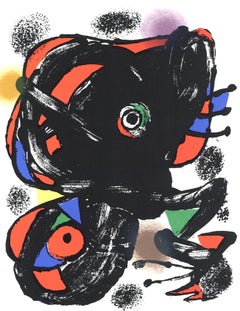
Joan Miro, The Extreme Origin, from XXe siecle, 1976

Joan Miro, The Extreme Origin, from XXe siecle, 1976

By Joan Miró

Located in Southampton, NY

This exquisite lithograph by Joan Miro (1893–1983), titled L'origine extreme (The extreme origin), from the album XXe Siecle, Nouvelle serie, XXXVIIIe Annee, No. 47, originates from ...

Category

1970s Surrealist Joan Miró Art

Materials

Lithograph

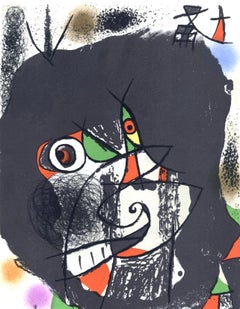
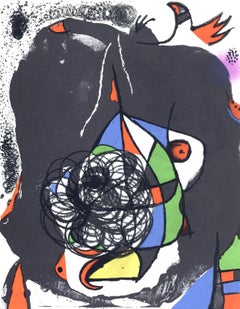
Joan Miro, Figure, The Stage Revolutions, from XXe Siecle, 1975

Joan Miro, Figure, The Stage Revolutions, from XXe Siecle, 1975

By Joan Miró

Located in Southampton, NY

This exquisite lithograph by Joan Miro (1893–1983), titled Personnage (Figure), from the album Les Revolutions Sceniques du XXe Siecle, originates from the 1975 edition published by ...

Category

1970s Surrealist Joan Miró Art

Materials

Lithograph

Joan Miro, Figure, The Stage Revolutions, from XXe Siecle, 1975

Joan Miro, Figure, The Stage Revolutions, from XXe Siecle, 1975

By Joan Miró

Located in Southampton, NY

This exquisite lithograph by Joan Miro (1893–1983), titled Personnage (Figure), from the album Les Revolutions Sceniques du XXe Siecle, originates from the 1975 edition published by ...

Category

1970s Surrealist Joan Miró Art

Materials

Lithograph

Joan Miro, Number 46, from XXe siecle, 1976

Joan Miro, Number 46, from XXe siecle, 1976

By Joan Miró

Located in Southampton, NY

This exquisite lithograph by Joan Miro (1893–1983), titled Numéro 46 (Number 46), from the album XXe Siecle, Nouvelle serie, XXXVIIIe Annee, No. 46, originates from the 1976 edition ...

Category

1970s Surrealist Joan Miró Art

Materials

Lithograph

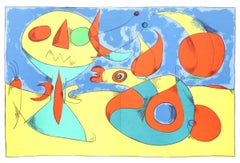
Joan Miro, Birds of Prey, from XXe siecle, 1977

Joan Miro, Birds of Prey, from XXe siecle, 1977

By Joan Miró

Located in Southampton, NY

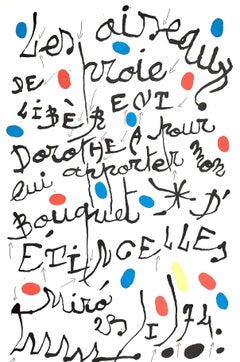
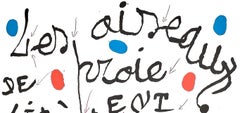
This exquisite lithograph by Joan Miro (1893–1983), titled Les oiseaux de proie (Birds of Prey), from the album XXe Siecle, Numero special hors abonnement, Hommage a Dorothea Tanning...

Category

1970s Surrealist Joan Miró Art

Materials

Lithograph

Joan Miro, Homage to Dorothea Tanning, from XXe siecle, 1977

Joan Miro, Homage to Dorothea Tanning, from XXe siecle, 1977

By Joan Miró

Located in Southampton, NY

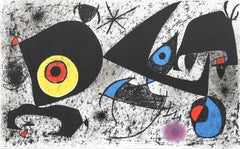
This exquisite lithograph by Joan Miro (1893–1983), titled Hommage a Dorothea Tanning (Homage to Dorothea Tanning), from the album XXe Siecle, Numero special hors abonnement, Hommage...

Category

1970s Surrealist Joan Miró Art

Materials

Lithograph

Joan Miro, Homage to Miro, from XXe siecle, 1972

Joan Miro, Homage to Miro, from XXe siecle, 1972

By Joan Miró

Located in Southampton, NY

This exquisite lithograph by Joan Miro (1893–1983), titled Hommage a Miro (Homage to Miro), from the album XXe Siecle, Numero special hors abonnement, Hommage a Miro, originates from the 1972 edition published by Societe Internationale d'Art XXe siecle, Paris, under the direction of Gualtieri di San Lazzaro, editeur, Paris, and printed by Arte Adrien Maeght, Paris, 1972. Hommage a Miro celebrates the artist’s poetic abstraction, rhythmic color, and lyrical forms, serving as both a tribute to and expression of his enduring creative spirit. Executed as lithographs on velin paper, this work measures 12.5 x 19.5 inches, with centerfold as issued. Unsigned and unnumbered, as issued. The edition exemplifies the superb craftsmanship of Arte Adrien Maeght, Paris. Artwork Details: Artist: Joan Miro (1893–1983) Title: Hommage a Miro (Homage to Miro), from the album XXe Siecle, Numero special hors abonnement, Hommage a Miro Medium: Lithographs on velin paper Dimensions: 12.5 x 19.5 inches (31.75 x 49.53 cm), with centerfold as issued Inscription: Unsigned and unnumbered, as issued Date: 1972 Publisher: Societe Internationale d'Art XXe siecle, Paris, under the direction of Gualtieri di San Lazzaro, editeur, Paris Printer: Arte Adrien Maeght, Paris Catalogue raisonne reference: Patrick Cramer, Joan Miro: Catalogue Raisonne des Livres Illustres, Geneva: Patrick Cramer Editeur, 1989, illustration 165; Joan Miro Lithographe IV, Paris: Maeght Editeur, 1981, illustration 868. Condition: Well preserved, consistent with age and medium Provenance: From the album XXe Siecle, Numero special hors abonnement, Hommage a Miro, published by Societe Internationale d'Art XXe siecle, Paris, under the direction of Gualtieri di San Lazzaro, editeur, Paris; printed by Arte Adrien Maeght, Paris, 1972 About the Publication: Gualtieri di San Lazzaro's XXe Siecle (Twentieth Century) was one of the most influential art journals of the modern era, founded in Paris in 1938 as a platform for the greatest painters, sculptors, and writers of the 20th century. San Lazzaro, a visionary editor, critic, and champion of modernism, believed that art and literature should coexist as expressions of a shared human imagination. Under his direction, XXe Siecle became a cultural bridge between Europe and the wider world, publishing special issues devoted to leading figures such as Picasso, Matisse, Chagall, Braque, Calder, Miro, Kandinsky, and Leger. Each edition combined essays by renowned critics and poets with original lithographs printed by the foremost ateliers of Paris, London, and New York, including Mourlot, Curwen, and Universal Graphics, creating a uniquely rich dialogue between text and image. Through XXe Siecle, San Lazzaro preserved the creative spirit of the avant-garde during and after World War II, championing freedom of expression and the evolution of abstraction, surrealism, and modern thought. Over nearly four decades, the journal shaped international taste and defined the intellectual landscape of postwar art publishing. Today, XXe Siecle remains celebrated for its extraordinary synthesis of art, literature, and design, an enduring testament to Gualtieri di San Lazzaro's belief that the visual arts are the soul of the modern age. About the Artist: Joan Miro (1893–1983) was a Catalan painter, sculptor, printmaker, and ceramicist whose visionary imagination and lyrical abstraction made him one of the most influential and beloved artists of the 20th century. Born in Barcelona, Miro drew inspiration from Catalan folk art, Romanesque frescoes, and the luminous landscapes of Mont-roig del Camp, developing a deep connection to nature that infused his work with vitality and symbolism. After formal training at the Escola d'Art in Barcelona, he absorbed the lessons of Post-Impressionism and Cubism before moving to Paris in the early 1920s, where he became a leading figure in the Surrealist movement. There, Miro forged a personal visual language of biomorphic shapes, floating symbols, and radiant color harmonies that reflected both spontaneity and spiritual depth. In creative dialogue with peers such as Alexander Calder, Alberto Giacometti, Salvador Dali, Wassily Kandinsky, Marcel Duchamp, and Man Ray, he helped revolutionize modern art by dissolving the boundaries between abstraction and dream imagery. Miro's inventive approach extended far beyond painting, embracing sculpture, ceramics, and monumental public commissions that redefined how art could interact with space and emotion. His expressive freedom and gestural abstraction profoundly influenced later artists including Jackson Pollock, Mark Rothko, Alexander Calder, Jean Dubuffet, Antoni Tapies, and Joan Mitchell, inspiring generations who sought to merge instinct, color, and imagination. Today, Miro's work remains a cornerstone of modernism, prized by collectors and celebrated in major museums worldwide. His highest auction record was achieved by Peinture (Etoile Bleue) (1927), which sold for £23,561,250 (approximately $37 million) at Sotheby's, London, on June 19, 2012. Joan Miro Hommage a Miro, Miro Homage to Miro...

Category

1970s Surrealist Joan Miró Art

Materials

Lithograph

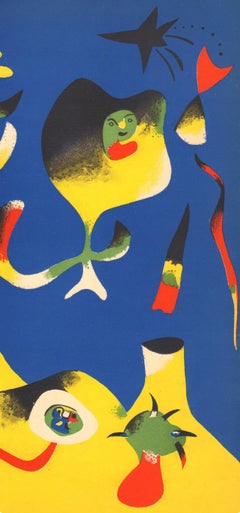
Joan Miro, The Air, from Verve, Revue Artistique, 1938

Joan Miro, The Air, from Verve, Revue Artistique, 1938

By Joan Miró

Located in Southampton, NY

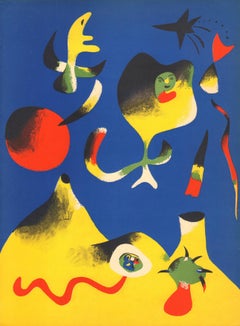
This exquisite lithograph by Joan Miro (1893–1983), titled L'air (The Air), from Verve, Revue Artistique et Litteraire, Vol. I, No. 3, originates from the 1938 issue published by Editions de la revue Verve, Paris, under the direction of Teriade, Editeur, Paris, and printed by Mourlot Freres, Paris, 1938. This lyrical and atmospheric composition embodies Miro's fascination with the invisible rhythms of nature and the poetry of movement. L'air captures the ethereal and weightless essence of the natural world through his fluid linework and organic forms, evoking a sense of freedom and transformation. The work reflects Miro's deep belief in the interconnectedness of all living things and his pursuit of an art that transcends material boundaries to reach the spiritual realm. Created during one of the artist's most innovative periods, this piece demonstrates the harmony between abstraction and imagination that defines his unique visual language. Executed as a lithograph on velin du Marais paper, this work measures 14 x 10.5 inches. Signed in the plate and unnumbered as issued. The edition exemplifies the superb craftsmanship of the Mourlot Freres atelier, renowned for its collaborations with the leading modernists of the 20th century. Artwork Details: Artist: Joan Miro (1893–1983) Title: L'air (The Air), from Verve, Revue Artistique et Litteraire, Vol. I, No. 3, 1938 Medium: Lithograph on velin du Marais paper Dimensions: 14 x 10.5 inches Inscription: Signed in the plate and unnumbered as issued Date: 1938 Publisher: Editions de la revue Verve, Paris, under the direction of Teriade, Editeur, Paris Printer: Mourlot Freres, Paris Catalogue raisonne references: Dupin, Jacques, et al. Miro Graveur. D. Lelong, 1984, illustration 1310. Miro, Joan, et al. Joan Miro: Lithographs. Leon Amiel, 1972, illustration 6. Condition: Well preserved, consistent with age and medium Provenance: From Verve, Revue Artistique et Litteraire, Vol. I, No. 3, published by Editions de la revue Verve, Paris, 1938 About the Publication: Verve, Revue Artistique et Litteraire was one of the most influential art periodicals of the 20th century, founded in Paris in 1937 by the visionary Greek-born publisher Teriade (Stratis Eleftheriades). Conceived as a synthesis of art and literature, Verve brought together the greatest modern artists and writers of its time—Henri Matisse, Pablo Picasso, Marc Chagall, Georges Braque, Joan Miro, Fernand Leger, and others—alongside poets and philosophers such as Paul Eluard, Albert Camus, and Jean-Paul Sartre. Each issue was a work of art in itself, luxuriously printed by master lithographers such as Mourlot Freres and produced in collaboration with leading typographers and designers. Verve became a platform for avant-garde creativity, publishing original lithographs and essays that reflected the evolving spirit of modernism. Matisse collaborated closely with Teriade from the magazine's inception, producing some of its most iconic issues, including those devoted to his paper cut-outs. The final Verve issue of 1958, which featured La Tristesse du Roi and the Nu Bleu series, stands as a testament to Matisse's enduring genius and to the publication's legacy as the definitive meeting of art, poetry, and printing craftsmanship in 20th-century France. About the Artist: Joan Miro (1893–1983) was a Catalan painter, sculptor, printmaker, and ceramicist whose visionary imagination and lyrical abstraction made him one of the most influential and beloved artists of the 20th century. Born in Barcelona, Miro drew inspiration from Catalan folk art, Romanesque frescoes, and the luminous landscapes of Mont-roig del Camp, developing a deep connection to nature that infused his work with vitality and symbolism. After formal training at the Escola d'Art in Barcelona, he absorbed the lessons of Post-Impressionism and Cubism before moving to Paris in the early 1920s, where he became a leading figure in the Surrealist movement. There, Miro forged a personal visual language of biomorphic shapes, floating symbols, and radiant color harmonies that reflected both spontaneity and spiritual depth. In creative dialogue with peers such as Alexander Calder, Alberto Giacometti, Salvador Dali, Wassily Kandinsky, Marcel Duchamp, and Man Ray, he helped revolutionize modern art by dissolving the boundaries between abstraction and dream imagery. Miro's inventive approach extended far beyond painting, embracing sculpture, ceramics, and monumental public commissions that redefined how art could interact with space and emotion. His expressive freedom and gestural abstraction profoundly influenced later artists including Jackson Pollock, Mark Rothko, Alexander Calder, Jean Dubuffet, Antoni Tapies, and Joan Mitchell, inspiring generations who sought to merge instinct, color, and imagination. Today, Miro's work remains a cornerstone of modernism, prized by collectors and celebrated in major museums worldwide. His highest auction record was achieved by Peinture (Etoile Bleue) (1927), which sold for £23,561,250 (approximately $37 million) at Sotheby's, London, on June 19, 2012. Joan Miro L'air, Miro Verve...

Category

1930s Surrealist Joan Miró Art

Materials

Lithograph

Joan Miro, The Three Eggs, from XXe Siecle, 1968

Joan Miro, The Three Eggs, from XXe Siecle, 1968

By Joan Miró

Located in Southampton, NY

This exquisite lithograph by Joan Miro (1893–1983), titled Les Trois Oeufs (The Three Eggs), from the album XXe Siecle, Nouvelle serie, XXIXe Annee No. 31, Decembre 1968, originates ...

Category

1960s Surrealist Joan Miró Art

Materials

Lithograph

Joan Miro, The Three Birds, from XXe siecle, 1967

Joan Miro, The Three Birds, from XXe siecle, 1967

By Joan Miró

Located in Southampton, NY

This exquisite lithograph by Joan Miro (1893–1983), titled Les Trois Oiseaux (The Three Birds), from the album XXe Siecle, Nouvelle serie, XXIXe Annee, No. 28, originates from the 19...

Category

1960s Surrealist Joan Miró Art

Materials

Lithograph

Joan Miro, Untitled, from XXe Siecle, 1958

Joan Miro, Untitled, from XXe Siecle, 1958

By Joan Miró

Located in Southampton, NY

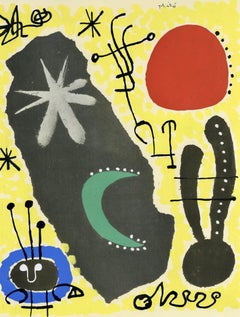
This exquisite lithograph and pochoir by Joan Miro (1893–1983), titled Sans titre (Untitled), from the album XXe Siecle, Nouvelle serie, XXe Annee, No. 10 (double), Mars 1958, origin...

Category

1950s Surrealist Joan Miró Art

Materials

Lithograph

Joan Miro, The Tree-like Woman, from XXe siecle, 1961

Joan Miro, The Tree-like Woman, from XXe siecle, 1961

By Joan Miró

Located in Southampton, NY

This exquisite lithograph by Joan Miro (1893–1983), titled La Femme Arborescente (The Tree-like Woman), from the album XXe Siecle, Nouvelle serie, XXIIe Annee, No. 16, originates fro...

Category

1960s Surrealist Joan Miró Art

Materials

Lithograph

Joan Miro, Figure, Bird, Star, from XXe siecle, 1959

Joan Miro, Figure, Bird, Star, from XXe siecle, 1959

By Joan Miró

Located in Southampton, NY

This exquisite linocut by Joan Miro (1893–1983), titled Personnage, Oiseau, Etoile (Figure, Bird, Star), from the album XXe Siecle, Nouvelle serie, XXIe Annee, No. 13, originates fro...

Category

1950s Surrealist Joan Miró Art

Materials

Linocut

Joan Miro, The Woman and the Bird, from XXe Siecle, 1956

Joan Miro, The Woman and the Bird, from XXe Siecle, 1956

By Joan Miró

Located in Southampton, NY

This exquisite lithograph and pochoir by Joan Miro (1893–1983), titled La Femme et l’Oiseau (The Woman and the Bird), from the album XXe Siecle, Nouvelle serie No. 6, originates from...

Category

1950s Surrealist Joan Miró Art

Materials

Lithograph

Joan Miro, Figures, from XXe Siecle, 1957

Joan Miro, Figures, from XXe Siecle, 1957

By Joan Miró

Located in Southampton, NY

This exquisite lithograph and pochoir by Joan Miro (1893–1983), titled Personnages (Figures), from the album XXe Siecle, Nouvelle serie, No. 8 (double), Janvier 1957, originates from...

Category

1950s Surrealist Joan Miró Art

Materials

Lithograph

Joan Miro, Woman and Bird in the Night, from XXe Siecle, 1957

Joan Miro, Woman and Bird in the Night, from XXe Siecle, 1957

By Joan Miró

Located in Southampton, NY

This exquisite lithograph and pochoir by Joan Miro (1893–1983), titled Femme et oiseau dans la nuit (Woman and Bird in the Night), from the album XXe Siecle, Nouvelle serie No. 8, or...

Category

1950s Surrealist Joan Miró Art

Materials

Lithograph

Joan Miro, The Prophet and The Bird and The Woman, from Derriere le Miroir, 1966

Joan Miro, The Prophet and The Bird and The Woman, from Derriere le Miroir, 1966

By Joan Miró

Located in Southampton, NY

This exquisite lithograph by Joan Miro (1893–1983), titled Le prophete et L'oiseau et la femme (The Prophet and The Bird and The Woman), originates from the historic 1966 double issu...

Category

1960s Surrealist Joan Miró Art

Materials

Lithograph

Joan Miro, The Star and the Woman in the Night, from Derriere le Miroir, 1966

Joan Miro, The Star and the Woman in the Night, from Derriere le Miroir, 1966

By Joan Miró

Located in Southampton, NY

This exquisite lithograph by Joan Miro (1893–1983), titled Letoile et La femme dans la nuit (The Star and the Woman in the Night), originates from the historic 1966 folio Derriere le...

Category

1960s Surrealist Joan Miró Art

Materials

Lithograph

Joan Miro, The Patagonian Star, from Derriere le Miroir, 1960

Joan Miro, The Patagonian Star, from Derriere le Miroir, 1960

By Joan Miró

Located in Southampton, NY

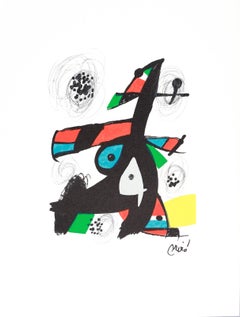
This exquisite lithograph by Joan Miro (1893–1983), titled L'Astre Patagon (The Patagonian Star), originates from the 1960 folio Derriere le Miroir, No. 119, Poetes, peintres, sculpteurs (Poets, Painters, Sculptors), published by Maeght Editeur, Paris, under the direction of Aime Maeght, and printed by Mourlot Freres, Paris. L'Astre Patagon embodies Miro's signature dreamlike abstraction—an interplay of cosmic forms, floating symbols, and lyrical color. This composition radiates the artist’s boundless imagination and his poetic dialogue between the material and the celestial. Executed on velin paper, this lithograph measures 15 x 22 inches (38.1 x 55.9 cm), with centerfold, as issued. Unsigned and unnumbered, as issued. The edition reflects the exceptional quality and craftsmanship of the Maeght and Mourlot collaborations, capturing Miro’s visual rhythm and surreal energy in a strikingly balanced composition. Artwork Details: Artist: Joan Miro (1893–1983) Title: L'Astre Patagon (The Patagonian Star), from Derriere le Miroir, No. 119, Poetes, peintres, sculpteurs (Poets, Painters, Sculptors), 1960 Medium: Lithograph on velin paper Dimensions: 15 x 22 inches (38.1 x 55.9 cm), with centerfold, as issued Inscription: Unsigned and unnumbered, as issued Date: 1960 Publisher: Maeght Editeur, Paris Printer: Mourlot Freres, Paris Catalogue raisonne references: Cramer, Patrick, and Joan Miro. Joan Miro, Catalogue Raisonne des Livres Illustres. P. Cramer, 1989, illustration 62. Miro, Joan. Joan Miro, Lithographe / II, 1953–1963. Preface by Raymond Queneau. Maeght, 1975, illustration 265 Condition: Well preserved, consistent with age and medium Provenance: From the 1960 folio Derriere le Miroir, No. 119, Poetes, peintres, sculpteurs (Poets, Painters, Sculptors), published by Maeght Editeur, Paris About the Publication: Derriere le Miroir (translated as "Behind the Mirror") was an iconic French art periodical published from 1946 to 1982 by Maeght Editeur, one of the most influential art publishers of the 20th century. Founded by Aime Maeght in Paris, the publication was conceived as a visual and literary collaboration between leading modern artists, poets, and critics. Each issue functioned as both an exhibition catalogue and a work of art in itself—featuring original lithographs printed directly from the artists' stones or plates, alongside essays, poems, and critical commentary. Over the course of 36 years, Derriere le Miroir produced more than 250 issues and showcased an extraordinary roster of artists including Henri Matisse, Marc Chagall, Joan Miro, Georges Braque, Alexander Calder, Fernand Leger, Pierre Bonnard, Alberto Giacometti, Eduardo Chillida, Ellsworth Kelly, Francis Bacon, Paul Rebeyrolle, Claude Garache, Antoni Tapies, Bram van Velde, Pierre Alechinsky, Pol Bury, Shusaku Arakawa, and Gerard Titus-Carmel. Printed in the ateliers of Mourlot, Arte, and Imprimerie Moderne du Lion, the periodical set new standards for quality in color lithography, combining fine art printing with elegant typography and poetic text. Beyond its visual brilliance, Derriere le Miroir also became a cultural chronicle of postwar European modernism. Each issue coincided with exhibitions held at Galerie Maeght, providing a collectible and widely accessible record of groundbreaking shows. Its integration of image, text, and philosophy created a dialogue between art and literature that elevated the modern art book to new aesthetic heights. Today, Derriere le Miroir remains one of the most sought-after and historically significant art publications, prized by collectors and scholars alike for its craftsmanship, influence, and its role in defining the visual language of 20th-century modernism. The Maeght Foundation in Saint-Paul-de-Vence continues to honor this legacy through exhibitions and archival preservation of the series, affirming Derriere le Miroir's enduring place in the history of modern art and fine art publishing. About the Artist: Joan Miro (1893–1983) was a Catalan painter, sculptor, and ceramicist whose imaginative, dreamlike vision helped spearhead the Surrealist movement and left an indelible mark on modern art. Born in Barcelona and deeply rooted in Catalan culture, Miro moved to Paris in the early 1920s where his playful shapes, cosmic motifs, and childlike yet sophisticated abstractions broke new ground alongside the great innovators of his time. His artistic dialogue aligned with contemporaries such as Pablo Picasso, Henri Matisse, Alexander Calder, Marc Chagall, Salvador Dali, Jackson Pollock, Georges Braque, Wassily Kandinsky, Marcel Duchamp, and Man Ray, each of whom challenged the conventions of form, color, and symbolism. Miro distilled these ideas into a uniquely poetic visual vocabulary—birds, stars, and bold spectral forms emerging from flat planes of color—that has inspired scores of artists and continues to influence modern and contemporary masters including Banksy, Damien Hirst, Jeff Koons, Andy Warhol, and Jasper Johns. His works are represented in leading museums worldwide, including MoMA, the Guggenheim, the Tate, and the Centre Pompidou, and remain highly sought after by collectors. The highest price ever paid for a Joan Miro artwork is approximately $37.06 million USD, achieved in June 2012 at Sotheby’s London for Peinture (Etoile Bleue) (1927). Joan Miro L'Astre Patagon, Miro Derriere le Miroir, Miro Maeght Editeur Paris, Miro Mourlot Freres, Miro 1960...

Category

1960s Surrealist Joan Miró Art
Materials

Lithograph

Joan Miro, Woman with a Mirror, from Derriere le miroir, 1956

Joan Miro, Woman with a Mirror, from Derriere le miroir, 1956

By Joan Miró

Located in Southampton, NY

This exquisite lithograph by Joan Miro (1893–1983), titled La femme au miroir (Woman with a Mirror), from the folio Derriere le miroir, 10 Ans d'Edition 1946–1956, No. 92–93, origina...

Category

1950s Surrealist Joan Miró Art

Materials

Lithograph

Joan Miro, Untitled, from Derriere le miroir, 1956

Joan Miro, Untitled, from Derriere le miroir, 1956

By Joan Miró

Located in Southampton, NY

This exquisite lithograph by Joan Miro (1893–1983), titled Sans titre (Untitled), from the folio Derriere le miroir, No. 87–89, originates from the 1956 edition published by Maeght E...

Category

1950s Surrealist Joan Miró Art

Materials

Lithograph

Joan Miro, Black Figure on Blue Background,  Composition with Chemical Formulas

Joan Miro, Black Figure on Blue Background, Composition with Chemical Formulas

By Joan Miró

Located in Southampton, NY

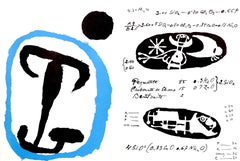
This exquisite lithograph by Joan Miro (1893–1983), titled Figure noire sur fond bleu et Composition avec formules chimiques (Black Figure on Blue Background and Composition with Che...

Category

1950s Surrealist Joan Miró Art

Materials

Lithograph

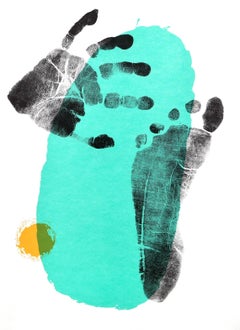
Joan Miro, Handprints on Blue-Green and Yellow Background, 1956

Joan Miro, Handprints on Blue-Green and Yellow Background, 1956

By Joan Miró

Located in Southampton, NY

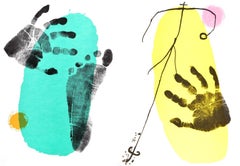
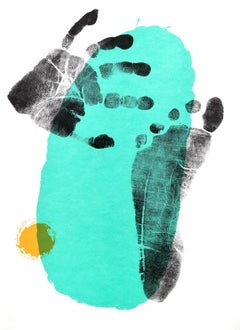
This exquisite lithograph by Joan Miro (1893–1983), titled Empreintes de mains sur fond bleu-vert et jaune (Handprints on Blue-Green and Yellow Background), from the folio Derriere l...

Category

1950s Surrealist Joan Miró Art

Materials

Lithograph

Joan Miro, Great Lands of Fire, from Derriere le miroir, 1956

Joan Miro, Great Lands of Fire, from Derriere le miroir, 1956

By Joan Miró

Located in Southampton, NY

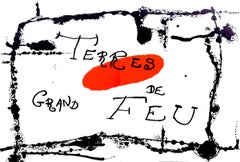
This exquisite lithograph by Joan Miro (1893–1983), titled Grandes terres de feu (Great Lands of Fire), from the folio Derriere le miroir, No. 87–89, originates from the 1956 edition...

Category

1950s Surrealist Joan Miró Art

Materials

Lithograph

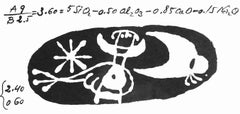
Joan Miro, Composition with Chemical Formulas, from Derriere le miroir, 1956

Joan Miro, Composition with Chemical Formulas, from Derriere le miroir, 1956

By Joan Miró

Located in Southampton, NY

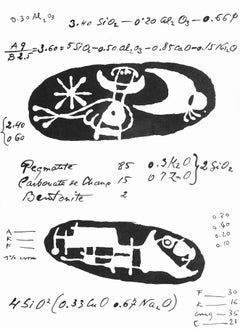
This exquisite lithograph by Joan Miro (1893–1983), titled Composition avec formules chimiques (Composition with Chemical Formulas), from the folio Derriere le miroir, No. 87–89, originates from the 1956 edition published by Maeght Editeur, Paris, and printed by Mourlot Freres, Paris, 1956. Composition avec formules chimiques showcases Miro’s unique blend of poetic abstraction and playful symbolism, merging scientific notations with his characteristic visual language of organic forms and vivid color harmonies. Executed as a lithograph on velin paper, this work measures 15 x 11 inches. Unsigned and unnumbered as issued. The edition exemplifies the superb craftsmanship of Mourlot Freres, Paris. Artwork Details: Artist: Joan Miro (1893–1983) Title: Composition avec formules chimiques (Composition with Chemical Formulas), from the folio Derriere le miroir, No. 87–89 Medium: Lithograph on velin paper Dimensions: 15 x 11 inches (38.1 x 27.94 cm) Inscription: Unsigned and unnumbered as issued Date: 1956 Publisher: Maeght Editeur, Paris Printer: Mourlot Freres, Paris Catalogue raisonne reference: Cramer, Patrick, and Isabelle Monod-Fontaine. Joan Miro: Catalogue Raisonne des Livres Illustres. Patrick Cramer Editeur, Geneva, 1989, no. 34. Condition: Well preserved, consistent with age and medium Provenance: From the folio Derriere le miroir, No. 87–89, published by Maeght Editeur, Paris; printed by Mourlot Freres, Paris, 1956 Notes: Excerpted from the folio (translated from French), Miroir Miro and Oasis Miro are extracted from the album by Jacques Prevert and Georges Ribemont-Dessaignes devoted to Miro. About the Publication: Derriere le miroir (Behind the Mirror) was one of the most important art publications of the 20th century, created and published by Maeght Editeur in Paris from 1946 to 1982. Founded by the visionary art dealer and publisher Aime Maeght, the series served as both an exhibition catalogue and a work of art in its own right, uniting original lithographs by leading modern and contemporary artists with critical essays, poetry, and design of the highest quality. Printed by master lithographers such as Mourlot Freres and Arte, Derriere le miroir became synonymous with the artistic vanguard of postwar Europe. Each issue was devoted to a single artist or theme and published to accompany exhibitions at the Galerie Maeght in Paris, featuring works by Pablo Picasso, Henri Matisse, Georges Braque, Joan Miro, Marc Chagall, Alexander Calder, Fernand Leger, and Alberto Giacometti, among others. The publication reflected Maeght’s belief that art should be both accessible and elevated—an ideal realized through its luxurious production values, meticulous printing, and collaboration with the greatest creative minds of its time. About the Artist: Joan Miro (1893–1983) was a Catalan painter, sculptor, printmaker, and ceramicist whose visionary imagination and lyrical abstraction made him one of the most influential and beloved artists of the 20th century. Born in Barcelona, Miro drew inspiration from Catalan folk art, Romanesque frescoes, and the luminous landscapes of Mont-roig del Camp, developing a deep connection to nature that infused his work with vitality and symbolism. After formal training at the Escola d'Art in Barcelona, he absorbed the lessons of Post-Impressionism and Cubism before moving to Paris in the early 1920s, where he became a leading figure in the Surrealist movement. There, Miro forged a personal visual language of biomorphic shapes, floating symbols, and radiant color harmonies that reflected both spontaneity and spiritual depth. In creative dialogue with peers such as Alexander Calder, Alberto Giacometti, Salvador Dali, Wassily Kandinsky, Marcel Duchamp, and Man Ray, he helped revolutionize modern art by dissolving the boundaries between abstraction and dream imagery. Miro's inventive approach extended far beyond painting, embracing sculpture, ceramics, and monumental public commissions that redefined how art could interact with space and emotion. His expressive freedom and gestural abstraction profoundly influenced later artists including Jackson Pollock, Mark Rothko, Alexander Calder, Jean Dubuffet, Antoni Tapies, and Joan Mitchell, inspiring generations who sought to merge instinct, color, and imagination. Today, Miro's work remains a cornerstone of modernism, prized by collectors and celebrated in major museums worldwide. His highest auction record was achieved by Peinture (Etoile Bleue) (1927), which sold for £23,561,250 (approximately $37 million) at Sotheby's, London, on June 19, 2012. Joan Miro Composition...

Category

1950s Surrealist Joan Miró Art

Materials

Lithograph

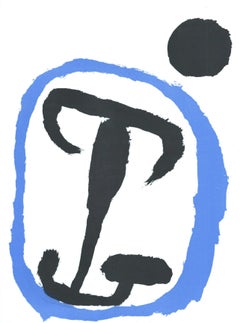
Joan Miro, Black Figure on Blue Background, from Derriere le miroir, 1956

Joan Miro, Black Figure on Blue Background, from Derriere le miroir, 1956

By Joan Miró

Located in Southampton, NY

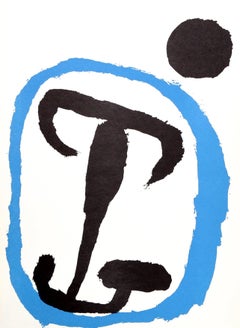
This exquisite lithograph by Joan Miro (1893–1983), titled Figure noire sur fond bleu (Black Figure on Blue Background), from the folio Derriere le miroir, No. 87–89, originates from...

Category

1950s Surrealist Joan Miró Art

Materials

Lithograph

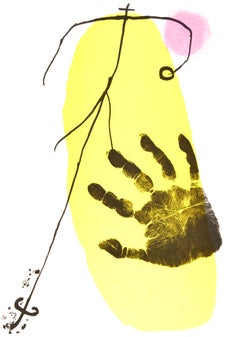
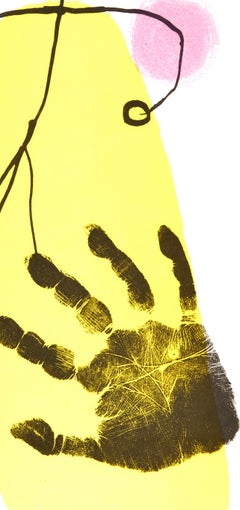
Joan Miro, Handprint on Yellow Background, from Derriere le miroir, 1956

Joan Miro, Handprint on Yellow Background, from Derriere le miroir, 1956

By Joan Miró

Located in Southampton, NY

This exquisite lithograph by Joan Miro (1893–1983), titled Empreinte de main sur fond jaune (Handprint on Yellow Background), from the folio Derriere le miroir, No. 87–89, originates...

Category

1950s Surrealist Joan Miró Art

Materials

Lithograph

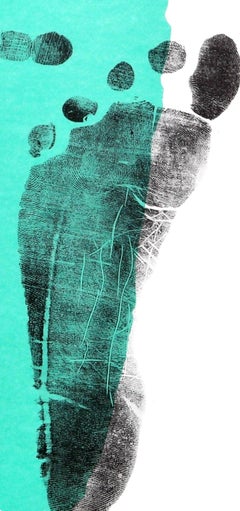
Joan Miro, Handprint on Blue-Green Background, from Derriere le miroir, 1956

Joan Miro, Handprint on Blue-Green Background, from Derriere le miroir, 1956

By Joan Miró

Located in Southampton, NY

This exquisite lithograph by Joan Miro (1893–1983), titled Empreinte de main sur fond bleu-vert (Handprint on Blue-Green Background), from the folio Derriere le miroir, No. 87–89, or...

Category

1950s Surrealist Joan Miró Art

Materials

Lithograph

Joan Miro, The Spanish Dancer, from Derriere le miroir, 1963

Joan Miro, The Spanish Dancer, from Derriere le miroir, 1963

By Joan Miró

Located in Southampton, NY

This exquisite lithograph by Joan Miro (1893–1983), titled La danseuse espagnole (The Spanish Dancer), from the folio Derriere le miroir, No. 139–140, originates from the 1963 editio...

Category

1960s Surrealist Joan Miró Art
Materials

Lithograph

Joan Miro, The Giants, from Derriere le miroir, 1963

Joan Miro, The Giants, from Derriere le miroir, 1963

By Joan Miró

Located in Southampton, NY

This exquisite lithograph by Joan Miro (1893–1983), titled Les geants (The Giants), from the folio Derriere le miroir, No. 139–140, originates from the 1963 edition published by Maeg...

Category

1960s Surrealist Joan Miró Art
Materials

Lithograph

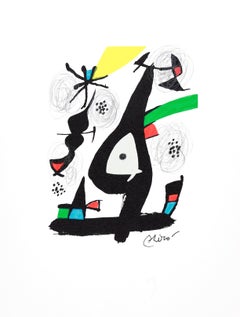
Joan Miro, The Sacred Scarab, from Derriere le miroir, 1963

Joan Miro, The Sacred Scarab, from Derriere le miroir, 1963

By Joan Miró

Located in Southampton, NY

This exquisite lithograph by Joan Miro (1893–1983), titled Le scarabee sacre (The Sacred Scarab), from the folio Derriere le miroir, No. 139–140, originates from the 1963 edition pub...

Category

1960s Surrealist Joan Miró Art
Materials

Lithograph

Joan Miro, The Prophet, from Derriere le miroir, 1963

Joan Miro, The Prophet, from Derriere le miroir, 1963

By Joan Miró

Located in Southampton, NY

This exquisite lithograph by Joan Miro (1893–1983), titled Le prophete (The Prophet), from the folio Derriere le miroir, No. 139–140, originates from the 1963 edition published by Ma...

Category

1960s Surrealist Joan Miró Art
Materials

Lithograph

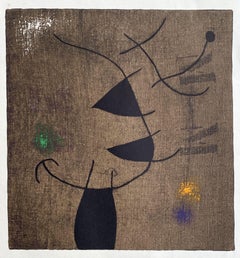
Joan Miro, The Star, from Derriere le miroir, 1963

Joan Miro, The Star, from Derriere le miroir, 1963

By Joan Miró

Located in Southampton, NY

This exquisite lithograph by Joan Miro (1893–1983), titled L'etoile (The Star), from the folio Derriere le miroir, No. 139–140, originates from the 1963 edition published by Maeght E...

Category

1960s Surrealist Joan Miró Art
Materials

Lithograph

Joan Miro, The Woman in the Night, from Derriere le miroir, 1963

Joan Miro, The Woman in the Night, from Derriere le miroir, 1963

By Joan Miró

Located in Southampton, NY

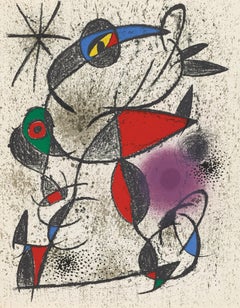
This exquisite lithograph by Joan Miro (1893–1983), titled La femme dans la nuit (The Woman in the Night), from the folio Derriere le miroir, No. 139–140, originates from the 1963 ed...

Category

1960s Surrealist Joan Miró Art
Materials

Lithograph

Joan Miro, The Bird and the Woman, from Derriere le miroir, 1963

Joan Miro, The Bird and the Woman, from Derriere le miroir, 1963

By Joan Miró

Located in Southampton, NY

This exquisite lithograph by Joan Miro (1893–1983), titled L'oiseau et la femme (The Bird and the Woman), from the folio Derriere le miroir, No. 139–140, originates from the 1963 edi...

Category

1960s Surrealist Joan Miró Art
Materials

Lithograph

Joan Miro, The Woman and the Bird, from Derriere le miroir, 1963

Joan Miro, The Woman and the Bird, from Derriere le miroir, 1963

By Joan Miró

Located in Southampton, NY

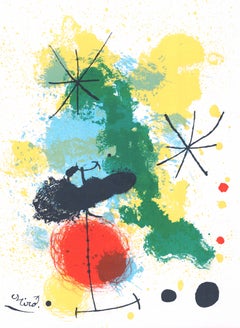
This exquisite lithograph by Joan Miro (1893–1983), titled La femme et l'oiseau (The Woman and the Bird), from the folio Derriere le miroir, No. 139–140, originates from the 1963 edi...

Category

1960s Surrealist Joan Miró Art
Materials

Lithograph

Joan Miro, Nocturnal, from Derriere le miroir, 1953

Joan Miro, Nocturnal, from Derriere le miroir, 1953

By Joan Miró

Located in Southampton, NY

This exquisite lithograph by Joan Miro (1893–1983), titled Nocturne (Nocturnal), from the folio Derriere le miroir, No. 57–59, originates from the 1953 edition published by Maeght Ed...

Category

1950s Surrealist Joan Miró Art
Materials

Lithograph

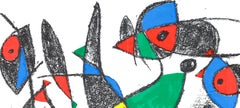
Joan Miro, The Three Blues, from Derriere le miroir, 1951

Joan Miro, The Three Blues, from Derriere le miroir, 1951

By Joan Miró

Located in Southampton, NY

This exquisite lithograph by Joan Miro (1893–1983), titled Les Trois Bleus (The Three Blues), from the folio Derriere le miroir, Sur Quatre Murs (Behind the Mirror, On Four Walls), N...

Category

1950s Surrealist Joan Miró Art
Materials

Lithograph

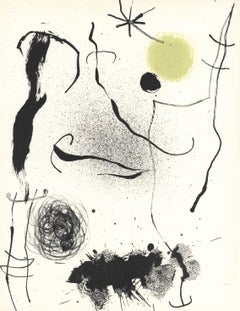
Joan Miro, Figures Before the Sun, from Derriere le miroir, 1950

Joan Miro, Figures Before the Sun, from Derriere le miroir, 1950

By Joan Miró

Located in Southampton, NY

This exquisite lithograph by Joan Miro (1893–1983), titled Personnages devant le soleil (Figures Before the Sun), from the folio Derriere le miroir, No. 29–30, originates from the 19...

Category

1950s Surrealist Joan Miró Art
Materials

Lithograph

Joan Miro, Untitled, from Derriere le miroir, 1950

Joan Miro, Untitled, from Derriere le miroir, 1950

By Joan Miró

Located in Southampton, NY

This exquisite lithograph by Joan Miro (1893–1983), titled Sans titre (Untitled), from the folio Derriere le miroir, No. 29–30, originates from the 1950 edition published by Maeght E...

Category

1950s Surrealist Joan Miró Art
Materials

Lithograph

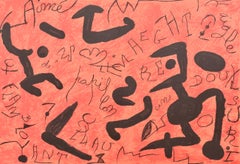
Joan Miro, Lithograph, from Lithographs II, 1975

Joan Miro, Lithograph, from Lithographs II, 1975

By Joan Miró

Located in Southampton, NY

This exquisite lithograph by Joan Miro (1893–1983), titled Lithograph, from the album Joan Miro Lithographs, Volume II, originates from the 1975 edition published by Leon Amiel, New York, and printed by Mourlot Freres, Paris, 1975. Lithograph reflects Miros poetic mastery of line, movement, and color, capturing his lifelong pursuit of visual rhythm and lyrical abstraction. Combining spontaneity and control, this composition embodies Miros signature balance of playful geometry and poetic energy—translating instinct and imagination into a harmonious field of motion and light. Executed as a lithograph on velin paper, this work measures 12.5 x 9.625 inches. Unsigned and unnumbered as issued. The edition exemplifies the refined craftsmanship and technical mastery of Mourlot Freres, Paris, one of the foremost printmaking ateliers of the 20th century. Artwork Details: Artist: Joan Miro (1893–1983) Title: Lithograph, from the album Joan Miro Lithographs, Volume II, 1975 Medium: Lithograph on velin paper Dimensions: 12.5 x 9.625 inches (31.8 x 24.4 cm) Inscription: Unsigned and unnumbered as issued Date: 1975 Publisher: Leon Amiel, New York Printer: Mourlot Freres, Paris Catalogue raisonne references: Cramer, Patrick, and Joan Miro. Joan Miro, Catalogue Raisonne Des Livres Illustres. P. Cramer, 1989, illustration 198. Cramer, Patrick. Joan Miro: Lithographs Volume V 1972–1975. Maeght, 1992, illustration 1036. Condition: Well preserved, consistent with age and medium Provenance: From the album Joan Miro Lithographs, Volume II, published by Leon Amiel, New York; printed by Mourlot Freres, Paris, 1975 Notes: Excerpted from the album, The original Joan Miro lithographs were printed by Mourlot, the illustrations by Arte Adrien Maeght, and the text by Imprimerie Union, Paris, France. V̅ examples of this English-language edition, numbered I-V̅, have been printed. A deluxe French edition of CL examples, numbered I-CL, with II additional original lithographs signed by Joan Miro, and LXXX suites, numbered I-LXXX, containing the XIII original lithographs on velin with wide margins and with each lithograph signed by the artist, have also been printed. About the Publication: Joan Miro Lithographs, Volume II, published in 1975 by Leon Amiel, New York, with lithographs printed by Mourlot Freres, Paris, is the second installment in the monumental four-volume series documenting Miros complete lithographic work. The project was conceived as both an artistic and scholarly endeavor, uniting Miro’s technical innovation with comprehensive cataloguing of his print oeuvre. Volume II chronicles an essential period in Miros career—from 1950 to 1956—when his exploration of symbolic abstraction, vibrant color, and gestural spontaneity reached new levels of expressive freedom. The collaboration between Miro and the master lithographers at Mourlot resulted in works of exceptional brilliance and vitality, capturing the artist’s playful yet deeply spiritual sensibility. The album was produced with meticulous attention to detail, printed on the highest-quality velin paper, and accompanied by essays and documentation that provide historical and artistic context. Issued in English and French-language editions, Joan Miro Lithographs, Volume II stands as a landmark in 20th-century printmaking—testament to the enduring creative partnership between Miro, Mourlot, and the publishers Maeght and Amiel. About the Artist: Joan Miro (1893–1983) was a Catalan painter, sculptor, printmaker, and ceramicist whose visionary imagination and lyrical abstraction made him one of the most influential and beloved artists of the 20th century. Born in Barcelona, Miro drew inspiration from Catalan folk art, Romanesque frescoes, and the luminous landscapes of Mont-roig del Camp, developing a deep connection to nature that infused his work with vitality and symbolism. After formal training at the Escola d'Art in Barcelona, he absorbed the lessons of Post-Impressionism and Cubism before moving to Paris in the early 1920s, where he became a leading figure in the Surrealist movement. There, Miro forged a personal visual language of biomorphic shapes, floating symbols, and radiant color harmonies that reflected both spontaneity and spiritual depth. In creative dialogue with peers such as Alexander Calder, Alberto Giacometti, Salvador Dali, Wassily Kandinsky, Marcel Duchamp, and Man Ray, he helped revolutionize modern art by dissolving the boundaries between abstraction and dream imagery. Miros inventive approach extended far beyond painting, embracing sculpture, ceramics, and monumental public commissions that redefined how art could interact with space and emotion. His expressive freedom and gestural abstraction profoundly influenced later artists including Jackson Pollock, Mark Rothko, Alexander Calder, Jean Dubuffet, Antoni Tapies, and Joan Mitchell, inspiring generations who sought to merge instinct, color, and imagination. Today, Miros work remains a cornerstone of modernism, prized by collectors and celebrated in major museums worldwide. His highest auction record was achieved by Peinture (Etoile Bleue) (1927), which sold for 23,561,250 GBP (approximately 37 million USD) at Sotheby's, London, on June 19, 2012. Joan Miro Lithograph, Miro Lithographs Volume II, Miro Leon Amiel, Miro Mourlot...

Category

1970s Surrealist Joan Miró Art
Materials

Lithograph

Joan Miro, Lithograph V, from Lithographs II, 1975

Joan Miro, Lithograph V, from Lithographs II, 1975

By Joan Miró

Located in Southampton, NY

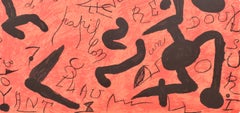
This exquisite lithograph by Joan Miro (1893–1983), titled Lithograph V, from the album Joan Miro Lithographs, Volume II, originates from the 1975 edition published by Leon Amiel, Ne...

Category

1970s Surrealist Joan Miró Art
Materials

Lithograph

Joan Miro, Lithograph VI, from Lithographs II, 1975

Joan Miro, Lithograph VI, from Lithographs II, 1975

By Joan Miró

Located in Southampton, NY

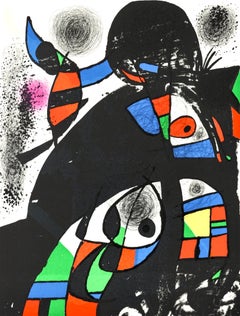
This exquisite lithograph by Joan Miro (1893–1983), titled Lithograph VI, from the album Joan Miro Lithographs, Volume II, originates from the 1975 edition published by Leon Amiel, N...

Category

1970s Surrealist Joan Miró Art
Materials

Lithograph

Joan Miro, Lithograph I, from Lithographs II, 1975

Joan Miro, Lithograph I, from Lithographs II, 1975

By Joan Miró

Located in Southampton, NY

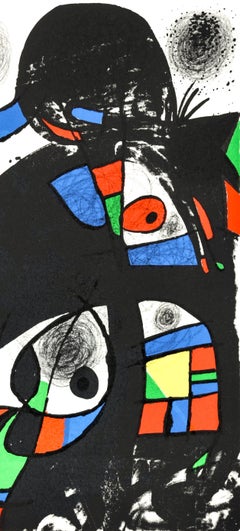
This exquisite lithograph by Joan Miro (1893–1983), titled Lithograph I, from the album Joan Miro Lithographs, Volume II, originates from the 1975 edition published by Leon Amiel, Ne...

Category

1970s Surrealist Joan Miró Art
Materials

Lithograph

Joan Miro, Lithograph XI, from Lithographs II, 1975

Joan Miro, Lithograph XI, from Lithographs II, 1975

By Joan Miró

Located in Southampton, NY

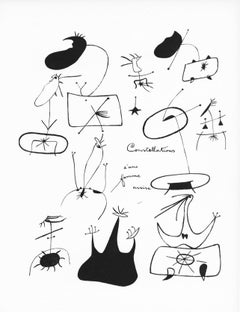
This exquisite lithograph by Joan Miro (1893–1983), titled Lithograph XI, from the album Joan Miro Lithographs, Volume II, originates from the 1975 edition published by Leon Amiel, N...

Category

1970s Surrealist Joan Miró Art
Materials

Lithograph

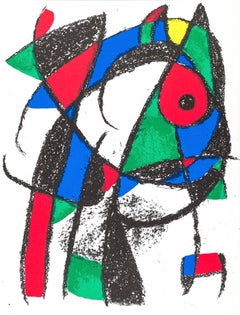
Joan Miro, Lithograph II, from Lithographs II, 1975

Joan Miro, Lithograph II, from Lithographs II, 1975

By Joan Miró

Located in Southampton, NY

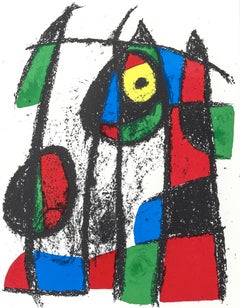
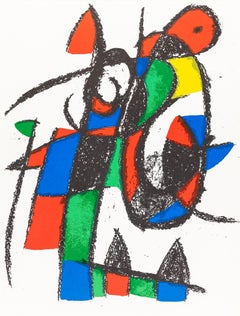
This exquisite lithograph by Joan Miro (1893–1983), titled Lithograph II, from the album Joan Miro Lithographs, Volume II, originates from the 1975 edition published by Leon Amiel, New York, and printed by Mourlot Freres, Paris, 1975. Lithograph II reflects Miros poetic mastery of line, movement, and color, capturing his lifelong pursuit of visual rhythm and lyrical abstraction. Combining spontaneity and control, this composition embodies Miros signature balance of playful geometry and poetic energy—translating instinct and imagination into a harmonious field of motion and light. Executed as a lithograph on velin paper, this work measures 12.5 x 9.625 inches. Unsigned and unnumbered as issued. The edition exemplifies the refined craftsmanship and technical mastery of Mourlot Freres, Paris, one of the foremost printmaking ateliers of the 20th century. Artwork Details: Artist: Joan Miro (1893–1983) Title: Lithograph II, from the album Joan Miro Lithographs, Volume II, 1975 Medium: Lithograph on velin paper Dimensions: 12.5 x 9.625 inches (31.8 x 24.4 cm) Inscription: Unsigned and unnumbered as issued Date: 1975 Publisher: Leon Amiel, New York Printer: Mourlot Freres, Paris Catalogue raisonne references: Cramer, Patrick, and Joan Miro. Joan Miro, Catalogue Raisonne Des Livres Illustres. P. Cramer, 1989, illustration 198. Cramer, Patrick. Joan Miro: Lithographs Volume V 1972–1975. Maeght, 1992, illustration 1038. Condition: Well preserved, consistent with age and medium Provenance: From the album Joan Miro Lithographs, Volume II, published by Leon Amiel, New York; printed by Mourlot Freres, Paris, 1975 Notes: Excerpted from the album, The original Joan Miro lithographs were printed by Mourlot, the illustrations by Arte Adrien Maeght, and the text by Imprimerie Union, Paris, France. V̅ examples of this English-language edition, numbered I-V̅, have been printed. A deluxe French edition of CL examples, numbered I-CL, with II additional original lithographs signed by Joan Miro, and LXXX suites, numbered I-LXXX, containing the XIII original lithographs on velin with wide margins and with each lithograph signed by the artist, have also been printed. About the Publication: Joan Miro Lithographs, Volume II, published in 1975 by Leon Amiel, New York, with lithographs printed by Mourlot Freres, Paris, is the second installment in the monumental four-volume series documenting Miros complete lithographic work. The project was conceived as both an artistic and scholarly endeavor, uniting Miro’s technical innovation with comprehensive cataloguing of his print oeuvre. Volume II chronicles an essential period in Miros career—from 1950 to 1956—when his exploration of symbolic abstraction, vibrant color, and gestural spontaneity reached new levels of expressive freedom. The collaboration between Miro and the master lithographers at Mourlot resulted in works of exceptional brilliance and vitality, capturing the artist’s playful yet deeply spiritual sensibility. The album was produced with meticulous attention to detail, printed on the highest-quality velin paper, and accompanied by essays and documentation that provide historical and artistic context. Issued in English and French-language editions, Joan Miro Lithographs, Volume II stands as a landmark in 20th-century printmaking—testament to the enduring creative partnership between Miro, Mourlot, and the publishers Maeght and Amiel. About the Artist: Joan Miro (1893–1983) was a Catalan painter, sculptor, printmaker, and ceramicist whose visionary imagination and lyrical abstraction made him one of the most influential and beloved artists of the 20th century. Born in Barcelona, Miro drew inspiration from Catalan folk art, Romanesque frescoes, and the luminous landscapes of Mont-roig del Camp, developing a deep connection to nature that infused his work with vitality and symbolism. After formal training at the Escola d'Art in Barcelona, he absorbed the lessons of Post-Impressionism and Cubism before moving to Paris in the early 1920s, where he became a leading figure in the Surrealist movement. There, Miro forged a personal visual language of biomorphic shapes, floating symbols, and radiant color harmonies that reflected both spontaneity and spiritual depth. In creative dialogue with peers such as Alexander Calder, Alberto Giacometti, Salvador Dali, Wassily Kandinsky, Marcel Duchamp, and Man Ray, he helped revolutionize modern art by dissolving the boundaries between abstraction and dream imagery. Miros inventive approach extended far beyond painting, embracing sculpture, ceramics, and monumental public commissions that redefined how art could interact with space and emotion. His expressive freedom and gestural abstraction profoundly influenced later artists including Jackson Pollock, Mark Rothko, Alexander Calder, Jean Dubuffet, Antoni Tapies, and Joan Mitchell, inspiring generations who sought to merge instinct, color, and imagination. Today, Miros work remains a cornerstone of modernism, prized by collectors and celebrated in major museums worldwide. His highest auction record was achieved by Peinture (Etoile Bleue) (1927), which sold for 23,561,250 GBP (approximately 37 million USD) at Sotheby's, London, on June 19, 2012. Joan Miro Lithograph II...

Category

1970s Surrealist Joan Miró Art
Materials

Lithograph

Joan Miró art for sale on 1stDibs.

Find a wide variety of authentic Joan Miró art available for sale on 1stDibs. If you’re browsing the collection of art to introduce a pop of color in a neutral corner of your living room or bedroom, you can find work that includes elements of green, purple and other colors. You can also browse by medium to find art by Joan Miró in lithograph, etching, aquatint and more. Much of the original work by this artist or collective was created during the 20th century and is mostly associated with the abstract style. Not every interior allows for large Joan Miró art, so small editions measuring 8 inches across are available. Customers who are interested in this artist might also find the work of Francisco Nicolás, Antoni Tàpies, and Karel Appel. Joan Miró art prices can differ depending upon medium, time period and other attributes. On 1stDibs, the price for these items starts at $216 and tops out at $15,575, while the average work can sell for $3,483.

Questions About Joan Miró Art
  • 1stDibs ExpertApril 5, 2022
    You can find Joan Miró paintings at the Fundació Joan Miró in Barcelona, Spain; the Museum of Modern Art in New York, New York; the Art Institute of Chicago in Chicago, Illinois; and the Tate Gallery in London, UK. In addition, the artist's work is available to purchase through some dealers and on various reputable online platforms. Shop a range of Joan Miró art on 1stDibs.
  • 1stDibs ExpertApril 5, 2022
    Joan Miró is known as one of the pioneers of Surrealism, but at times his work steered towards Fauvism and Expressionism as well. The visual world Miró created with his expressive lines, signature symbols and biomorphic shapes was truly radical and it influenced artists such as Jackson Pollock and Mark Rothko. Shop a wide range of Joan Miró art from some of the world’s top sellers on 1stDibs.
  • 1stDibs ExpertOctober 15, 2024
    Joan Miró contributed to Surrealism by producing pieces that incorporated nonobjective imagery and evoked the subconscious. With his wide-ranging oeuvre, including strikingly original paintings, prints, ceramics, sculptures, metal engravings and murals, the Catalan modernist was a critical force in moving 20th-century art toward complete abstraction. In addition to impacting fellow Surrealists, the radical visual world Miró created with its expressive lines, signature symbols and biomorphic shapes influenced American Abstract Expressionists such as Jackson Pollock and Color Field painters like Mark Rothko and Barnett Newman. On 1stDibs, find a selection of Joan Miró art.