Marc Chagall Art

French, 1887-1985

Described by art critic Robert Hughes as "the quintessential Jewish artist of the twentieth century," the Russian-French modernist Marc Chagall worked in nearly every artistic medium. Influenced by Symbolism, Fauvism, Cubism and Surrealism, he developed his own distinctive style, combining avant-garde techniques and motifs with elements drawn from Eastern European Jewish folk art.

Born Moishe Segal in 1887, in Belarus (then part of the Russian empire), Chagall is often celebrated for his figurative paintings, but he also produced stained-glass windows for the cathedrals of Reims and Metz, in France; for the United Nations, in New York; and for the Hadassah Hospital in Jerusalem, as well as book illustrations, stage sets, ceramics, tapestries and fine-art prints. Characterized by a bold color palette and whimsical imagery, his works are often narrative, depicting small-village scenes and quotidian moments of peasant life, as in his late painting The Flight into Egypt from 1980.

Before World War I, Chagall traveled between St. Petersburg, Paris and Berlin. When the conflict broke out, he returned to Soviet-occupied Belarus, where he founded the Vitebsk Arts College before leaving again for Paris in 1922. He fled to the United States during World War II but in 1947 returned to France, where he spent the rest of his life. His peripatetic career left its mark on his style, which was distinctly international, incorporating elements from each of the cultures he experienced.

Marc Chagall remains one of the past century’s most respected talents — find his art on 1stDibs.

to
452
1,252
219
112
30
8
Overall Width
to
Overall Height
to
3
2
1,614
2
132
34
54
452
674
146
35
440
420
387
29
26
10
7
2
968
712
411
402
393
308
221
115
55
53
35
29
27
26
18
17
16
14
12
12
808
798

Use search to find more

11,856
2,888
2,541
1,496

Use search to find more

Artist: Marc Chagall
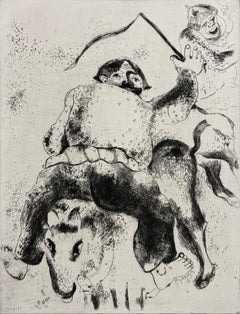
Marc Chagall, The Village of Plyushkin, from Dead Souls, 1923–1927

Marc Chagall, The Village of Plyushkin, from Dead Souls, 1923–1927

By Marc Chagall

Located in Southampton, NY

This exquisite etching by Marc Chagall (1887–1985), titled Le Village de Pliouchkine (The Village of Plyushkin), originates from the celebrated folio Nicolas Gogol, Les Ames mortes, ...

Category

1920s Expressionist Marc Chagall Art

Materials

Etching

Marc Chagall, Encounter with a Peasant, from Dead Souls, 1923–1927

Marc Chagall, Encounter with a Peasant, from Dead Souls, 1923–1927

By Marc Chagall

Located in Southampton, NY

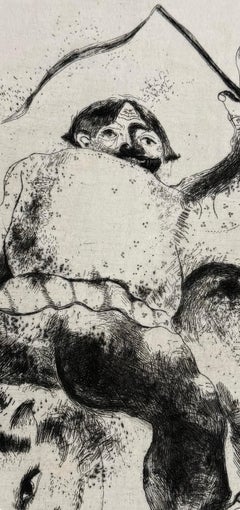
This exquisite etching by Marc Chagall (1887–1985), titled Rencontre d'un paysan (Encounter with a Peasant), originates from the celebrated folio Nicolas Gogol, Les Ames mortes, Eaux...

Category

1920s Expressionist Marc Chagall Art

Materials

Etching

Marc Chagall, The Deposit, from Dead Souls, 1923–1927

Marc Chagall, The Deposit, from Dead Souls, 1923–1927

By Marc Chagall

Located in Southampton, NY

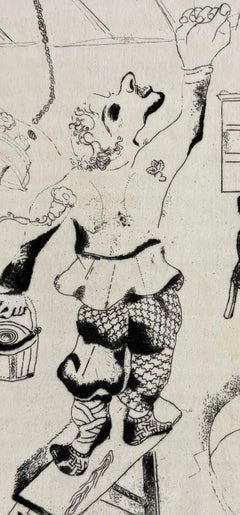
This exquisite etching by Marc Chagall (1887–1985), titled Les Arrhes (The Deposit), originates from the celebrated folio Nicolas Gogol, Les Ames mortes, Eaux-fortes originales de Ma...

Category

1920s Expressionist Marc Chagall Art

Materials

Etching

Marc Chagall, Sobakevitch Near the Armchair, from Dead Souls, 1923–1927

Marc Chagall, Sobakevitch Near the Armchair, from Dead Souls, 1923–1927

By Marc Chagall

Located in Southampton, NY

This exquisite etching by Marc Chagall (1887–1985), titled Sobakevitch pres du fauteuil (Sobakevitch Near the Armchair), originates from the celebrated folio Nicolas Gogol, Les Ames ...

Category

1920s Expressionist Marc Chagall Art

Materials

Etching

Marc Chagall, Tchitchikov and Sobakevitch…, from Dead Souls, 1923–1927

Marc Chagall, Tchitchikov and Sobakevitch…, from Dead Souls, 1923–1927

By Marc Chagall

Located in Southampton, NY

This exquisite etching by Marc Chagall (1887–1985), titled Tchitchikov et Sobakevitch discutent affaires (Tchitchikov and Sobakevitch Discuss Business), originates from the celebrate...

Category

1920s Expressionist Marc Chagall Art

Materials

Etching

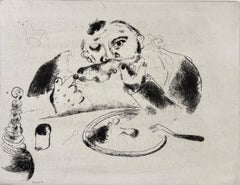
Marc Chagall, Sobakevitch at the Table, from Dead Souls, 1923–1927

Marc Chagall, Sobakevitch at the Table, from Dead Souls, 1923–1927

By Marc Chagall

Located in Southampton, NY

This exquisite etching by Marc Chagall (1887–1985), titled Sobakevitch a table (Sobakevitch at the Table), originates from the celebrated folio Nicolas Gogol, Les Ames mortes, Eaux-f...

Category

1920s Expressionist Marc Chagall Art

Materials

Etching

Marc Chagall, The Table Laden with Food, from Dead Souls, 1923–1927

Marc Chagall, The Table Laden with Food, from Dead Souls, 1923–1927

By Marc Chagall

Located in Southampton, NY

This exquisite etching by Marc Chagall (1887–1985), titled La table chargee de victuailles (The Table Laden with Food), originates from the celebrated folio Nicolas Gogol, Les Ames m...

Category

1920s Expressionist Marc Chagall Art

Materials

Etching

Marc Chagall, Dinner Is Served, from Dead Souls, 1923–1927

Marc Chagall, Dinner Is Served, from Dead Souls, 1923–1927

By Marc Chagall

Located in Southampton, NY

This exquisite etching by Marc Chagall (1887–1985), titled On passe a table (Dinner Is Served), originates from the celebrated folio Nicolas Gogol, Les Ames mortes, Eaux-fortes origi...

Category

1920s Expressionist Marc Chagall Art

Materials

Etching

Marc Chagall, Mrs. Sobakevich, from Dead Souls, 1923–1927

Marc Chagall, Mrs. Sobakevich, from Dead Souls, 1923–1927

By Marc Chagall

Located in Southampton, NY

This exquisite etching by Marc Chagall (1887–1985), titled Madame Sobakevitch (Mrs. Sobakevich), originates from the celebrated folio Nicolas Gogol, Les Ames mortes, Eaux-fortes originales de Marc Chagall (Nicolas Gogol, Dead Souls, Original Etchings by Marc Chagall), published by Teriade Editeur, Paris, 1948, and printed by Fort, Impressions artistiques, Paris, under the direction of Louis Fort, 1923–1927. The composition presents Madame Sobakevitch with a blend of caricature and psychological depth, rendering her presence through expressive line, domestic gravity, and Chagall’s distinctive fusion of satire and empathy. Executed as an etching on velin d'Arches filigrane paper, this work measures 17.764 x 10.827 inches (45.12 x 27.5 cm). Signed in the plate and unnumbered as issued. Printed by Fort, Impressions artistiques, Paris, under the direction of Louis Fort. Artwork Details: Artist: Marc Chagall (1887–1985) Title: Madame Sobakevitch (Mrs. Sobakevich), from Nicolas Gogol, Les Ames mortes, Eaux-fortes originales de Marc Chagall (Nicolas Gogol, Dead Souls, Original Etchings by Marc Chagall), 1948 Medium: Etching on velin d'Arches filigrane paper Dimensions: 17.764 x 10.827 inches (45.12 x 27.5 cm) Inscription: Signed in the plate and unnumbered as issued Date: 1948, published; 1923–1927, printed Publisher: Teriade Editeur, Paris Printer: Fort, Impressions artistiques, Paris, under the direction of Louis Fort Catalogue raisonne reference: Cramer, Patrick, and Meret Meyer. Marc Chagall: Catalogue Raisonne Des Livres Illustres. P. Cramer ed., 1995 Condition: Well preserved, consistent with age and medium Provenance: From Nicolas Gogol, Les Ames mortes, Eaux-fortes originales de Marc Chagall (Nicolas Gogol, Dead Souls, Original Etchings by Marc Chagall), published by Teriade Editeur, Paris, 1948 Notes: Excerpted from the folio (translated from French), It was taken from this album, on velin d'Arches filigrane Les Ames mortes, including a suite on japon nacre and non commerce examples reserved for collaborators. All colophons are signed by the artist. About the Publication: Nicolas Gogol, Les Ames mortes, Eaux-fortes originales de Marc Chagall (Nicolas Gogol, Dead Souls, Original Etchings by Marc Chagall) stands among the most important illustrated literary works of the twentieth century. Conceived over several decades and rooted in Chagalls deep emotional connection to Gogols satirical vision of Russian society, the album unites text and image in a profoundly imaginative synthesis. Published by Teriade in 1948 and printed by Fort, Impressions artistiques, Paris, under the direction of Louis Fort, the album embodies the highest standards of Parisian printmaking and remains a cornerstone of twentieth century livre dartiste production. About the Artist: Marc Chagall (1887–1985) was a Belarus born French painter, printmaker, and designer whose visionary imagination, radiant color, and deeply poetic symbolism made him one of the most beloved and influential artists of the twentieth century. Rooted in the imagery of his Jewish heritage and the memories of his childhood in Vitebsk, Chagalls art wove together themes of faith, love, folklore, and fantasy with a dreamlike modern sensibility. His unique style merging elements of Cubism, Fauvism, Expressionism, and Surrealism defied categorization, transforming ordinary scenes into lyrical meditations on memory and emotion. Over a prolific career spanning painting, printmaking, stained glass, ceramics, and stage design, Chagall brought an unparalleled poetic sensibility to modern art. His works are held in major museums worldwide, including the Museum of Modern Art, the Centre Pompidou, the Tate, and the Guggenheim. The highest price ever paid for a Marc Chagall artwork is approximately 28.5 million USD, achieved in 2017 at Sothebys New York for Les Amoureux (1928). Marc Chagall etching...

Category

1920s Expressionist Marc Chagall Art

Materials

Etching

Marc Chagall, Sobakevitch, from Dead Souls, 1923–1927

Marc Chagall, Sobakevitch, from Dead Souls, 1923–1927

By Marc Chagall

Located in Southampton, NY

This exquisite etching by Marc Chagall (1887–1985), titled Sobakevitch (Sobakevitch), originates from the celebrated folio Nicolas Gogol, Les Ames mortes, Eaux-fortes originales de Marc Chagall (Nicolas Gogol, Dead Souls, Original Etchings by Marc Chagall), published by Teriade Editeur, Paris, 1948, and printed by Fort, Impressions artistiques, Paris, under the direction of Louis Fort, 1923–1927. The composition presents Sobakevitch as a figure of monumental gravity, rendered with dense line, architectural solidity, and satirical force, transforming Gogols character into a visual embodiment of weight, obstinacy, and material presence. Executed as an etching on velin d'Arches filigrane paper, this work measures 17.764 x 10.827 inches (45.12 x 27.5 cm). Signed in the plate and unnumbered as issued. Printed by Fort, Impressions artistiques, Paris, under the direction of Louis Fort. Artwork Details: Artist: Marc Chagall (1887–1985) Title: Sobakevitch (Sobakevitch), from Nicolas Gogol, Les Ames mortes, Eaux-fortes originales de Marc Chagall (Nicolas Gogol, Dead Souls, Original Etchings by Marc Chagall), 1948 Medium: Etching on velin d'Arches filigrane paper Dimensions: 17.764 x 10.827 inches (45.12 x 27.5 cm) Inscription: Signed in the plate and unnumbered as issued Date: 1948, published; 1923–1927, printed Publisher: Teriade Editeur, Paris Printer: Fort, Impressions artistiques, Paris, under the direction of Louis Fort Catalogue raisonne reference: Cramer, Patrick, and Meret Meyer. Marc Chagall: Catalogue Raisonne Des Livres Illustres. P. Cramer ed., 1995 Condition: Well preserved, consistent with age and medium Provenance: From Nicolas Gogol, Les Ames mortes, Eaux-fortes originales de Marc Chagall (Nicolas Gogol, Dead Souls, Original Etchings by Marc Chagall), published by Teriade Editeur, Paris, 1948 Notes: Excerpted from the folio (translated from French), It was taken from this album, on velin d'Arches filigrane Les Ames mortes, including a suite on japon nacre and non commerce examples reserved for collaborators. All colophons are signed by the artist. About the Publication: Nicolas Gogol, Les Ames mortes, Eaux-fortes originales de Marc Chagall (Nicolas Gogol, Dead Souls, Original Etchings by Marc Chagall) stands among the most important illustrated literary works of the twentieth century. Conceived over several decades and rooted in Chagalls deep emotional connection to Gogols satirical vision of Russian society, the album unites text and image in a profoundly imaginative synthesis. Published by Teriade in 1948 and printed by Fort, Impressions artistiques, Paris, under the direction of Louis Fort, the album embodies the highest standards of Parisian printmaking and remains a cornerstone of twentieth century livre dartiste production. About the Artist: Marc Chagall (1887–1985) was a Belarus born French painter, printmaker, and designer whose visionary imagination, radiant color, and deeply poetic symbolism made him one of the most beloved and influential artists of the twentieth century. Rooted in the imagery of his Jewish heritage and the memories of his childhood in Vitebsk, Chagalls art wove together themes of faith, love, folklore, and fantasy with a dreamlike modern sensibility. His unique style merging elements of Cubism, Fauvism, Expressionism, and Surrealism defied categorization, transforming ordinary scenes into lyrical meditations on memory and emotion. Over a prolific career spanning painting, printmaking, stained glass, ceramics, and stage design, Chagall brought an unparalleled poetic sensibility to modern art. His works are held in major museums worldwide, including the Museum of Modern Art, the Centre Pompidou, the Tate, and the Guggenheim. The highest price ever paid for a Marc Chagall artwork is approximately 28.5 million USD, achieved in 2017 at Sothebys New York for Les Amoureux (1928). Marc Chagall etching...

Category

1920s Expressionist Marc Chagall Art

Materials

Etching

Marc Chagall, The House of Sobakevitch, from Dead Souls, 1923–1927

Marc Chagall, The House of Sobakevitch, from Dead Souls, 1923–1927

By Marc Chagall

Located in Southampton, NY

This exquisite etching by Marc Chagall (1887–1985), titled La Maison de Sobakevitch (The House of Sobakevitch), originates from the celebrated folio Nicolas Gogol, Les Ames mortes, E...

Category

1920s Expressionist Marc Chagall Art

Materials

Etching

Marc Chagall, The Evening at the Governors House, from Dead Souls, 1923–1927

Marc Chagall, The Evening at the Governors House, from Dead Souls, 1923–1927

By Marc Chagall

Located in Southampton, NY

This exquisite etching by Marc Chagall (1887–1985), titled La Soiree chez le gouverneur (The Evening at the Governors House), originates from the celebrated folio Nicolas Gogol, Les ...

Category

1920s Expressionist Marc Chagall Art

Materials

Etching

Marc Chagall, The Dreams of Tchitchikov, from Dead Souls, 1923–1927

Marc Chagall, The Dreams of Tchitchikov, from Dead Souls, 1923–1927

By Marc Chagall

Located in Southampton, NY

This exquisite etching by Marc Chagall (1887–1985), titled Les reves de Tchitchikov (The Dreams of Tchitchikov), originates from the celebrated folio Nicolas Gogol, Les Ames mortes, ...

Category

1920s Expressionist Marc Chagall Art

Materials

Etching

Marc Chagall, Father Mitiai and Father Miniai, from Dead Souls, 1923–1927

Marc Chagall, Father Mitiai and Father Miniai, from Dead Souls, 1923–1927

By Marc Chagall

Located in Southampton, NY

This exquisite etching by Marc Chagall (1887–1985), titled Le pere Mitiai et le pere Miniai (Father Mitiai and Father Miniai), originates from the celebrated folio Nicolas Gogol, Les...

Category

1920s Expressionist Marc Chagall Art

Materials

Etching

Marc Chagall, Gathering of Peasants, from Dead Souls, 1923–1927

Marc Chagall, Gathering of Peasants, from Dead Souls, 1923–1927

By Marc Chagall

Located in Southampton, NY

This exquisite etching by Marc Chagall (1887–1985), titled Attroupement des paysans (Gathering of Peasants), originates from the celebrated folio Nicolas Gogol, Les Ames mortes, Eaux...

Category

1920s Expressionist Marc Chagall Art

Materials

Etching

Marc Chagall, Collision on the Road, from Dead Souls, 1923–1927

Marc Chagall, Collision on the Road, from Dead Souls, 1923–1927

By Marc Chagall

Located in Southampton, NY

This exquisite etching by Marc Chagall (1887–1985), titled Collusion en chemin (Collision on the Road), originates from the celebrated folio Nicolas Gogol, Les Ames mortes, Eaux-fort...

Category

1920s Expressionist Marc Chagall Art

Materials

Etching

Marc Chagall, The Coachman Feeds the Horses, from Dead Souls, 1923–1927

Marc Chagall, The Coachman Feeds the Horses, from Dead Souls, 1923–1927

By Marc Chagall

Located in Southampton, NY

This exquisite etching by Marc Chagall (1887–1985), titled Le cocher donne a manger aux chevaux (The Coachman Feeds the Horses), originates from the celebrated folio Nicolas Gogol, L...

Category

1920s Expressionist Marc Chagall Art

Materials

Etching

Marc Chagall, The Appearance of the Policemen, from Dead Souls, 1923–1927

Marc Chagall, The Appearance of the Policemen, from Dead Souls, 1923–1927

By Marc Chagall

Located in Southampton, NY

This exquisite etching by Marc Chagall (1887–1985), titled Apparition des policiers (The Appearance of the Policemen), originates from the celebrated folio Nicolas Gogol, Les Ames mo...

Category

1920s Expressionist Marc Chagall Art

Materials

Etching

Marc Chagall, The Playing Cards, from Dead Souls, 1923–1927

Marc Chagall, The Playing Cards, from Dead Souls, 1923–1927

By Marc Chagall

Located in Southampton, NY

This exquisite etching by Marc Chagall (1887–1985), titled Les cartes a jouer (The Playing Cards), originates from the celebrated folio Nicolas Gogol, Les Ames mortes, Eaux-fortes or...

Category

1920s Expressionist Marc Chagall Art

Materials

Etching

Marc Chagall, The Painters, from Dead Souls, 1923–1927

Marc Chagall, The Painters, from Dead Souls, 1923–1927

By Marc Chagall

Located in Southampton, NY

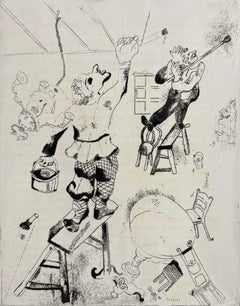
This exquisite etching by Marc Chagall (1887–1985), titled Les Peintres (The Painters), originates from the celebrated folio Nicolas Gogol, Les Ames mortes, Eaux-fortes originales de...

Category

1920s Expressionist Marc Chagall Art

Materials

Etching

Marc Chagall, Nozdriov, from Dead Souls, 1923–1927

Marc Chagall, Nozdriov, from Dead Souls, 1923–1927

By Marc Chagall

Located in Southampton, NY

This exquisite etching by Marc Chagall (1887–1985), titled Nozdriov (Nozdriov), originates from the celebrated folio Nicolas Gogol, Les Ames mortes, Eaux-fortes originales de Marc Ch...

Category

1920s Expressionist Marc Chagall Art

Materials

Etching

Marc Chagall, Meal at the Inn, from Dead Souls, 1923–1927

Marc Chagall, Meal at the Inn, from Dead Souls, 1923–1927

By Marc Chagall

Located in Southampton, NY

This exquisite etching by Marc Chagall (1887–1985), titled Repas dans le traktir (Meal at the Inn), originates from the celebrated folio Nicolas Gogol, Les Ames mortes, Eaux-fortes o...

Category

1920s Expressionist Marc Chagall Art

Materials

Etching

Marc Chagall, The Inn House, from Dead Souls, 1923–1927

Marc Chagall, The Inn House, from Dead Souls, 1923–1927

By Marc Chagall

Located in Southampton, NY

This exquisite etching by Marc Chagall (1887–1985), titled La maison du traktir (The Inn House), originates from the celebrated folio Nicolas Gogol, Les Ames mortes, Eaux-fortes orig...

Category

1920s Expressionist Marc Chagall Art

Materials

Etching

Marc Chagall, The Small Town, from Dead Souls, 1923–1927

Marc Chagall, The Small Town, from Dead Souls, 1923–1927

By Marc Chagall

Located in Southampton, NY

This exquisite etching by Marc Chagall (1887–1985), titled La petite ville (The Small Town), originates from the celebrated folio Nicolas Gogol, Les Ames mortes, Eaux-fortes original...

Category

1920s Expressionist Marc Chagall Art

Materials

Etching

Marc Chagall, Tchitchikov's Farewell to Manilov, from Dead Souls, 1923–1927

Marc Chagall, Tchitchikov's Farewell to Manilov, from Dead Souls, 1923–1927

By Marc Chagall

Located in Southampton, NY

This exquisite etching by Marc Chagall (1887–1985), titled Les Adieux de Tchitchikov à Manilov (Tchitchikov's Farewell to Manilov), originates from the celebrated folio Nicolas Gogol...

Category

1920s Expressionist Marc Chagall Art

Materials

Etching

Marc Chagall, The Road Sign, from Dead Souls, 1923–1927

Marc Chagall, The Road Sign, from Dead Souls, 1923–1927

By Marc Chagall

Located in Southampton, NY

This exquisite etching by Marc Chagall (1887–1985), titled L’indication de la route (The Road Sign), originates from the celebrated folio Nicolas Gogol, Les Ames mortes, Eaux-fortes ...

Category

1920s Expressionist Marc Chagall Art

Materials

Etching

Marc Chagall, Morning Tea, from Dead Souls, 1923–1927

Marc Chagall, Morning Tea, from Dead Souls, 1923–1927

By Marc Chagall

Located in Southampton, NY

This exquisite etching by Marc Chagall (1887–1985), titled Le the du matin (Morning Tea), originates from the celebrated folio Nicolas Gogol, Les Ames mortes, Eaux-fortes originales ...

Category

1920s Expressionist Marc Chagall Art

Materials

Etching

Marc Chagall, The Farmyard, from Dead Souls, 1923–1927

Marc Chagall, The Farmyard, from Dead Souls, 1923–1927

By Marc Chagall

Located in Southampton, NY

This exquisite etching by Marc Chagall (1887–1985), titled La basse-cour (The Farmyard), originates from the celebrated folio Nicolas Gogol, Les Ames mortes, Eaux-fortes originales d...

Category

1920s Expressionist Marc Chagall Art

Materials

Etching

Marc Chagall, Tchitchikov on the Bed, from Dead Souls, 1923–1927

Marc Chagall, Tchitchikov on the Bed, from Dead Souls, 1923–1927

By Marc Chagall

Located in Southampton, NY

This exquisite etching by Marc Chagall (1887–1985), titled Tchitchikov sur le lit (Tchitchikov on the Bed), originates from the celebrated folio Nicolas Gogol, Les Ames mortes, Eaux-...

Category

1920s Expressionist Marc Chagall Art

Materials

Etching

Marc Chagall, Mrs. Korobotchka, from Dead Souls, 1923–1927

Marc Chagall, Mrs. Korobotchka, from Dead Souls, 1923–1927

By Marc Chagall

Located in Southampton, NY

This exquisite etching by Marc Chagall (1887–1985), titled Madame Korobotchka (Mrs. Korobotchka), originates from the celebrated folio Nicolas Gogol, Les Ames mortes, Eaux-fortes ori...

Category

1920s Expressionist Marc Chagall Art

Materials

Etching

Marc Chagall, The Britchka Has Overturned, from Dead Souls, 1923–1927

Marc Chagall, The Britchka Has Overturned, from Dead Souls, 1923–1927

By Marc Chagall

Located in Southampton, NY

This exquisite etching by Marc Chagall (1887–1985), titled La britchka s’est renversee (The Britchka Has Overturned), originates from the celebrated folio Nicolas Gogol, Les Ames mor...

Category

1920s Expressionist Marc Chagall Art

Materials

Etching

Marc Chagall, On the Road to Sobakevitch, from Dead Souls, 1923–1927

Marc Chagall, On the Road to Sobakevitch, from Dead Souls, 1923–1927

By Marc Chagall

Located in Southampton, NY

This exquisite etching by Marc Chagall (1887–1985), titled En route vers Sobakevitch (On the Road to Sobakevitch), originates from the celebrated folio Nicolas Gogol, Les Ames mortes...

Category

1920s Expressionist Marc Chagall Art

Materials

Etching

Marc Chagall, The Steward, from Dead Souls, 1923–1927

Marc Chagall, The Steward, from Dead Souls, 1923–1927

By Marc Chagall

Located in Southampton, NY

This exquisite etching by Marc Chagall (1887–1985), titled L’intendant (The Steward), originates from the celebrated folio Nicolas Gogol, Les Ames mortes, Eaux-fortes originales de M...

Category

1920s Expressionist Marc Chagall Art

Materials

Etching

Marc Chagall, Dinner at Manilov’s, from Dead Souls, 1923–1927

Marc Chagall, Dinner at Manilov’s, from Dead Souls, 1923–1927

By Marc Chagall

Located in Southampton, NY

This exquisite etching by Marc Chagall (1887–1985), titled Repas chez Manilov (Dinner at Manilov’s), originates from the celebrated folio Nicolas Gogol, Les Ames mortes, Eaux-fortes ...

Category

1920s Expressionist Marc Chagall Art

Materials

Etching

Marc Chagall, The Inn, from Dead Souls, 1923–1927

Marc Chagall, The Inn, from Dead Souls, 1923–1927

By Marc Chagall

Located in Southampton, NY

This exquisite etching by Marc Chagall (1887–1985), titled Le traktir (The Inn), originates from the celebrated folio Nicolas Gogol, Les Ames mortes, Eaux-fortes originales de Marc C...

Category

1920s Expressionist Marc Chagall Art

Materials

Etching

Marc Chagall, The Arrival of Tchitchikov, from Dead Souls, 1923–1927

Marc Chagall, The Arrival of Tchitchikov, from Dead Souls, 1923–1927

By Marc Chagall

Located in Southampton, NY

This exquisite etching by Marc Chagall (1887–1985), titled L’arrivee de Tchitchikov (The Arrival of Tchitchikov), originates from the celebrated folio Nicolas Gogol, Les Ames mortes,...

Category

1920s Expressionist Marc Chagall Art

Materials

Etching

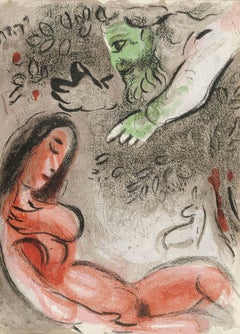
Marc Chagall, Eve Cursed by God, from Drawings for the Bible, 1960

Marc Chagall, Eve Cursed by God, from Drawings for the Bible, 1960

By Marc Chagall

Located in Southampton, NY

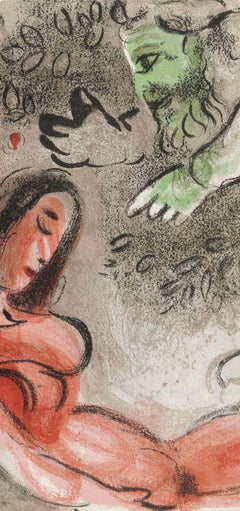
This exquisite lithograph by Marc Chagall (1887–1985), titled Eve maudite par Dieu (Eve Cursed by God), from Marc Chagall, Dessins Pour La Bible (Drawings for the Bible), Verve: Revue Artistique et Litteraire, Vol. X, No. 37-38, originates from the July 29, 1960 issue published by Editions de la revue Verve, Paris, under the direction of Teriade, Editeur, Paris, and printed by Mourlot Freres, Paris, 1960. This visionary composition reflects Chagall’s poetic interpretation of the biblical moment of divine judgment following the Fall, evoking themes of transgression, consequence, and spiritual awakening through his luminous color and dreamlike symbolism. The flowing forms and expressive imagery convey a sense of tension and emotional gravity, capturing Eve’s moment of reckoning and its enduring resonance within Chagall’s distinctive visual language. Infused with movement and lyricism, the work transforms sacred narrative into a meditative vision of loss, accountability, and the origins of human suffering. The piece forms part of Chagall’s celebrated series of lithographs and drawings created for Dessins Pour La Bible, a monumental project uniting art, scripture, and mysticism in one of the artist’s most important achievements. Executed as a lithograph on velin du Marais paper, this work measures 14 x 10.5 inches (35.56 x 26.67 cm). Unsigned and unnumbered as issued. The edition exemplifies the superb craftsmanship of the Mourlot Freres atelier, renowned for its collaborations with the greatest modern masters of the 20th century. Artwork Details: Artist: Marc Chagall (1887–1985) Title: Eve maudite par Dieu (Eve Cursed by God), from Marc Chagall, Dessins Pour La Bible (Drawings for the Bible), Verve: Revue Artistique et Litteraire, Vol. X, No. 37-38, July 29, 1960 Medium: Lithograph on velin du Marais paper Dimensions: 14 x 10.5 inches (35.56 x 26.67 cm) Inscription: Unsigned and unnumbered as issued Date: 1960 Publisher: Editions de la revue Verve, Paris, under the direction of Teriade, Editeur, Paris Printer: Mourlot Freres, Paris Catalogue raisonne references: Chagall, Marc, et al. Chagall Lithographe. Andre Sauret, 1960-1986, illustration 230-276. Cramer, Patrick, and Meret Meyer. Marc Chagall: Catalogue Raisonne des Livres Illustres. P. Cramer ed., 1995, illustration 42. Condition: Well preserved, consistent with age and medium Provenance: From Marc Chagall, Dessins Pour La Bible (Drawings for the Bible), Verve: Revue Artistique et Litteraire, Vol. X, No. 37-38, published by Editions de la revue Verve, Paris, 1960 Notes: Excerpted from the folio (translated from French), This double issue of Verve includes the drawings that Marc Chagall executed in 1958 and 1959 on biblical themes that he had not generally dealt with in his illustration for the Bible, engraved with etching and which were included in issue 33/34 of Verve. This album has 96 renderings in black and 24 color litbographies as well as the cover that were specially made for this album. It was completed printing on July 29, 1960 by Draeger Freres for black gravures and by Mourlot Freres for color lithography. About the Publication: Marc Chagall, Dessins Pour La Bible (Drawings for the Bible), published as Verve Vol. X, No. 37-38 on July 29, 1960, represents a significant continuation and expansion of Chagall’s profound engagement with biblical imagery and spiritual narrative. Conceived and directed by the visionary publisher Teriade, the publication builds upon the earlier Verve issue devoted to Chagall’s Bible illustrations by presenting a new body of work executed in 1958 and 1959, exploring themes and episodes that had not been fully addressed in the initial series. Printed in Paris by Draeger Freres for black gravures and Mourlot Freres for color lithography, the edition demonstrates an exceptional level of technical refinement and artistic collaboration. The publication includes an extensive suite of ninety six black reproductions and twenty four color lithographs, as well as specially created cover imagery, reflecting Chagall’s continued innovation in translating sacred themes into graphic form. As part of the broader tradition of Verve, one of the most important artistic and literary publications of the twentieth century, this issue exemplifies the fusion of text, image, and craftsmanship at the highest level. Today, Verve Vol. X, No. 37-38 stands as a major achievement within Chagall’s graphic oeuvre, reaffirming his role as one of the foremost interpreters of biblical narrative in modern art. About the Artist: Marc Chagall (1887–1985) was a Belarus-born French painter, printmaker, and designer whose visionary imagination, radiant color, and deeply poetic symbolism made him one of the most beloved and influential artists of the 20th century. Rooted in the imagery of his Jewish heritage and the memories of his childhood in Vitebsk, Chagall’s art wove together themes of faith, love, folklore, and fantasy with a dreamlike modern sensibility. His unique style merging elements of Cubism, Fauvism, Expressionism, and Surrealism defied categorization, transforming ordinary scenes into lyrical meditations on memory and emotion. Influenced by Russian icon painting, medieval religious art, and the modern innovations of artists such as Pablo Picasso, Henri Matisse, and Georges Braque, Chagall developed a profoundly personal visual language filled with floating figures, vibrant animals, musicians, and lovers that symbolized the transcendent power of imagination and love. During his early years in Paris, he became an integral part of the Ecole de Paris circle, forming friendships with Amedeo Modigliani, Fernand Leger, and Sonia Delaunay, and his creative spirit resonated with that of his peers and successors Alexander Calder, Alberto Giacometti, Salvador Dali, Joan Miro, Wassily Kandinsky, Marcel Duchamp, and Man Ray, artists who sought to push the boundaries of perception, emotion, and form. Over a prolific career that spanned painting, printmaking, stained glass, ceramics, and stage design, Chagall brought an unparalleled poetic sensibility to modern art, infusing even the most abstract subjects with human warmth and spiritual depth. His works are held in the most prestigious museums around the world, including the Museum of Modern Art, the Centre Pompidou, the Tate, and the Guggenheim, where they continue to inspire generations of artists and collectors. The highest price ever paid for a Marc Chagall artwork is approximately 28.5 million USD, achieved in 2017 at Sotheby’s New York for Les Amoureux (1928). Marc Chagall Eve...

Category

1960s Expressionist Marc Chagall Art

Materials

Lithograph

Marc Chagall, Abraham and Sarah, from Drawings for the Bible, 1956

Marc Chagall, Abraham and Sarah, from Drawings for the Bible, 1956

By Marc Chagall

Located in Southampton, NY

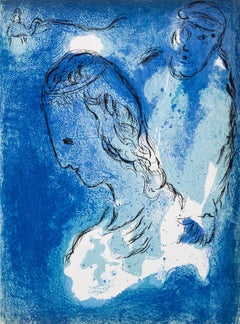
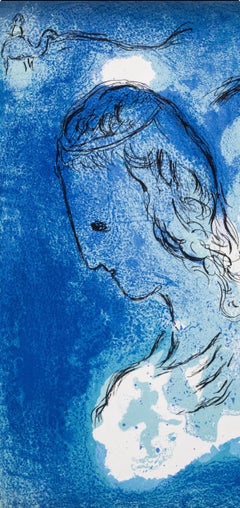
This exquisite lithograph by Marc Chagall (1887–1985), titled Abraham et Sarah (Abraham and Sarah), from Marc Chagall, Dessins Pour La Bible (Drawings for the Bible), Verve: Revue Ar...

Category

1950s Expressionist Marc Chagall Art

Materials

Lithograph

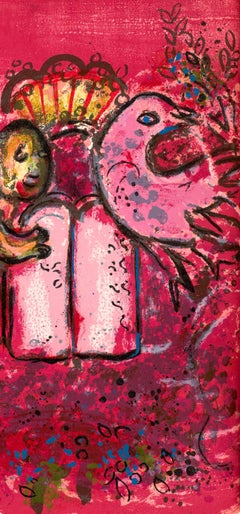
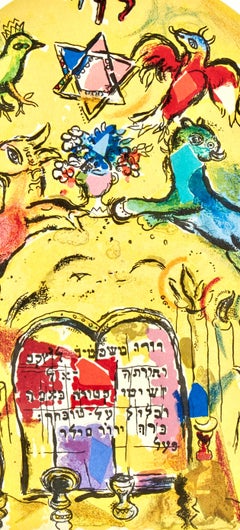
Marc Chagall, The Lion of Judah and the Tablets of the Law, 1962

Marc Chagall, The Lion of Judah and the Tablets of the Law, 1962

By Marc Chagall

Located in Southampton, NY

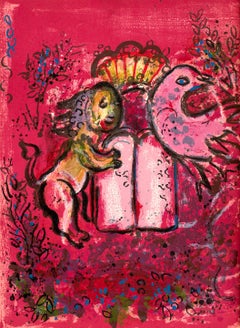
This exquisite lithograph by Marc Chagall (1887–1985), titled Le lion de Juda et les Tables de la Loi (The Lion of Judah and the Tablets of the Law), from the album Marc Chagall, The...

Category

1960s Expressionist Marc Chagall Art

Materials

Lithograph

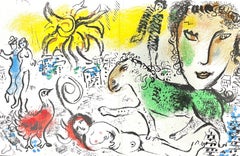
Marc Chagall, Sun Over the City, from XXe siecle, 1973

Marc Chagall, Sun Over the City, from XXe siecle, 1973

By Marc Chagall

Located in Southampton, NY

This exquisite lithograph by Marc Chagall (1887–1985), titled Soleil sur la ville (Sun Over the City), from the album Chagall Monumental Works, Special Issue of the XXe Siecle Review...

Category

1970s Expressionist Marc Chagall Art

Materials

Lithograph

Marc Chagall, Bouquet for Fernand, from Memories and Portraits of Artists, 1972

Marc Chagall, Bouquet for Fernand, from Memories and Portraits of Artists, 1972

By Marc Chagall

Located in Southampton, NY

This exquisite lithograph by Marc Chagall (1887–1985), titled Bouquet pour Fernand (Bouquet for Fernand), from the album Souvenirs et Portraits d'Artistes (Memories and Portraits of ...

Category

1970s Expressionist Marc Chagall Art

Materials

Lithograph

Marc Chagall, Homage to Georges Braque, from Derriere le Miroir, 1964

Marc Chagall, Homage to Georges Braque, from Derriere le Miroir, 1964

By Marc Chagall

Located in Southampton, NY

This exquisite lithograph by Marc Chagall (1887–1985), titled Hommage a Georges Braque (Homage to Georges Braque), originates from the 1964 folio Derriere le Miroir, Nos. 144–145–146, L’Hommage a Georges Braque (Tribute to Georges Braque). Published by Maeght Editeur, Paris, under the direction of Aime Maeght, and printed by Mourlot Freres, Paris, this luminous composition stands as Chagall’s poetic tribute to his friend and contemporary Georges Braque, “Neither the sun nor the brilliance of the moon can calm today this strange sadness. Something close has gone, though his life was distant. And there is nothing with which this life can be compared. And from this departure there arise feelings inexpressible, like his colors which spoke but not to everyone. I have seen his plastic world so far from the worries of the day and his personality beyond this world. That is what he called “reality.” How true he was, and how troubling that is! Perhaps if we enter into the grandeur of certain French paintings — La Poix d’Avignon, a still life by Chardin, or The Embarkation for Cythera by Watteau — then the dream of Braque will seem clearer to us. And our path will become clearer too.” In Hommage a Georges Braque, Chagall fuses symbolic imagery to evoke themes of flight, harmony, and spiritual transcendence, celebrating Braque’s lifelong devotion to art and transformation. The composition reflects Chagall’s unique synthesis of emotion and imagination, merging the visionary with the intimate. Executed on velin paper, this lithograph measures 15 x 22 inches (38.1 x 55.9 cm), with centerfold, as issued. Signed in the plate and unnumbered, as issued. The edition exemplifies Chagall’s lyrical command of color and form within the refined graphic artistry of Derriere le Miroir. Artwork Details: Artist: Marc Chagall (1887–1985) Title: Hommage a Georges Braque (Homage to Georges Braque), from Derriere le Miroir, Nos. 144–145–146, L’Hommage a Georges Braque (Tribute to Georges Braque), 1964 Medium: Lithograph on velin paper Dimensions: 15 x 22 inches (38.1 x 55.9 cm), with centerfold, as issued Inscription: Signed in the plate and unnumbered, as issued Date: 1964 Publisher: Maeght Editeur, Paris Printer: Mourlot Freres, Paris Condition: Well preserved, consistent with age and medium Provenance: From the 1964 folio Derriere le Miroir, Nos. 144–145–146, published by Maeght Editeur, Paris Notes: Excerpted from the folio (translated from French): Taken from this special issue of “Behind the Mirror,” CCCL examples on velin de Rives were numbered, constituting the original edition of L’Hommage a Georges Braque. These deluxe examples also included an etching based on Trois oiseaux sur fond violet. The lithographs for this issue were printed in the ateliers of Maeght Editeur, Levallois. The text was printed by Fequet et Baudier, typographers. Finished printing May 13, 1964. About the Publication: Derriere le Miroir (translated as "Behind the Mirror") was an iconic French art periodical published from 1946 to 1982 by Maeght Editeur, one of the most influential art publishers of the 20th century. Founded by Aime Maeght in Paris, the publication was conceived as a visual and literary collaboration between leading modern artists, poets, and critics. Each issue functioned as both an exhibition catalogue and a work of art in itself—featuring original lithographs printed directly from the artists' stones or plates, alongside essays, poems, and critical commentary. Over the course of 36 years, Derriere le Miroir produced more than 250 issues and showcased an extraordinary roster of artists including Henri Matisse, Marc Chagall, Joan Miro, Georges Braque, Alexander Calder, Fernand Leger, Pierre Bonnard, Alberto Giacometti, Eduardo Chillida, Ellsworth Kelly, Francis Bacon, Paul Rebeyrolle, Claude Garache, Antoni Tapies, Bram van Velde, Pierre Alechinsky, Pol Bury, Shusaku Arakawa, and Gerard Titus-Carmel. Printed in the ateliers of Mourlot, Arte, and Imprimerie Moderne du Lion, the periodical set new standards for quality in color lithography, combining fine art printing with elegant typography and poetic text. Beyond its visual brilliance, Derriere le Miroir also became a cultural chronicle of postwar European modernism. Each issue coincided with exhibitions held at Galerie Maeght, providing a collectible and widely accessible record of groundbreaking shows. Its integration of image, text, and philosophy created a dialogue between art and literature that elevated the modern art book to new aesthetic heights. Today, Derriere le Miroir remains one of the most sought-after and historically significant art publications, prized by collectors and scholars alike for its craftsmanship, influence, and its role in defining the visual language of 20th-century modernism. The Maeght Foundation in Saint-Paul-de-Vence continues to honor this legacy through exhibitions and archival preservation of the series, affirming Derriere le Miroir's enduring place in the history of modern art and fine art publishing. About the Artist: Marc Chagall (1887–1985) was a Belarus-born French painter, printmaker, and designer whose visionary use of color and poetic symbolism made him one of the most beloved and influential artists of the 20th century. Rooted in the rich imagery of his Jewish heritage and childhood in Vitebsk, Chagall’s dreamlike compositions fused memory, folklore, faith, and romance with the expressive innovations of modern art. His work evolved alongside and in dialogue with the great modern masters—Pablo Picasso, Henri Matisse, Alexander Calder, Salvador Dali, Joan Miro, Georges Braque, Wassily Kandinsky, Marcel Duchamp, and Man Ray—artists who, like Chagall, redefined artistic language for a new century. Spanning painting, printmaking, stained glass, ceramics, stage design, and illustration, Chagall’s career reflected both his deep spirituality and his boundless imagination. His works are held in major museum collections worldwide, including the Museum of Modern Art, the Guggenheim, the Tate, and the Centre Pompidou. The highest price ever paid for a Marc Chagall artwork is approximately $28.5 million USD, achieved in 2017 at Sotheby’s New York for Les Amoureux (1928). Marc Chagall Hommage a Georges Braque, Chagall Derriere le Miroir, Chagall Maeght Editeur Paris, Chagall Mourlot Freres, Chagall 1964...

Category

1960s Expressionist Marc Chagall Art

Materials

Lithograph

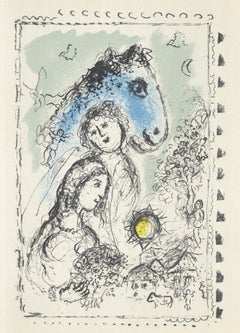
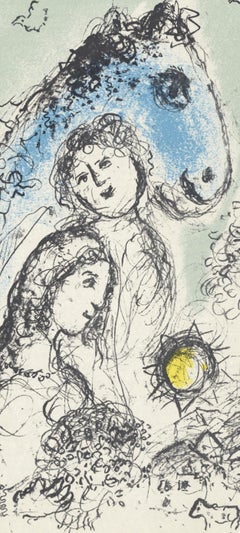
Marc Chagall, Blue Horse with Couple, from Derriere le Miroir, 1982

Marc Chagall, Blue Horse with Couple, from Derriere le Miroir, 1982

By Marc Chagall

Located in Southampton, NY

This exquisite lithograph by Marc Chagall (1887–1985), titled Cheval bleu au couple (Blue Horse with Couple), originates from the historic 1982 folio Derriere le Miroir, No. 250, Hommage a Aime et Marguerite Maeght (Tribute to Aime and Marguerite Maeght). Published by Maeght Editeur, Paris, under the direction of Aime Maeght, and printed by Imprimerie Moderne du Lion, Paris, this vibrant composition reflects Chagall’s lyrical fusion of color, dream, and devotion. In Cheval bleu au couple, ethereal figures and a radiant blue horse float within a luminous space of poetic imagination, evoking love, memory, and transcendence. The image captures the artist’s timeless ability to unite fantasy and emotion within the expressive language of modernism. Executed on velin paper, this lithograph measures 15 x 11 inches (38.1 x 27.9 cm). As issued, it is unsigned and unnumbered, consistent with the authorized publication format. The edition exemplifies Chagall’s mastery of color lithography and his lifelong exploration of faith, folklore, and the human spirit. Artwork Details: Artist: Marc Chagall (1887–1985) Title: Cheval bleu au couple (Blue Horse with Couple), from Derriere le Miroir, No. 250, Hommage a Aime et Marguerite Maeght (Tribute to Aime and Marguerite Maeght), 1982 Medium: Lithograph on velin paper Dimensions: 15 x 11 inches (38.1 x 27.9 cm) Inscription: Unsigned and unnumbered, as issued Date: 1982 Publisher: Maeght Editeur, Paris Printer: Imprimerie Moderne du Lion, Paris Catalogue raisonne references: Chagall, Marc, et al. Chagall Lithographe VI, 1980–1985. Andre Sauret, Editeur, 1986, illustration 993. Cramer, Patrick, and Meret Meyer. Marc Chagall: Catalogue Raisonne Des Livres Illustres. P. Cramer ed., 1995, illustration 113. Condition: Well preserved, consistent with age and medium Provenance: From the 1982 folio Derriere le Miroir, No. 250, published by Maeght Editeur, Paris Notes: Excerpted from the folio (translated from French), This special issue of Derriere le Miroir was designed and defined by Aime Maeght in the fall of 1980. He envisioned its publication as a celebration with which artists and writers published since 1946 were to be associated. He also chose Francois Chapon, president of the Reverdy Committee, to write the presentation. This Derriere le Miroir number 250 took the form, after its disappearance on September 5, 1981, of a tribute to Aime Maeght and his wife Marguerite Maeght who died four years earlier. 24 artists agreed to create an original graphic work for this issue which includes the general table of all issues as well as excerpts from texts by 32 writers. Finished printing on June 2, 1982 on the presses of the l'Imprimerie moderne du Lion in Paris. CL examples were printed on velin d'Arches, numbered from I to CL, and some non-commercial examples constituting the original edition. About the Publication: Derriere le Miroir (translated as "Behind the Mirror") was an iconic French art periodical published from 1946 to 1982 by Maeght Editeur, one of the most influential art publishers of the 20th century. Founded by Aime Maeght in Paris, the publication was conceived as a visual and literary collaboration between leading modern artists, poets, and critics. Each issue functioned as both an exhibition catalogue and a work of art in itself—featuring original lithographs printed directly from the artists' stones or plates, alongside essays, poems, and critical commentary. Over the course of 36 years, Derriere le Miroir produced more than 250 issues and showcased an extraordinary roster of artists including Henri Matisse, Marc Chagall, Joan Miro, Georges Braque, Alexander Calder, Fernand Leger, Pierre Bonnard, Alberto Giacometti, Eduardo Chillida, Ellsworth Kelly, Francis Bacon, Paul Rebeyrolle, Claude Garache, Antoni Tapies, Bram van Velde, Pierre Alechinsky, Pol Bury, Shusaku Arakawa, and Gerard Titus-Carmel. Printed in the ateliers of Mourlot, Arte, and Imprimerie Moderne du Lion, the periodical set new standards for quality in color lithography, combining fine art printing with elegant typography and poetic text. Beyond its visual brilliance, Derriere le Miroir also became a cultural chronicle of postwar European modernism. Each issue coincided with exhibitions held at Galerie Maeght, providing a collectible and widely accessible record of groundbreaking shows. Its integration of image, text, and philosophy created a dialogue between art and literature that elevated the modern art book to new aesthetic heights. Today, Derriere le Miroir remains one of the most sought-after and historically significant art publications, prized by collectors and scholars alike for its craftsmanship, influence, and its role in defining the visual language of 20th-century modernism. The Maeght Foundation in Saint-Paul-de-Vence continues to honor this legacy through exhibitions and archival preservation of the series, affirming Derriere le Miroir's enduring place in the history of modern art and fine art publishing. About the Artist: Marc Chagall (1887–1985) was a Belarus-born French painter, printmaker, and designer whose visionary use of color and poetic symbolism made him one of the most beloved and influential artists of the 20th century. Rooted in the rich imagery of his Jewish heritage and childhood in Vitebsk, Chagall’s dreamlike compositions fused memory, folklore, faith, and romance with the expressive innovations of modern art. His work evolved alongside and in dialogue with the great modern masters—Pablo Picasso, Henri Matisse, Alexander Calder, Salvador Dali, Joan Miro, Georges Braque, Wassily Kandinsky, Marcel Duchamp, and Man Ray—artists who, like Chagall, redefined artistic language for a new century. Spanning painting, printmaking, stained glass, ceramics, stage design, and illustration, Chagall’s career reflected both his deep spirituality and his boundless imagination. His works are held in major museum collections worldwide, including the Museum of Modern Art, the Guggenheim, the Tate, and the Centre Pompidou. The highest price ever paid for a Marc Chagall artwork is approximately $28.5 million USD, achieved in 2017 at Sotheby’s New York for Les Amoureux (1928). Marc Chagall Cheval bleu au couple, Marc Chagall lithograph, Chagall Derriere le Miroir, Chagall Maeght...

Category

1980s Expressionist Marc Chagall Art

Materials

Lithograph

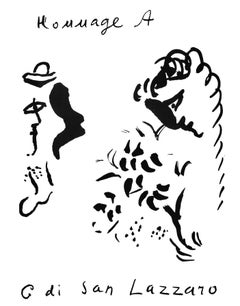
Marc Chagall, Homage to G. di San Lazzaro, from San Lazzaro et ses Amis, 1975

Marc Chagall, Homage to G. di San Lazzaro, from San Lazzaro et ses Amis, 1975

By Marc Chagall

Located in Southampton, NY

This exquisite lithograph by Marc Chagall (1887–1985), titled Hommage a G. di San Lazzaro (Homage to G. di San Lazzaro), from the album San Lazzaro et ses Amis, Hommage au fondateur ...

Category

1970s Expressionist Marc Chagall Art

Materials

Lithograph

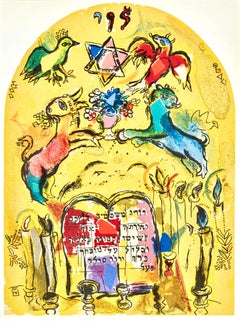
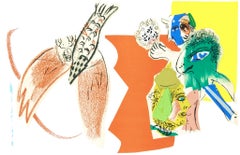
Marc Chagall, The Tribe of Levi, from XXe siecle, 1983 (after)

Marc Chagall, The Tribe of Levi, from XXe siecle, 1983 (after)

By Marc Chagall

Located in Southampton, NY

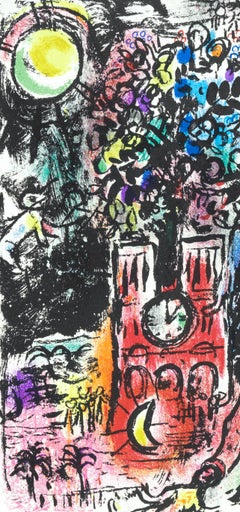
This exquisite lithograph after Marc Chagall (1887–1985), titled La Tribu de Levi (The Tribe of Levi), from the special issue of the XXe Siecle Review, Chagall in Jerusalem, originat...

Category

1980s Expressionist Marc Chagall Art

Materials

Lithograph

Marc Chagall, Dream at the Circus, from XXe Siecle, 1966

Marc Chagall, Dream at the Circus, from XXe Siecle, 1966

By Marc Chagall

Located in Southampton, NY

This exquisite lithograph by Marc Chagall (1887–1985), titled Reve au cirque (Dream at the Circus), from the album XXe Siecle, Nouvelle serie, XXVIIIe Annee N°26, Mai 1966, originate...

Category

1960s Expressionist Marc Chagall Art

Materials

Lithograph

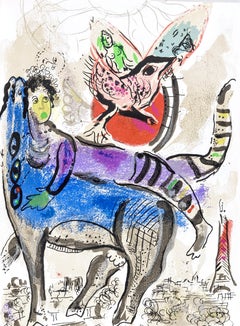
Marc Chagall, The Blue Cow, from XXe Siecle, 1967

Marc Chagall, The Blue Cow, from XXe Siecle, 1967

By Marc Chagall

Located in Southampton, NY

This exquisite lithograph by Marc Chagall (1887–1985), titled La Vache Bleue (The Blue Cow), from the album XXe Siecle, Nouvelle serie, XXIXe Annee No. 29, Decembre 1967, Panorama 70...

Category

1960s Expressionist Marc Chagall Art

Materials

Lithograph

Marc Chagall, The Red Horse, from XXe Siecle, 1970

Marc Chagall, The Red Horse, from XXe Siecle, 1970

By Marc Chagall

Located in Southampton, NY

This exquisite lithograph by Marc Chagall (1887–1985), titled Le Cheval Rouge (The Red Horse), from the album XXe Siecle, XXXIIe Annee, Nouvelle serie, No. 34, Juin 1970, originates ...

Category

1970s Expressionist Marc Chagall Art

Materials

Lithograph

Marc Chagall, Daphnis and Chloe, from XXe Siecle, 1960

Marc Chagall, Daphnis and Chloe, from XXe Siecle, 1960

By Marc Chagall

Located in Southampton, NY

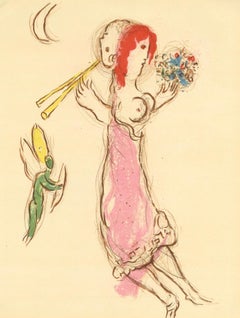
This exquisite lithograph by Marc Chagall (1887–1985), titled Daphnis et Chloe (Daphnis and Chloe), from the album XXe Siecle, Nouvelle serie, XXIIe Annee, No. 14, Juin 1960, originates from the 1960 edition published by Societe Internationale d'Art XXe Siecle, Paris, under the direction of Gualtieri di San Lazzaro, editeur, Paris, and printed by Mourlot Freres, Paris, 1960. Daphnis et Chloe reflects Chagall’s poetic fusion of love, mythology, and dreamlike imagery, inspired by the ancient Greek pastoral romance and reimagined through his luminous color harmonies and floating forms. The work embodies Chagall’s timeless exploration of passion, innocence, and the spiritual beauty of nature, rendered in his signature chromatic radiance and lyricism. Executed as a lithograph on velin paper, this work measures 12.5 x 9.75 inches. Unsigned and unnumbered as issued. The edition exemplifies the superb craftsmanship of Mourlot Freres, Paris. Artwork Details: Artist: Marc Chagall (1887–1985) Title: Daphnis et Chloe (Daphnis and Chloe), from the album XXe Siecle, Nouvelle serie, XXIIe Annee, No. 14, Juin 1960 Medium: Lithograph on velin paper Dimensions: 12.5 x 9.75 inches (31.75 x 24.77 cm) Inscription: Unsigned and unnumbered as issued Date: 1960 Publisher: Societe Internationale d'Art XXe Siecle, Paris, under the direction of Gualtieri di San Lazzaro, editeur, Paris Printer: Mourlot Freres, Paris Catalogue raisonne reference: Mourlot, Fernand, and Marc Chagall. Chagall Lithographe, Volume II, 1957–1962. Chagall Lithographe, Sauret, 1963, illustration 227 Condition: Well preserved, consistent with age and medium Provenance: From the album XXe Siecle, Nouvelle serie, XXIIe Annee, No. 14, Juin 1960, published by Societe Internationale d'Art XXe Siecle, Paris; printed by Mourlot Freres, Paris, 1960 About the Publication: Gualtieri di San Lazzaro's XXe Siecle (Twentieth Century) was one of the most influential art journals of the modern era, founded in Paris in 1938 as a platform for the greatest painters, sculptors, and writers of the 20th century. San Lazzaro, a visionary editor, critic, and champion of modernism, believed that art and literature should coexist as expressions of a shared human imagination. Under his direction, XXe Siecle became a cultural bridge between Europe and the wider world, publishing special issues devoted to leading figures such as Picasso, Matisse, Chagall, Braque, Calder, Miro, Kandinsky, and Leger. Each edition combined essays by renowned critics and poets with original lithographs and woodcuts printed by the foremost ateliers of Paris, Milan, and New York, including Mourlot, Curwen, and Amilcare Pizzi, creating a uniquely rich dialogue between text and image. The 1960 issue, XXe Siecle, Nouvelle serie, No. 14, showcased Daphnis et Chloe, one of Chagall’s most celebrated lithographic subjects, coinciding with his work on the monumental suite of lithographs inspired by the same pastoral tale, published by Teriade. Through this publication, San Lazzaro further cemented Chagall’s reputation as the modern poet of color and love, uniting myth, nature, and emotion in visual form. Today, XXe Siecle remains an essential record of 20th-century modernism, celebrated for its seamless integration of fine art, literature, and design. About the Artist: Marc Chagall (1887–1985) was a Belarus-born French painter, printmaker, and designer whose visionary imagination, radiant color, and deeply poetic symbolism made him one of the most beloved and influential artists of the 20th century. Rooted in the imagery of his Jewish heritage and the memories of his childhood in Vitebsk, Chagall’s art wove together themes of faith, love, folklore, and fantasy with a dreamlike modern sensibility. His unique style—merging elements of Cubism, Fauvism, Expressionism, and Surrealism—defied categorization, transforming ordinary scenes into lyrical meditations on memory and emotion. Influenced by Russian icon painting, medieval religious art, and the modern innovations of artists such as Pablo Picasso, Henri Matisse, and Georges Braque, Chagall developed a profoundly personal visual language filled with floating figures, vibrant animals, musicians, and lovers that symbolized the transcendent power of imagination and love. During his early years in Paris, he became an integral part of the Ecole de Paris circle, forming friendships with Amedeo Modigliani, Fernand Leger, and Sonia Delaunay, and his creative spirit resonated with that of his peers and successors—Alexander Calder, Alberto Giacometti, Salvador Dali, Joan Miro, Wassily Kandinsky, Marcel Duchamp, and Man Ray—artists who, like Chagall, sought to push the boundaries of perception, emotion, and form. Over a prolific career that spanned painting, printmaking, stained glass, ceramics, and stage design, Chagall brought an unparalleled poetic sensibility to modern art, infusing even the most abstract subjects with human warmth and spiritual depth. His works are held in the most prestigious museums around the world, including the Museum of Modern Art, the Centre Pompidou, the Tate, and the Guggenheim, where they continue to inspire generations of artists and collectors. The highest price ever paid for a Marc Chagall artwork is approximately 28.5 million USD, achieved in 2017 at Sotheby’s New York for Les Amoureux (1928). Marc Chagall Daphnis...

Category

1960s Expressionist Marc Chagall Art

Materials

Lithograph

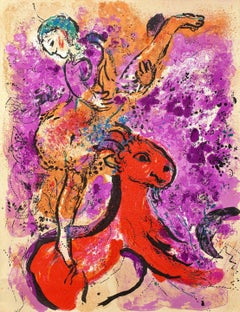
Marc Chagall, The Horsewoman with the Red Horse, from XXe Siecle, 1957

Marc Chagall, The Horsewoman with the Red Horse, from XXe Siecle, 1957

By Marc Chagall

Located in Southampton, NY

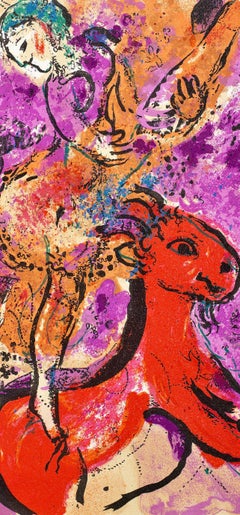
This exquisite lithograph and pochoir by Marc Chagall (1887–1985), titled L'ecuyere au cheval rouge (The Horsewoman with the Red Horse), from the album XXe Siecle, Nouvelle serie No....

Category

1950s Expressionist Marc Chagall Art

Materials

Lithograph

Marc Chagall, The Tree of Jesse, from Derriere le Miroir, 1960

Marc Chagall, The Tree of Jesse, from Derriere le Miroir, 1960

By Marc Chagall

Located in Southampton, NY

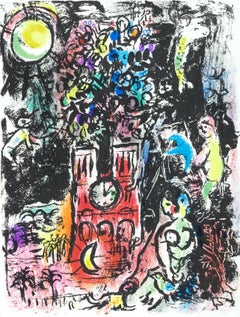
This exquisite lithograph by Marc Chagall (1887–1985), titled L’Arbre de Jesse (The Tree of Jesse), originates from the 1960 folio Derriere le Miroir, No. 119, Poetes, peintres, sculpteurs (Poets, Painters, Sculptors), published by Maeght Editeur, Paris, under the direction of Aime Maeght, and printed by Mourlot Freres, Paris. This lyrical composition exemplifies Chagall’s visionary fusion of faith, memory, and color, uniting biblical symbolism with the artist’s poetic sensibility. In L’Arbre de Jesse, Chagall reimagines a sacred theme as a vibrant allegory of spiritual lineage, evoking the mystical harmony between heaven and earth that defines his most celebrated works. Executed on velin paper, this lithograph measures 15 x 11 inches (38.1 x 27.9 cm), as issued. Unsigned and unnumbered, as issued. The edition reflects the exceptional quality and craftsmanship of the Maeght and Mourlot collaborations, which brought Chagall’s radiant imagery to print with unparalleled fidelity. Artwork Details: Artist: Marc Chagall (1887–1985) Title: L’Arbre de Jesse (The Tree of Jesse), from Derriere le Miroir, No. 119, Poetes, peintres, sculpteurs (Poets, Painters, Sculptors), 1960 Medium: Lithograph on velin paper Dimensions: 15 x 11 inches (38.1 x 27.9 cm), as issued Inscription: Unsigned and unnumbered, as issued Date: 1960 Publisher: Maeght Editeur, Paris Printer: Mourlot Freres, Paris Catalogue raisonne references: Mourlot, Fernand, and Marc Chagall. “Chagall Lithographe, Volume II, 1957–1962.” Chagall Lithographe, Sauret, 1963, illustration 297. Cramer, Patrick, and Meret Meyer. Marc Chagall: Catalogue Raisonné Des Livres Illustrés. P. Cramer ed., 1995, illustration 40 Condition: Well preserved, consistent with age and medium Provenance: From the 1960 folio Derriere le Miroir, No. 119, Poetes, peintres, sculpteurs (Poets, Painters, Sculptors), published by Maeght Editeur, Paris About the Publication: Derriere le Miroir (translated as "Behind the Mirror") was an iconic French art periodical published from 1946 to 1982 by Maeght Editeur, one of the most influential art publishers of the 20th century. Founded by Aime Maeght in Paris, the publication was conceived as a visual and literary collaboration between leading modern artists, poets, and critics. Each issue functioned as both an exhibition catalogue and a work of art in itself—featuring original lithographs printed directly from the artists' stones or plates, alongside essays, poems, and critical commentary. Over the course of 36 years, Derriere le Miroir produced more than 250 issues and showcased an extraordinary roster of artists including Henri Matisse, Marc Chagall, Joan Miro, Georges Braque, Alexander Calder, Fernand Leger, Pierre Bonnard, Alberto Giacometti, Eduardo Chillida, Ellsworth Kelly, Francis Bacon, Paul Rebeyrolle, Claude Garache, Antoni Tapies, Bram van Velde, Pierre Alechinsky, Pol Bury, Shusaku Arakawa, and Gerard Titus-Carmel. Printed in the ateliers of Mourlot, Arte, and Imprimerie Moderne du Lion, the periodical set new standards for quality in color lithography, combining fine art printing with elegant typography and poetic text. Beyond its visual brilliance, Derriere le Miroir also became a cultural chronicle of postwar European modernism. Each issue coincided with exhibitions held at Galerie Maeght, providing a collectible and widely accessible record of groundbreaking shows. Its integration of image, text, and philosophy created a dialogue between art and literature that elevated the modern art book to new aesthetic heights. Today, Derriere le Miroir remains one of the most sought-after and historically significant art publications, prized by collectors and scholars alike for its craftsmanship, influence, and its role in defining the visual language of 20th-century modernism. The Maeght Foundation in Saint-Paul-de-Vence continues to honor this legacy through exhibitions and archival preservation of the series, affirming Derriere le Miroir's enduring place in the history of modern art and fine art publishing. About the Artist: Marc Chagall (1887–1985) was a Belarus-born French painter, printmaker, and designer whose visionary use of color and poetic symbolism made him one of the most beloved and influential artists of the 20th century. Rooted in the rich imagery of his Jewish heritage and childhood in Vitebsk, Chagall’s dreamlike compositions fused memory, folklore, faith, and romance with the expressive innovations of modern art. His work evolved alongside and in dialogue with the great modern masters—Pablo Picasso, Henri Matisse, Alexander Calder, Salvador Dali, Joan Miro, Georges Braque, Wassily Kandinsky, Marcel Duchamp, and Man Ray—artists who, like Chagall, redefined artistic language for a new century. Spanning painting, printmaking, stained glass, ceramics, stage design, and illustration, Chagall’s career reflected both his deep spirituality and his boundless imagination. His works are held in major museum collections worldwide, including the Museum of Modern Art, the Guggenheim, the Tate, and the Centre Pompidou. The highest price ever paid for a Marc Chagall artwork is approximately $28.5 million USD, achieved in 2017 at Sotheby’s New York for Les Amoureux (1928). Marc Chagall L’Arbre de Jesse, Chagall Derriere le Miroir, Chagall Maeght...

Category

1960s Expressionist Marc Chagall Art

Materials

Lithograph

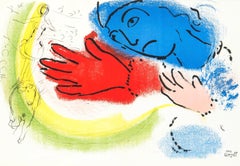
Marc Chagall, The Horsewoman, from Derriere le miroir, 1956

Marc Chagall, The Horsewoman, from Derriere le miroir, 1956

By Marc Chagall

Located in Southampton, NY

This exquisite lithograph by Marc Chagall (1887–1985), titled L'Ecuyere (The Horsewoman), from the folio Derriere le miroir, 10 Ans d'Edition 1946-1956, No. 92-93, originates from th...

Category

1950s Expressionist Marc Chagall Art

Materials

Lithograph

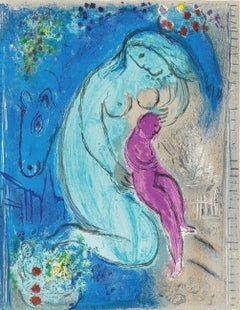
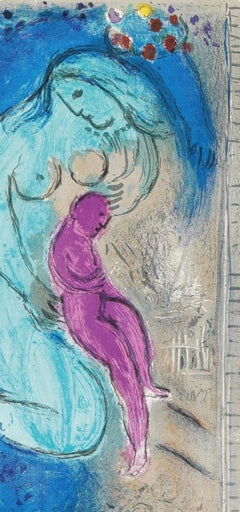
Marc Chagall, Flower Quay, from Derriere le miroir, 1954

Marc Chagall, Flower Quay, from Derriere le miroir, 1954

By Marc Chagall

Located in Southampton, NY

This exquisite lithograph by Marc Chagall (1887–1985), titled Quai de fleurs (Flower Quay), from the folio Derriere le miroir, No. 67–68, originates from the 1954 edition published b...

Category

1950s Expressionist Marc Chagall Art

Materials

Lithograph

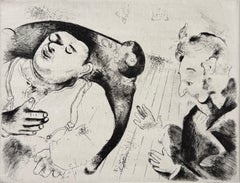
Marc Chagall, The Opera, from Derriere le miroir, 1954

Marc Chagall, The Opera, from Derriere le miroir, 1954

By Marc Chagall

Located in Southampton, NY

This exquisite lithograph by Marc Chagall (1887–1985), titled L'Opera (The Opera), from the folio Derriere le miroir, No. 67–68, originates from the 1954 edition published by Maeght ...

Category

1950s Expressionist Marc Chagall Art
Materials

Lithograph

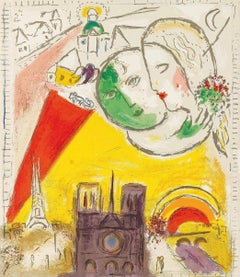
Marc Chagall, The Sunday, from Derriere le miroir, 1954

Marc Chagall, The Sunday, from Derriere le miroir, 1954

By Marc Chagall

Located in Southampton, NY

This exquisite lithograph by Marc Chagall (1887–1985), titled Le Dimanche (The Sunday), from the folio Derriere le miroir, No. 67–68, originates from the 1954 edition published by Ma...

Category

1950s Expressionist Marc Chagall Art
Materials

Lithograph

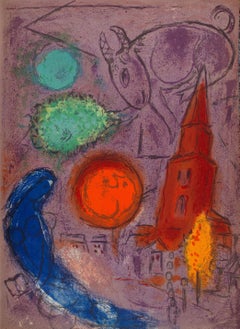
Marc Chagall, Saint-Germain of the Fields, from Derriere le miroir, 1954

Marc Chagall, Saint-Germain of the Fields, from Derriere le miroir, 1954

By Marc Chagall

Located in Southampton, NY

This exquisite lithograph by Marc Chagall (1887–1985), titled Saint-Germain des Pres (Saint-Germain of the Fields), from the folio Derriere le miroir, No. 67–68, originates from the 1954 edition published by Maeght Editeur, Paris, and printed by Mourlot Freres, Paris, 1954. Saint-Germain des Pres reflects Chagall’s poetic vision of Paris, capturing the neighborhood’s spiritual and cultural essence through his unique blend of memory, color, and imagination. The work embodies Chagall’s ability to transform the familiar into the transcendent, merging architectural harmony with human emotion and dreamlike symbolism. Executed as a lithograph on velin paper, this work measures 15 x 11 inches. Unsigned and unnumbered as issued. The edition exemplifies the superb craftsmanship of Mourlot Freres, Paris. Artwork Details: Artist: Marc Chagall (1887–1985) Title: Saint-Germain des Pres (Saint-Germain of the Fields), from the folio Derriere le miroir, No. 67–68 Medium: Lithograph on velin paper Dimensions: 15 x 11 inches (38.1 x 27.94 cm) Inscription: Unsigned and unnumbered as issued Date: 1954 Publisher: Maeght Editeur, Paris Printer: Mourlot Freres, Paris Catalogue raisonne reference: Cramer, Patrick, and Meret Meyer. Marc Chagall: Catalogue Raisonne des Livres Illustres. Patrick Cramer Editeur, 1995, illustration 24; Mourlot, Fernand, and Marc Chagall. Chagall Lithographe I: 1922–1957. Andre Sauret, 1960, illustration 100. Condition: Well preserved, consistent with age and medium Provenance: From the folio Derriere le miroir, No. 67–68, published by Maeght Editeur, Paris; printed by Mourlot Freres, Paris, 1954 Notes: On the occasion of the ‘Paris’ exhibition, Marc Chagall created for this triple issue of Derriere Le Miroir XII pages of Lithography. About the Publication: Derriere le miroir (Behind the Mirror) was one of the most important art publications of the 20th century, created and published by Maeght Editeur in Paris from 1946 to 1982. Founded by the visionary art dealer and publisher Aime Maeght, the series served as both an exhibition catalogue and a work of art in its own right, uniting original lithographs by leading modern and contemporary artists with critical essays, poetry, and design of the highest quality. Printed by master lithographers such as Mourlot Freres and Arte, Derriere le miroir became synonymous with the artistic vanguard of postwar Europe. Each issue was devoted to a single artist or theme and published to accompany exhibitions at the Galerie Maeght in Paris, featuring works by Pablo Picasso, Henri Matisse, Georges Braque, Joan Miro, Marc Chagall, Alexander Calder, Fernand Leger, and Alberto Giacometti, among others. The publication reflected Maeght’s belief that art should be both accessible and elevated—an ideal realized through its luxurious production values, meticulous printing, and collaboration with the greatest creative minds of its time. About the Artist: Marc Chagall (1887–1985) was a Belarus-born French painter, printmaker, and designer whose visionary imagination, radiant color, and deeply poetic symbolism made him one of the most beloved and influential artists of the 20th century. Rooted in the imagery of his Jewish heritage and the memories of his childhood in Vitebsk, Chagall’s art wove together themes of faith, love, folklore, and fantasy with a dreamlike modern sensibility. His unique style—merging elements of Cubism, Fauvism, Expressionism, and Surrealism—defied categorization, transforming ordinary scenes into lyrical meditations on memory and emotion. Influenced by Russian icon painting, medieval religious art, and the modern innovations of artists such as Pablo Picasso, Henri Matisse, and Georges Braque, Chagall developed a profoundly personal visual language filled with floating figures, vibrant animals, musicians, and lovers that symbolized the transcendent power of imagination and love. During his early years in Paris, he became an integral part of the Ecole de Paris circle, forming friendships with Amedeo Modigliani, Fernand Leger, and Sonia Delaunay, and his creative spirit resonated with that of his peers and successors—Alexander Calder, Alberto Giacometti, Salvador Dali, Joan Miro, Wassily Kandinsky, Marcel Duchamp, and Man Ray—artists who, like Chagall, sought to push the boundaries of perception, emotion, and form. Over a prolific career that spanned painting, printmaking, stained glass, ceramics, and stage design, Chagall brought an unparalleled poetic sensibility to modern art, infusing even the most abstract subjects with human warmth and spiritual depth. His works are held in the most prestigious museums around the world, including the Museum of Modern Art, the Centre Pompidou, the Tate, and the Guggenheim, where they continue to inspire generations of artists and collectors. The highest price ever paid for a Marc Chagall artwork is approximately 28.5 million USD, achieved in 2017 at Sotheby’s New York for Les Amoureux (1928). Marc Chagall Saint-Germain des Pres 1954, Chagall Saint-Germain of the Fields, Chagall Derriere le miroir No. 67–68, Chagall Mourlot lithograph, Chagall Maeght...

Category

1950s Expressionist Marc Chagall Art
Materials

Lithograph

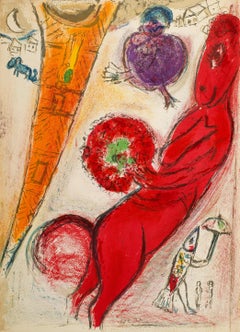
Marc Chagall, The Eiffel Tower and the Donkey, from Derriere le miroir, 1954

Marc Chagall, The Eiffel Tower and the Donkey, from Derriere le miroir, 1954

By Marc Chagall

Located in Southampton, NY

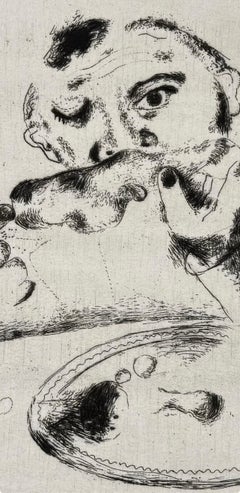
This exquisite lithograph by Marc Chagall (1887–1985), titled La Tour Eiffel a l'Ane (The Eiffel Tower and the Donkey), from the folio Derriere le miroir, No. 67–68, originates from ...

Category

1950s Expressionist Marc Chagall Art
Materials

Lithograph

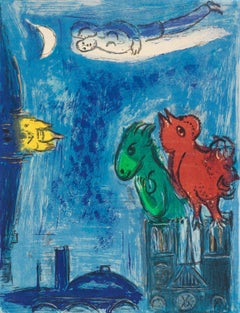
Marc Chagall, The Monsters of Notre-Dame, from Derriere le miroir, 1954

Marc Chagall, The Monsters of Notre-Dame, from Derriere le miroir, 1954

By Marc Chagall

Located in Southampton, NY

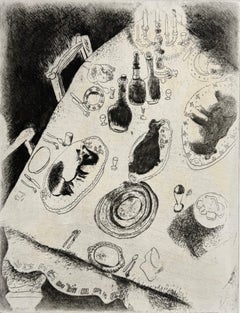
This exquisite lithograph by Marc Chagall (1887–1985), titled Les Monstres de Notre-Dame (The Monsters of Notre-Dame), from the folio Derriere le miroir, No. 67–68, originates from t...

Category

1950s Expressionist Marc Chagall Art
Materials

Lithograph

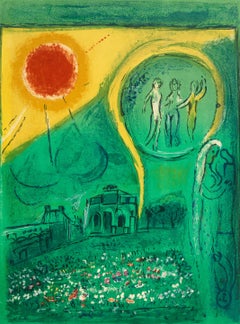
Marc Chagall, The Carousel of the Louvre, from Derriere le miroir, 1954

Marc Chagall, The Carousel of the Louvre, from Derriere le miroir, 1954

By Marc Chagall

Located in Southampton, NY

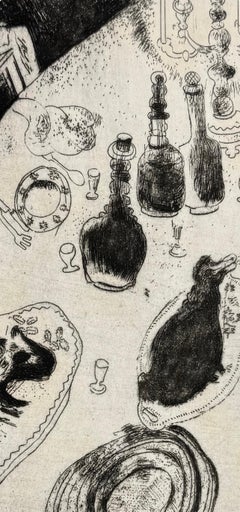
This exquisite lithograph by Marc Chagall (1887–1985), titled Le Carrousel du Louvre (The Carousel of the Louvre), from the folio Derriere le miroir, No. 67–68, originates from the 1...

Category

1950s Expressionist Marc Chagall Art
Materials

Lithograph

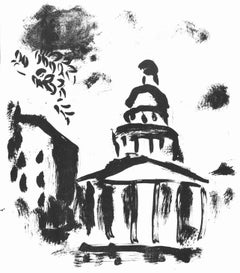
Marc Chagall, The Pantheon, from Derriere le miroir, 1954

Marc Chagall, The Pantheon, from Derriere le miroir, 1954

By Marc Chagall

Located in Southampton, NY

This exquisite lithograph by Marc Chagall (1887–1985), titled Le Pantheon (The Pantheon), from the folio Derriere le miroir, No. 67–68, originates from the 1954 edition published by ...

Category

1950s Expressionist Marc Chagall Art

Materials

Lithograph

Marc Chagall art for sale on 1stDibs.

Find a wide variety of authentic Marc Chagall art available for sale on 1stDibs. If you’re browsing the collection of art to introduce a pop of color in a neutral corner of your living room or bedroom, you can find work that includes elements of orange, blue, yellow and other colors. You can also browse by medium to find art by Marc Chagall in lithograph and more. Much of the original work by this artist or collective was created during the 20th century and is mostly associated with the Surrealist style. Not every interior allows for large Marc Chagall art, so small editions measuring 5 inches across are available. Customers who are interested in this artist might also find the work of Salvador Dalí, Leonor Fini, and André Masson. Marc Chagall art prices can differ depending upon medium, time period and other attributes. On 1stDibs, the price for these items starts at $75 and tops out at $1,450,000, while the average work can sell for $1,229.

Questions About Marc Chagall Art

  • 1stDibs ExpertMarch 26, 2024
    Marc Chagall is famous for his art. He is one of the best known artists of the 20th century.

    Chagall produced magnificent stained-glass windows for structures in France, Israel, Germany and the United States, and his lively paintings of Paris are revered all over the world. The Russian-French modernist worked in nearly every artistic medium. Influenced by Symbolism, Fauvism, Cubism and Surrealism, Chagall developed his own distinctive style, combining avant-garde techniques and motifs with elements drawn from Eastern European Jewish folk art.

    Find authentic Marc Chagall prints and paintings on 1stDibs.
  • 1stDibs ExpertMarch 22, 2022
    Marc Chagall was a painter, illustrator, glass artisan, print maker and set designer who made a lasting impact on modern art. He was born on July 7, 1887, in Liozna, Belarus, and died on March 28, 1985, in Saint Paul de Vence, France. On 1stDibs, shop a selection of Marc Chagall art.
  • 1stDibs ExpertMarch 22, 2022
    Marc Chagall was born in Liozna, Belarus on July 7, 1887. He went on to become one of the most influential artists of the 20th century, creating works that drew from the movements of Cubism, Surrealism and Fauvism. On 1stDibs, find a selection of Marc Chagall art.
  • 1stDibs ExpertMarch 22, 2022
    Marc Chagall was born on July 7, 1887, in Liozna, Belarus. He was an influential artist who worked in a variety of mediums, including paint, stained glass and illustrations. Chagall died on March 28, 1985, in Saint Paul de Vence, France. On 1stDibs, find a collection of Marc Chagall art.
  • 1stDibs ExpertMarch 22, 2022
    To pronounce Marc Chagall, say "Mark Shu-GALL." The artist's real name was Moishe Shagal. Although the artist changed his name, he referenced his heritage in many works by including fish to represent his father who worked as a herring merchant. Shop a variety of Marc Chagall art on 1stDibs.
  • 1stDibs ExpertFebruary 7, 2024
    Marc Chagall painted around 10,000 works during the course of his 75-year career. The Russian-French modernist worked in nearly every artistic medium. Influenced by Symbolism, Fauvism, Cubism and Surrealism, he developed his own distinctive style, combining avant-garde techniques and motifs with elements drawn from Eastern European Jewish folk art. On 1stDibs, find a selection of Marc Chagall art.
  • 1stDibs ExpertMarch 26, 2024
    Yes, Marc Chagall worked in the Expressionist style, but he is associated with a range of modes and was inspired by various styles.

    Chagall's lithographs as well as his other prints and paintings widely influenced the fantastic imagery of Surrealism and other movements of the 20th century. Known for his dreamlike creations inspired by folk art, Chagall drew on the colors and forms introduced by Cubism and Fauvism for a distinctive style all his own.

    Expressionist artists experimented in paintings and prints with skewed perspectives, abstraction and unconventional, bright colors to portray how isolating and anxious the world felt rather than how it appeared. You can certainly detect the trademark bright colors and dramatic, exaggerated brushstrokes of Expressionism reflected in Chagall’s works such as his Vision of Paris and I and the Village.

    Find a selection of Marc Chagall art on 1stDibs.
  • 1stDibs ExpertMarch 26, 2024
    To collect Marc Chagall art, seek out works from well known and respected sources. When it comes to making an investment of any kind, it’s important to conduct research and only work with reputable sellers. You can shop the collections of art dealers, auction houses and trusted online platforms to find authentic Marc Chagall paintings, prints and other works.
    There are many reasons to collect art. A meaningful collection of art should help a residence feel more like itself. Buy art that speaks to you. Take your time when you’re shopping for art, and choose works that will resonate with you.

    Shop Marc Chagall art on 1stDibs.
  • 1stDibs ExpertOctober 15, 2024
    To tell if a Chagall print is real, experts recommend having a certified appraiser or experienced art dealer evaluate your piece. Fewer than 5% of Chagall's prints are signed and numbered, and counterfeiters have taken advantage of this and flooded the market with many convincing replicas. As a result, it can be very difficult to authenticate an original Chagall without experience and training. On 1stDibs, find a collection of Marc Chagall art.
  • 1stDibs ExpertMarch 26, 2024
    Marc Chagall’s body of work is quite big. Over the course of his 75-year career, Chagall created approximately 10,000 pieces, including prints, paintings, book illustrations, stained glass windows and more.

    The Russian-French modernist worked in nearly every artistic medium, and Chagall’s vibrant and densely colorful prints are known around the world. Characterized by a bold color palette and whimsical imagery, his works are often narrative, depicting small-village scenes and quotidian moments of peasant life, as in his late painting The Flight into Egypt from 1980.

    On 1stDibs, find a selection of Marc Chagall art.
  • 1stDibs ExpertMarch 22, 2022
    Yes, Marc Chagall used oil paint to produce many of his paintings. He also worked with gouaches and watercolors. Not just a painter, Chagall made stained glass windows, illustrations, prints, ceramics and other types of works throughout his life. Find a collection of Marc Chagall art on 1stDibs.
  • 1stDibs ExpertMarch 22, 2022
    Yes, Marc Chagall migrated to the United States. The Jewish artist fled Europe during World War II, moving to New York City in 1941. He settled in France in 1947 and lived there until he died in 1985. On 1stDibs, shop a range of Marc Chagall art.
  • 1stDibs ExpertMarch 22, 2022
    Many artists and things inspired Marc Chagall. Historians believe that his Jewish heritage and his hometown of Liozna, Belarus, served as sources of inspiration throughout his life. His work also displays the influence of surrealist, cubist, symbolist and fauve artists. On 1stDibs, shop a variety of Marc Chagall art.
  • 1stDibs ExpertMarch 26, 2024
    Marc Chagall used a variety of materials in his art. The Russian-French modernist worked in nearly every artistic medium. Influenced by Symbolism, Fauvism, Cubism and Surrealism, Chagall developed his own distinctive style, combining avant-garde techniques and motifs with elements drawn from Eastern European Jewish folk art.

    Chagall produced magnificent stained-glass windows for structures in France, Israel, Germany and the United States. Additionally, his lively paintings of Paris are revered all over the world. Chagall had created etchings of Russian life during the 1920s but would explore printmaking later more deeply, during the 1950s, when he sought guidance from veteran lithographer Charles Sorlier, who became a friend and collaborator.

    Find authentic Marc Chagall art on 1stDibs.
  • 1stDibs ExpertMarch 22, 2022
    Marc Chagall lived many places over the course of his life. He was born in Liozna, Belarus, on July 7, 1887. When he began working as an artist, he lived and worked in Saint Petersburg, Russia; Paris, France; and Berlin, Germany. During World War II, he relocated to the U.S. and then returned to Paris where he primarily resided until his death in 1985. On 1stDibs, find a variety of Marc Chagall art.
  • 1stDibs ExpertApril 5, 2022
    One of Marc Chagall’s most known works is entitled I and the Village. His style mixes bold colors in both the cubism and fauvism style. Shop a selection of Marc Chagall’s pieces from some of the world’s top art dealers on 1stDibs.
  • 1stDibs ExpertMarch 26, 2024
    Yes, Marc Chagall personally signed some of his bookplates. Other bookplate illustrations created by the artist bear a reproduction of his signature. Many of the signed versions come from the collections of notable historical figures, including Nicholas II, the last Russian czar. Find signed Marc Chagall lithographs on 1stDibs.
  • 1stDibs ExpertSeptember 28, 2021
    A Marc Chagall painting is likely worth anywhere between $50,000 to $70,000 according to current estimates. Marc Chagall is a Russian-French artist of Belarusian Jewish origin who is credited to be among the pioneering modernists. Adept in several styles and techniques, Chagall was best-known for creating stain-glass, tapestries and murals apart from paintings. On 1stDibs, find a variety of Marc Chagall paintings.