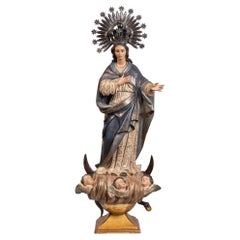
Completely hand-crafted in 18th century Spain, this sculpture of the Virgin Mary of Immaculate Conception stands 1.5 meters / 5 feet tall, is topped by a silver halo / crown, and was most certainly created for devotional purposes, to be displayed in a church or chapel. Besides its impressive size, this sculpture is an excellent, truly museum-quality example of the Spanish “Estofado” polychrome technique, developed during the Gothic period to imitate rich brocade fabrics. The finely carved “fabric” areas of the sculpture would be first covered in gesso, and then a layer of gold leaf would be applied. The gold leaf would then be painted over with various colors of tempera paints. Once dry, the painted surface would be incised or scratched away in patterns, revealing the gold beneath.
The sculpture was professionally restored in 2022 by a firm that is often contracted by the Spanish government to work on historic building interiors and museum pieces. The virgin was carefully cleaned, repaired and its condition stabilized. A complete and fully-illustrated restoration report will be included with purchase.
Often confused with the virgin birth of Jesus, the belief that the Blessed Virgin Mary herself was conceived “immaculately” without original sin has been variously defended and debated within the Catholic Church since the pre-Middle Ages. For centuries, artists struggled to create an acceptable visual representation of this highly abstract concept, in part taking inspiration from the Book of Revelation and other scriptural sources.
In this case, we see the Virgin standing on a half moon (biblically inspired, though also an ancient symbol of chastity) with her long natural hair loose down her back, another indication of purity. Both her white tunic and flowing blue mantle...
Category
18th Century Spanish Baroque Antique Gilt Decorative Objects
MaterialsSilver, Gold Leaf